


Nursery Closet Organizer Set: How to Choose and Install It
The closet door bumps a stack of diapers, the rod already sags, and bedtime is close. A nursery closet organizer set can end that scramble, but only if you treat it like furniture, not a cute bin kit. Toddlers pull drawers, step on shelves, and tug pockets stuffed with blankets. Labels help at 2 a.m. Anchoring and climb risk matter more. Pick the type before you buy a tape measure.
Choose the Right Set Before You Measure
A free-standing clothing-storage unit at least 27 inches tall falls under federal stability testing, per the federal clothing-storage standard, which also calls for tip-over warnings based on ASTM F2057 or a successor standard. Treat that height as your own screening line even when a set sits below it. A 26-inch cube tower a toddler can still climb deserves the same scrutiny as a covered dresser, so check labels, stability features, and the maker's anchor instructions before any tall piece goes in a child's room.
| Organizer type | Typical footprint | Anchoring needed | Federal stability rules |
|---|---|---|---|
| Fabric hanging organizer | Hangs inside the closet, under 27 inches tall | Rod or door hook, no wall anchor | Usually not covered |
| Wire or fabric cube unit | Under 27 inches tall, 2 to 4 cubes wide | Anchor if placed near a crib or changing area | Covered only if it's a clothing-storage unit 27 inches or taller; open cubes usually aren't |
| Modular shelf or cube tower | 30 to 60 inches tall | Wall anchor kit required | Open shelving usually isn't covered, but anchor it anyway |
| Dresser or chest with drawers | About 30 to 36 inches wide and 16 to 20 inches deep | Wall anchor kit required | Usually covered; drawers should have interlocks |
A fabric organizer on a rod skips the wall anchor but still needs a loaded-weight check so the rod doesn't bow under a season of baby clothes. Match hardware to the wall itself: studs or toggles in drywall, longer screws in plaster, masonry anchors in block.
Then match the type to the room. For a small closet or a no-drill rental, shortlist a hanging organizer. For a shared room with a solid wall and years of use ahead, shortlist an anchored tower. More layout ideas are in our nursery storage solutions guide.
Types of Nursery Closet Organizers
A nursery closet organizer set can be one product or a mix of a few. These are the types that show up most often, and each one solves a different space problem.
Hanging shelves
- What it is: A fabric or canvas shelf unit that hangs from the closet rod.
- Best for: Folded clothes, extra diapers, and light bins when you don't want to drill.
- Watch for: Check the rod under a full load so it doesn't bow.
Closet rod size dividers
- What it is: Markers that clip or hang on the rod to separate clothes by size.
- Best for: Hand-me-downs and quick changes when more than one size is in the closet at once.
- Watch for: Keep the hangers and dividers light enough that the rod stays level.
Over-door pockets
- What it is: A pocket organizer that hangs over the closet door.
- Best for: Small, frequently used items such as hats, burp cloths, or a few daily outfits when shelf space is tight.
- Watch for: Keep the pockets lightly loaded so the door can still close, and skip heavy bottles or anything a toddler could use as a foothold.
Drawer units
- What it is: A chest, cube dresser, or fabric-drawer tower that sits on the floor, in the closet or just outside it.
- Best for: Clothes you don't hang and items you want out of sight.
- Watch for: A free-standing clothing-storage unit may fall under the federal clothing-storage standard. Use the maker's anchor kit, and don't leave open drawers as a step.
Double-rod kits
- What it is: A second closet rod, or a kit that adds a lower rod under the first.
- Best for: Short baby clothes in a narrow closet, with everyday outfits on the lower rod and out-of-season pieces on the upper one.
- Watch for: Confirm both rods are secure, and keep the lower rod and anything under it from becoming a climbing step.
Nursery Closet Organizer Ideas for Small Closets
A small closet can still hold a full season if hanging space, the door, and the floor each do a job.
Add a double rod. Short baby and toddler clothes often leave unused space under a single high rod. A second, lower rod doubles hanging room without taking the shelf. Put everyday sizes on the lower rod, and keep the upper rod for clothes that aren't in use yet. Make sure the lower rod is secure and isn't used as a step.
Use the door. Over-door pockets take pressure off shallow shelves. Keep those pockets light so the door still closes and doesn't sag, and store only items that won't tempt a child to climb or pull the organizer down.
Put bins under the hanging clothes. Low bins can hold spare outfits or a few soft books. Keep that lower layer non-climbable: no open drawers, no stacked bins that act as steps, and no tempting toys on top of the bins. Heavier items belong in the lowest bins.
What a Nursery Closet Organizer Set Should Include
Before you buy, check that the set has the pieces you'll actually use:
- Size dividers on the rod or in bins, so current sizes stay separate from the next size up.
- Labeled bins for daily outfits, extras, and hand-me-downs. Picture labels help when more than one caregiver is putting clothes away.
- Hangers that fit infant and toddler clothes and don't overload the rod.
- An anchor kit for any free-standing tower, drawer unit, or other clothing-storage piece that needs to be secured to the wall. If the set doesn't include one, get a kit that matches your wall and follow the maker's instructions.
How to Measure and Install Your Set
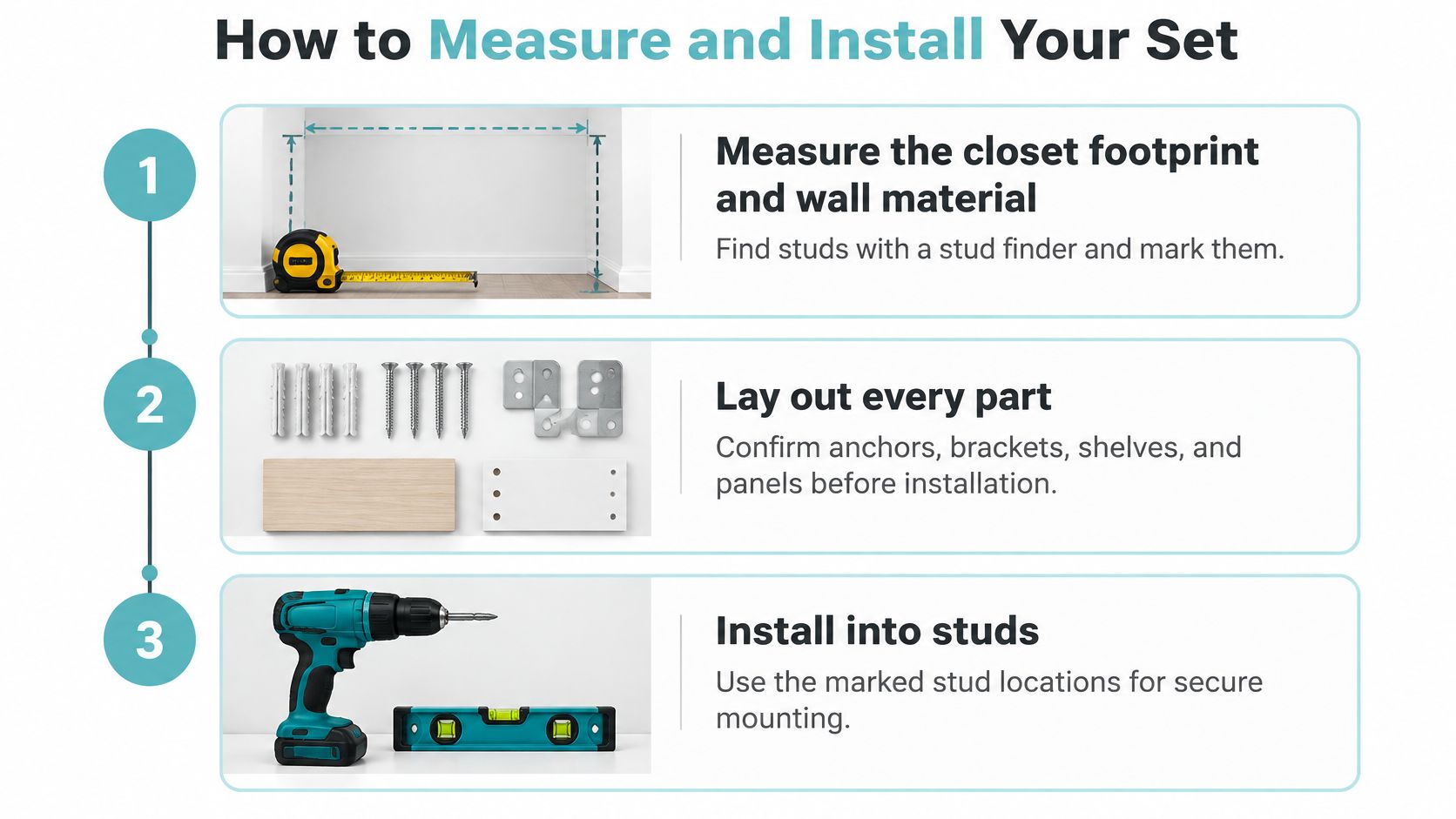
CPSC's Anchor It campaign tells families to anchor dressers and bookcases to the wall, keep toys and other tempting items where kids won't climb for them, and store heavier items on lower shelves. On any unit with drawers, add interlocks so only one drawer can open at a time.
- Measure the footprint and the wall. Mark studs with a stud finder before you buy hardware.
- Lay out every part against the parts list. A missing bracket found mid-drill stops the job.
- Assemble the frame on the floor and keep the shelves square.
- Drill pilot holes into studs. Use a wall-rated anchor only where no stud exists. Drywall alone pulls out.
- Fasten the anti-tip restraint into structural material. Follow that maker's kit.
- Stand the frame and tighten every screw.
- Load the lowest bins first. Keep heavy items below shoulder height. Filling the top first makes the unit top-heavy.
- Pull and wobble with both hands at the top and the bottom, then repeat after one week. No visible movement at full load means it passes.
Check Tip-Over Risk and Keep It Clean
The CPSC tip-over report estimated an annual average of 19,400 emergency-department-treated injuries from furniture, television, and appliance tip-overs during 2019–2021, including 8,900 among children. Across reported tip-over fatalities from 2000 through 2021, 482 of 592 deaths, 81%, involved children. Those figures don't prove a closet organizer caused an incident. They show why nursery storage earns the same anchoring and loading care as a dresser.
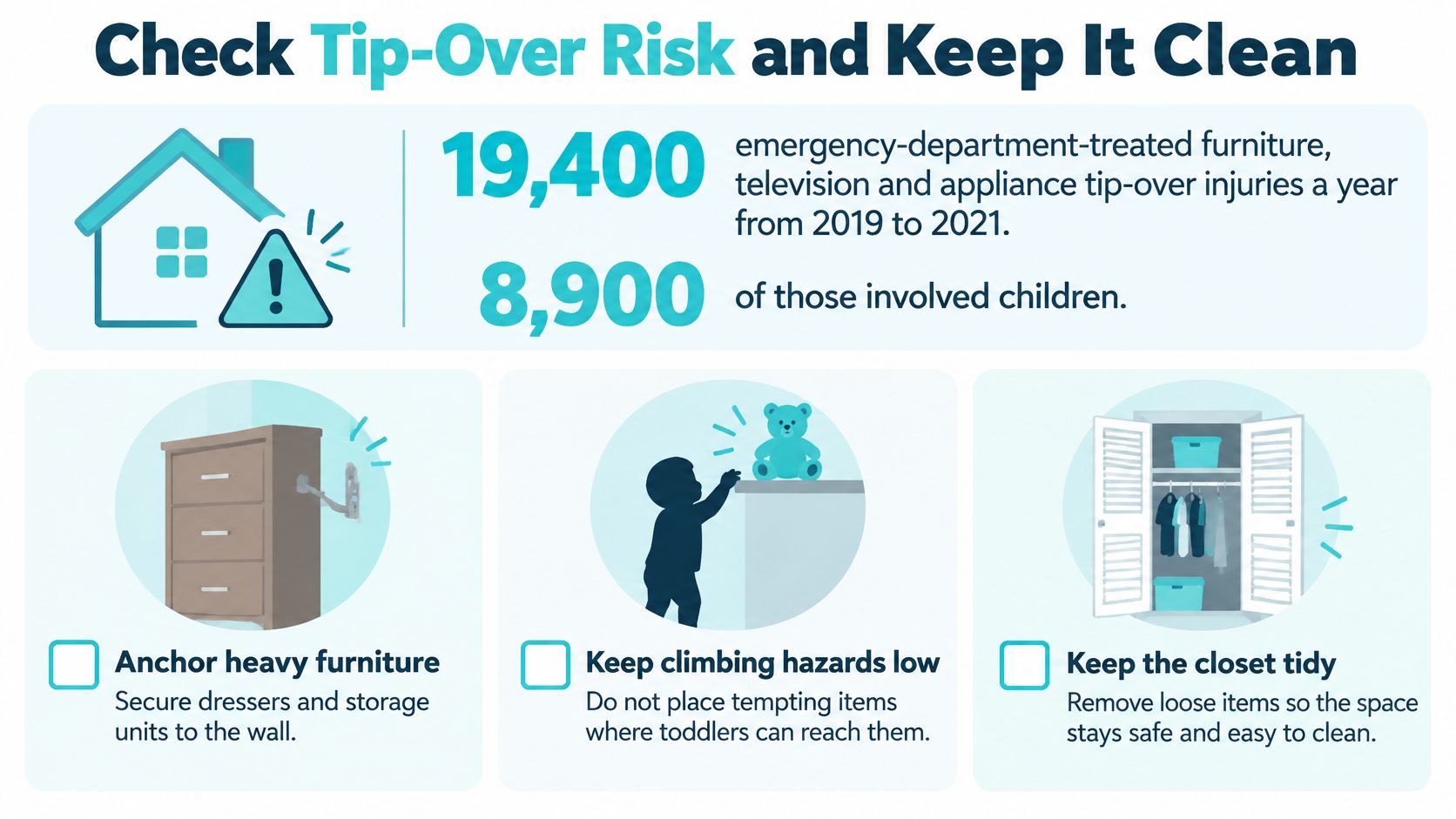
A toddler will pull an open drawer, step on a bin, or yank a fabric pocket full of blankets. Each of those moves weight forward and turns storage into climbing gear. Before each season, check four things:
- No step: no open drawer or shelf works as a foothold.
- No high weight: no heavy bin sits above shoulder height.
- Nothing risky in reach: cords, small parts, and medicines stay out.
- Hardware holds: anchors stay tight, and only one drawer opens at a time.
A wide base doesn't replace an anchor, and watching the child doesn't either.
Do a pull-and-wobble check monthly and a full hardware review each season. Look for loose screws, cracked brackets, frayed straps, sagging shelves, and bins that no longer sit flat. Replace worn parts instead of only retightening them. Reassess the whole setup when a child pulls to stand or starts climbing, because each new skill changes what counts as reachable.
Wipe a fabric hanging organizer clean with a damp cloth. A wider home childproofing plan covers the rest of the room. Put the monthly check on the calendar, since a reminder is easier to keep than a habit.
Organize Clothes and Toys by Zone

Everyday clothes placed low speed a change and let a toddler choose a shirt. Toys placed just as low become a ladder, which is the climbing risk the Anchor It campaign warns about. Low storage isn't automatically safer.
| Zone | Shelf height | What goes there |
|---|---|---|
| Adult-only zone | Top shelf, out of child reach | Creams, medicines, cosmetics, backup supplies |
| Caregiver zone | Waist to shoulder height | Daily outfits, diapers, wipes |
| Child-access zone | Lowest shelf | A few soft clothes and books, nothing climbable |
Put heavy blankets and bulky bins low, and keep lightweight seasonal clothing high. Recheck the zones at crawling, pulling to stand, climbing, toilet training, and independent dressing.
Say a grandparent covers nap time. Picture labels, size notes on hand-me-down bins, and a swap every three months beat a system only one parent understands. A portable fabric organizer can move between homes. Leave the wall-anchored unit where the lease forbids new holes. For storage beyond the closet, see our nursery organizer ideas, a nursery storage bench, a nursery storage cart, and a diaper organizer for the changing table. Folding routines are covered in the best way to organize baby clothes.
FAQs
Do closet organizers need to be anchored?
It depends on the type. The federal clothing-storage standard covers free-standing furniture intended for the storage of clothing, typical of bedroom furniture, manufactured after September 1, 2023. Hanging shelves and over-door pockets are not free-standing, so that rule does not apply to them. Open cube shelves usually aren't covered either. CPSC's Anchor It campaign still tells families to anchor dressers and bookcases to the wall. If a piece can tip, use the maker's anchor kit and keep tempting items where a child won't climb for them.
What size bins fit a standard closet shelf?
There isn't one standard bin size that fits every closet shelf. Closet depth, shelf thickness, and door clearance vary, so measure the shelf's depth, width, and the height to the shelf or rod above it before you buy bins. Leave a little room so the bin can slide in and out without catching. If the closet is shallow, choose a shorter bin rather than one that hangs over the edge.
How do I organize baby clothes by size?
Group what fits now, and keep the next size up in a separate, clearly marked bin or rod section. Size dividers and labels, including picture labels, make that split obvious to anyone who puts laundry away. Add size notes to hand-me-down bins, and plan a swap every few months as your child outgrows a size. For folding routines, see the best way to organize baby clothes.
When should I switch from a baby closet setup to a toddler one?
There's no single age. Recheck the closet at each new skill: crawling, pulling to stand, climbing, toilet training, and independent dressing. Once a child pulls to stand or climbs, move tempting items off the higher shelves and check that every anchor is tight. Once a child starts dressing, put a few everyday outfits in the child-access zone on the lowest shelf.
Decide on Your Set and Anchor It Before Baby Arrives
A tidy closet can still become a ladder once a toddler can pull up, so choose the organizer type from closet width and wall material before you think about bins or labels. A tight closet suits a narrow hanging organizer, so confirm the listed size with the maker before ordering.
Measure again after you choose the mounting spot, then match the hardware to the wall: studs or toggles for drywall, longer screws for plaster, masonry anchors for block. Put the anchoring work on the calendar before the due date, because that is the step many parents skip while paint, bedding, and tiny clothes get attention. Keep daily-use weight low, place the three zones so the heaviest items sit closest to the floor, and leave upper space for lighter storage. Set a reminder for a pull-and-wobble check one week later.
This week, pick one organizer type and write the measurements down so the purchase starts from facts.
Sources and Further Reading
Two references earn a read before you buy hardware. The CPSC tip-over report on furniture, television, and appliance instability explains why anchoring matters as much as shelf layout, and the agency's Anchor It campaign gives plain guidance on securing dressers, bookcases, and other storage.
The federal clothing-storage rule, often called STURDY, is set out in the eCFR clothing-storage standard. It covers free-standing clothing-storage units manufactured after September 1, 2023, protects children up to 72 months old, and points to ASTM F2057 or a successor for its warning language. If you add a chest or dresser beside the closet, the manufacture date tells you whether the rule applies.