


Nursery Storage Cart Guide: Safety, Setup and Buying Tips
At 3 a.m., one hand is holding a wiggling baby and the other is reaching for a diaper that's two rooms away. A nursery storage cart can close that gap, but the popular advice to “just get a rolling cart” skips an important detail: wheels are a safety feature, not only a convenience. Choose the cart for its job, then check how it behaves when it's loaded, locked and within a curious toddler's reach.
Disclosure: Hiccapop makes the Portable Wipe Warmer & Dispenser mentioned in this post.
What a Nursery Storage Cart Does and Where It Fits
A nursery storage cart is a wheeled, multi-tier unit for keeping daily supplies close to a changing table, crib or feeding chair. Think of it as a rolling pantry or a kitchen island on wheels, only sized for the diapers, wipes, burp cloths and other items that make a long night slightly less of a scavenger hunt.
Its job might be a changing-station caddy, a staging spot for packing a diaper bag, or a feeding corner for bottles and cloths. The same cart can hold laundry while you sort it, corral books and toys in a playroom, or carry supplies between rooms. That flexibility is useful when you're tired and don't want to make another trip. It's less useful if the cart is overloaded, hard to steer or easy for a child to move.
The trade-off is built into the design: wheels make the cart portable, but also make it movable when you don't want it to move. Carts belong to the wider category of furniture and storage used around young children, so stability matters alongside capacity. The U.S. Consumer Product Safety Commission's 2023 tip-over report estimates an average of 17,800 emergency-department-treated tip-over injuries per year involving furniture, televisions and appliances from 2020 through 2022. Children younger than 18 accounted for 44% of those injuries, and furniture made up 82% of the total. Those figures describe furniture and other products in general, not nursery carts specifically.
That context is a reason to inspect a cart's height, wheel locks, bin retention and load placement before buying. Start by naming the main job: will this cart stay beside a changing table, move between rooms, or serve as a low toy bin? That answer determines its useful size, height and features.
Cart Types and Materials Compared
Slim rolling cart (two to three bins)
- Footprint or dimensions: Narrow frame, fits beside a changing table
- Common materials: Steel wire or plastic
Fabric bin cart
- Footprint or dimensions: Compact; check the listing for exact dimensions
- Common materials: Canvas or polyester on a metal frame
Steel wire cart
- Footprint or dimensions: Open-sided; check the listing for exact dimensions
- Common materials: Powder-coated steel
Wood or MDF cart
- Footprint or dimensions: Solid-sided; check the listing for exact dimensions
- Common materials: Wood or MDF
For a tight space beside a changing table, a slim two- or three-tier cart is often the practical fit. Compare overall height with bin depth: deeper bins hold more, but can be awkward to reach into or pull open. Listings vary by cart type, so check the individual product page for the exact footprint and price of fabric, wire or wood styles.
Fabric-bin carts are light and suit soft items such as burp cloths, blankets and toys. Fabric can sag if a bin is overloaded, so keep heavy bottles and supplies you'll pull out one-handed elsewhere. Steel wire shelves allow airflow around bottles and wipes, and their open sides make contents easy to see. Small items may slip through, though, and the shelves can look cluttered without bins. Wood or MDF can blend with nursery furniture; check the joints and frame for wobble before loading.
Buying rule: Match the listed weight limit to the load you plan to carry, not the cart's empty weight. Choose a footprint that fits the room and the cart's job, then check whether the frame can be anchored. The right material and size matter, but the cart's wheels also affect whether it stays put when parked.
Casters, Wheel Locks and Floor Surfaces
A cart's wheels are a safety feature, not just a convenience. On hardwood, a loaded cart may roll easily. Carpet takes more effort to cross, and a threshold can catch a caster, stopping the wheels while the frame keeps moving. That change in movement matters when you're steering one-handed.
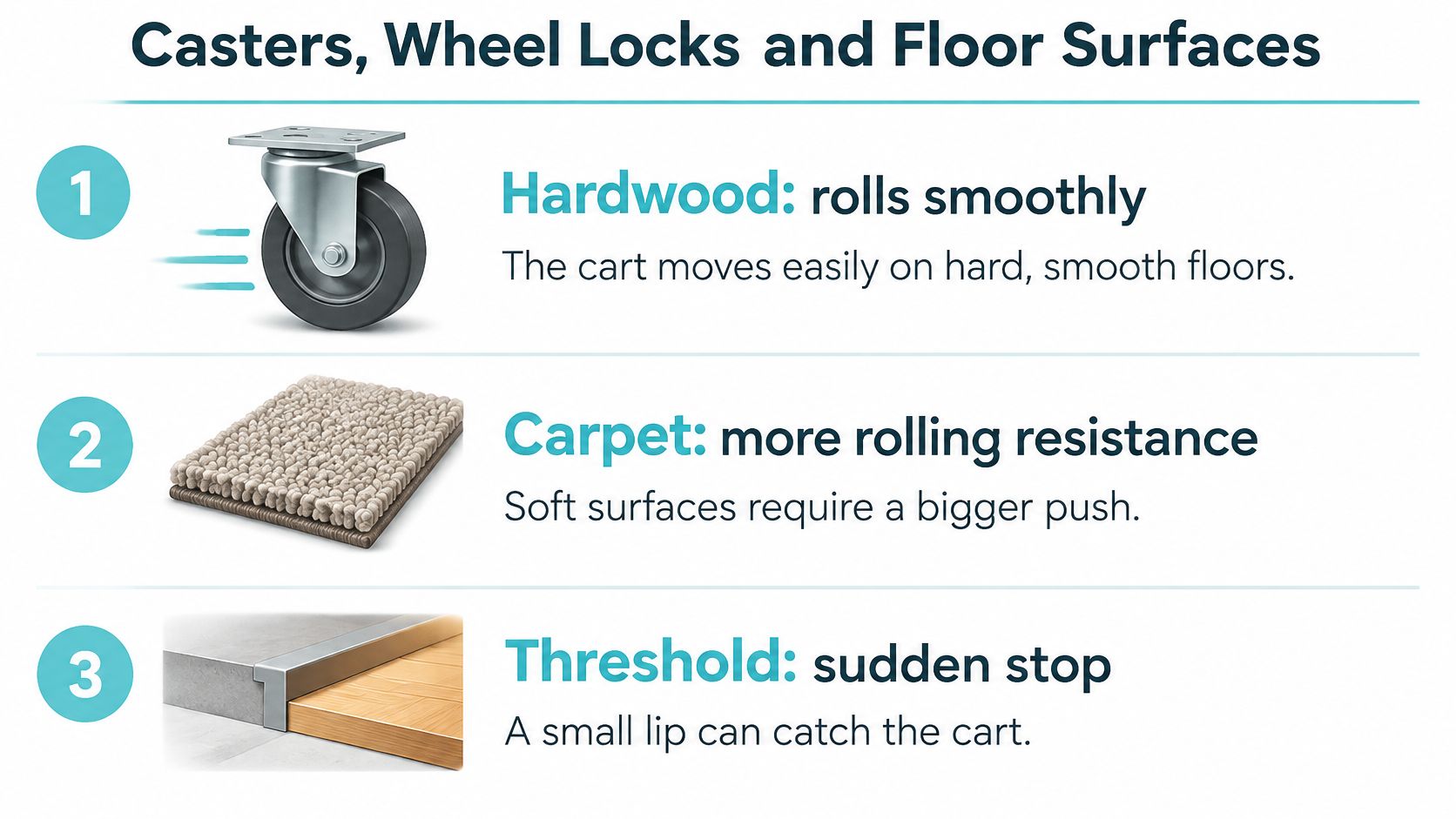
Choose positive wheel locks that engage securely, a broad wheelbase and a frame that keeps weight low. Lock all four casters when the cart is parked. A bin pulled fully open shifts its load beyond the base, so check that the frame stays steady and no wheel lifts.
Tall furniture and clothing-storage units can tip if a child pulls or climbs on them. Keep a nursery cart's heavier contents low, and use an approved anchoring system if the cart is designed to be secured. The right setup depends on the room: check the floor at the changing area, feeding spot and storage location, especially where carpet meets a threshold. A cart that rolls smoothly on one surface may be harder to control on another.
Use this acceptance test before trusting a cart in its intended spot:
- Load it as you plan to use it. An empty cart won't show how its loaded wheels and frame behave.
- Lock every caster. Check each brake directly rather than assuming the pedal has caught.
- Pull each drawer or bin fully open. The extended load puts more weight beyond the base.
- Check for movement. No wheel should lift, and the frame shouldn't rotate or tilt.
- Repeat on carpet and at thresholds. Confirm the cart stays manageable across every surface where you'll use it.
If the cart tilts or shifts, reduce the load or choose a different location. A brake that won't hold is a reason to choose another cart, not a minor annoyance.
Tip-Over Risk, Anchoring and Stability Limits
Three conditions make a cart easier to tip: a high center of gravity, heavy items in upper compartments, and a child pulling, climbing or leaning on an open bin. Wheels add another variable because a cart with free-moving wheels can roll as the child applies force. Lowering the load helps, but a sturdier setup also accounts for where the cart sits and whether it can be secured.
ASTM F2057-23, which CPSC adopted as its mandatory rule (16 CFR part 1261), provides a useful stability benchmark for certain larger storage units. The ASTM F2057-23 specification formally covers freestanding clothing-storage units at least 27 inches (686 mm) high, so a low nursery cart may fall outside its scope. The standard's height threshold and open-drawer focus still give caregivers practical questions to ask about height, open bins and stability.
Keep heavy items in the lowest basket, lock the casters when the cart is parked, and avoid placing it where a child can use it as a step. CPSC advises anchoring furniture children might climb, pull up on or fall against to the wall. Its home childproofing guidance warns that tip-overs can cause crushing injuries. For broader room-by-room childproofing, see Hiccapop's guide to childproofing your home.
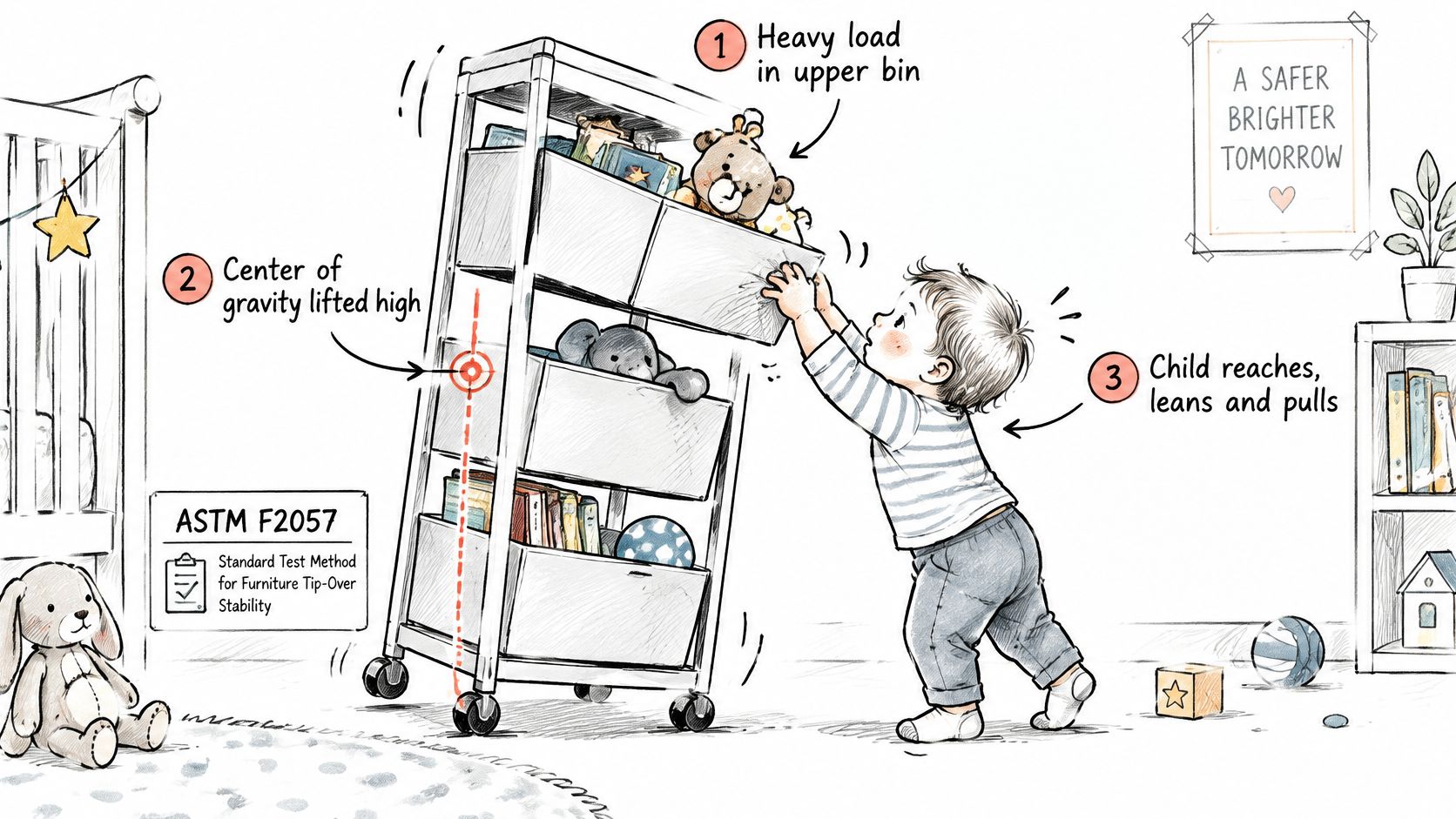
For a cart that stays parked, anchoring can be straightforward. If you move it between rooms, use a removable tether only where you can secure it reliably; a loose, disconnected strap doesn't protect anything. When mobility conflicts with stability, choose the anchor and accept a little less portability.
- Choose the anchor point before loading. Pick a wall stud, with the fastening point easy for an adult to reach and out of a toddler's reach.
- Attach an approved anti-tip strap or tether. Keep it removable if you regularly move the cart, but reconnect it whenever the cart is parked in its secured location.
- Check the setup. Pull gently on the top edge and each open bin. If the cart rocks or lifts, lower the load or move it somewhere it can be anchored.
Organizing Contents by Zone and Child Stage
Treat the cart like a layered house: a locked pantry at the top, a kitchen counter in the middle and a family table at floor level. The top zone is for adult hands, the middle is for supplies an adult hands over, and the lowest bin is for items a child can use under supervision.
Caregiver-only
- Typical contents: Medicines, creams, batteries, cords, small accessories
- Access rule: Top shelf or lidded bin, adult hands only
Supervised access
- Typical contents: Diapers, wipes, bottles, feeding supplies
- Access rule: Middle level, handed over by an adult
Child-accessible
- Typical contents: Lightweight, age-appropriate toys and soft items
- Access rule: Lowest bin, cleared when the child is cruising or climbing
In practice, keep upper levels light and uninteresting, put heavier diapering or feeding supplies near the base, and move small objects that could attract a toddler or pose a choking risk out of reach.
For a cart that moves between rooms, Hiccapop's Portable Wipe Warmer & Dispenser is cordless, comes with two power bases and holds up to a week's worth of wipes, with a built-in changing light that shuts off after 10 minutes. Keep it on the cart's middle level with the other diapering supplies, and leave the power bases on the changing table or dresser with their cords out of your child's reach.
Adapt the zones as your child changes. A rolling baby needs a clear base and no loose items within grabbing range. When a toddler starts cruising, check low bins and handles for things they can pull on. Once climbing begins, don't leave tempting objects within reach, even if they seem harmless.
Make caregiver handoffs easier with a visible inventory card listing what belongs in each zone, how much to refill and what needs an expiry check. Wipes and creams shouldn't sit indefinitely in a cart that moves from a supervised changing area to a less closely watched room. For more nursery organization ideas, use Hiccapop's practical guide as a starting point.
A packed cart isn't automatically a useful cart. Overfilling can encourage reaching, raise the load and make the unit harder to control. Leave room to see what's there and remove what doesn't serve the cart's main job.
Matching a Cart to Your Nursery Layout
Portable doesn't mean lower risk. A cart moved between rooms encounters different floors, thresholds, and furniture each time, and a child can push or pull it while its wheels are free to move or a bin is extended. CPSC recommends anchoring furniture, storing heavier items on lower shelves, and keeping toys and other appealing items where kids won't be tempted to climb for them; its Anchor It! campaign shows how to install an anchoring kit. Match the cart to the room and routine, not the other way around.
Small nursery, beside changing table
- Best cart choice: Slim two-tier rolling cart
- Main constraint: Limited floor space
- Priority feature: Narrow footprint and locking casters
Shared room or bedroom
- Best cart choice: Cart with lidded bins
- Main constraint: Child reach and climbing
- Priority feature: Closed bins and low loads
Carpeted or multi-room home
- Best cart choice: Heavier base with wider wheelbase
- Main constraint: Carpet and thresholds
- Priority feature: Wheel locks that hold on carpet
Grandparent or babysitter home
- Best cart choice: Fixed-position cart with anchor kit
- Main constraint: Unfamiliar hazards
- Priority feature: Anchoring option and visible inventory
Travel setup
- Best cart choice: Light, fold-flat cart
- Main constraint: Frequent moves and unknown floors; anchoring often isn't possible
- Priority feature: Quick-lock casters
For a small nursery, measure the gap beside the changing table and confirm that the cart can still turn without blocking a walkway. In a shared room, closed bins reduce visual clutter, but they don't make hazardous contents harmless; keep the load low and the cart out of climbing range. A carpeted or multi-room setup needs casters that lock firmly on the surface where the cart will sit.
A grandparent's or babysitter's home calls for a simple setup: a fixed parking spot, an anchor option and a visible inventory so another caregiver can see what's inside. Travel is the awkward case. A light, fold-flat cart may be easier to carry, but anchoring may not be practical, so keep the load modest and don't leave it unsecured beside a child.
Before choosing, check each room for three things: what the child can reach, what the floor will do to the wheels, and whether you can anchor the cart. A tether can remain removable for a cart that changes rooms, but wheel locks alone aren't enough if a toddler can pull on an open bin. For ideas on arranging compact rooms, Hiccapop's space-saving nursery furniture guide can help you think through the footprint.
Confirm the Cart Fits Your Setup Before You Buy
Start with the cart's main job. A diapering station beside a changing table needs quick access and a narrow footprint; a cart that travels between rooms needs manageable weight and casters suited to those floors. Measure the intended parking spot, including the room needed to open each bin without blocking a path.
Then check the listing for the cart's dimensions, weight limit, caster locks and anchoring options. Compare the stated capacity with your planned load, not with an imagined maximum. Ask the seller what stability testing the cart has passed and request documentation. No federal stability rule is written specifically for nursery carts; CPSC's mandatory tip-over rule, 16 CFR part 1261, covers clothing storage units 27 inches or taller.
Cite the relevant guidance by name when you contact a seller: CPSC for childproofing and anchoring advice, and ASTM F2057 or 16 CFR part 1261 for the scope of the clothing-storage stability rules. A compact cart may not be covered by the same standard as a taller clothing-storage unit, so ask what tests apply to the specific product.
In the first week, set the cart in its intended spot, check that the wheels and anchor work there, and load it using the access zones. Review the setup after your child reaches a new stage, especially when cruising or climbing changes what they can reach.
Share your room layout and your child's age in the comments so the cart choice can suit your space.
For more ideas on setting up a calm, practical nursery, browse the Hiccapop blog.