


Nursery Storage Bench Guide: Sizes, Safety and Styling
You're taping paper outlines on the nursery floor at midnight, trying to make blankets, board books, and seventeen stuffed animals disappear into one tidy spot. A nursery storage bench looks like the perfect answer. It's a seat, a toy box, and a cute photo prop all at once. That's exactly why you can't shop for it like decor. If a toddler can sit on it, climb it, or yank a lid open solo, you're buying children's furniture, and it needs a safety audit first.
Nursery Storage Bench Sizes That Fit Your Room
Say you measure a 36-inch wall, fall for a 48-inch bench, and discover on delivery day that it blocks the closet door. It happens more often than you'd think, and it's avoidable. Measure the empty gap, then subtract door swings before you fall in love with a finish.
Pick Your Size Class First
Compact
- Typical width: 24-30 in
- Best placement: Beside a glider or in a changing corner
- Watch for: Tips easily when loaded with heavy items
Standard
- Typical width: 30-42 in
- Best placement: Under a window or along a long wall
- Watch for: Anchor it if a child can climb onto it
Long
- Typical width: 42-60 in
- Best placement: Shared toy zone or playroom side of the nursery
- Watch for: Needs clear floor space and anchoring at the wall
Compact benches run about 14 to 16 inches in seat height. Standard and long models usually sit 16 to 18 inches high, which works for an adult perch during story time. Toddler-height benches, often 36 to 48 inches wide for a play corner, drop to 12 to 14 inches, so small legs can reach the floor instead of dangling and tipping forward.
Before you order, mark crib and changing table positions on the floor with painter's tape. Then leave a 30-inch walkway so you're not squeezing past the bench with a baby in your arms at 2 a.m.
Keep the bench out of window cord zones, and don't shove it tight against a crib where it becomes a launch pad. If your room is tight, this guide to space saving nursery furniture ideas for small rooms can help you rethink the layout before you commit.
Run this three-part check. Width fits the gap, seat height suits your child's age, and depth stays under about 18 inches so the bench stays out of traffic.
Types of Nursery Storage Bench and Who Each Suits
Think of a nursery storage bench as a low box with a seat-height top. The storage style decides how it behaves. An open cubby bench is a bookshelf lying down. A lift-top chest is a toy box with a cushion. A drawer bench is a small dresser that kneels.
That simple picture tells you a lot. If toddlers can see toys, they'll reach for them. If storage hides clutter, you'll be managing a lid or drawer every day. When comparing frames and tops, look at materials side by side instead of judging by color alone.
Five Types Compared
Open cubby bench
- Best for: Sorting toys, books and bins by age
- Main trade-off: Cubbies can become a step for climbing
- Seat comfort: Firm; add a washable cushion
Lift-top chest bench
- Best for: Bulky blankets, plush and dress-up clothes
- Main trade-off: Lid needs hinge and pinch checks
- Seat comfort: Good with a padded lid
Drawer bench
- Best for: Diapers, wipes and small clothing kept out of sight
- Main trade-off: Pulled drawers act as steps
- Seat comfort: Firm; best as a short perch
Upholstered lidded bench
- Best for: Living-room-style nurseries and story time
- Main trade-off: Fabric and foam add emissions and lid risk
- Seat comfort: Most comfortable for adults
Changing bench with shelves
- Best for: Diaper changes at raised height
- Main trade-off: Raised surface needs a strap and a hand on the child
- Seat comfort: Not designed for sitting
Open cubbies are the strongest fit for most single-child rooms. Toddlers can grab a bin, play, and learn to put it back without wrestling a heavy lid. The trade-off is real, though. Every low shelf is also a step, so you can't skip anchoring.
Lift-top chest benches swallow bulky blankets and that giant plush giraffe nobody asked for. They look tidy when closed, but you inherit hinge checks. Drawer benches win for diapers, wipes, and tiny socks that vanish in open bins, yet an open drawer is an invitation to climb.
Practical rule: For a shared room, choose open cubbies with labeled bins per child. For a single-child room where you want clutter hidden, an anchored drawer bench beats a lidded chest for daily speed.
Upholstered benches feel best for grown-up reading marathons, but fabric traps spit-up and needs real cleaning, not a hopeful wipe. Changing benches aren't seats at all. Don't let a cute listing blur that line.
Materials and Finishes That Affect Air Quality
A nursery storage bench can affect the air in a room where a baby sleeps. Composite wood, including particleboard, plywood, and medium-density fiberboard, may contain formaldehyde and other VOC sources in its adhesives, coatings, and glues. The U.S. Environmental Protection Agency notes that concentrations of many VOCs are consistently higher indoors, up to ten times higher, than outdoors.
EPA's formaldehyde facts page lists resins used in composite wood products, including hardwood plywood, particleboard, and medium-density fiberboard, among household sources of formaldehyde. You don't need to rule out every composite panel. Check what the bench is made of, especially if it will sit in a small room with limited ventilation.
Solid wood isn't automatically the better choice. Paint, finishes, glue, foam cushions, and upholstery can also emit VOCs. A pine bench with a strong-smelling finish may be a poorer pick than CARB Phase 2 or TSCA Title VI compliant plywood that is fully sealed and aired out. Treat labels such as “non-toxic” and “eco-friendly” as incomplete unless the product details explain the materials and finish.
Materials Compared
Solid hardwood (oak, maple)
- Air-quality notes: No composite binders; check the finish
- Durability: High
- Cleaning: Wipe with mild soap and water
- Best use: Long-term heirloom bench
Solid pine
- Air-quality notes: No composite binders; knots and finish matter
- Durability: Dents easily
- Cleaning: Wipe with mild soap
- Best use: Budget solid-wood option
Plywood
- Air-quality notes: Check for CARB Phase 2 or TSCA Title VI compliance
- Durability: Good
- Cleaning: Wipe with a damp cloth
- Best use: Sturdy frames and lids
MDF
- Air-quality notes: Higher emissions when unsealed; verify compliance labeling
- Durability: Moderate; swells if wet
- Cleaning: Wipe lightly; avoid soaking
- Best use: Painted or upholstered frames
Particleboard
- Air-quality notes: Can emit more when unsealed; check that it is sealed
- Durability: Low to moderate
- Cleaning: Wipe lightly
- Best use: Use only with a verified sealed finish
Bamboo
- Air-quality notes: Check the adhesive and whether it is engineered
- Durability: Good
- Cleaning: Wipe with a damp cloth
- Best use: Modern, low-profile benches
Rattan or wicker
- Air-quality notes: Check the lacquer
- Durability: Good; can split when dry
- Cleaning: Dust, then wipe gently
- Best use: Open baskets and cubbies
Before buying, check three details: whether composite panels meet CARB Phase 2 or TSCA Title VI compliance, whether all faces, cut edges, and drilled holes are sealed, and whether cushions or liners add foam or adhesive layers. Ask how long odors typically last, too. The front of a bench may look finished while hidden edges and holes remain exposed.
For a broader room-by-room checklist, see these environmentally conscious products for families. Use that guidance alongside the bench's product specifications, not in place of them.
A Simple Decision Framework
- Pregnancy and newborn rooms: Choose solid wood or low-emission composites labeled CARB Phase 2 or TSCA Title VI compliant, and set up the bench weeks before the due date.
- Asthma-sensitive households: Avoid a bench with a strong odor. If its smell is unpleasant in the store, choose another.
- No outdoor airing space: Open the windows and run a fan to ventilate the room. Keep your baby out while strong odors persist.
Tip-Over and Lid Safety Checks Before You Buy
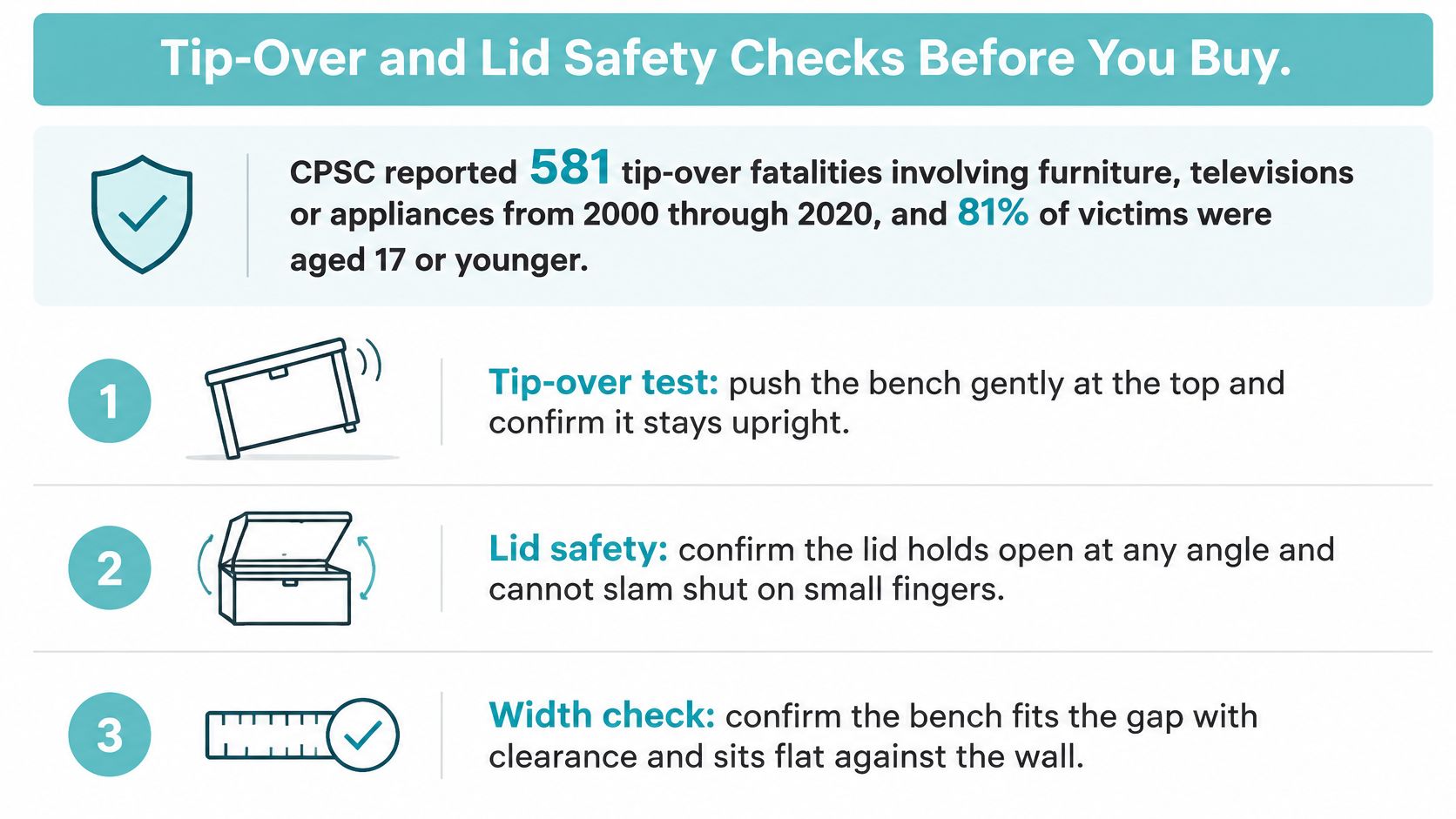
Most buying guides skip this part. Don't. The U.S. Consumer Product Safety Commission tip-over report, released Feb. 3, 2022, found 581 tip-over fatalities involving furniture, televisions, or appliances from 2000 through 2020, and 472 of them, 81%, were children ages 17 and younger. The same report estimated an average of 22,500 people required emergency-department treatment for tip-over injuries each year from 2018 through 2020.
A bench is shorter than a dresser, so it feels harmless, and CPSC's counts don't even include benches, storage boxes, or baby furniture. The physics don't care about categories. When a child climbs onto a lid or pulls a drawer toward them, the center of gravity shifts forward and the overturning force grows. Low furniture can still shift, rock, and tip onto a small body.
Run this visual audit before any bench earns a spot on your shortlist, then work through the table in the store or with the product manual open.
Your Safety Audit Checklist
Footprint
- What to look for: Base wider than the seat with flat, non-skid feet
- Red flag: Narrow legs or rounded base that rocks
Wall anchor
- What to look for: Anchor hardware included and usable into studs
- Red flag: No anchor kit or only a thin back-panel attachment
Lid hinge
- What to look for: Hinge holds the lid open at any angle
- Red flag: Lid drops freely or slams shut
Lid lock
- What to look for: No automatic lock on the lid
- Red flag: Spring latch that can trap a child inside
Ventilation
- What to look for: Open cubbies or vents on any lidded box
- Red flag: Fully enclosed box with a lid
Top surface
- What to look for: Flat seat without climbable shelves above it
- Red flag: Stacked shelves or ledges above the seat
Weight limit
- What to look for: Maximum load stated in the product information
- Red flag: No stated load for seating or storage
Load placement
- What to look for: Instructions to keep heavy items low
- Red flag: Only top-shelf storage with no guidance
CPSC's mandatory tip-over standard for clothing storage units (16 CFR part 1261, which adopts ASTM F2057-23) is intended to protect children up to 72 months old; a storage bench may not be covered, so ask the maker what stability testing it has done. If a brand can't answer stability questions at all, that's your answer.
Lids deserve their own test. The American Academy of Pediatrics' Make Baby's Room Safe checklist on HealthyChildren.org says, “The best toy chest is a box or basket without a lid. However, if it has a lid, make sure it has safe hinges that hold the lid open and do not pinch.” Open the lid halfway and let go. It should stay put, not drift down onto fingers, hands, or a head.
A lidded box should never become an enclosed play space. Check hinges every few months for looseness, and fix wobble immediately.
The walk-away red flag is simple. No anchor kit and a lid that slams. Either flaw alone needs fixing. Together, they end the search.
When a Storage Bench Doubles as Seating
A bench sold as seating creates problems a plain storage box doesn't. You invite sitting, then standing, then bouncing, then using the seat as a step stool to reach something more interesting. That's normal toddler logic, and your setup has to expect it.
The numbers explain the bluntness. CPSC estimates cited in June 2019 congressional testimony show tip-over injuries involving children younger than six and dressers or other clothing-storage units rose from 2,100 in 2015 to 2,800 in 2016, an increase of about 33% in one year. A bench isn't a tall dresser, but treating low nursery furniture like harmless decor is how families skip anchoring.
Three Scenarios You'll Actually Face
The window seat in a shared bedroom. It looks perfect for story time under the window. The risk is a toddler standing on the lid to watch trucks outside. Use a closed, flat design with no ledge above the seat, move it away from cords, and anchor it before the first story.
The playroom bench under a wall shelf. Convenient for you, a climbing route for them. A toddler will stand on the bench to reach books or toys stored just out of reach. Move the shelf higher than bench plus toddler plus outstretched arm, or move the bench. There's no clever middle option.
The bench as a changing platform. Don't improvise this. A cushion isn't a safety feature. If a product is built for changing, a strap and a hand on your child at all times matter more than any seat padding. If it isn't built for changing, don't use it that way because the height feels handy.
House Rules That Work
- Thin, removable cushion: Thick cushions raise the effective seat height and slide under wiggling kids.
- Nothing climbable on top: Never store ride-on toys, step stools, or tempting favorites on the seat.
- Anchor before sitting: Nobody tests the seat until the wall restraint is installed and checked.
Seating earns its place only when the bench stays anchored, the lid passes your checks, and the top stays boring. Cute piles of plush toys on top undo all three.
How to Anchor and Set Up Your Bench
Installation isn't finished when the last screw from the flat-pack goes in. It's finished when the bench is level, aired out, anchored into studs, and tested. Give yourself an hour without a toddler "helping."
Start with the first two setup steps below, because rushing them creates problems you'll smell or feel for months.
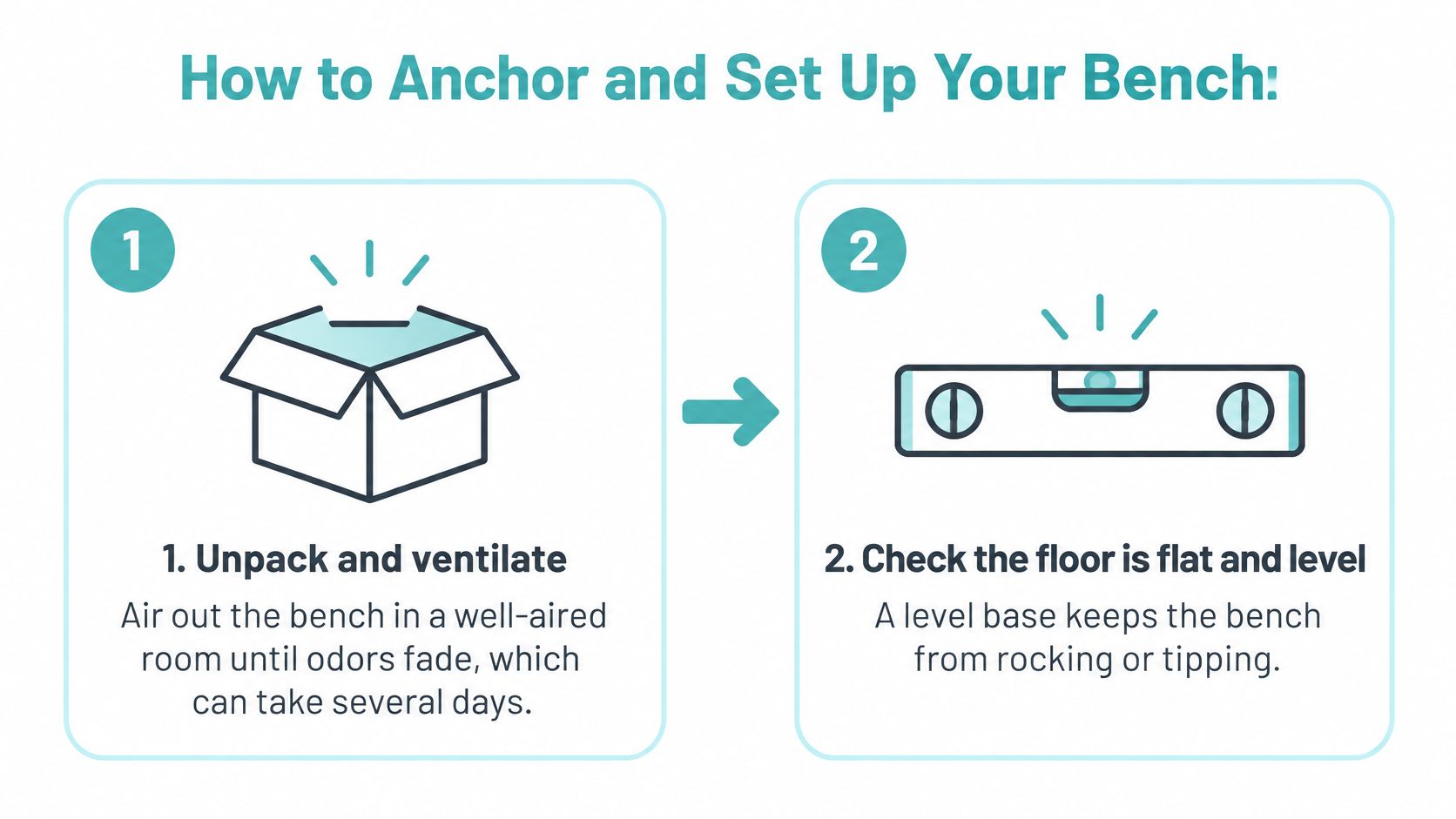
- Unpack and ventilate. Assemble the bench in a well-aired room and let odors fade, which can take several days. Don't move a strong-smelling bench straight beside the crib.
- Check the floor. Confirm the surface is flat and level. Shim the feet if the bench rocks, because a rocking base multiplies tip risk.
- Find studs. Use a stud finder and mark studs with tape. Wall-side screws belong in studs, not drywall alone.
- Place it carefully. Push the bench against the wall, away from the crib, window cords, and changing table traffic.
- Attach to solid wood. Mount the furniture-side fastener to solid wood along the top or sides, not only to a thin back panel or decorative trim. That thin panel can tear loose under a climbing child.
- Use the supplied restraint exactly as directed, following the kit's instructions and CPSC's Anchor It guidance. Don't swap in a random picture hook or skip a strap because the bench feels heavy.
- Test it hard. Push firmly on the top and each corner. Confirm it doesn't rock or slide, then open any lid halfway and confirm it stays open at any angle.
- Load heavy items low. Books and dense toys go in bottom cubbies. Light, less tempting items go higher and out of easy reach.
- Recheck on a schedule. Inspect anchors and hinges every few months and after any move, even across the room. The room-by-room walkthrough on how to childproof your home pairs well with this recheck habit.
Common slip: Anchoring only into drywall or a thin back panel looks finished and fails under load. Studs on the wall side, solid wood on the furniture side.
An unanchored bench isn't an installed bench. It's furniture waiting for its most important step.
Sources to Check Before You Buy
Verify claims yourself before you spend money. Start with CPSC's 2021 tip-over report (published February 2022) for injury and fatality counts, CPSC's Anchor It campaign for anchoring steps, and 16 CFR part 1261 for the clothing storage unit stability rule. Check the U.S. Environmental Protection Agency pages on VOCs and indoor air quality and formaldehyde for composite wood guidance.
For lid design, read the American Academy of Pediatrics' guidance on HealthyChildren.org: the Make Baby's Room Safe checklist on lidless toy chests and hinges, and the Toy Box Safety page on lid supports. For composite panel emissions labels, see the California Air Resources Board composite wood products program on CARB Phase 2 compliance.
Injury statistics come from reporting periods that change. Check the latest CPSC release before quoting any figure to family or a retailer.
Choose Your Bench Before You Style It
Style comes last. Treat the bench as children's furniture that needs a safety audit, not just a place to hide toys. Check three things before buying: the width fits the gap with room for doors and walkways, the seat height suits your child's age, and the design passes your safety checks. A bench with open storage avoids lid hazards, while a lidded model needs a lid that passes the hinge checks and secure hardware. Anchor hardware should be included.
A bench that fails any check is a skip, whatever its paint color. A poor fit can obstruct a walkway, and a seat that does not suit your child can invite risky climbing. The right look cannot fix either problem.
Once a bench passes, echo one existing tone, such as wood that matches the changing table or a painted lid that picks up the wall color.
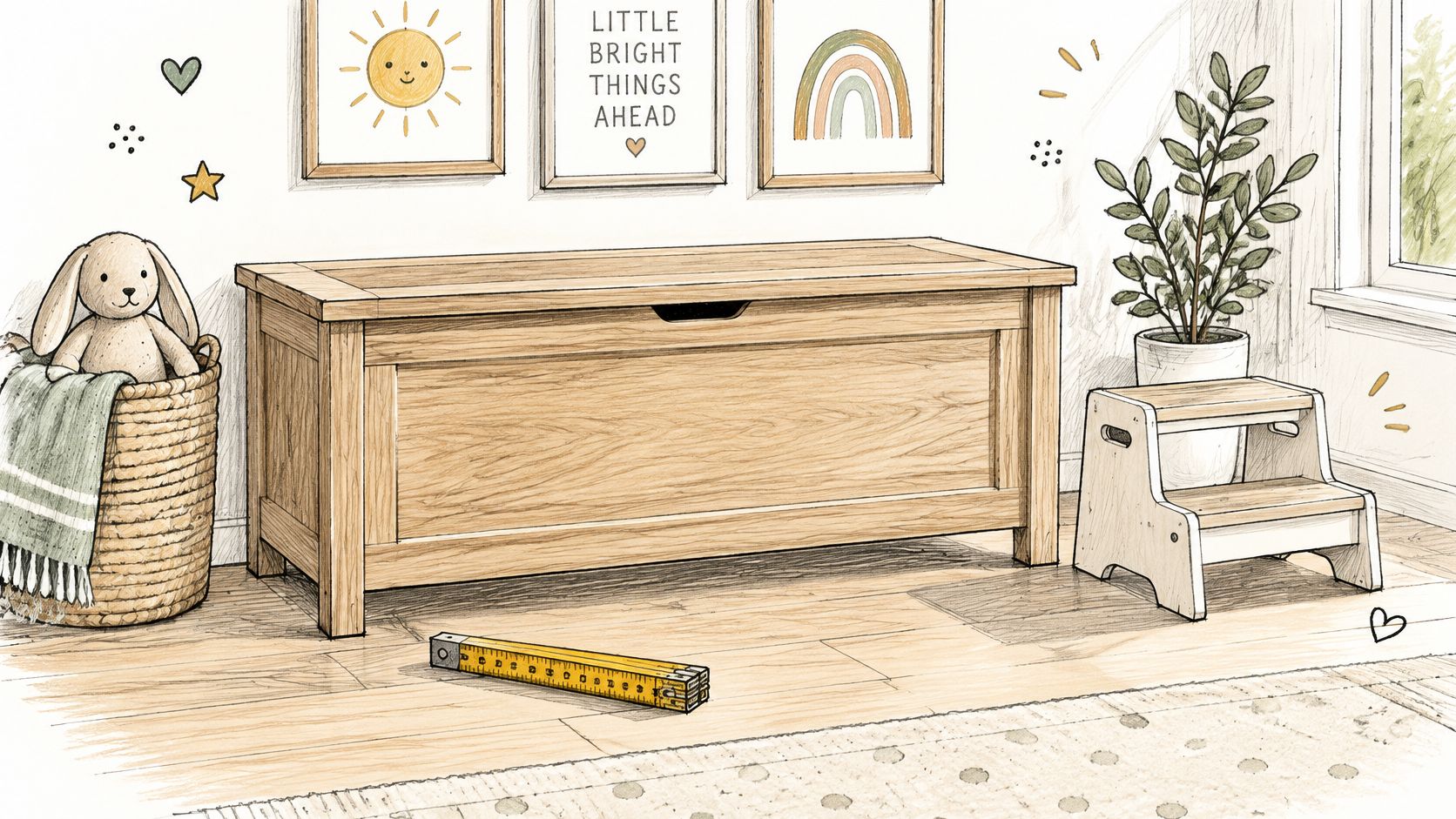
Use labeled baskets inside cubbies at your child's eye level to keep toys reachable, rather than stacking bins into a tower. Keep bulky decor, plush piles, and framed art off the bench. Hang art on the wall above it, out of reach of a standing toddler who may climb onto the seat. Seating adds a fall scenario that a simple toy bin does not, so keep the top clear and treat the bench as climbable furniture.
Measure the wall, tape out the footprint, and compare two or three benches against the same three checks. For any option, consider whether its storage and seat create lid-pinch or climbing risks.
Share your room measurements and toughest storage question in the comments. Include the gap width and your child's age to get help checking your shortlist.