


When to Move Baby from Bassinet to Crib (a Practical Guide)
Move your baby out of the bassinet when they hit the manufacturer's weight, height, or developmental limit—or when a new skill means that bassinet is no longer the right sleep space. Always follow the instructions for your specific product.
For a lot of families, the switch lands somewhere in the first several months. There is no universal birthday stamped on the bassinet. The better question is: Does this sleep space still match my baby's size, development, and the limits printed on the product?
Why the Bassinet-to-Crib Move Is About Cues, Not a Calendar
You put your baby down one evening and something feels off. Feet are closer to the end. The cozy tuck from last week looks more like a squeeze. That restless little stretch is usually the first whisper that the gear—not the calendar—is talking.
A bassinet is built for a short early chapter. A crib is built for the longer story. The move usually happens when size or mobility outgrows what that bassinet was designed to handle.
So skip “How many months old?” Ask instead: “Does my baby still fit this sleep space safely tonight?”
Average timing helps you prepare—it should not make the call
Plenty of babies graduate during the first several months because growth and mobility speed up. Treat that as a heads-up, not a deadline.
The rule that holds up: follow the manufacturer's instructions first. Rolling and pushing up can also be stop points, depending on the product and applicable guidance.
Health Canada advises moving a baby from a bassinet to a crib or cradle when they can roll over, while also following the manufacturer's recommended age, weight, and height limits.
What This Looks Like in Real Life
Parents rarely decide this from a milestone poster on the wall. They notice a pattern at 2 a.m.
- The manual suddenly matters: You flip the label and see clear weight, height, age, or developmental limits.
- Movement has changed: Your baby is more active—or hitting a mobility cue that means the bassinet is no longer appropriate.
- Your baby is bumping the product's limits: The sleep space no longer matches their size.
Those signals beat a vague “around 4 months” tip every time. The label wins over the group chat.
The Safety Triggers That Should Drive the Decision
Stop asking only about age. Start asking whether your baby has hit a stop point for this sleep space.
Manufacturer instructions come first. Developmental milestones such as rolling and pushing up can also be stop points, depending on the product and the guidance that applies. Bassinets cover a limited stage. Cribs and other approved infant sleep products are built for longer use.
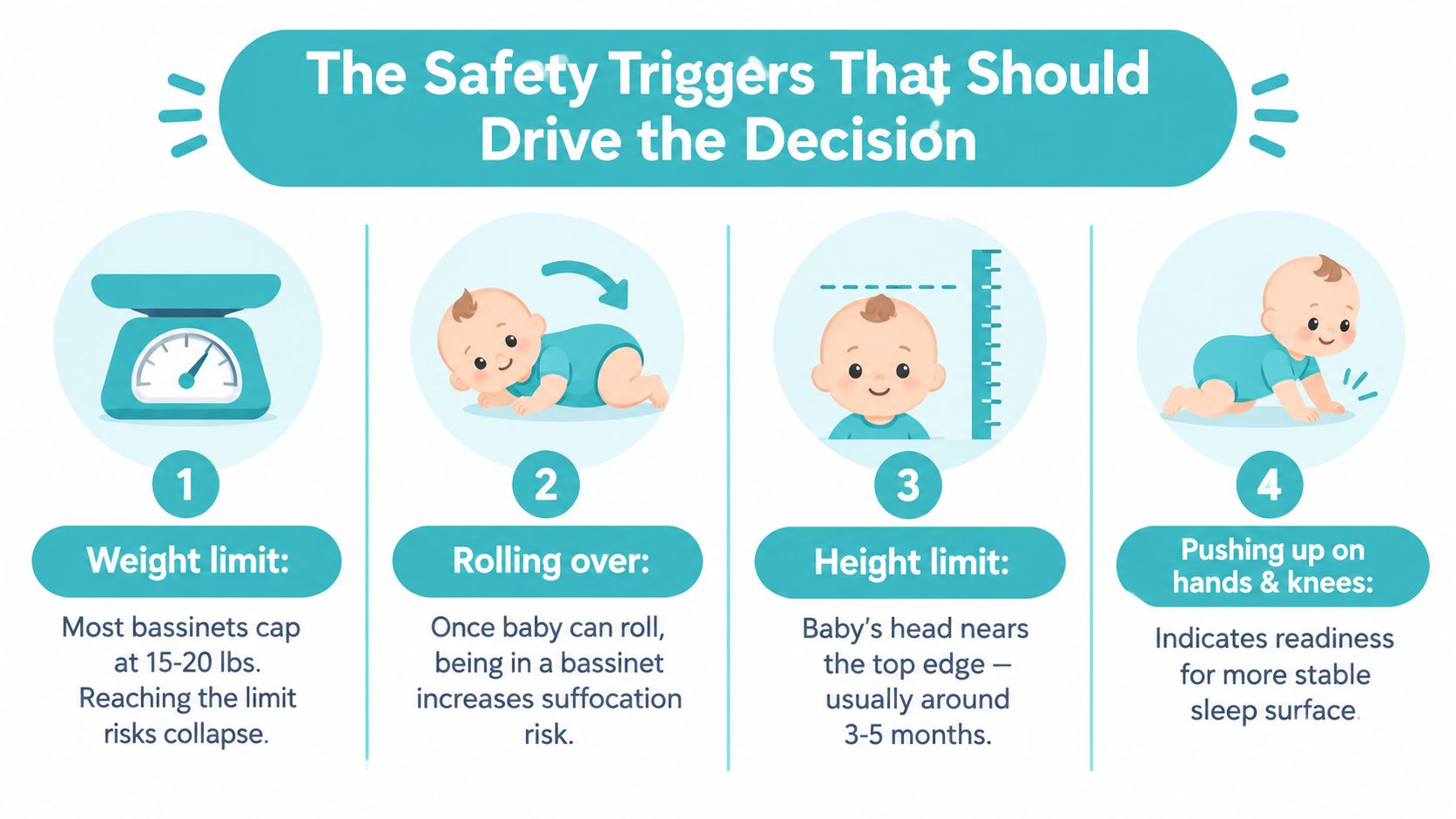
Weight, height, or other manufacturer limits
Start with the label and manual for your exact bassinet.
Those limits reflect how the product was designed and tested. Once your baby reaches the applicable limit, stop using the bassinet for sleep—even if another milestone has not shown up yet.
A general age tip should never override a more specific product limit.
Rolling
Rolling is a big developmental change—and an easy one to miss until it is not.
If your baby begins rolling, check the bassinet instructions immediately. Some models require you to stop once an infant can roll; others list different developmental cutoffs.
When the bassinet is outgrown, move to an appropriate next sleep product. If you are also sorting mattress firmness for that crib, see how firm a crib mattress should be.
Pushing up
Pushing up can be another hard stop for bassinets and cradles.
The current ASTM F2194-25 standard for bassinets and cradles covers bassinets and cradles intended primarily for infants up to approximately 5 months of age or until the child begins to push up on hands and knees, whichever comes first.
That does not mean every baby must move on their 5-month birthday. It means pay attention to intended use and developmental limits—not age alone.
A cramped fit is a product-fit concern
Sometimes the first clue is simply: this looks tight.
Feet at the end panel or less room to stretch is not automatically an emergency. It is a nudge to re-read the size limits.
Call it a fit concern, not a universal hard stop. Manufacturer limits and developmental requirements still decide when the bassinet is done.
One rule that travels well: instructions first—then move at the first applicable safety limit, not when Instagram says “everyone switches at six months.”
Bassinet vs. Crib: Sleep Surface and Room-Sharing Logistics
It is a classic 2 a.m. plot twist. Room-sharing still works. The bassinet suddenly looks tiny. The crib across the room looks enormous—and weirdly final.
Emotionally it is a leap. Technically it is usually a size-and-logistics upgrade. Like a bassinet, a crib should offer a firm, flat sleep surface when it meets applicable safety requirements and is used as directed. Cribs simply cover a broader stage and give growing babies more room.
Moving to a crib does not automatically mean moving to a separate nursery. And once the crib is set up, details like how high a crib mattress should be for a newborn and crib mattress size dimensions matter for day-to-day safety.
Side-by-side comparison
| Feature | Bassinet | Crib |
|---|---|---|
| Sleep surface | Firm and flat when used as directed | Firm and flat when used as directed |
| Side height | Sized for the bassinet's intended stage | Taller sides and a larger sleep area |
| Footprint | Smaller; easier beside the bed | Larger; usually less portable |
| Typical window | Shorter, per product limits | Longer-term infant sleep option |
| Best next step | Follow age, size, and developmental limits | Follow crib instructions and mattress requirements |
Reframe the question from “Is my baby old enough for a crib?” to “Which approved sleep space still matches size, development, and the manual?”
Room-sharing can continue
“Move to the crib” is not the same sentence as “move to the nursery.”
American Academy of Pediatrics recommends room-sharing without bed-sharing. For U.S. families, the CPSC identifies compliant cribs, bassinets, play yards, and bedside sleepers as products intended for infant sleep. Always use the product according to its instructions.
Need a compact option for travel or a small bedroom footprint? Pair this with the travel infant crib guide and portable crib weight limits—still following each product's limits.
Crib Safety Standards Worth Checking Before the First Night
Treat night one like any other gear check: intact crib, correct mattress for that crib, setup that matches current safe-sleep guidance.
CPSC and AAP guidance centers on a firm, flat sleep surface with only a fitted sheet. See the Consumer Product Safety Commission's safe-sleep guidance and the American Academy of Pediatrics' safe-sleep guidance. For sheet fit specifics, use the crib mattress fitted sheet fit guide. For what belongs in the crib (spoiler: almost nothing), browse baby crib bedding ideas that stay bare-crib safe.
Hand-me-down or garage-stored crib? Inspect carefully and check recalls before bedtime. A quick pass through the crib safety checklist helps.
Your first-night crib checklist
- Check the crib: Good condition, required hardware and instructions, not recalled.
- Check structure: Meets applicable current safety requirements.
- Check mattress fit: Mattress designed for your crib; tight fit per the manufacturer.
- Keep it bare: Fitted sheet only—no pillows, toys, loose blankets, quilts, or bumpers.
- Back to sleep: Place baby on their back for every sleep.
Picture mattress fit like a lid that belongs on that container. Wrong lid? Replace the mattress—do not stuff the gaps. If you want a firm, crib-specific option in this category, the Hiccapop dual-sided crib mattress has an infant-firm side and a toddler side, with a leak-resistant cover and CertiPUR-US certified foam (always confirm the final fit in your crib).
When Babies Start Rolling Earlier Than Expected
Some babies treat the developmental timeline like a polite suggestion. Then they start practicing parkour in the dark.
Rolling ages vary. Watch your baby and the bassinet instructions—not just a month marker.
Once they hit a developmental limit on that product, move to an appropriate sleep space that allows safe movement.
Signs to pay attention to
- Rolling or signs of reaching the product's rolling/developmental limit
- Pushing up on hands and knees
- Other movement that hits the bassinet's stated developmental limit
No birthday required before you re-check the manual.
If rolling starts, stop arms-restrained swaddling. Prefer a wearable that allows normal movement and matches their stage.
A Gentle Step-by-Step Transition Plan for the First Week
There is no mandatory seven-day program—the nights below are a flexible first-week rhythm, not a required schedule. Some babies shrug. Some file a formal complaint at lights-out. Both are normal.
If the bassinet's limits say it is time, keep the rest of bedtime familiar so the new space is the only big change.
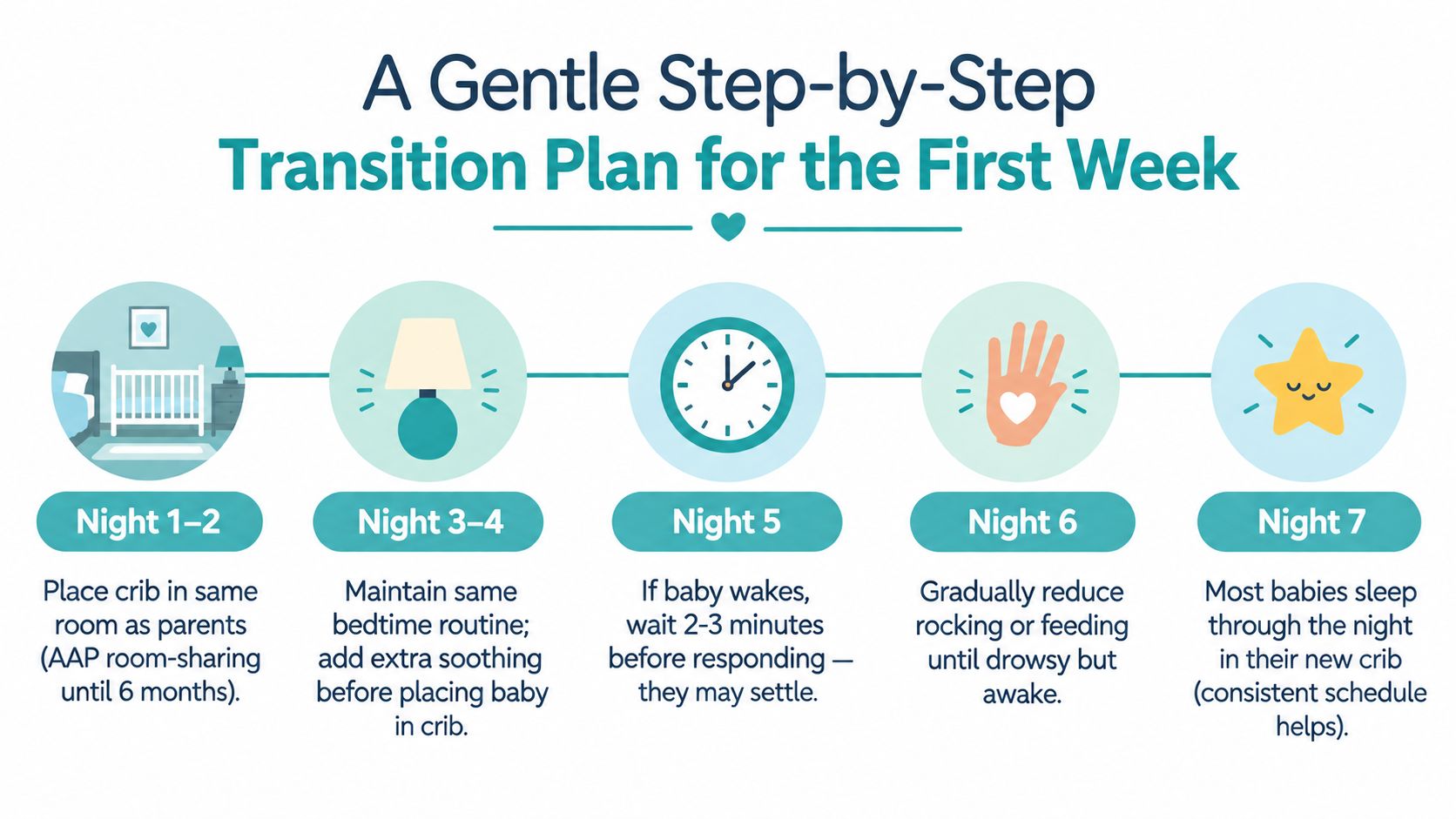
Nights 1 and 2
Still room-sharing? Keep the crib or other approved sleep product in your room.
Same routine. Same sleep clothes. Same lights-out cues.
Nights 3 and 4
Keep nights in the new sleep space.
Avoid overhauling naps, feeds, and bedtime all at once. Familiar rhythms make a new surface feel less alien.
Nights 5 through 7
Stay consistent with the crib or other appropriate product.
Adjustable mattress height? Follow the crib manufacturer's instructions for your baby's stage—more on how high a crib mattress should be for a newborn.
Goal: a safe, consistent sleep space for who your baby is now—not a perfect seven-day spreadsheet.
If sleep gets weird
Infancy is full of surprise night wakings. One rough night does not prove the crib was a mistake.
Prioritize a safe setup first. If baby seems unwell or you worry about breathing, feeding, or unusual behavior, call your pediatrician—do not diagnose it as “bad transition vibes.”
Traveling soon after the switch? Keep sheet fit boring and correct with tips from travel bed sheets, and revisit pack and play mattress safe sleep basics if a play yard is part of the trip plan.
Common Misconceptions Parents Bring to the Move
Most confusion is not carelessness. It is slogan-ified advice.
“I should wait until 6 months”
Not necessarily. There is no universal six-month rule. Timing follows the bassinet instructions, your baby's size, and cues like rolling or pushing up.
“If I move to a crib, room-sharing is over”
Nope. Product and location are different decisions. An approved crib can live in your bedroom.
“One rough night means my baby wasn't ready”
Usually not. New surfaces can earn a protest. If the bassinet's limits are met, do not keep using it just because change is inconvenient.
Ask: Is this an appropriate and safe sleep space for my baby now?—not “Did anyone cry?”
Quick Answers to the Questions Parents Ask Next
Can my baby move before 4 months?
Yes—if they hit a manufacturer or developmental stop point earlier. Instructions and development beat a target month.
What replaces the swaddle?
Once rolling signs appear, stop arms-restrained swaddling. Choose a sleep sack that fits their size/stage and allows normal movement.
Does the crib need to stay in my bedroom?
Only if you want to keep room-sharing. The AAP's room-sharing guidance (without bed-sharing) ideally covers at least the first 6 months—see the room-sharing section above for the principle and product options.
Is crying at bedtime a reason to stop?
Not by itself. Protest can be normal. Unwell, uncomfortable, or worrying symptoms? Call the pediatrician.
Should I keep the bassinet set up?
Only while your baby stays within the stated limits. After a stop point, it is not a backup sleep space just because it is still assembled.
For toddler travel sleep later on (not infant bassinets), families sometimes look at an inflatable toddler travel bed—different product category, different rules, always follow that manual.
A Note on Safe Sleep
Guidance evolves and products differ. Follow your manual and current advice from trusted authorities.
U.S. references worth bookmarking: the Consumer Product Safety Commission's safe-sleep guidance and the American Academy of Pediatrics' safe-sleep guidance.
The current ASTM F2194-25 standard for bassinets and cradles describes bassinets and cradles as intended primarily for infants up to approximately 5 months of age or until the child begins to push up on hands and knees, whichever comes first.
Disclosure
Hiccapop manufactures baby and toddler products, including sleep-related products such as crib mattresses and travel sleep gear. This article is educational and is not a substitute for CPSC, AAP, Health Canada, or your product manuals.
If you are building a simpler safe-sleep setup, Hiccapop and the nursery essentials collection include practical nursery and sleep gear—including the Hiccapop dual-sided crib mattress—designed for real family use. Match every product to your baby's stage and the instructions in the box.
Related Products
-
![]()

- Regular price
- $149.99
- Sale price
- $149.99
- Regular price
-
- Unit price
- per
Sold out -
![Grey mesh playard (TravelPod) with a sleeping baby inside, shown next to its compact grey travel bag/backpack.]()

- Regular price
- $139.99
- Sale price
- $139.99
- Regular price
-
$199.99 - Unit price
- per
Sold out -
![Inflatable toddler travel bed featuring a white four-bumper frame, navy blue inflatable mattress, electric air pump, and blue carry bag.]()

- Regular price
- $99.99
- Sale price
- $99.99
- Regular price
-
$99.99 - Unit price
- per
Sold out


Related Products
-
![]()
- Regular price
- $149.99
- Sale price
- $149.99
- Regular price
-
- Unit price
- per
Sold out -
![Grey mesh playard (TravelPod) with a sleeping baby inside, shown next to its compact grey travel bag/backpack.]()
- Regular price
- $139.99
- Sale price
- $139.99
- Regular price
-
$199.99 - Unit price
- per
Sold out -
![Inflatable toddler travel bed featuring a white four-bumper frame, navy blue inflatable mattress, electric air pump, and blue carry bag.]()
- Regular price
- $99.99
- Sale price
- $99.99
- Regular price
-
$99.99 - Unit price
- per
Sold out