


How High Should Crib Mattress Be for Newborn Safety
The newborn crib mattress should sit in the highest safe setting that keeps it firm, flat, and tightly fitted, with no more than a 3.15-inch (80 mm) gap at the corner. The mattress itself must be no more than 6 inches thick.
It's usually 2 a.m. when this question becomes urgent. You've just fed your baby, your back is sore, and you're leaning over a crib with the mattress sitting stubbornly low. If you've recently had a C-section, that bend can feel especially rough. The good news is simple: a newborn doesn't need the mattress at the bottom. A high setting is appropriate, provided the fit and sleep surface are safe.
The Newborn Crib Height Question Every Tired Parent Asks
A fully lowered crib mattress may look like the safest choice because it creates more distance between your baby and the top rail. For a newborn, though, that distance doesn't protect against climbing. Newborns can't sit, pull up, or deliberately get over the rail. The higher setting reduces how far you need to lift and lower a fragile, sleepy baby.
Choose the highest manufacturer-approved position. Then check the mattress itself. It needs to remain level, firm, and snug inside the frame, with the corner gap staying under 3.15 inches, or 80 mm, when measured with a fitted sheet. The U.S. Consumer Product Safety Commission explains the full-size crib mattress fit requirement and thickness limit in its crib mattress safety guidance.
Practical rule: High for an immobile newborn. Lower at the first sign of mobility, not when the calendar tells you to.
The height question also affects your body. A manageable lift lets you keep your baby close to your chest instead of reaching far down and twisting upward. Keep a stable changing surface nearby for diaper changes, whether that's a nursery station or a portable changing mat for soccer parents that can serve families on the move.
The crib setting is only one part of the answer. A high mattress with a loose fit is unsafe, and a low mattress with soft bedding still creates hazards. Start high, check the fit, and prepare to lower it quickly when your baby begins pushing up.
What the CPSC Mattress Standard Actually Requires
The federal standard gives you two measurements that directly affect the newborn setting. A full-size crib mattress must leave a gap of less than 3.15 inches, or 80 mm, between the mattress and crib sides when measured with a fitted sheet. It must also be no more than 6 inches thick. These requirements appear in 16 C.F.R. part 1241, after the CPSC finalized the standard in Federal Register 87 FR 8640. For a plain-language explanation, see this guide to crib mattress safety standards.
That math determines whether the highest support position works safely. The mattress must fit the frame tightly and must not reduce the protective height of the crib sides. A thinner mattress can leave more side-wall clearance at the same support setting, while a thicker mattress fills more of that space. Never raise the support to compensate for a mattress that fits poorly.
Check the corner, not just the middle
Press the mattress firmly into one corner, where a gap can open. Measure between the mattress edge and the crib side with the fitted sheet installed. Use the CPSC's 80 mm limit, not a quick visual check from across the nursery.
A full-size crib mattress also has federally defined minimum dimensions of 27 1/4 inches by 51 5/8 inches. Those dimensions explain why an old or mismatched mattress should not be forced into a newer frame. Check the mattress label and your crib manual before choosing a support position.
Do not add a topper, wedge, or second mattress to change the height. Use one properly specified mattress, installed exactly as the crib manufacturer describes. For a newborn who cannot roll, sit, or push up, choose the highest approved setting only after confirming the fit, thickness, and corner gap. Lower it as soon as your baby gains mobility.
Understanding Your Crib's Height Levels and What Each One Means
At 2 a.m., the highest setting can feel like the obvious newborn choice. It is only safe when the mattress fits tightly, stays firm and flat, and leaves the required clearance around the crib sides. Your baby's movement, not the label on the setting, decides when to lower it.
Many cribs have four adjustment levels, but manufacturers use different names. You may see newborn, middle, toddler, and lowest, or a row of holes. Count the approved notches and follow your manual. The setting number matters less than your baby's abilities and the remaining side-wall height.
| Crib setting | Baby stage | Typical age | Safety check |
|---|---|---|---|
| Highest | Newborn who can't roll, sit, or push up | Newborn stage | Mattress is firm, flat, and tightly fitted |
| Second | Baby beginning to roll or push through the arms | Early mobility | Recheck the corner gap after moving it |
| Third | Independent sitter or early puller | Sitting and pre-standing stage | Confirm the rail still provides adequate clearance |
| Lowest | Baby who pulls to stand or cruises | Before standing becomes routine | Use the lowest approved support position |
Treat these stages as practical markers, not deadlines. Rolling, pushing up, sitting, and pulling to stand can happen in a different order for each baby. Consumer guidance commonly places independent sitting around 5 to 7 months, while standing or pulling up often appears around 9 to 10 months. Consumer Reports' crib safety overview advises using the lowest mattress position as climbing risk increases, typically by about age 1.
The boundary is the crib's approved clearance. For a non-full-size crib, the side height must reach at least 20 inches when the side is at its highest and the mattress support is at its lowest, according to the CPSC guidance referenced earlier. A newborn setting is therefore a starting position, not permission to ignore the mattress thickness, corner gap, or your baby's first push upward.
When Babies Sit Up and the Mattress Has to Move
Maya noticed the change during an ordinary nap. Iris had been content on the upper setting, but around 6 months, she began rolling to her side, pushing onto her hands and knees, and trying to sit. The moment Maya saw Iris brace herself against the mattress and lift her chest, she stopped treating the top setting as permanent.
That's the right instinct. Independent sitting commonly appears around 5 to 7 months, but the warning signs can arrive first. Watch for rolling with purpose, pushing up strongly, getting onto hands and knees, or sitting unsupported. You don't need to wait for a perfect milestone or a specific appointment.
Let movement set the deadline
Move the mattress down as soon as your baby can sit independently or shows pre-climbing mobility. If your crib has several settings, dropping one notch can be a practical first adjustment when your baby is sitting but not yet pulling up. Check your manual, because some manufacturers require a larger move at that point.
After lowering the mattress, repeat the corner-gap check and make sure the support is level. A changed position can expose loose hardware or reveal that the mattress doesn't fit evenly.
Maya lowered Iris's mattress to the next approved notch and found that the new height worked better for both of them. Iris had enough room to settle without struggling against an awkwardly low surface, while Maya could still place her down without folding herself over the rail. The baby's movement, not a growth chart, gave her the answer.
Pulling to Stand and the Lowest Setting Rule
Once a baby pulls up on the crib rail, the upper settings are finished. Around 9 to 10 months, many babies begin pulling to stand and cruising, and the crib side becomes something to grip rather than a passive barrier. At that point, side-rail clearance decides whether the mattress is safe.
Consumer Reports notes that a baby typically needs the lowest crib-mattress level by about age 1, when climbing risk increases. Don't use that age as permission to wait if your baby is already standing. A strong, heavy baby may gain earlier advantage than a smaller or less mobile baby.
The math explains why the lower support matters. A 26-inch side rail minus a 6-inch mattress at the lowest support leaves roughly 20 inches of rail height, while placing that same mattress at a high setting can reduce effective clearance to about 14 inches. Those calculations are practical illustrations of why a standing baby needs the support as low as the manufacturer permits, not a reason to modify the crib or substitute an unapproved mattress.
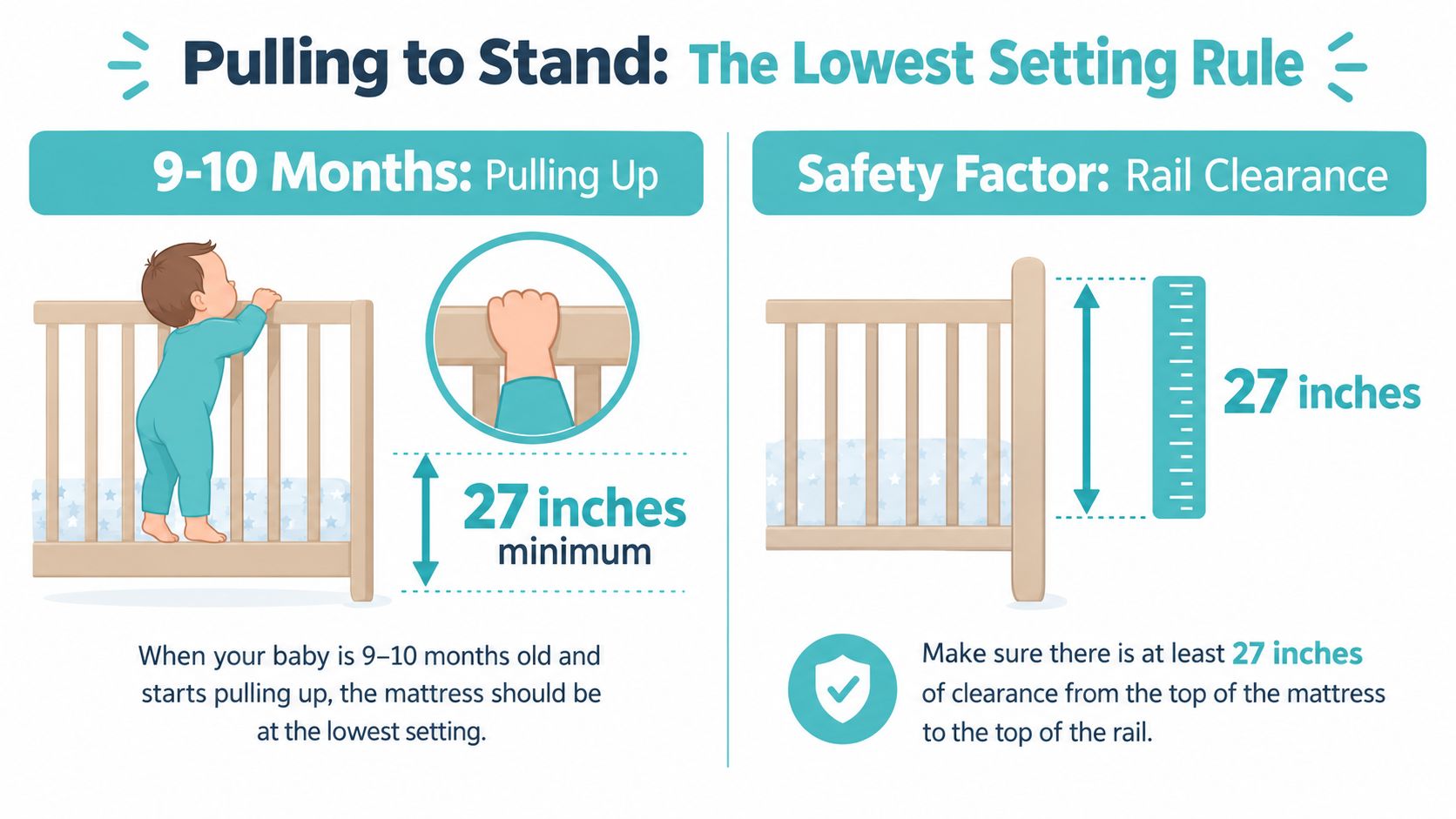
The CPSC's full-size crib mattress specifications include a minimum mattress size of 27 1/4 inches by 51 5/8 inches, but your crib manual controls the approved support positions and rail design. Once your child pulls to stand, use the lowest setting. Yes, your back may complain. The climb-out risk matters more.
How to Measure and Adjust the Mattress Safely
Treat every adjustment as a small installation job. Before moving the support, clear the crib and keep your baby somewhere safe.
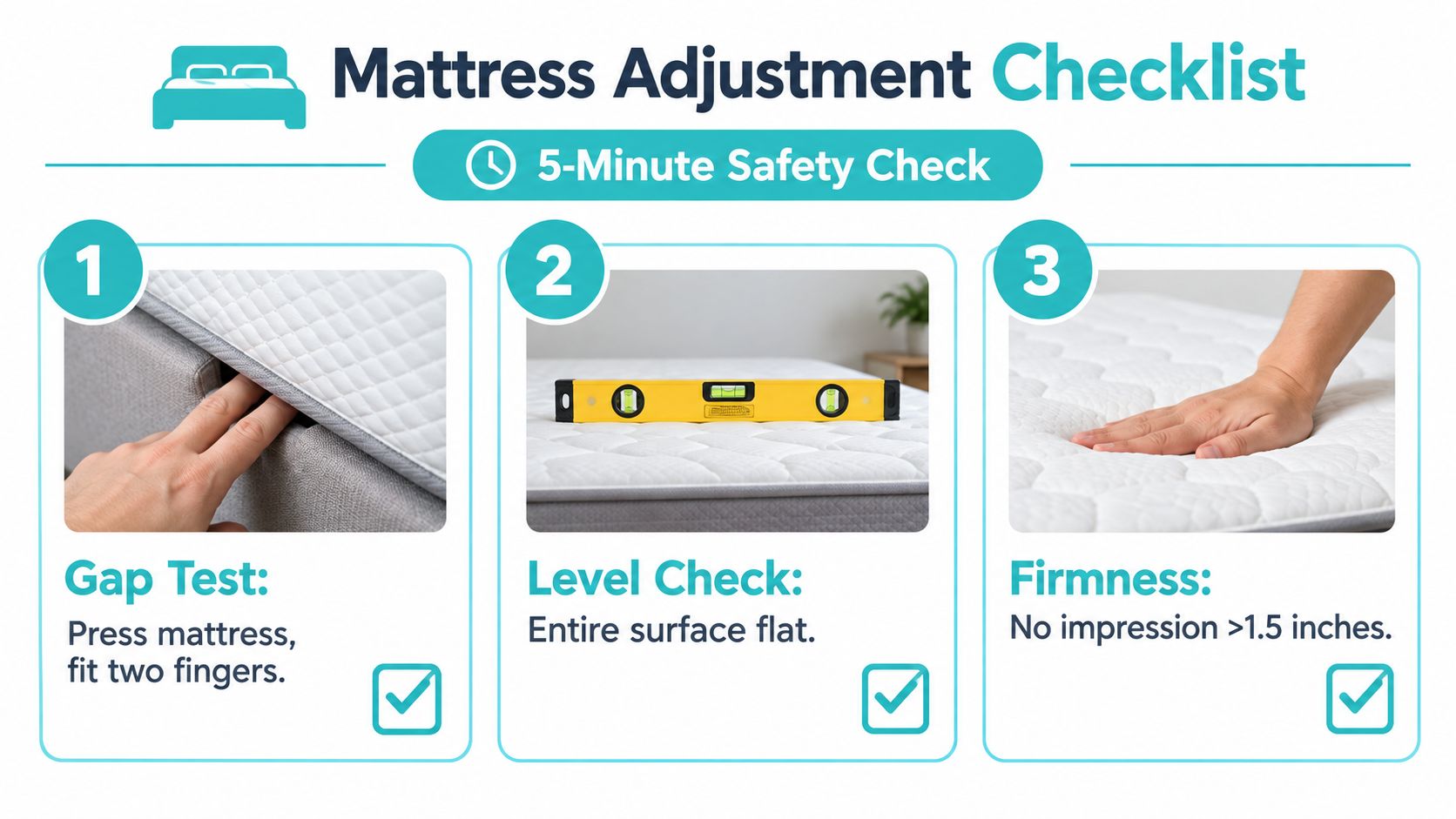
- Test the corner gap. Press the mattress into a corner with the fitted sheet on. Measure the opening against the CPSC limit of 80 mm, or 3.15 inches, using a ruler or an appropriate gauge. A gap that looks small from above can open when the mattress shifts.
- Inspect the fitted sheet. It should hug all four corners and stay smooth. Remove loose bedding, padding, toys, and positioners. A wrinkled or oversized sheet doesn't belong in the crib.
- Check the support hardware. Remove the mattress support as your manual describes. Confirm that screws, pins, and barrel nuts are seated, then reinstall every part in the approved holes. If you're rebuilding or relocating the crib, use the manufacturer's assembly directions, such as this crib assembly guide from Hiccapop.
- Confirm firmness and levelness. Press near the area where your baby's face rests. The surface should stay flat and spring back without a lasting depression. Don't use an incline to address spit-up unless a medical professional and the product instructions specifically support a separate safe solution.
- Measure total thickness. Include any added layer when checking the mattress. The total must stay at or below the 6-inch thickness limit described in the CPSC standard.
Take a quick photo of the active support notch after you finish. That helps grandparents, babysitters, and exhausted partners return the mattress to the same approved position.
Common Crib Height Mistakes and Your Quick Action Plan
Parents make crib-height mistakes for understandable reasons. They're tired, trying to solve a practical problem, and often working from advice that focuses on convenience while skipping the fit check.
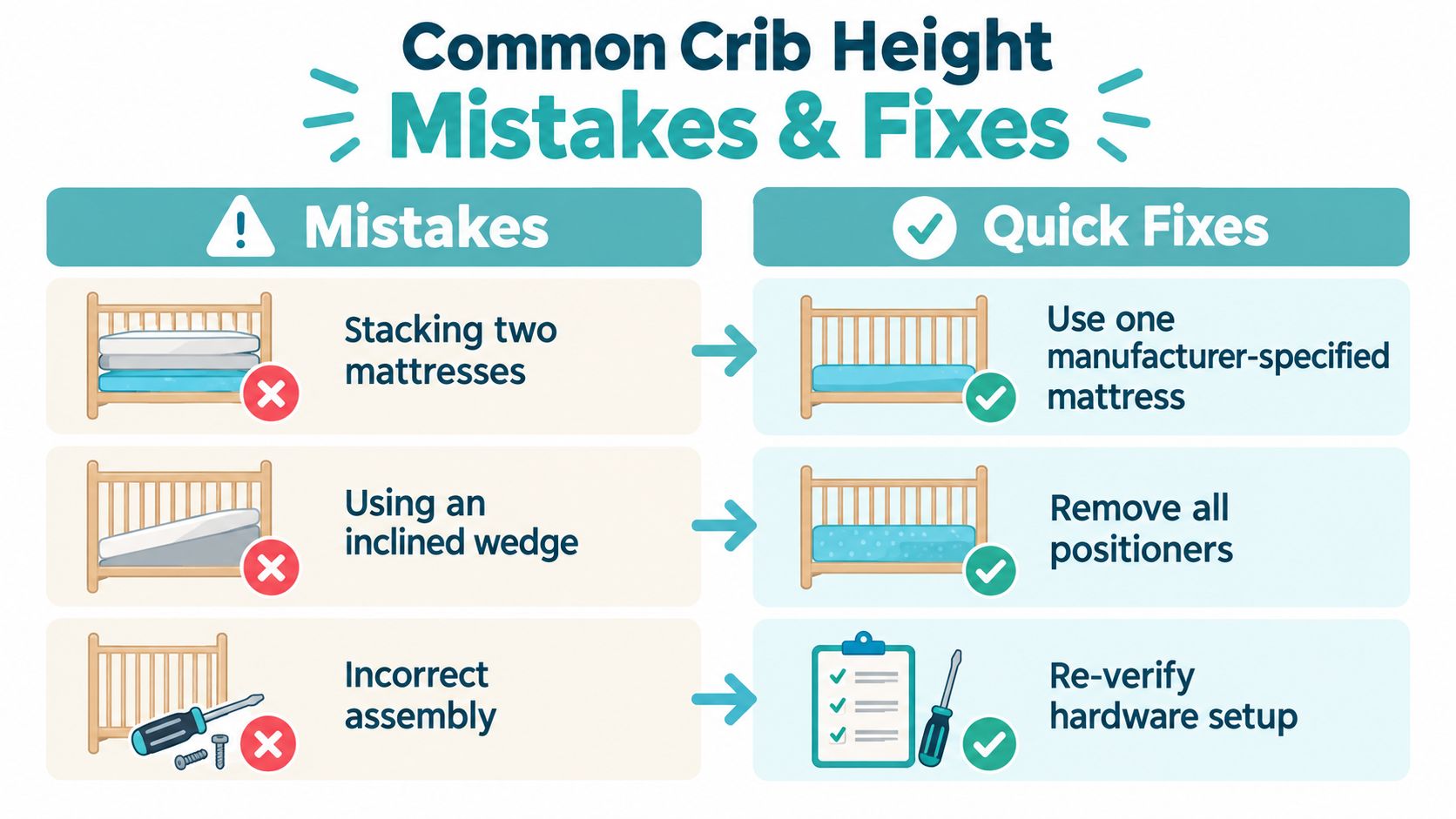
- Stacking mattresses: Use one mattress specified for the crib. Two mattresses can create an unstable sleep surface and alter the intended rail clearance.
- Adding an incline wedge: Remove inclined wedges, positioners, and similar inserts from the sleep space. A newborn needs a firm, flat surface, not a slope.
- Judging the gap by eye: Press the mattress into a corner and measure it. Visual judgment isn't reliable.
- Reusing a poor-fitting hand-me-down: Replace any mattress that doesn't fit snugly or exceeds the crib's specified thickness.
- Skipping a hardware check after moving: Reinspect every connection after transporting or reassembling the crib. Use this crib safety checklist from Hiccapop as a practical reference.
A useful plan for tonight is short. Measure the corner gap with a ruler or 80 mm gauge, confirm the fitted sheet stays tight, press-test the surface for firmness, and inspect the support hardware. Recheck the setup every few weeks and whenever your baby's movement changes, especially rolling, sitting, or pulling up.
This video offers another visual reminder of safe crib basics:
The habit loop is simple: choose the highest safe newborn setting, verify the gap and thickness, then lower the mattress when your baby becomes mobile. Height, fit, and development belong in the same check.
Hiccapop offers crib mattresses and other nursery essentials designed to support a firm, properly fitted sleep setup, along with practical products that make everyday caregiving easier. Visit Hiccapop to compare options for your nursery and build a safer, more manageable routine from the first night home.