


Crib Mattress Fitted Sheet Safety and Fit Guide
You're standing in the nursery with a clean crib, a new mattress, and a fitted sheet that looks perfect in the package. Then you wash it, stretch it over the mattress, and notice a corner lifting slightly. That small wrinkle or gap isn't a decorating problem. With infant bedding, fit is a safety issue.
A crib mattress fitted sheet should stay smooth, tight, and firmly secured after every wash. Fabric softness and nursery style can matter, but they come after mattress dimensions, elastic recovery, pocket depth, and the sheet's ability to remain in place. Use this practical checklist to assess what you already own and what you're considering buying.
Why Your Crib Mattress Fitted Sheet Is Safety Equipment
Many parents begin with color, pattern, or fabric feel. That's understandable, but a “crib-sized” label alone doesn't prove that a sheet fits your particular mattress safely. A loose bottom sheet can shift under an infant and create entrapment or suffocation hazards, which is why the U.S. Consumer Product Safety Commission advises caregivers to use only a fitted bottom sheet made specifically for crib use and pair it with a firm, tight-fitting mattress. Read the CPSC crib safety tips before treating bedding as a style purchase.
A baby moves differently from an adult. Infants can press, kick, and roll against fabric without being able to deliberately remove it or correct a dangerous position. If the sheet pulls away from the mattress, the resulting fold or opening can change the sleep surface exactly where it needs to remain stable.
Practical rule: If the sheet can be pulled loose, it doesn't belong on the mattress, regardless of how attractive or soft it feels.
The National Institutes of Health reported that nearly 55 percent of U.S. infants were placed to sleep with potentially unsafe bedding during 2008–2010, compared with 85.9 percent during 1993–1995 among the surveyed caregivers. The same guidance describes the safer setup as a baby sleeping alone, on the back, on a firm surface covered by a fitted sheet. The NIH summary makes the central point clear: a fitted sheet isn't an optional finishing touch.
Understanding Federal Sizing and Corner Gap Rules
Federal requirements turn a vague instruction such as “make it snug” into measurable design criteria. A full-size crib mattress must measure at least 27 1/4 inches wide by 51 5/8 inches long, and the mattress must fit the crib without creating a dangerous opening. Under the federal crib-mattress test, the mattress is evaluated with a fitted test sheet in place, and the resulting corner gap must not exceed 3.15 inches, or 80.0 millimeters. See the federal crib-mattress regulation for the technical language.
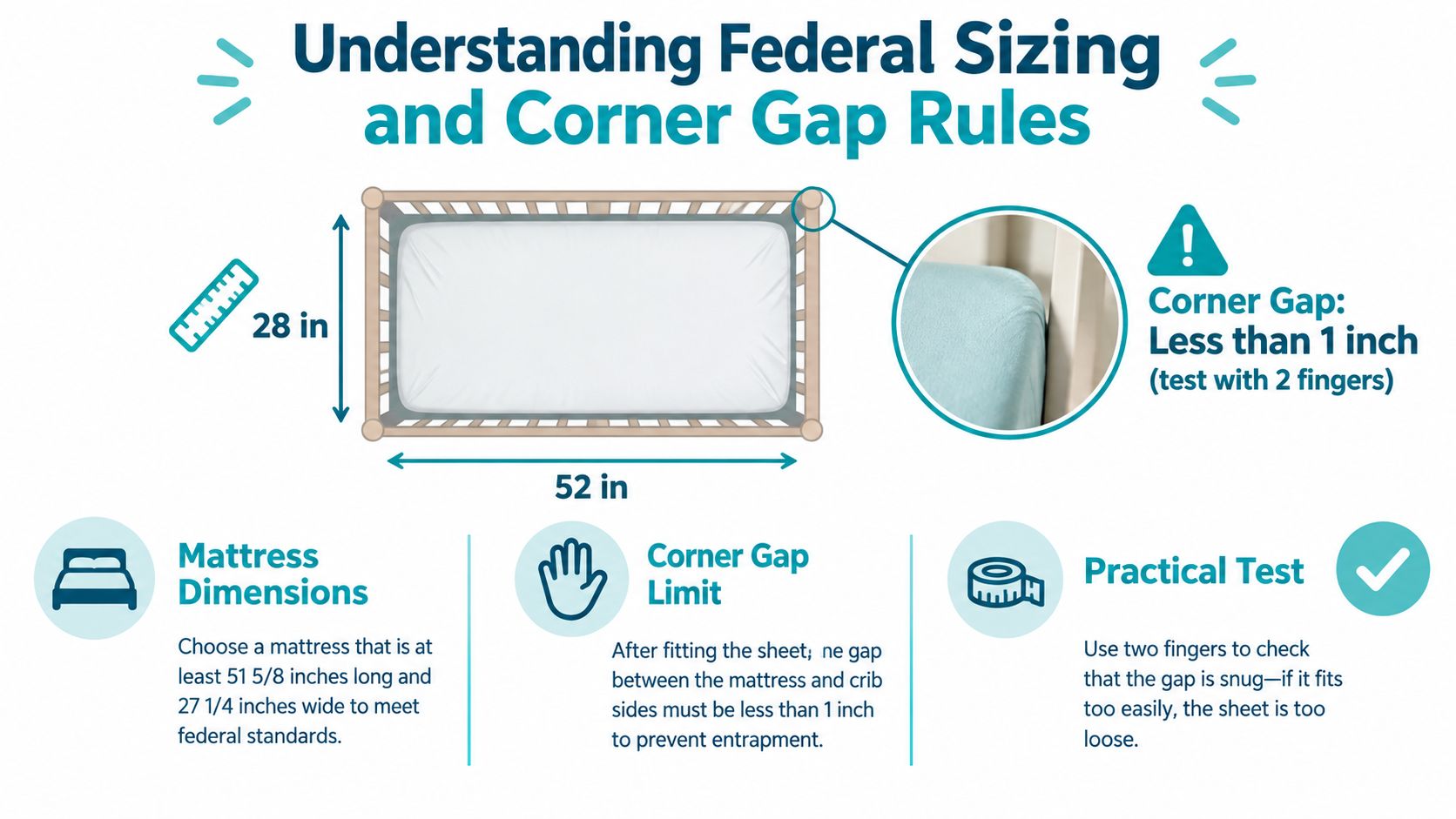
The corner-gap measurement matters because a sheet can look tidy from above while failing to hold the mattress and its edges securely. Elastic recovery determines whether the fitted edge returns to its original tension after stretching. Pocket depth determines whether the sheet can wrap around the mattress without riding upward. Fabric stretch affects both. If any of these features is wrong for the mattress, a corner can loosen during ordinary movement.
The CPSC's updated crib-mattress standard, incorporating ASTM F2933-25 with CPSC modifications, became effective May 3, 2026. The standard retains the 3.15-inch (80.0 mm) corner-gap limit used in the applicable mattress testing. That technical threshold isn't a suggestion about comfort. It's a compliance measurement connected to entrapment prevention.
For practical buying guidance, compare the mattress's actual measurements with the sheet manufacturer's specifications. Don't assume every full-size crib mattress has identical thickness or edge construction. Hiccapop's guidance on crib mattress size and dimensions is a useful reference when you're checking compatibility.
Evaluating Materials for Breathability and Shrinkage
Choose the material only after confirming that the sheet's dimensions and construction match the mattress. A breathable fabric can still be unsafe if it shrinks, loses elasticity, or pulls off at the corners.
Cotton is a practical default because it's widely available, washable, and comfortable across different room conditions. Open weaves can encourage airflow, while tighter weaves may feel smoother. The important question is whether the finished sheet keeps its shape after laundering. A cotton sheet that shrinks enough to strain the elastic may become difficult to install flat.
Bamboo blends often feel smooth and lightweight, but the blend composition and manufacturing finish matter more than the word “bamboo” on the label. Check the care instructions, inspect the elastic, and judge the sheet after washing rather than relying on the out-of-package feel.
Waterproof synthetics can protect the mattress from moisture, but they may alter the hand feel and airflow of the top layer. Avoid any design that makes the sleep surface padded, uneven, or prone to bunching. A waterproof layer should remain thin and securely fitted beneath the sheet.
Compare the behavior, not the marketing
| Material choice | What to assess | Safety priority |
|---|---|---|
| Cotton | Shrinkage, weave, elastic recovery | Must stay smooth after washing |
| Bamboo blend | Blend content and care response | Must retain its original shape |
| Waterproof synthetic | Heat, surface texture, and stiffness | Must not create bulk or shifting |
Wash according to the label before judging final fit. If you want more detail on airflow and construction, review Hiccapop's guide to breathable crib sheets. Breathability is useful, but it never compensates for a loose corner.
The Post-Wash Fit Test Every Parent Must Perform
A sheet that fits before laundering may not fit afterward. Heat, agitation, and repeated drying can change the fabric and weaken the elastic, so perform a physical inspection every time the sheet returns to the crib.
- Inspect the elastic. Stretch it gently along all four corners. It should spring back firmly rather than sagging or staying elongated.
- Fit the sheet completely. Place it over the mattress, tuck the elastic under every corner, and smooth the surface from the center outward. Wrinkles, raised edges, and diagonal tension are warning signs.
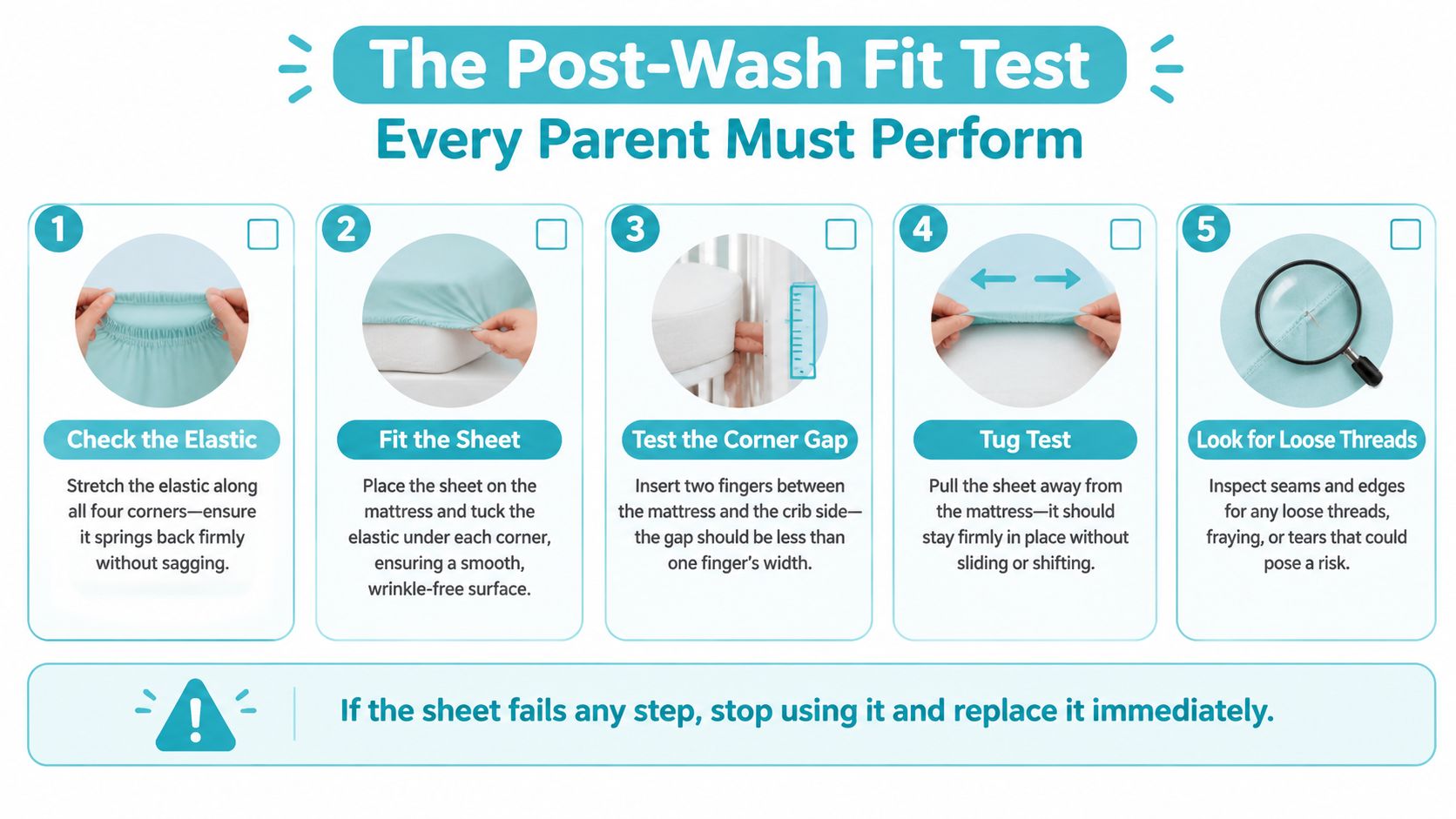
- Check each corner gap. Look at all four corners, not just the one that's easiest to see. The sheet must remain secure against the mattress and crib structure.
- Perform the tug test. Pull the sheet gently away from the mattress at each corner and along the sides. It should stay anchored without sliding or shifting.
- Inspect the fabric. Look for loose threads, fraying, stretched seams, thinning areas, or tears. Small damage can worsen quickly during the next wash.
Stop using the sheet if it fails one step. A replacement costs less than guessing whether a loose edge will stay put.
Laundering Rules That Preserve Elastic Integrity
Laundry is part of the safety system. A sheet's fit can change when fibers shrink and elastic loses tension, so follow the care label and avoid treating every fabric as indestructible.
Use a mild detergent and wash the sheet separately from items with hooks, zippers, or rough fasteners that can catch the fabric. Harsh cleaners and aggressive cycles can wear down fibers and elastic. High heat can also change the sheet's dimensions, especially when the fabric is already under tension.
A safer care routine
-
- Read the label first. Manufacturer instructions take priority over generic washing habits.
- Choose a gentler cycle. Reduce unnecessary agitation when the sheet is lightly soiled.
- Use controlled drying. Lower-heat drying or line drying can help preserve shape, provided the care label permits it.
- Check the corners afterward. Never return a sheet to the crib without checking tension and surface smoothness.
- Retire distorted bedding. If it remains loose, warped, or difficult to fit, replace it rather than trying to stretch it back into service.
Keep a spare sheet available so a damaged or poorly fitting one doesn't get used during a tired middle-of-the-night change.
Final Safety Audit and Replacement Triggers
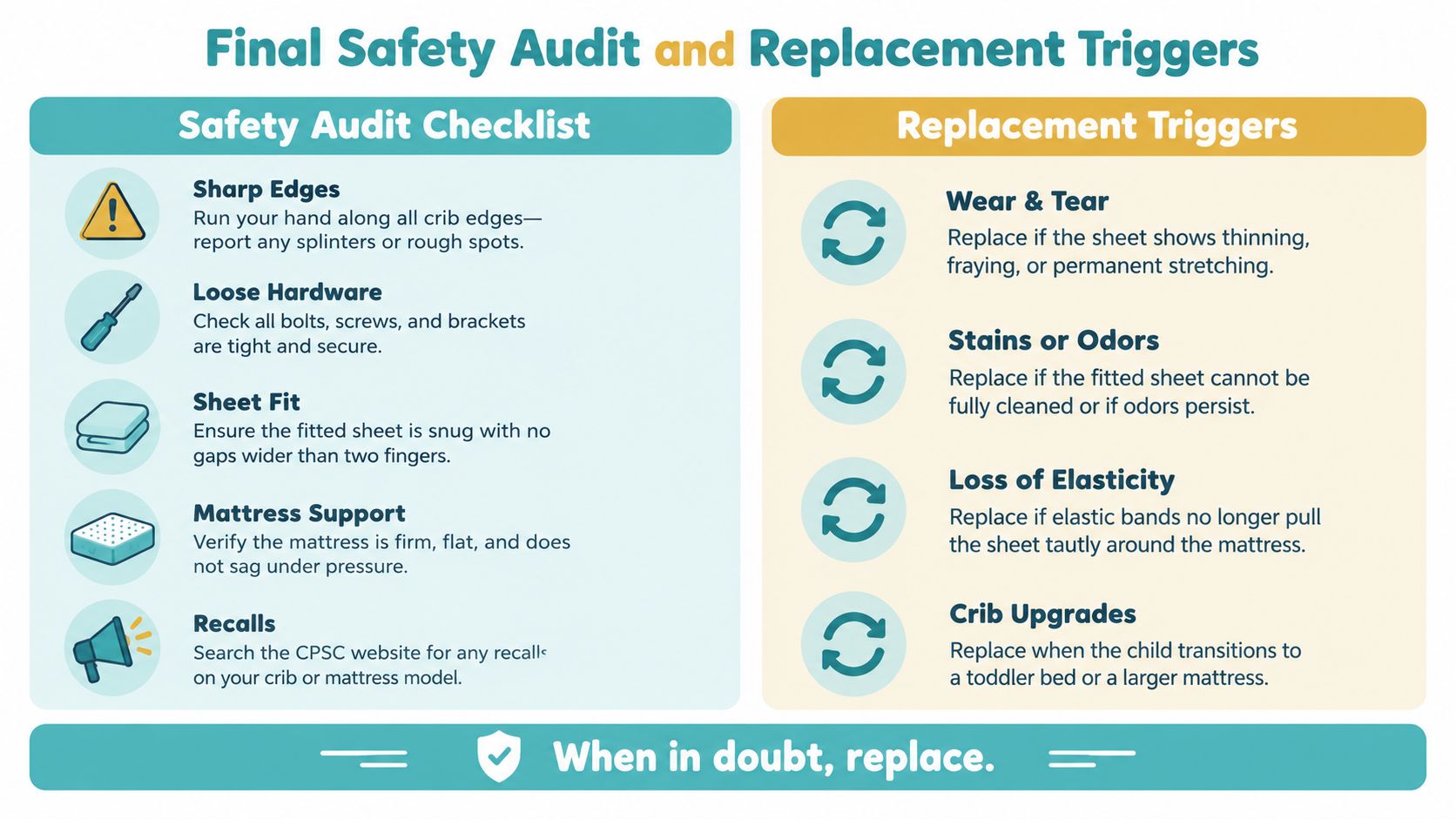
Before the next sleep, inspect the complete setup rather than the sheet alone. The crib frame should be sound, the mattress should remain firm and flat, and the fitted sheet should stay tight across the entire surface. CPSC's analysis of reported crib-mattress fatalities from January 2010 through April 2021 found that 22% involved fit issues, with gaps between the mattress and crib rail or play-yard mesh creating a wedging or entrapment hazard. Review the CPSC crib-mattress safety rule for the underlying safety discussion.
Check the setup
- Crib edges: Feel for splinters, sharp points, or rough areas.
- Hardware: Confirm bolts, screws, and brackets are secure.
- Mattress support: Make sure the mattress is firm, level, and free from sagging.
- Fitted sheet: Confirm all corners remain smooth and anchored.
- Recalls: Search the CPSC website for recalls affecting your crib or mattress model.
Replace the sheet when
- Elastic has weakened: It no longer pulls the sheet taut around the mattress.
- Corners stay loose: The sheet won't remain properly fitted after washing.
- Fabric is damaged: Fraying, thinning, tears, or loose threads are visible.
- The surface has changed: Permanent wrinkles, bunching, or warping remain.
- Cleaning no longer works: Stains or odors persist despite proper laundering.
A safe crib mattress fitted sheet should be boringly dependable. Check the fit after every wash, use the mattress dimensions rather than the label as your guide, and replace bedding at the first sign of structural failure.
Hiccapop® 's nursery guides and product lineup can help you build a clean, well-organized sleep setup. Visit Hiccapop® to explore options.
For more sizing context, see Hiccapop’s crib mattress size and dimensions guide. Always follow CPSC and AAP safe-sleep guidance and your mattress and crib manufacturer instructions.
Related Products
-
![Grey mesh playard (TravelPod) with a sleeping baby inside, shown next to its compact grey travel bag/backpack.]()

- Regular price
- $139.99
- Sale price
- $139.99
- Regular price
-
$199.99 - Unit price
- per
Sold out -
![White Hiccapop playard mattress (PlayPad) standing next to its blue carrying bag, with a 38 by 26 inch guaranteed fit badge. Product is verified by the Baby Safety Alliance and uses CertiPUR-US certified foam in it's construction.]()

- Regular price
- $39.99
- Sale price
- $39.99
- Regular price
-
$54.99 - Unit price
- per
Sold out


Related Products
-
![Grey mesh playard (TravelPod) with a sleeping baby inside, shown next to its compact grey travel bag/backpack.]()
- Regular price
- $139.99
- Sale price
- $139.99
- Regular price
-
$199.99 - Unit price
- per
Sold out -
![White Hiccapop playard mattress (PlayPad) standing next to its blue carrying bag, with a 38 by 26 inch guaranteed fit badge. Product is verified by the Baby Safety Alliance and uses CertiPUR-US certified foam in it's construction.]()
- Regular price
- $39.99
- Sale price
- $39.99
- Regular price
-
$54.99 - Unit price
- per
Sold out