


Portable Crib Weight Limit Explained for Safe Sleep
Most portable cribs are rated around 30 to 35 lb for the main sleep surface, while bassinet inserts often cap near 15 lb. These are common manufacturer ratings, not one universal federal weight limit. A child under 35 in. who can't climb out is within the applicable play-yard safety reference, but height and climbing ability are equally important stop signals.
You're at a hotel, visiting grandparents, or unfolding the travel crib after months in storage. Your child is sleeping peacefully, but one question keeps tapping at the back of your mind: Is the portable crib still safe for this size and stage? The answer isn't one universal number printed across every model. It's a small safety system with different limits for different modes, plus developmental signs that can end use first.
Why Portable Crib Weight Limits Matter More Than You Think
A portable crib can look sturdy enough to hold a squirming toddler, especially when the frame locks firmly and the mattress base feels solid. But the manufacturer's limit isn't a casual estimate. It reflects how the product is intended to handle a child's weight, movement, body size, and attempts to use the sides as a ladder.
Think of the limit as a boundary on a hiking trail. The sign doesn't mean the ground becomes unsafe one step beyond it, but it tells you where the tested route ends. Inside that boundary, the frame, floor, mesh, rails, and locking points are designed for the stated use. Outside it, you're guessing.
A child's movement changes the equation. Rolling, sitting, pulling up, and leaning against a rail place forces on the portable crib that a quiet sleeper doesn't. A child who can climb may create a fall risk even while remaining below the printed weight limit. That's why safe use depends on weight, height, and mobility together, not on the bathroom scale alone.
Practical rule: Treat the lowest applicable limit as the real limit. If the bassinet insert has a lower rating than the main playard, the insert is the part that governs use.
Families often use portable cribs in more than one setting, from a bedroom at home to a temporary sleep space on the road. A clear setup routine, including checking the frame and following the product instructions, belongs in every location. Hiccapop's guidance on travel crib safety offers another useful reminder that portability doesn't remove the need for caref
What a Portable Crib Is and How Safety Standards Shape Limits
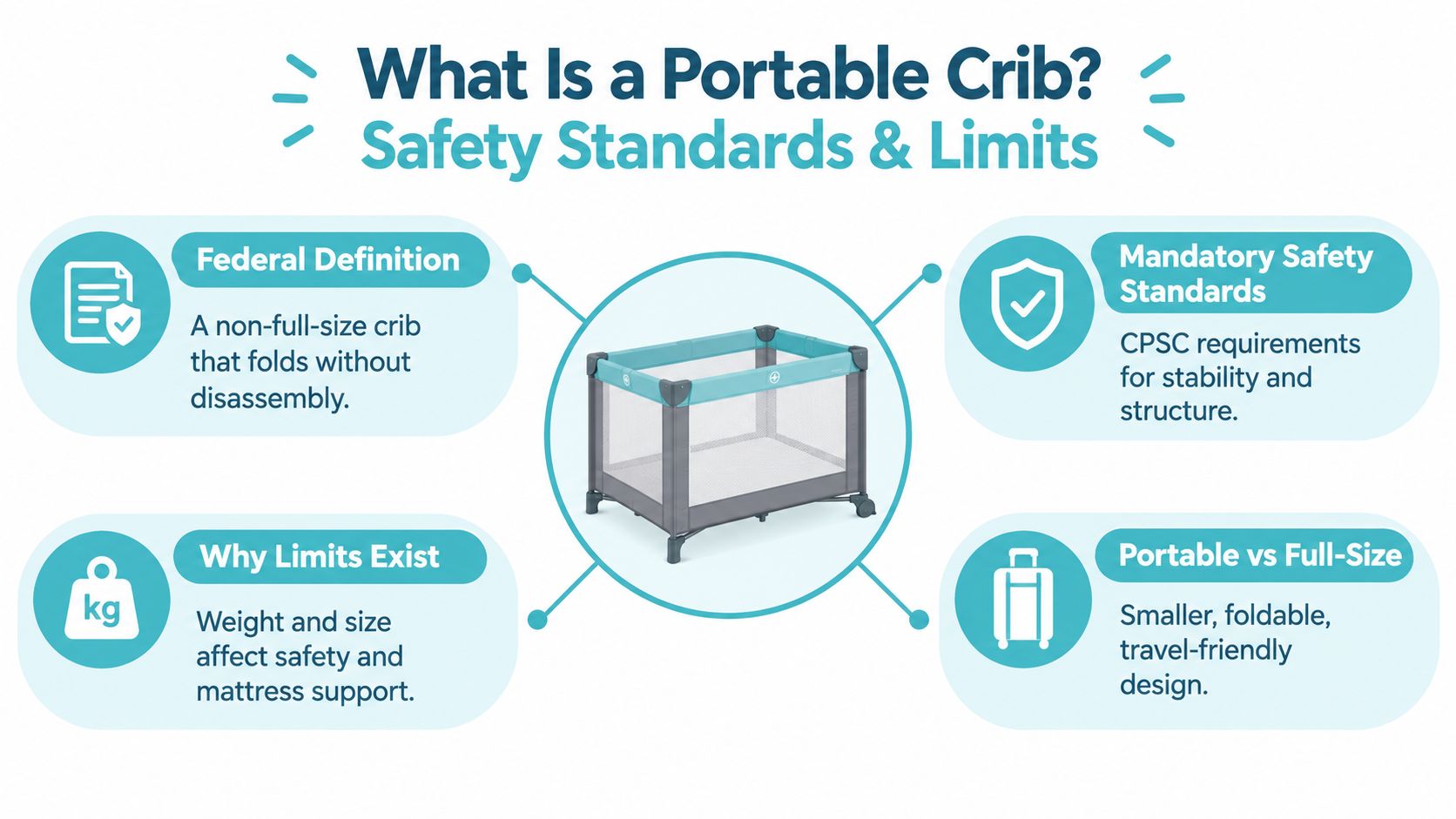
In the United States, non-full-size baby cribs are covered by 16 CFR part 1220, which incorporates ASTM F406 with applicable CPSC modifications. CPSC guidance explains that the mandatory standard covers non-full-size baby cribs and identifies the applicable versions of ASTM F406 by manufacturing date. CPSC guidance for non-full-size baby cribs
A portable crib that meets the federal definition of a non-full-size baby crib is therefore subject to mandatory safety requirements. Manufacturers must account for structural integrity, resistance to unintended collapse, and other safety conditions specified by the applicable standard.
Why the number varies by product
Federal standards establish safety requirements, but they don't turn every portable crib into the same product. A compact travel crib, a playard with a raised bassinet, and a floor-level folding crib may have different construction, sleep surfaces, and accessories. Each manufacturer sets the model-specific rating and provides the applicable limits and use conditions in the product labeling and manual.
The portable crib weight limit therefore works more like a vehicle's seating specification than a universal age recommendation. The product category tells you what safety requirements apply, while the individual model tells you the exact capacity and use conditions.
It's also important to distinguish non-full-size cribs from play yards. 16 CFR part 1220 covers non-full-size baby cribs, while 16 CFR part 1221 covers play yards. CPSC states that play yards are framed enclosures with mesh or fabric sides and that the regulation incorporates ASTM F406. Play yards are intended for children who cannot climb out and are less than 35 in. (890 mm) in height. CPSC guidance for play yards
For parents, the useful translation is simple: federal rules define the product category and safety expectations, but your specific label and manual define how that particular crib or play yard should be used. Hiccapop's overview of a portable baby bed for travel can help families think about portability as part of a complete sleep setup, not as a substitute for product-specific instructions.
Typical Portable Crib Weight Limits by Mode and Model
Search for “how much weight can a portable crib hold?” and you'll often see one number. That's where confusion begins. A single product may have a bassinet insert with one limit and a lower playard sleep surface with another.
Manufacturer ratings commonly fall around 30 to 35 lb for the main playard or sleep surface, while some bassinet inserts are rated around 15 lb. The under-35-in. and unable-to-climb-out criteria are a separate play-yard safety reference; they should not be presented as a universal 30-lb federal weight limit. CPSC identifies the 35-inch and climbing criteria for play yards. CPSC guidance for play yards
Here's how the modes commonly differ:
| Sleep Mode | Typical Weight Limit | Height and Mobility Stop Signal |
|---|---|---|
| Bassinet insert | Around 15 lb | Stop when the child reaches the insert's limit or begins pushing up on hands and knees |
| Main playard or floor-level surface | Around 30 lb, with some models around 35 lb | Stop at the manufacturer's limit, near the applicable height boundary, or when the child can climb out |
| Travel crib with model-specific guidance | Varies by product | Follow the manual, and stop when height or climbing ability ends safe use |
The contrast is important. A baby may outgrow the raised bassinet while still having plenty of room in the main unit. Moving to the lower, manufacturer-approved configuration may be appropriate only if the manual permits that transition and the child can sleep safely on the lower surface.
Bassinet weight limits are also product-specific. Around 15 lb is common market practice, not one universal federal number, so always follow the insert's label and manual.
The right question isn't “Can this crib hold my child?” It's “Which sleep mode is in use, and what condition ends that mode first?”
If portability is your priority, compare the folded size, setup process, and approved sleep configurations along with the weight rating. A lightweight portable crib still needs to match your child's current stage and the sleeping surface you plan to use.
How to Read Your Portable Crib Label and Manual With Confidence
Generic guidance can orient you, but the manufacturer's manual is the final word for your model. Pull out the paperwork, look for the model name or number, and check every configuration listed.
Start with the product itself
Look for a sewn-on label inside the frame, near the mattress base, or on the legs. Some products place warnings on the underside or near the folding joints. A label may identify the maximum child weight, maximum height, approved modes, or a stop condition related to climbing.
Then inspect the manual's specifications and warnings. Don't assume that a number listed beside “bassinet” also applies to the main crib, and don't assume that the main crib's rating applies to an accessory or insert.
Separate the child limit from everything else
A manual may discuss the child's maximum weight, the mattress requirements, and accessory restrictions in different places. Read those statements together. The child's weight rating isn't permission to add another mattress, use an unapproved pad, or alter the frame.
Use this quick check:
- Identify the model. Record the name and model number before searching online.
- Find every configuration. Check the bassinet, raised level, changing station, and floor-level sleep surface separately.
- Read the stop signals. Look for wording about height, pushing up, standing, or climbing.
- Confirm the mattress setup. Use only the mattress or pad specified for that configuration.
- Ask the manufacturer. If the label is missing or unclear, provide the model number and ask for the current manual.
The federal framework provides structural expectations, but the model-specific manual tells you how the manufacturer tested and intended the product to function. That distinction is why a general “portable crib weight limit” search should never replace the instructions that came with your crib.
Signs Your Child Has Outgrown the Portable Crib
The scale is only one piece of the decision. Your child may still be below the stated weight limit and still need to move out because height or mobility has changed the risk.
Watch for these signals:
- The weight limit is reached. Once your child meets or exceeds the manufacturer's maximum, stop using that configuration.
- Height is approaching the boundary. CPSC identifies under 35 in. and unable to climb out as the applicable use criteria for play yards, so a taller child needs especially careful attention to the product's own wording. CPSC guidance for play yards
- Your child pushes up on hands and knees. This matters particularly for bassinet-style products. ASTM's bassinet-and-cradle standard covers products intended to provide sleeping accommodations for an infant up to approximately 5 months, or until the child begins pushing up on hands and knees, whichever comes first, as described by ASTM International's bassinet and cradle standard.
- Your child pulls to stand. Standing changes the relationship between the child's body and the side rails.
- Your child attempts to climb out. A climbing attempt is a clear signal to stop using that sleep space, even if the child is comfortably under the weight rating.
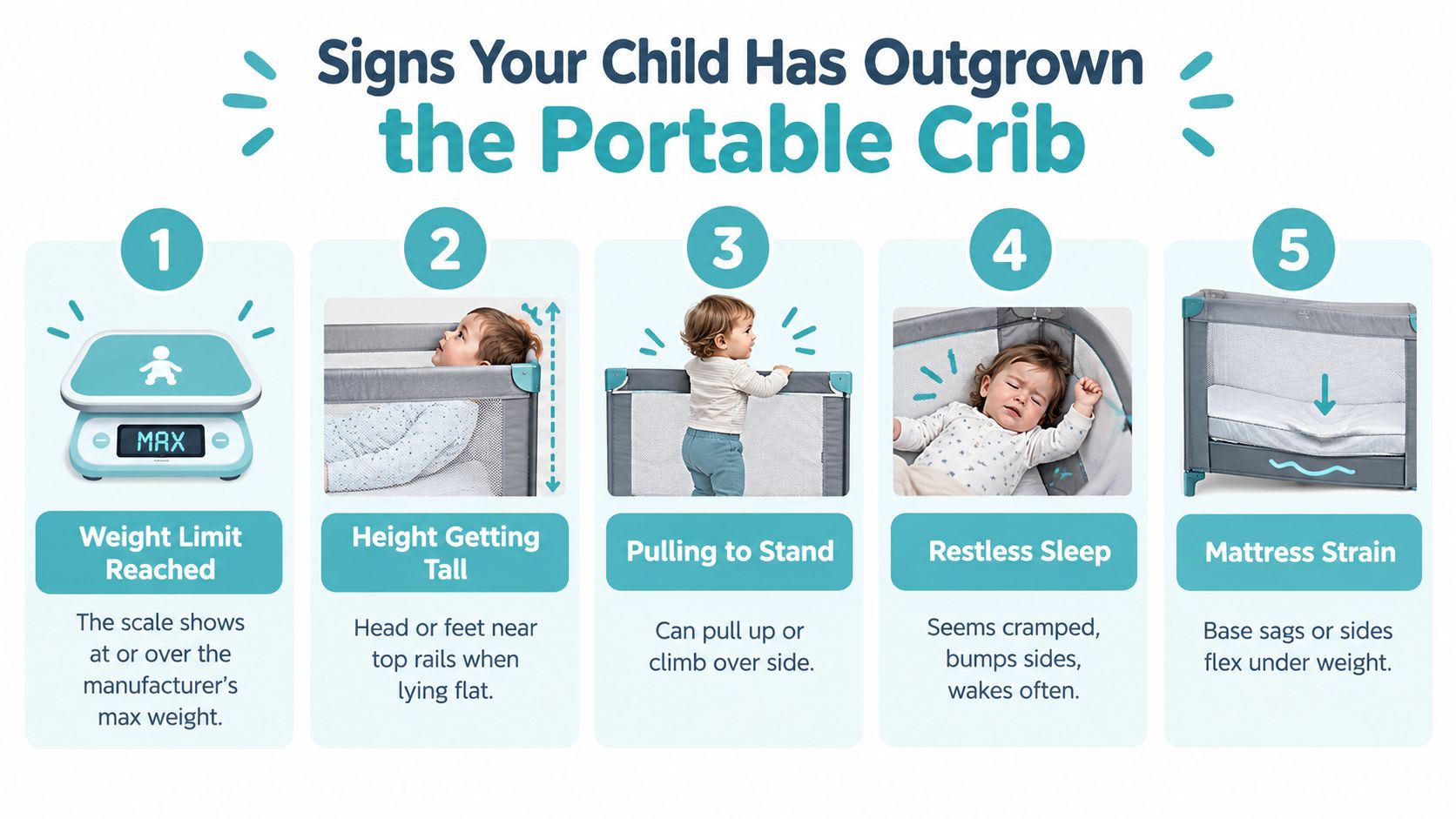
Children don't all reach these milestones in the same order. A child may become mobile before reaching a numerical limit, while another may approach the weight rating without showing climbing behavior. For developmental guidance, compare your child's abilities with information from your pediatrician or other trusted child-development resources, then return to your product manual for the safety decision.
Watch the whole child: Weight, height, and mobility are separate signals. The first one to reach the product's stopping point is the one that matters.
Safe Next Steps and Transition Options After the Limit
Reaching a limit doesn't mean you've done anything wrong. It means your child has grown into the next sleep arrangement.
If your baby has outgrown a bassinet insert but still fits the main unit, check whether the manual allows use of the floor-level configuration. Follow the stated setup exactly, including the approved mattress position and accessories. Don't improvise a middle setting.
If the entire portable crib is no longer suitable, consider a full-size crib at home or a travel crib specifically rated for your child's current stage. Some travel cribs don't list an upper weight limit, but their instructions may end use around age 3 or when a child can climb out. Standard portable cribs may instead list limits such as 35 lb, so compare the product's actual instructions rather than assuming all travel cribs follow the same rule.
For travel, preserve the familiar basics: a firm approved sleep surface, a clear sleep space, and a fully locked frame. Never add an extra mattress to soften or raise the floor, and don't use pillows, loose blankets, or stuffed items to make a larger space feel cozier.
A Hiccapop® inflatable toddler travel bed with safety bumpers is another type of travel sleep option. It is not a portable crib, so families should follow its separate product instructions rather than transferring crib or play-yard rules to it.
Common Mistakes Troubleshooting and Myths About Weight Limits
The biggest myth is that every portable crib has one universal limit. Bassinet inserts, main playards, and travel cribs can follow different thresholds, and height or climbing may end use first. Treat the label and manual as the source for your exact product.
Avoid these shortcuts:
- Using the insert too long: A child can outgrow the raised level before outgrowing the main crib.
- Adding padding: Extra mattresses or pads can change the intended fit and support.
- Ignoring damage: Stop and inspect loose joints, torn mesh, bent rails, broken locks, or a sagging base.
- Guessing with secondhand gear: If the manual and model label are missing, contact the manufacturer before use.
- Assuming age is enough: Developmental ability can matter more than a birthday.
A portable crib should open fully, lock securely, and remain stable on a suitable surface. If anything feels loose, warped, incomplete, or difficult to lock, set it aside until the manufacturer confirms the correct replacement or repair.
Check your portable crib label and manual today, then compare the stated limit with your child's current weight, height, and mobility. For product-specific labels, manuals, and stage guidance, start with your crib's manufacturer instructions.