


Baby Crib Bedding Ideas That Actually Keep Your Nursery Safe
You finish your registry, open a few nursery tabs, and suddenly every crib on the internet looks like a tiny boutique hotel bed. Quilted bumpers. Coordinated pillows. A plush comforter folded just so. A matching six-piece set that makes the room look “done” in one click.
It's a trap.
The prettiest crib photos often ignore what safe sleep guidance says belongs inside a crib. If you're searching for baby crib bedding ideas, the right question isn't “What looks complete?” It's “What still works once I strip out the risky stuff?” That edit matters. A lot.
I'm opinionated on this because I've done the late-night nursery setup shuffle myself, and because some “crib bedding” products shouldn't be near a sleeping infant at all. Bumpers, sleep positioners, stuffed animals, loose blankets, decorative pillows. Cute? Sometimes. Sleep-safe? No.
If allergies are part of your nursery planning too, it's worth pairing safer sleep basics with cleaner room air and dust control. These Purified Air Duct Cleaning expert allergy tips are a practical read for parents trying to make the whole sleep environment calmer, not just the crib.
This is the version of baby crib bedding ideas I wish more roundups gave parents. Less staged fluff, more real-life filtering. Every idea below has to survive two anchors: the CDC bare-crib baseline and the mattress-fit check, including the newer corner gap under 3.15 inches rule when a fitted sheet is on the mattress.
The Crib Bedding Rabbit Hole Most Parents Fall Into
The usual shopping path goes sideways fast. You start with “I just need sheets,” then a themed bedding bundle winks at you, and before long you're looking at bumper pads and tiny decorative cushions that have no business in a crib.
What product pages get wrong
The American Academy of Pediatrics says infants should sleep on a firm, flat surface in a safety-approved crib with only a fitted sheet and no other bedding or soft objects in the sleep area. It specifically names pillows, comforters, quilts, sheepskins, blankets, and unfitted sheets as hazards because they raise the risk of SIDS, suffocation, entrapment, and strangulation, as summarized by Missouri safe sleep guidance quoting AAP recommendations.
That means a lot of products sold as crib bedding are really nursery decor. Treat them that way.
Soft things belong in the room, not in the crib.
What stays and what goes
A simple filter helps:
- Keep: a fitted crib sheet, a firm crib mattress, and room decor that never enters the sleep space.
- Skip: crib bumpers, sleep positioners, stuffed animals, loose blankets, quilts, comforters, and decorative pillows.
- Repurpose: themed quilts can live on a chair, on the wall, or later as supervised floor-time padding outside sleep.
A nursery can still look polished. It just can't rely on stuffing the crib full of accessories to get there.
The Non-Negotiable Safety Baseline Before You Browse a Single Set
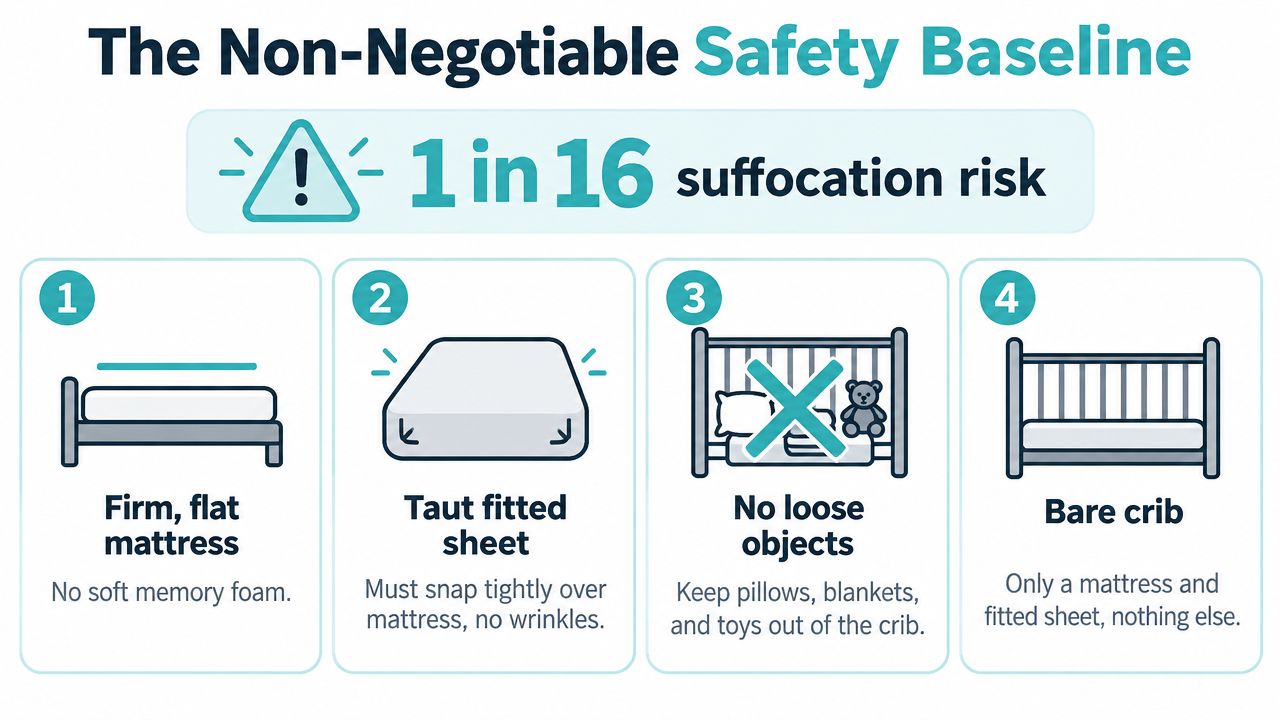
The safest crib setup is boring in the best way. The CDC recommends a firm, flat crib mattress covered only by a fitted sheet, with blankets, pillows, bumper pads, and soft toys kept out of the sleep area. That guidance isn't random. Soft bedding is associated with a 16-fold higher risk of explained suffocation compared with no soft bedding use, according to the CDC's infant safe sleep guidance.
The four rules I wouldn't bend
First, use a firm, flat mattress. If the surface squishes around your baby's face, that's the problem. Soft materials can bring the surface closer to the nose and mouth and change airflow in ways that raise risk.
Second, put on one taut fitted sheet. Not two layers. Not a loose muslin drape pretending to fit. A sheet should hug the mattress tightly and stay put.
Third, skip bumpers, including padded styles and anything that acts like padding around the interior. The CPSC says the safest crib setup is a properly assembled crib with an appropriately sized mattress and a tightly fitted sheet, and it explicitly warns caregivers never to place soft bedding or padded objects such as bumpers, pillows, sleep positioners, stuffed animals, or cushions in the crib, as stated in this CPSC crib safety statement.
Fourth, no loose blankets, quilts, or comforters in the crib for infant sleep. If baby needs warmth, use a wearable sleep sack instead of loose bedding.
Practical rule: If you'd need to move it out of the crib before bedtime, don't style with it in the crib in the first place.
The part most roundups skip
Photos can fool you because “styled” doesn't mean “sleep-ready.” Learn to scan a crib quickly. If you see extra fabric, padding, stuffed animals, or anything angled, it fails the test.
A good deep dive on crib-specific setup details is Hiccapop's guide to crib mattress safety standards. Read it with your mattress and sheets next to you, not while casually scrolling. This stuff is easiest to catch when you physically check the setup.
Four Nursery Design Directions Worth Stealing From
You don't need to abandon style. You just need to move style off the mattress and onto the rest of the room.
Soft-neutral
Cream, oat, warm white, pale wood. This one's popular because it feels calm without trying too hard. The safe version uses a single fitted cotton sheet, maybe in ivory or a subtle stripe, while the texture lives in curtains, a rug, and a chair throw well away from the crib.
The matching quilt from the bedding set? Fold it on the glider or save it for supervised cuddle time elsewhere.
Themed and character
Parents get ambushed by cuteness. The woodland, safari, moon-and-stars, or storybook set usually arrives with extra pieces you don't need inside a crib.
Keep the theme on the walls, in framed prints, and in the sheet pattern. If you want more textile personality, you can even browse juvenile minky collections for inspiration on color and motif, then use that inspiration in curtains, a nursing pillow cover, or a decorative bin instead of the sleep space itself.
Organic-botanical
Leaf prints, sage, clay, natural fibers. This look holds up beautifully under the safe-sleep rules because it already leans on room texture more than stuffed crib styling.
A botanical-print fitted sheet works. A faux-vine draped over the crib rail does not. Same vibe, much safer execution.
Monochrome-modern
Black-and-white, one bold accent color, clean lines. This is the easiest style to keep safety-compliant because restraint is the whole point.
Use contrast through paint, artwork, or a high-contrast fitted sheet. Don't use novelty crib inserts or padded “head support” pieces to create shape inside the crib.
| Four Nursery Design Directions vs. the Safety Baseline | Safe Elements to Keep | Items to Remove or Repurpose | Safety Verdict |
|---|---|---|---|
| Soft-neutral | Plain fitted sheet, natural wood, layered room textiles outside crib | Quilted crib set pieces, decorative pillows | Excellent if the crib stays spare |
| Themed or character | Printed fitted sheet, wall decals, framed art | Stuffed toys in crib, bumper set, matching comforter | Works well if the theme stays out of the sleep space |
| Organic-botanical | Leaf-print sheet, earthy palette, woven decor elsewhere | Rail drapes, padded accessories, loose muslin layers | Very crib-friendly when kept minimal |
| Monochrome-modern | Bold sheet, crisp crib finish, graphic wall art | Padded inserts and decorative shaping pieces | Probably the easiest style to keep safe |
How to Verify Your Mattress and Sheet Actually Fit a Safe Crib
This is the engineering part, and yes, it matters.
Use measurements, not marketing words
Health Canada summarizes standard crib sizing guidance this way: the crib interior should be 28 inches by 52 3/8 inches, and the mattress should be at least 27 1/4 inches by 51 5/8 inches and no more than 6 inches thick. It also stresses a flat, firm mattress with a fitted sheet and no loose bedding, as outlined in Health Canada's safe sleep environment guidance.
So don't trust “standard fit” on a package unless the actual fit checks out in your actual crib.
My five-step audit
- Press the mattress surface. It should feel firm and flat, not plush or hammock-like.
- Check the crib and mattress pairing. Hand-me-down mattresses and older crib frames often mismatch.
- Put the sheet on and inspect the corners. The fitted sheet must sit tight without bunching.
- Look at the corner gap. A cited safety standard says that when a crib mattress is fitted with a sheet, the corner gap must not exceed 3.15 inches (80.0 mm), according to Intertek's summary of the crib mattress standard update.
- Recheck after washing. Some sheets loosen, some mattresses shift, and older gear gets sloppy fast.
If you want a practical product-by-product fit walkthrough, Hiccapop's post on the crib mattress fitted sheet relationship is useful for comparing what a snug setup should look like.
| Mattress and Sheet Fit Verification at a Glance | Pass Standard | Fail Threshold | Fix |
|---|---|---|---|
| Mattress size | Fits snugly in crib with no significant gaps | Visible space around edges | Use a properly sized crib mattress |
| Mattress thickness | No more than 6 inches | Over 6 inches | Replace with crib-appropriate mattress |
| Sheet tension | Tight and smooth over all corners | Bunching, slack, easy lift-off | Switch to a better-fitting fitted sheet |
| Corner gap with sheet on | Under 3.15 inches | More than 3.15 inches | Reassess mattress-sheet-crib combination |
Picking Fabrics That Look Good and Survive the Wash
Fabric choice matters less for “luxury feel” and more for fit, cleanup, and whether the sheet keeps behaving after repeated laundry.
What I'd choose first
Cotton is the easiest default. It usually gives you a crisp, stable fit and suits almost every nursery style.
Jersey knit can be excellent too because the stretch helps corners stay snug. If you're using a standard crib mattress, a fitted jersey sheet often hugs better than a stiffer fabric.
A single mention for product shopping: the Hiccapop dual-sided foam crib mattress is one example of a crib-specific mattress format parents may pair with fitted sheets, provided the final fit in the crib checks out in person.
Fabrics I'd watch more carefully
Muslin looks airy and soft, but it can loosen up and create slack if the fit isn't spot on. For crib sleep, I'd rather have taut than drapey every time.
Bamboo rayon feels smooth and can look lovely in botanical or softer nursery palettes, but I'd still judge it by corner hold after washing, not by the packaging language.
If laundry is your sticking point, any system that helps you keep a clean sheet rotation going is worth considering. Parents juggling frequent changes might appreciate services that pickup laundry in Singapore, especially if sheet turnover is part of a busy newborn routine.
A pretty sheet that slips or bags out isn't a good crib sheet.
For more on material feel and airflow tradeoffs, Hiccapop's guide to breathable sheets for crib is a useful companion read.
| Crib Sheet Fabrics Compared on Safety and Style Metrics | Breathability | Wash Durability | Fit Retention | Best For |
|---|---|---|---|---|
| Organic cotton | Good | Generally dependable | Usually stable | Minimal, monochrome, everyday use |
| Bamboo rayon | Often comfortable | Varies by weave | Check after washing | Soft botanical or neutral rooms |
| Muslin | Airy feel | Can soften and loosen | Watch for slack | Decor style inspiration more than sleep-space priority |
| Jersey knit | Comfortable stretch | Usually good if quality is solid | Often strong corner hold | Parents who want a snug fit |
Two Realistic Crib Setups Compared
One nursery looked fantastic in photos. The other looked almost too plain.
Nursery A
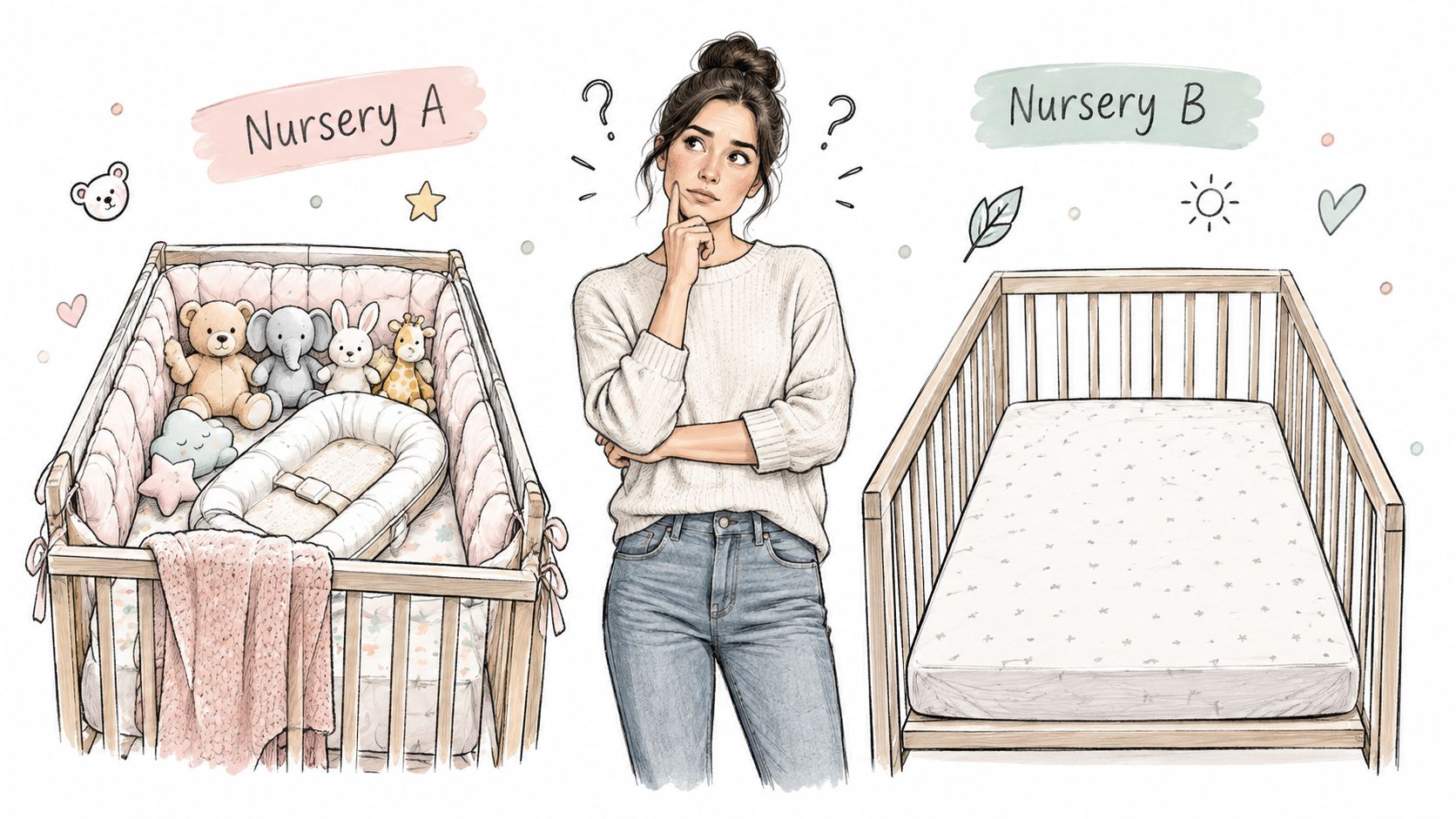
Parents bought the full themed bundle. Quilted bumper. Positioner. Tiny plush animals lined up at the head of the crib. It looked polished for pictures, but every sleep required stripping the crib back down, and that kind of setup invites “just this once” shortcuts.
The styling also made it harder to notice when the setup shifted. Extra accessories clutter your view of the parts that matter.
Nursery B
Parents chose one white fitted sheet and built the room around it. Paint color did the heavy lifting. A mobile added movement. Framed prints and a book ledge gave the room personality.
The best-looking safe nurseries don't ask the crib to do all the decorating.
This setup aged better because there was less to manage, less to wash, and less to second-guess at bedtime. That's the whole point. A design idea only lasts if it still works when everyone is tired.
A Parent-Friendly Shopping and Care Checklist
The safest shopping list is short. Good. Nursery budgets have enough enemies already.
Shopping
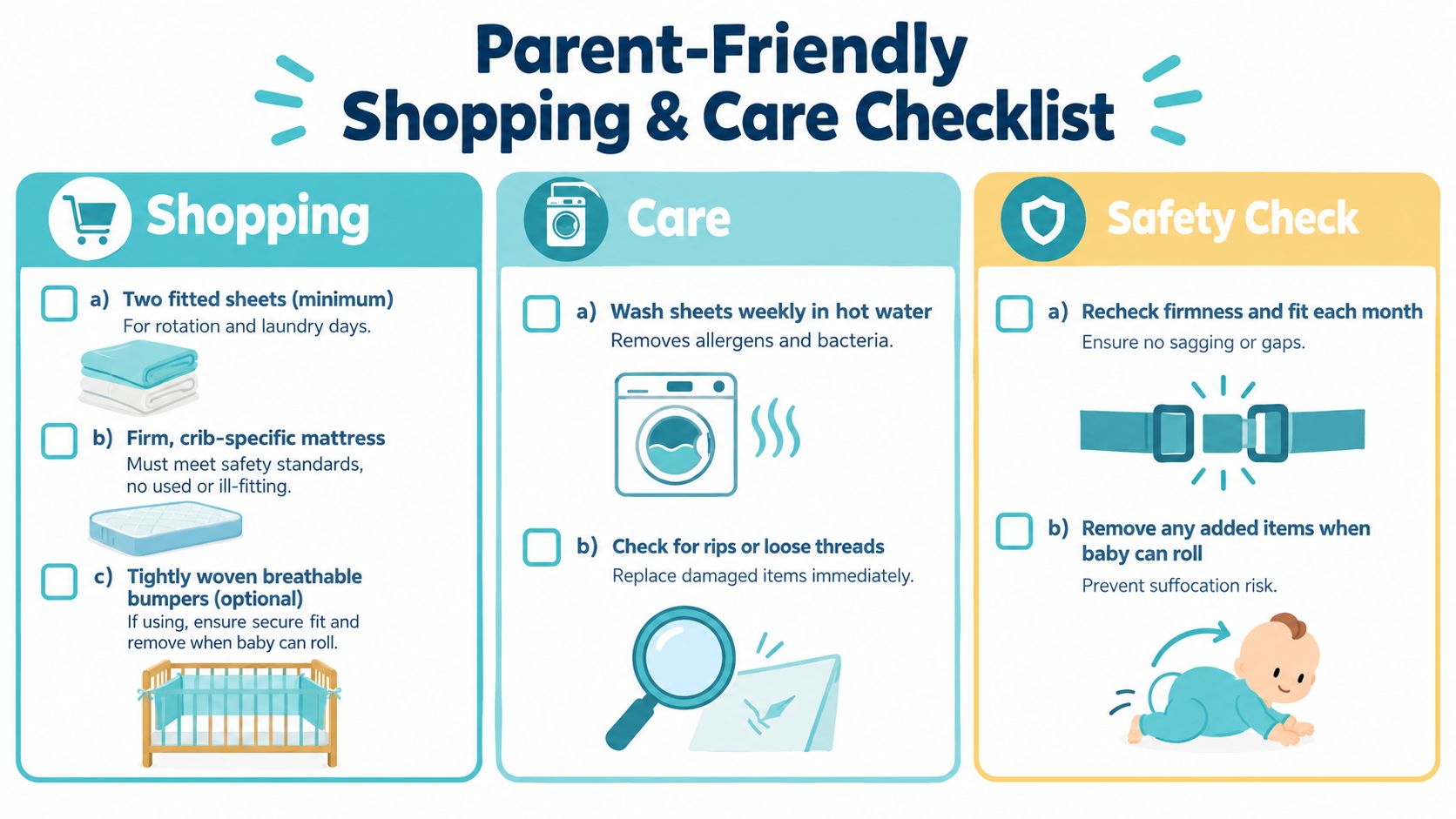
- Buy at least two fitted sheets. One on the mattress, one clean and ready.
- Choose a firm crib-specific mattress. Check the fit yourself once the sheet is on.
- Skip entire product categories. Bumpers, pillows, comforters, positioners, and stuffed animals don't belong in the crib.
- Ignore “complete crib set” language. Complete for photos isn't complete for safe sleep.
Nursery staging
The CPSC reported that in 2019 to 2021, 523 deaths were reported among children younger than age five associated with nursery products, an annual average of 174 deaths, and 126 of those deaths involved unsafe sleep environments with soft bedding added to cribs, playpens, or bassinets. In the same report, cribs, mattresses, bassinets, playpens, inclined infant sleep products, and infant carriers were linked to 76% of all fatalities, according to the CPSC report on unsafe sleep environments and nursery products.
That's why I'd set the room up like this:
- Keep the crib bare. Mattress plus fitted sheet.
- Use a sleep sack for warmth. Not a loose blanket.
- Place white noise outside the crib. Helpful for the room, not an accessory for the sleep surface.
- Keep anything draped or dangling off the rails. Out.
Care
- Wash sheets regularly. Clean bedding matters, especially in spit-up season.
- Use fragrance-free detergent if your baby's skin is sensitive.
- Dry with care. Heat can wear elastic out faster over time.
- Retire damaged sheets early. Loose elastic, thinning fabric, or pilling are good reasons to stop using a sheet in the crib.
Three hard rules stay in place: no aftermarket padding, no positioners, and nothing draped over the rail.
Bringing It All Together Without Sacrificing Style
The tension here is real. Pinterest loves a plush, layered crib. Safe sleep guidance does not. Between those two, I'm choosing safety every time.
The good news is that style survives just fine when you stop asking the crib to act like a display shelf. Put the personality on the walls. Use a mural, framed art, a statement mobile, a textured rug, or a neat little shelf of board books. Let the crib do one job well.
The best baby crib bedding ideas are the ones that still make sense at 2 a.m., with one eye open, when nobody wants to fuss with extra pieces. A firm, flat mattress and a single fitted sheet are the center of the whole setup. Everything else has to orbit around that.
If you've landed on a nursery theme you love, I'd love to know how you pulled it off without cluttering the crib. Parents are often at their most creative when they work within smart limits.
If you're building a nursery that needs to look good and function in real life, Hiccapop offers practical baby gear and crib-related resources that line up with a safety-first setup. Their crib mattress and sheet guidance can help you think less like a decorator and more like the very capable parent-engineer your nursery needs.