


Booster Seat Safety Recommendations: 2026 Parent Guide
A child can outgrow a forward-facing car seat and still be too small for the vehicle's seat belt. You may notice it in a borrowed car, a rental SUV, or during a long drive when your child starts slouching to keep the shoulder belt away from the neck. The right next step isn't based on age alone. It's based on fit, body position, and whether your child can stay correctly seated for the entire trip.
Why Booster Seats Still Matter After the Harness
A parent wrestling with a car-seat buckle in a bright parking lot may wonder whether it's finally time to switch to a regular seat belt. The answer depends on what happens after the buckle clicks. If the lap belt rests across a child's stomach or the shoulder belt touches the neck, the belt isn't positioned to provide its intended protection.
A belt-positioning booster raises the child so the vehicle belt can work with their body rather than against it. The lap belt should sit low across the upper thighs, while the shoulder belt should cross the center of the shoulder and chest. These details matter because a vehicle seat belt is designed for an adult-sized body.
Practical rule: Outgrowing the harness doesn't automatically mean outgrowing the booster.
Guidance from the National Highway Traffic Safety Administration follows a milestone-based approach. After a child outgrows a forward-facing car seat, they should ride in a booster in the back seat until the adult seat belt fits properly without it. In U.S. guidance, that often means reaching about 4 feet 9 inches, commonly between ages 8 and 12, with some children not ready until age 12.
The American Academy of Pediatrics and NHTSA focus on belt fit because children grow at different rates, and vehicles have different seat shapes and belt geometries. An eight-year-old may still need a booster, while an older child may fit one vehicle better than another. For a plain-language explanation of the equipment and transition, see this guide to what a booster seat is.
Understanding the Five-Step Belt Fit Test
Age and height are useful reference points, but they don't make the final decision. The five-step belt fit test shows whether your child is ready in a specific seating position.
- Your child sits all the way back against the vehicle seat.
- Their knees bend comfortably over the edge of the seat.
- The lap belt lies snugly across the upper thighs, not the abdomen.
- The shoulder belt crosses the middle of the shoulder and chest, not the neck or face.
- Your child can stay in that position throughout the trip.
The 4 feet 9 inches benchmark is a practical guide, not a graduation certificate. A 2011 observational study summarized by the CDC estimated that 46% of car seats and booster seats were used incorrectly in ways that could reduce their effectiveness. That figure should reassure rather than shame parents. It shows why checking positioning matters more than relying on a birthday.
The belt must also fit in the vehicle your child is riding in today. If any part of the test fails, use the booster and repeat the check later. A child who can sit correctly for a short trip but slouches during a longer drive isn't ready to ride without it.
Choosing the Right Seat for Every Stage
Car-seat stages work best as a progression, not a race. Infants and young toddlers should remain rear-facing until they reach the rear-facing height or weight limit of their specific seat. That position supports a young child's head, neck, and spine during a crash.
After the rear-facing limits are reached, move to a forward-facing seat with a five-point harness. Keep using the forward-facing harness until the child reaches the seat's stated height or weight limit. At that point, transition to a belt-positioning booster.
The American Academy of Pediatrics says children who exceed the forward-facing seat's height or weight limit should use a booster until the vehicle belt fits properly, typically at about 4 feet 9 inches and between 8 and 12 years old.
| Stage | Move on when |
|---|---|
| Rear-facing seat | The child reaches the seat's rear-facing height or weight limit |
| Forward-facing harness | The child reaches the harness seat's stated limits |
| Booster seat | The vehicle belt passes the five-step fit test |
Manufacturer instructions still matter. A child may be ready for a booster after outgrowing a harness, but that doesn't mean they're ready for an adult belt alone. The safest transition is the one that keeps the child in the current stage until its limits are reached.
The Critical Importance of Back Seat Riding
During a sudden stop, a child in the front seat is closer to the dashboard, steering wheel, and deploying airbag. The rear seat creates more space from those forces, which is why the AAP recommends that children younger than 13 ride in the back seat, including children who use boosters.
A booster improves belt placement, but it does not make the front seat appropriate. Choose a rear seating position where the booster and lap-and-shoulder belt fit the child, match the vehicle, and can be used exactly as instructed. The fit test remains the deciding check, rather than age or height alone.
Booster seats also provide meaningful protection compared with seat belts alone. NHTSA cites research showing that children ages 4 to 8 in booster seats are about 45% less likely to sustain injuries in crashes than children using seat belts alone.
The NTSB, summarizing NHTSA's evaluation of child restraint effectiveness (DOT HS 813 047), reports that booster seats were associated with a 65% to 68% reduction in moderate-to-critical injuries among children ages 5 to 8, with an 86% reduction reported for children ages 7 to 8 in the study's analysis of non-rollover crashes.
| Age group | Reported finding |
|---|---|
| Ages 4 to 8 | About 45% lower injury risk compared with seat belts alone |
| Ages 5 to 8 | 65% to 68% reduction in moderate-to-critical injuries, per NTSB's summary of NHTSA research |
| Ages 7 to 8 | 86% reduction in moderate-to-critical injuries in non-rollover crashes, per NTSB's summary of NHTSA research |
Vehicle design affects the protection available. Before a family road trip, parents can review their vehicle's crash-test results through NHTSA's ratings or IIHS's ratings. Then confirm that the booster, belt, and rear seating position work together correctly.
Mastering Booster Safety While Traveling
A child may pass the belt fit test in the family sedan and fail it in a rental car. The shoulder belt might cross the neck, or the lap belt may ride over the stomach instead of resting low on the thighs. Those differences make travel, carpools, taxis, and rideshares a practical test of booster readiness.
The Insurance Institute for Highway Safety's child-safety guidance describes boosters as appropriate for children who have outgrown child restraints but still don't fit adult belts correctly. It also notes that some children don't fit a seat belt properly until age 12, so a familiar age cutoff can't replace an actual check.
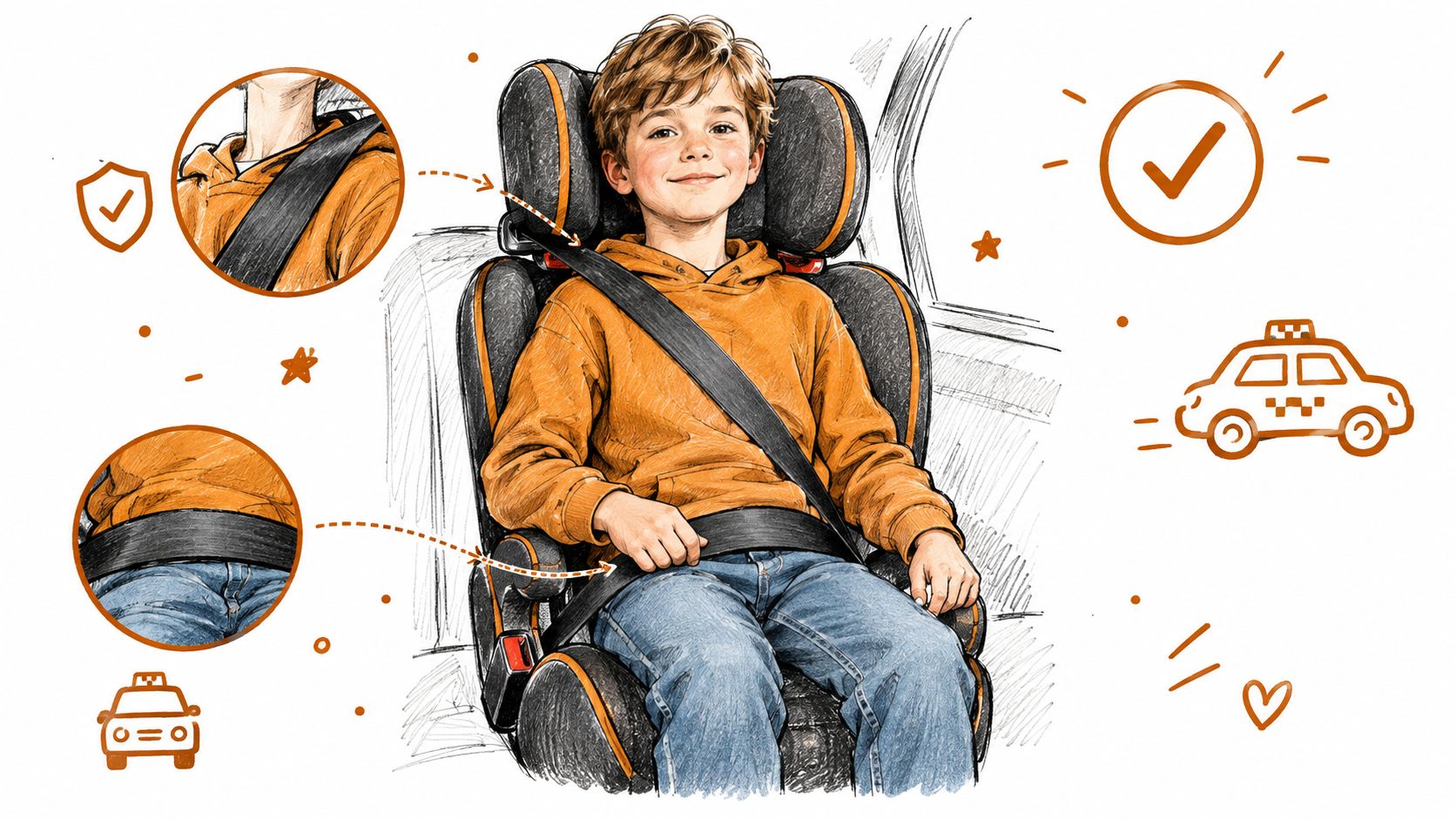
Before a trip, test the booster and belt in the exact vehicle and seating position your child will use. A portable option can simplify carpools and travel, provided it's used according to its instructions and with a compatible lap-and-shoulder belt. Families planning flights, hotel stays, or frequent car changes may also find this guide to portable booster seats for travel useful.
A booster that works at home may still be necessary in another car, even if your child looks tall enough without it.
If the belt crosses the neck or face, switch back to the booster. If the lap belt rides high, don't accept that position for convenience. The specific vehicle and seating position can change how the belt fits, so age alone should not determine when a child stops using a booster.
Avoiding the Rush to Graduate Early
A child may look tall enough for the seat belt on a short trip, yet slump or shift when tired on a longer drive. That is why age and height provide context, while the belt fit test makes the final decision.
Children can also feel pressure to stop using a booster when siblings or friends have graduated. Don't let that pressure set the timeline. Follow the seat's limits, then check how the belt rests on your child.
The lap belt should lie low across the upper thighs, and the shoulder belt should cross the chest and shoulder, away from the neck. Your child should sit upright with their back against the seat and keep that position without leaning or sliding.
Apply the test again for a rental car, taxi, rideshare, or a relative's vehicle. A belt that fits in the family car may sit differently in another seat, turning a familiar trip into a poor fit. A booster helps position the belt on the child's body, much as glasses position lenses for clear vision. For more guidance, review what age is right for a booster seat, then let the fit test guide the decision.
Essential Safety Checklist for Caregivers
Safety checks should happen whenever the vehicle, seating position, or caregiver changes. A grandparent's car, a babysitter's minivan, and a rideshare may all require a fresh belt-fit check.
Use this short routine before setting off:
- Check the belt path: Confirm the lap belt is low across the thighs and the shoulder belt crosses the chest.
- Check the seat condition: Look for cracks, frayed components, or other visible damage.
- Check the instructions: Use the booster according to its manufacturer's guidance and the vehicle owner's manual.
- Check the child's position: Make sure your child sits upright, faces forward, and can stay that way for the trip.
- Check the seating location: Keep children in the rear seat and use a lap-and-shoulder belt with the booster.
The Insurance Institute for Highway Safety explains that boosters are for children who are too big for child restraints but not yet able to fit adult belts correctly. Some children don't achieve that fit until age 12, which is why age alone shouldn't end booster use.
Hiccapop® offers baby and toddler products, including booster seats and travel-focused essentials, designed to make everyday routines easier for caregivers. Visit Hiccapop® to explore options for every stage as your child grows.
Disclosure
Hiccapop® makes baby and toddler products, including the booster seats mentioned at the end of this article.
Related Products
-
![Navy blue inflatable car booster seat and its blue travel bag, with a small photo of a boy using the seat.]()

- Regular price
- $39.99 - $41.99
- Sale price
- $39.99
- Regular price
-
$44.99 - Unit price
- per
Sold out


Related Products
-
![Navy blue inflatable car booster seat and its blue travel bag, with a small photo of a boy using the seat.]()
- Regular price
- $39.99 - $41.99
- Sale price
- $39.99
- Regular price
-
$44.99 - Unit price
- per
Sold out