


What Is a Booster Seat? A Parent's Guide to Safety Rules
So, your kiddo has graduated from the toddler car seat with its five-point harness, and now you’re entering the world of booster seats. What exactly are they, and why are they such a big deal?
Think of a booster seat as the essential stepping stone between a forward-facing car seat and letting your child use the car's seat belt all by themselves. It's a critical safety device designed to solve one specific problem: seat belts are made for adult bodies, and they just don't fit young children correctly. Using one is a non-negotiable step for keeping your "big kid" safe on the road.
The Critical Bridge to Big Kid Safety
At its core, a booster seat is a simple tool with a vital job. It "boosts" your child up, elevating them so that your vehicle's built-in seat belt can work properly. Without that lift, the lap belt rides up onto their soft belly and the shoulder belt cuts across their neck—a recipe for serious, even life-threatening, injuries in a crash.
Moving from a harnessed car seat to a booster is a huge milestone for kids and parents alike. But it's a decision that should be based on maturity and proper fit, not just hitting a certain age or weight. Getting this transition right is everything.
Let's break down the most common questions right off the bat.
Booster Seat Quick Facts
This table gives you a quick snapshot of the key things to know.
| Question | Answer |
|---|---|
| What is its main purpose? | To elevate a child so the car's seat belt fits them safely. |
| Who is it for? | Children who have outgrown their forward-facing car seat but are too small for an adult seat belt. |
| Why is it necessary? | It prevents "seat belt syndrome," where an ill-fitting belt causes severe internal injuries in a crash. |
| Is it just a cushion? | Nope! It's an engineered safety device that correctly positions the lap and shoulder belts on the strongest parts of a child's body. |
These points are just the start, but they cover the core mission of every booster seat on the market.
How a Booster Seat Protects Your Child
A booster seat works by making sure your vehicle’s own safety system functions as designed, but for a child's smaller frame. A correct, safe fit means two things are happening:
- The lap belt sits low and snug across your child's strong upper thighs and hip bones—never across their soft tummy.
- The shoulder belt crosses the middle of their chest and shoulder, staying well away from their neck and face.
When a lap belt cuts across a child's abdomen, it can cause devastating internal damage to organs like the spleen, liver, and intestines during a crash. This is often called “seat belt syndrome,” and it's precisely what a booster seat is designed to prevent.
A booster isn't just a cushion to help your child see out the window. It's a non-negotiable safety device that correctly positions the adult seat belt, turning a potential hazard into a protective shield.
Getting this stage of car seat safety right is one of the most important things you can do as a parent. Now, let's dig into the different types of boosters you'll find on the shelf.
High-Back vs. Backless Boosters: Making the Right Choice
Once you've figured out your child is ready for the next big step, you'll walk into the car seat aisle and see a couple of main options. The biggest decision usually boils down to two types: the high-back booster and the backless booster. Both are built to get that adult seat belt sitting just right, but they have different strengths for different kids and situations.
Let's unpack what makes each one tick so you can feel confident picking the perfect fit for your family.
High-Back Boosters: The All-Around Protector
A high-back booster looks a lot like a slimmed-down version of the forward-facing car seat your child is used to. It features a full back and a headrest, which is critical for providing side-impact protection and giving sleepy kids a place to rest their head without slumping into an unsafe position.
For younger or smaller children just graduating from a harness, this style is really the gold standard for safety.
- Key Feature: The built-in shoulder belt guides are a total game-changer. They position the shoulder belt perfectly across the strongest part of your child’s body—the middle of their shoulder and their collarbone—keeping it away from their neck and preventing it from slipping off.
- Best For: Simply put, high-back boosters are the safest choice. They become absolutely essential in cars that have low seat backs or no headrests, since the booster itself provides the head and neck support the vehicle seat is missing.
A high-back booster is your best bet if your child is new to boosters, tends to fall asleep in the car, or if your vehicle lacks adequate headrests in the back seat. The added structure offers superior protection and comfort.
Backless Boosters: The Portable Powerhouse
A backless booster is exactly what it sounds like: a cushioned seat that simply lifts your child up. That’s it. They’re compact, lightweight, and incredibly easy to shuttle between cars, which makes them a go-to for carpools, travel, and trips with the grandparents.
But that convenience comes with a trade-off. A backless booster offers zero head, neck, or side-impact protection on its own. Its only job is to raise your child up so the lap portion of the seat belt lies low and snug across their strong hip bones.
- Critical Requirement: For a backless booster to be used safely, the vehicle seat itself must have a headrest that comes up to at least the top of your child’s ears. Without proper head support from the vehicle, there is nothing to protect your child from whiplash in a crash.
- Best For: Think of a backless booster as a great option for older, more mature kids who you know can sit upright and properly for the entire ride. Its portability makes it an excellent secondary seat for quick, occasional trips.
To make the decision easier, here's a quick side-by-side look at the two main types of booster seats.
High-Back vs. Backless Booster At a Glance
| Feature | High-Back Booster | Backless Booster |
|---|---|---|
| Side-Impact Protection | Yes, built-in head and torso wings. | No, relies entirely on the vehicle. |
| Shoulder Belt Guide | Yes, routes the belt perfectly. | No (some have a clip, but less effective). |
| Head & Neck Support | Yes, essential for sleeping kids. | No, requires vehicle headrest. |
| Portability | Bulkier and heavier. | Lightweight and easy to move. |
| Best For | Younger booster riders, long trips, any car. | Older booster riders, carpooling, travel. |
| Vehicle Requirement | Works in any vehicle with a lap/shoulder belt. | Vehicle must have a supportive headrest. |
Ultimately, the choice depends on your child's maturity, your vehicle, and how you'll be using the seat.
What About Combination Seats?
You'll also see combination seats on the shelves. These are clever multi-taskers that start as a forward-facing seat with a five-point harness and later convert into a high-back booster seat.
They are a fantastic way to get more mileage out of a single car seat purchase. If you're currently shopping for a harnessed seat, looking into some of the best convertible booster seats can be a smart investment that covers you for years to come.
Why Proper Booster Use Is a Lifesaver
Moving your child out of their forward-facing car seat feels like a huge milestone. They’re a “big kid” now! But it’s so important to remember that the next step—the booster seat—is every bit as critical for their safety.
Jumping the gun and moving to a vehicle's seat belt too early can turn a fender-bender into something far worse. A booster seat isn't just a suggestion; it’s a non-negotiable safety device.
The Danger of a Poorly Fitting Seat Belt
Think about it: a car's seat belt was designed for an adult body. It's meant to sit low across strong hip bones and flat against the shoulder and chest. On a small child, that same belt becomes a hazard. It rides up high on their soft belly and cuts dangerously across their neck.
In a crash, the force is incredible. When that force is applied by an ill-fitting seat belt, it can cause devastating internal damage to a child's organs—the spleen, liver, and intestines are especially vulnerable. It can even injure their spinal cord. This specific pattern of injury is so tragically common it even has a name: seat belt syndrome.
A booster seat’s entire purpose is to prevent this. By lifting your child up, it positions the vehicle's safety system correctly on their body, making sure the lap belt stays on their hips and the shoulder belt crosses their chest.
One of the most common and dangerous mistakes a parent can make is moving a child to a seat belt too soon. A booster seat is the essential bridge between a harnessed car seat and the adult seat belt.
The Numbers Don't Lie
The data is crystal clear. According to the Centers for Disease Control and Prevention (CDC), using a booster seat slashes the risk of serious injury by 45% for kids aged 4–8 when compared to using a seat belt alone.
What’s more, in states that passed booster seat laws, children in this age group were over four times more likely to be buckled up correctly and 20% less likely to die in a crash. You can see the full impact for yourself in the CDC's child passenger safety report.
Of course, just owning a booster isn't enough. It has to be used correctly on every single trip. Taking a few extra seconds to get it right is one of the most powerful things you can do to keep your child safe on the road.
Knowing When Your Child Is Truly Ready
Figuring out the exact moment to move your child from their forward-facing car seat into a booster is one of those questions that keeps parents up at night. You'll see minimums like 40 pounds or age four printed on the box, but the real answer is so much more than a number. True readiness is a blend of their age, their size, and, most importantly, their maturity level.
The biggest question to ask yourself is this: can my child sit properly for the entire car ride, every single time? I mean no slouching, no leaning over to poke their sibling, and definitely no tucking that shoulder belt under their arm for comfort. You’re moving them from the cocoon of a five-point harness to a system that completely relies on their cooperation. (If you’re still in the earlier stages, you might find our guide on how long to keep your child rear-facing helpful.)
Beyond Age and Weight: The Maturity Factor
Think about it this way: a vehicle's seat belt is designed for an adult body. A booster seat's entire job is to "boost" your child up so the belt fits them correctly. If a child is too short, that lap belt rides up on their soft belly instead of their strong hip bones, and the shoulder belt cuts right across their neck. This is the same reason some adults need to understand how seat belt adjusters are used for shorter individuals. Maturity is the key piece of the puzzle—your child has to get it and follow the rules.
Sadly, many of us make this transition way too soon. A AAA analysis of U.S. crash data revealed that a shocking 25.3% of parents move their kids to boosters prematurely. Car crashes are still a leading cause of death for kids ages 1–13. In 2023 alone, 190 of the 555 child fatalities involved children who were completely unrestrained.
This is where the right gear makes all the difference. Using a booster isn't just a suggestion; it's a critical safety step that dramatically reduces risk.
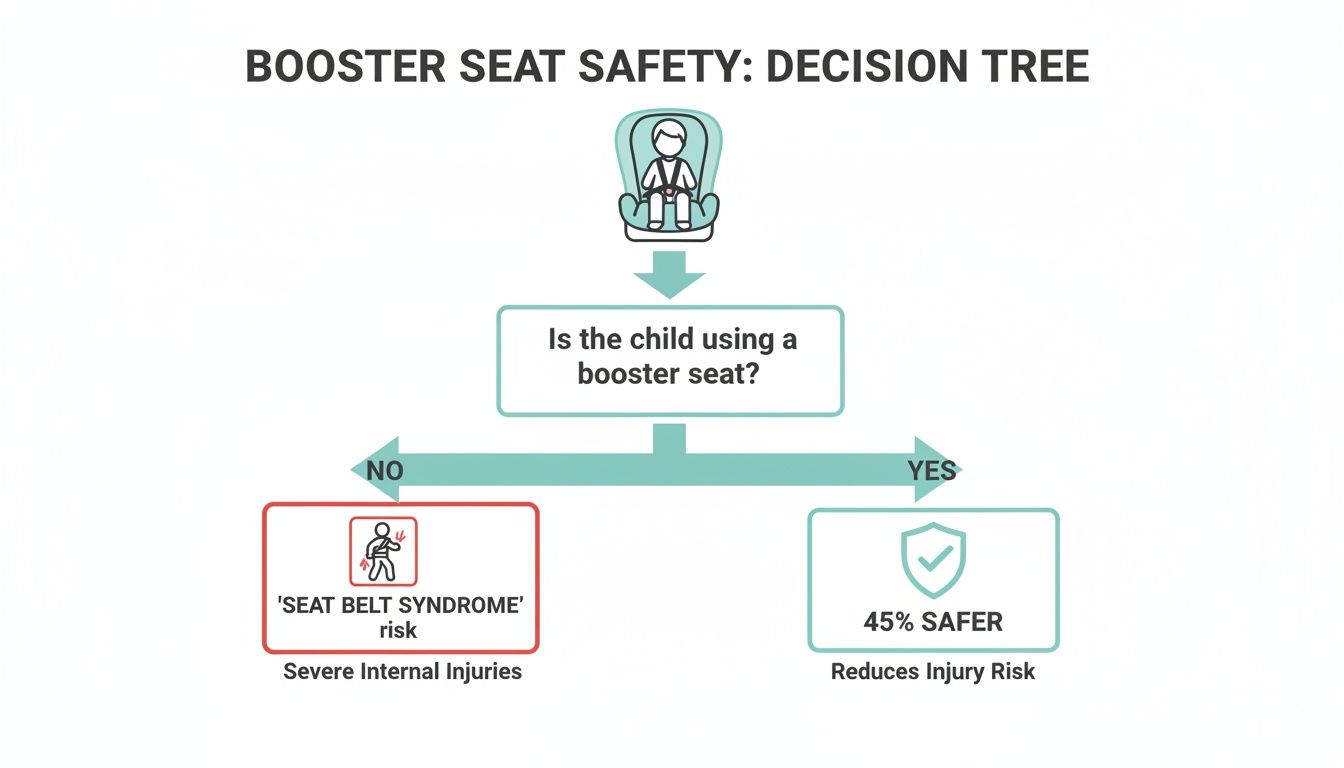
The data doesn't lie. A properly used booster makes a child 45% less likely to be injured in a crash. It works by ensuring the seat belt is positioned over the strongest parts of their body, ready to do its job.
The Gold Standard: The 5-Step Test
So how do you know for sure when they can finally ditch the booster altogether? Thankfully, safety experts created a simple checklist to take out all the guesswork: the "5-Step Test." It’s your go-to tool for seeing if your child is ready to use the vehicle's seat belt on its own.
The 5-Step Test isn't about age or weight—it's about how the seat belt fits your child's body in your specific vehicle. A child might pass in one car but not another.
Here’s what to look for. Have your child sit in the back seat without a booster and check these five points:
- Back Against the Seat: Can your child sit with their lower back flat against the vehicle's seat?
- Knees Bend at the Edge: Do their knees bend naturally over the edge of the seat cushion? If they have to scoot forward, they're not ready.
- Lap Belt on Thighs: Is the lap belt lying flat and low across their upper thighs and hip bones? It should never be on their soft tummy.
- Shoulder Belt on Chest: Does the shoulder belt cross the middle of their chest and shoulder? It shouldn't be on their neck or slipping off their arm.
- Can They Stay Seated? Can they comfortably and consistently stay in this position for the whole ride, even if they fall asleep?
If you can confidently say "yes" to all five questions, your child is likely ready to graduate. But until that day comes, the safest place for them is in a booster seat. No question.
Understanding Booster Seat Laws and Best Practices
Trying to figure out the rules for booster seats can feel like navigating a maze. Why? Because the laws are different everywhere you go, creating a confusing patchwork of requirements that varies wildly from state to state.
Our advice? Keep it simple. Always look up your local laws, but think of them as the absolute minimum safety standard. Frankly, many state laws haven't caught up with the latest safety recommendations from child safety experts.
Going Beyond the Bare Minimum
Instead of just checking a legal box, it's far safer to follow the best practices from groups like the American Academy of Pediatrics (AAP) and the National Highway Traffic Safety Administration (NHTSA). Their guidelines aren't based on politics or compromise; they're based on years of research into what actually keeps kids safe in a crash.
The guiding principle is this: a child needs a booster seat until the car's own seat belt fits them correctly. For most kids, this sweet spot isn't reached until they are 4 feet 9 inches tall and somewhere between 8 and 12 years old. That's a much higher bar than many state laws require, but it’s the one that truly counts when it matters most.
Following best practices means your child might be in a booster seat longer than their friends. Resisting the pressure to "graduate" them early is one of the most important safety decisions you can make as a parent.
The Key Best Practices to Follow
It's shockingly easy to move a child out of their booster too soon. In fact, a 2024 study revealed that a staggering 80% of parents transition their children to a seat belt before they’re truly ready. This is happening despite clear evidence that boosters slash the risk of serious injury by 45% for kids aged 4 to 10. You can see the full findings in the Safe Kids Worldwide report.
To avoid this common and dangerous mistake, stick to these expert-backed rules of the road:
- Always Use a Booster Until They Pass the 5-Step Test: This is your gold standard for knowing when they're ready. Don't go by age or weight alone—the test tells the real story.
- Lap and Shoulder Belts Are a Team: A booster must always be used with both a lap and shoulder belt. Never, ever use a booster with just a lap belt.
- Back Seat Until 13: The back seat is by far the safest spot for any child under 13. A deploying front airbag is designed for an adult body and can cause severe or even fatal injuries to a child.
Your Booster Seat Questions Answered
We’ve covered a ton of ground, from the nuts and bolts of high-back versus backless boosters to the maze of state laws. To wrap things up, let's dive into the common, real-world questions I hear from parents all the time. Think of this as your go-to cheat sheet for those nagging "what if" scenarios.
Getting these little details right is what makes a booster seat a true life-saving device instead of just a plastic seat in your car. Let's clear up any lingering confusion so you can feel completely confident every time you buckle up your little one.
Can I Use a Booster Seat on an Airplane?
This question comes up constantly, and the answer is a straightforward no. Booster seats are designed to work with a car’s lap and shoulder belt system—a setup you simply won't find on an airplane. In fact, FAA regulations specifically prohibit using them during takeoff and landing.
The safest way for a child to fly is in their own seat using an FAA-approved car seat with a five-point harness. If your child has already outgrown their harnessed seat and is in a booster, they are big enough to use the plane's lap belt by itself. You can just check your booster as luggage; most airlines will even do it for free!
Do Booster Seats Expire?
Yes, they absolutely do! Just like milk or medicine, booster seats have a shelf life. You'll typically find an expiration date stamped right into the plastic on the bottom or back of the seat. For most boosters, this is usually 6 to 10 years from the date it was made.
But why? It's not just a marketing gimmick. Over the years, the plastic can become brittle from the constant cycle of hot and cold temperatures inside a car. On top of that, safety standards are always improving. An old seat just isn't up to today's safety game. Always check the date, especially if you’re getting a seat secondhand.
How Do I Clean a Booster Seat?
Let’s be real: kids are messy. Crushed crackers, sticky juice, and mysterious smudges are a fact of parenting life. Luckily, most booster seat manufacturers know this and design them for easy cleanup.
- Check the Manual First: Your instruction manual is your best friend here. It will have specific dos and don'ts for cleaning the cover and the plastic shell.
- Fabric Covers: Most covers can be tossed in the washing machine on a gentle cycle with a mild detergent. The golden rule? Always let it air dry to avoid shrinking.
- The Plastic Shell: A simple wipe-down with a damp cloth and a little mild soap and water is all you need for the hard parts. Steer clear of harsh chemicals or abrasive cleaners, which can weaken the plastic.
Pro Tip: I always tell parents to keep a small pack of wipes in the car for spot-cleaning emergencies. Tackling a spill when it's fresh is way easier than trying to scrub out a fossilized stain weeks later.
Keeping the booster clean isn't just about looks. It also ensures that buckles and belt guides don't get gummed up with sticky stuff that could stop them from working properly in an emergency.
What if My Car Only Has Lap Belts in the Back Seat?
This is a huge safety red flag. A booster seat must be used with both a lap and a shoulder belt. Period. Using a booster with a lap-belt-only is incredibly dangerous and can lead to devastating abdominal and spinal injuries in a crash, something safety experts call "seat belt syndrome."
If you find yourself in this situation with an older vehicle, you have a couple of safe options:
- Stick with a Harnessed Seat: Look for a forward-facing car seat with a five-point harness that still fits your child's height and weight. These are designed to be safely installed with just a lap belt.
- Check for Retrofits: Contact your car dealership. It's sometimes possible to have modern shoulder belts installed in older cars.
- Use a Different Car: If possible, the simplest solution is to make sure your child rides in a vehicle that has modern lap-and-shoulder belts in every back seat.
When it comes to your child's safety, this is a non-negotiable rule. A booster seat needs that three-point seat belt to do its job.
When Can My Child Stop Using a Booster Seat?
The only reliable way to know if your child is ready to graduate from their booster is by using the 5-Step Test. This has nothing to do with their age, their weight, or the fact that their friends have stopped using one. It’s all about one thing: how the adult seat belt fits their body.
Before you even think about ditching the booster, have your child sit in the back seat without it and run through this checklist.
The 5-Step Test for Seat Belt Readiness
Use this checklist to determine if your child is ready to safely transition out of a booster seat and use the vehicle's adult seat belt.
| Step | Checklist Item | Pass/Fail |
|---|---|---|
| 1 | Does their back sit flat against the vehicle seat? | |
| 2 | Do their knees bend comfortably at the edge of the seat? | |
| 3 | Does the lap belt sit low on the hips, touching the thighs? | |
| 4 | Does the shoulder belt cross the center of their shoulder and chest? | |
| 5 | Can they stay seated properly for the entire trip? |
Your child needs to pass every single step to be safe without a booster. If you have to answer "no" to even one of these, they still need that boost to keep them safe.
At Hiccapop, we are dedicated to creating products that make parenting simpler and safer. From travel solutions to everyday essentials, our gear is designed with your family’s well-being in mind. Explore our full range of thoughtfully engineered baby and toddler products on the official Hiccapop website.