


What Age for Booster Seat? A Parent's Guide to Safety, Laws, & Readiness
When it comes to your child's safety, figuring out the right time to switch to a booster seat can feel like a high-stakes guessing game. As a parent, the question I hear most often is, "What's the magic age?" Here’s the simple, unvarnished truth: there isn’t one. The decision is far more about your child’s size—their height and weight—and, just as critically, their maturity level.
Before you even think about a booster, your child must have completely outgrown their forward-facing car seat with its 5-point harness. That means they’ve officially hit the maximum height or weight limit specified by the car seat manufacturer. Pushing those limits is the safest thing you can do.
The Real Answer to the Booster Seat Question
Let's cut right to the chase: deciding when to switch to a booster seat isn't about circling a date on the calendar. While age gives us a general ballpark, safety experts at the American Academy of Pediatrics (AAP) and other top organizations agree that a child's readiness is a mix of their weight, height, and maturity.
Moving a child to a booster seat too soon is a surprisingly common—and risky—mistake.
Think of it this way: a 5-point harness is like a custom-built safety cocoon for your child's small body. It’s engineered to distribute the immense forces of a crash across the strongest parts of their frame—their hips, shoulders, and chest. A booster seat is a step-down in protection. Its only job is to lift, or "boost," your child up so the car's adult-sized seat belt can sit correctly across their body.
Why Size and Maturity Outrank Age
Your number one goal should be keeping your child in that highly protective harnessed car seat for as long as possible. Many parents who are starting to think about this transition have kids in that active preschool and early elementary phase. For context, this is often the same time they're wearing shoe sizes from 7.5t to 13.5t. If you're curious about this stage, you can check out Pediped's collection for children in sizes 7.5t to 13.5t.
So, what are the real signs of readiness? Before making the switch, your child should meet all of these milestones:
- Weight: They’ve passed the maximum forward-facing weight for their harnessed seat. This is often 65 pounds or even more on newer seats.
- Height: Their shoulders are positioned above the top harness slots, or the tops of their ears are higher than the car seat's shell.
- Maturity: This one is huge. They must be mature enough to sit still and properly for the entire ride. That means no slouching, leaning over, or messing with the seat belt.
This infographic breaks down the key size requirements you should be looking for.
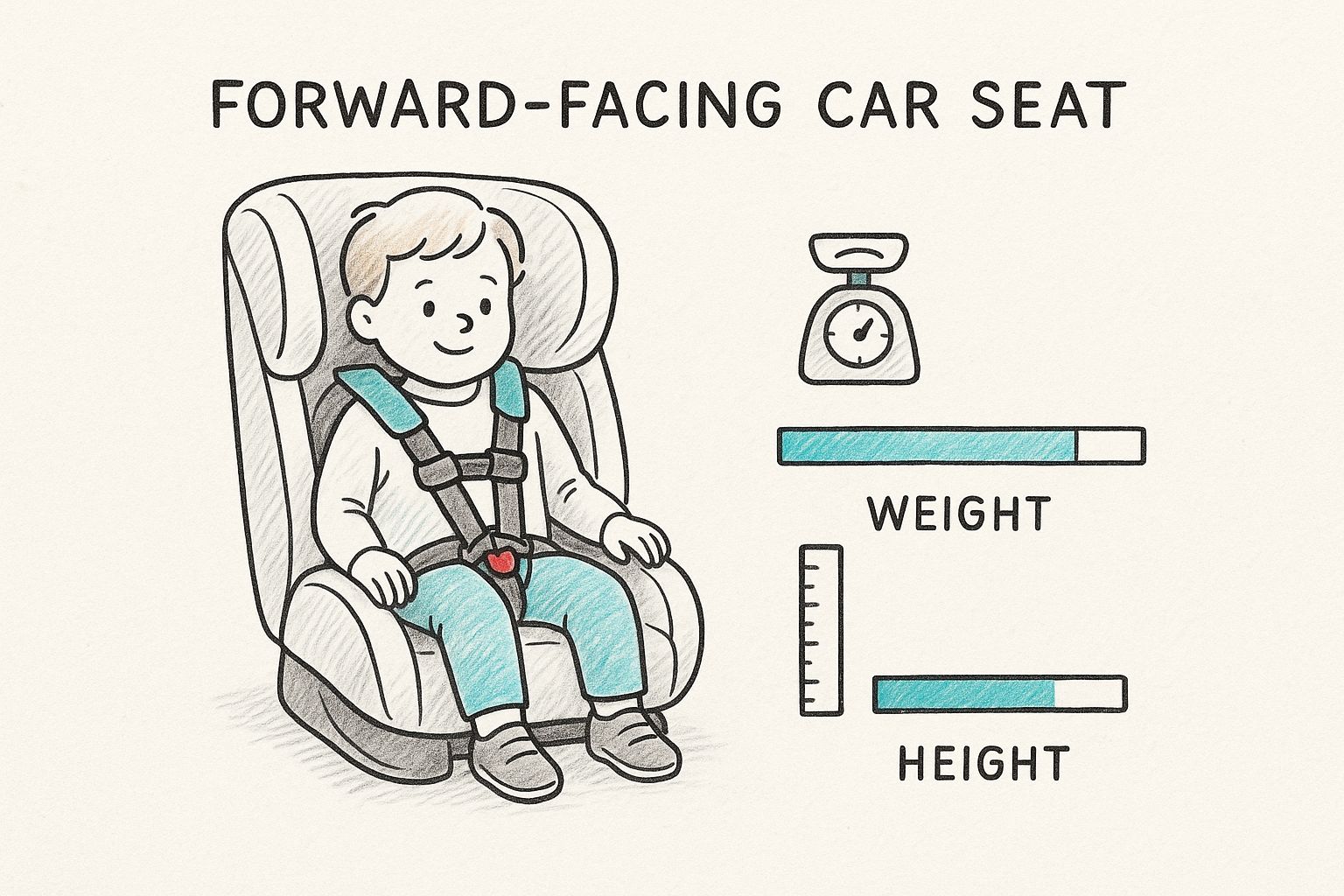
As you can see, the safest path forward is always to stick with the 5-point harness until your child officially outgrows it.
Booster Seat Readiness Checklist
Use this quick reference to see if your child meets the expert-recommended milestones for transitioning to a booster seat.
| Milestone | What to Look For | Why It Matters for Safety |
|---|---|---|
| Weight | Has exceeded the weight limit of their forward-facing harnessed seat (often 65 lbs). | The 5-point harness is tested and proven safest for children under this weight. |
| Height | Shoulders are above the top harness slots OR the tips of their ears are above the seat shell. | If they are too tall, the harness can't restrain them correctly in a crash. |
| Maturity | Can sit upright without slouching, wiggling, or unbuckling for the entire trip. | A booster seat only works if the child stays in the correct position. The seat belt can cause serious injury if they are out of place. |
| Age | Most children are not ready until at least 5 years old, but often closer to 6 or 7. | Younger children often lack the core strength and impulse control needed to sit safely without a harness. |
Remember, meeting just one of these criteria isn't enough. Your child needs to check every box before it's safe to make the move to a booster.
Navigating US Booster Seat Laws by State
If you’re looking for a single, clear-cut booster seat law for the whole country, you’re going to be disappointed. There isn't one. Instead, you'll find a confusing patchwork of state-specific rules, which is where a lot of the parental anxiety about the right age for a booster seat comes from.
This means the rules of the road can literally change the moment you cross a state line. A child who is legally buckled up in one state might be improperly restrained in the next. It creates a tricky situation where what's legally required doesn't always match up with what safety experts know is best.
State law is the bare minimum, not the gold standard. Just because your child meets the legal criteria to ride without a booster doesn't automatically mean it's the safest option for them.
Why Do State Laws Vary So Much?
So, what's behind all this variation? It comes down to the fact that each state legislature is responsible for setting its own child passenger safety laws. This process naturally leads to some states adopting much stricter rules than others.
For instance, states like California and New Jersey have laws that keep kids in boosters longer, which aligns more closely with what safety organizations recommend. On the flip side, some states set lower age and height limits, which can unfortunately encourage parents to transition their kids out of a booster seat too soon.
This is especially critical for families planning a road trip or renting a vehicle. You can often find helpful information on car seat and booster regulations for travelers from car rental company resources.
The Big Gap Between Law and Safety
The American Academy of Pediatrics (AAP) is crystal clear on this: kids should stay in a booster seat until they are 4 feet 9 inches tall and are somewhere between 8 and 12 years old.
But many state laws fall short of this guidance. Florida, for example, only legally requires boosters until age 6. While national data shows booster use for 6- to 7-year-olds is getting better—rising from 39.5% in 2021 to 43.3% in 2023—that still means most kids in this age group are not in the right seat for their size.
When you look outside the United States, you get a much clearer picture of what best practices in child passenger safety look like. Here in the U.S., we're often navigating a confusing patchwork of state-by-state laws. Many other countries, however, have set more straightforward and often stricter rules.
These international standards usually focus on a child's size, not just their age. This science-backed approach gives us a great perspective on why safety experts are so adamant about keeping kids in booster seats for as long as possible.
Europe’s Height-Based Approach
Across the European Union, the regulations are much more consistent and are considered some of the most rigorous in the world. They've largely moved away from age-based milestones and instead focus on a child's height to decide when they can safely use an adult seat belt.
Under these EU-wide rules, kids must ride in an appropriate child restraint or booster seat until they reach 135 cm (that’s about 4 feet 5 inches) tall. This standard didn't just appear out of nowhere; it’s backed by decades of research, especially from places like Sweden, which have some of the lowest child traffic fatality rates on the planet. You can read more about these rigorous European car seat laws to see how they're structured.
This height-first method takes the guesswork out of the equation. It's not about how old your child is, but about how the vehicle's seat belt actually fits their body—which is what really matters in a crash.
What We Can Learn from Global Leaders
Countries like Sweden are a fantastic example of what can be achieved with clear, strict safety standards. They've been pioneers for decades, championing things like keeping children rear-facing until at least age four.
Their incredible safety record drives home a simple but powerful point: longer is safer. The global consensus is clear that extending the time a child spends in a car seat or booster directly saves lives.
When you see how the countries with the best safety records handle this, the takeaway is simple. Graduating from a booster seat isn't about hitting a minimum legal age. It’s about making sure your child is genuinely big enough for the adult seat belt to do its job and protect them properly.
Why Maturity Matters More Than Milestones
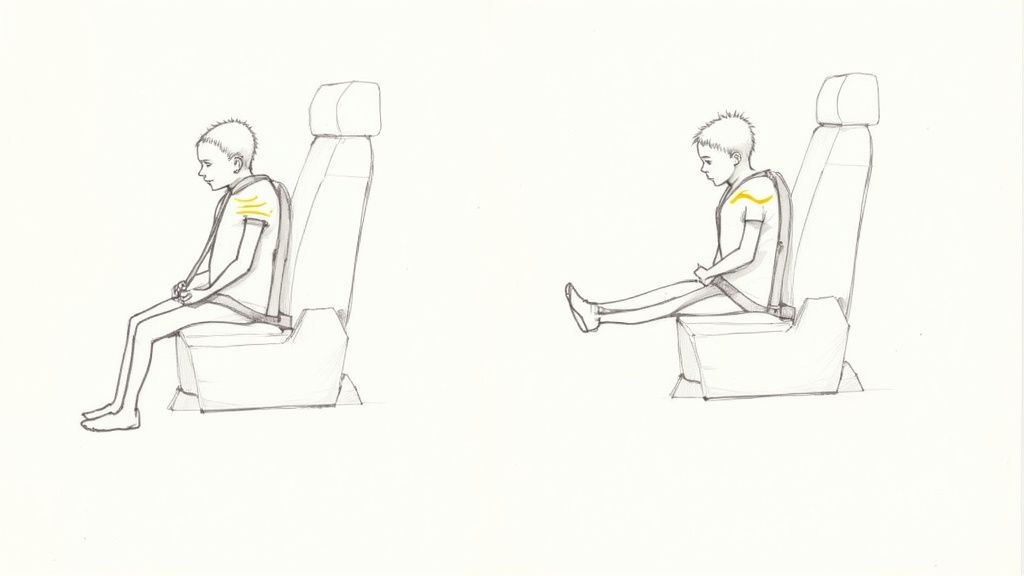
You can check every box for height and weight, but if you overlook one crucial factor, you’re missing the most important piece of the puzzle: your child's maturity. This has nothing to do with being a “good kid” and everything to do with their developmental readiness to sit still.
Let’s be real for a moment. A 5-point harness is an active restraint system—it physically holds your child in the safest position, no matter what. A booster seat, however, is a passive system. It’s not a restraint at all; it’s simply a belt-positioning device.
The booster’s entire job relies on your child doing their job, which is to sit properly for the whole ride. Every. Single. Time. If they start wiggling, slouching down, or tucking the shoulder belt under their arm, that booster seat suddenly becomes useless and can even introduce new dangers.
The Self-Control Checklist
Before you make the switch, take a moment to honestly evaluate if your child can handle the responsibility. Can they consistently:
- Stay Seated Properly? This means keeping their back flat against the vehicle seat for the entire trip without you having to constantly remind them. Slouching causes the lap belt to slide up over the soft belly, where it can cause serious internal injuries in a crash.
- Leave the Seat Belt Alone? Do they fiddle with the seat belt, pull the shoulder strap away, or try to unbuckle themselves?
- Not Lean Over? Can they fight the urge to lean way over to see something out the window or grab a dropped toy? Leaning moves the shoulder belt off their collarbone, which is the strong part of the body designed to take the force of a collision.
- Stay Awake Upright? What happens when they fall asleep? If they tend to slump over completely, their body can easily slide out of the correct belt path, rendering the booster ineffective.
This is the very reason experts urge parents to max out the limits of a 5-point harness. It’s the same logic behind other car seat stages, like understanding how long a child should stay rear-facing—it’s all about matching the equipment to their developmental stage, not just their size. A child who can’t sit still isn’t ready for a booster. Period.
It’s tempting to move your child out of their booster seat—they feel like a “big kid” and it seems more convenient. But making that switch before their body is truly ready can be a devastating mistake.
The Hidden Dangers of Graduating Too Soon
The biggest risk of moving a child out of a booster too early is something safety experts grimly call "seat belt syndrome."
This happens when a car’s seat belt, designed for an adult frame, rides up over a child's soft belly instead of sitting snugly on their strong hip bones. During a crash, the immense force is then pressed directly onto their unprotected internal organs, leading to catastrophic injuries to the spine, liver, and spleen.
How a Booster Seat Protects Your Child
Think of a booster seat as a simple but brilliant tool. Its only job is to lift your child up so the car's built-in safety system can finally fit them correctly. It literally boosts them into the proper position.
A correctly used booster seat ensures two critical things happen:
- The lap belt sits low and snug across their strong upper thighs and hip bones.
- The shoulder belt crosses the middle of their chest and collarbone, away from their neck.
These bony parts of the skeleton are built to handle the extreme forces of a collision. Without that booster providing the right height, the seat belt has nothing secure to hold onto, putting your child in serious danger.
Understanding this is key to seeing why it’s so important to wait until they pass the 5-Step Test. Even for families on the go, there are great travel-friendly options out there. It’s worth looking into whether inflatable booster seats are a safe choice for your specific needs.
Your Booster Seat Questions Answered
Stepping into the world of booster seats can feel overwhelming, but it doesn't have to be. Let's tackle some of the most common questions parents have, breaking them down into simple, clear answers so you can make the safest choice for your child with confidence.
What Is the Difference Between a High-Back and a Backless Booster?
Think of a high-back booster as the complete safety system. It lifts your child up for a better lap belt fit and provides critical support for their head and neck. This is a must-have in cars with low seat backs or no headrests. Plus, it has built-in guides to make sure the shoulder belt rests exactly where it should—across the strongest parts of your child's chest.
A backless booster is just the bottom cushion. It's designed to do one thing: lift your child so the lap belt sits low on their hips instead of across their soft tummy. They're super convenient and portable, but they're best reserved for older kids who have the maturity to sit properly for the entire ride, even if they doze off.
Can My Child Ever Use a Booster Seat in the Front Seat?
This is an easy one: no, never.
Both the American Academy of Pediatrics (AAP) and the National Highway Traffic Safety Administration (NHTSA) are crystal clear on this point. All children under the age of 13 belong in the back seat. Period. A front airbag deploys with incredible force designed for an adult's body, and it can cause devastating injuries to a child. The back seat is always the safest spot.
My Car Has Headrests; Do I Still Need a High-Back Booster?
Even with built-in vehicle headrests, a high-back booster is almost always the safer bet, especially for kids who are new to boosters. The side-impact "wings" on a high-back model offer a layer of protection that a car's headrest simply can't provide.
They also do a fantastic job of keeping a sleeping child upright. Without that support, a napping kid can easily slump over, causing the seat belt to slip into a dangerous position across their neck or abdomen. Once your child is older and can reliably sit still, a backless booster might be an option, but only if the vehicle headrest reaches at least the top of their ears.
How Do I Know When My Child Can Stop Using a Booster Altogether?
This is the final milestone in your car seat journey! Your child is ready to use the vehicle's seat belt alone once they can pass the 5-Step Test every single time they get in the car:
- Can they sit with their back flat against the vehicle seat?
- Do their knees bend naturally at the edge of the seat cushion?
- Does the lap belt sit low across their upper thighs, not their stomach?
- Is the shoulder belt centered on their shoulder and chest, away from their neck and face?
- Can they maintain this exact position for the entire trip, without slouching or shifting?
Don't rush this step. Most kids won't pass this test until they're between 10 and 12 years old and are at least 4 feet 9 inches tall. This is the ultimate sign of booster seat graduation.
For families on the move, finding the right gear is everything. If your adventures take you far and wide, check out our guide on the best Hiccapop portable booster seats for travel to keep your little one safe no matter where you go.