


Finding the Best Baby Safety Products for Your Home
Bringing a new baby home is an incredible experience, but the task of "baby proofing" your entire house can feel like you're preparing for a tiny, adorable hurricane. The truth is, the best baby safety products aren’t about spending a ton of money. They’re about finding what actually fits your home, your lifestyle, and your baby’s specific stage of mischief-making.
The real goal is creating a secure space where your little one can explore, learn, and grow without you having to hover over them every second. It's less about building a fortress and more about fostering a safe haven for curiosity.
Your Practical Guide to a Safer Home for Baby
Let's reframe how we think about this. Instead of a massive, intimidating checklist, think of baby proofing as building a "yes" space. It's an environment where curiosity is encouraged because you’ve already managed the major hazards. This isn’t about wrapping your home in bubble wrap; it’s about being one step ahead of your baby's next move—whether that's rolling off the sofa, perfecting the army crawl, or suddenly figuring out how cabinet doors work.
This guide will walk you through the essential product categories, room by room, to help turn that feeling of being overwhelmed into confident action. We’ll cover the must-haves for a newborn and the gear you'll need once they're on the move. A big piece of this puzzle also involves keeping things clean, so it’s worth incorporating some simplified baby-safe cleaning practices into your routine.
Matching Products to Your Needs
The secret is to find products that solve a real problem in your home. A sprawling house in the suburbs has completely different challenges than a compact city apartment. Figuring this out helps you focus your budget and energy where it truly counts.
Here's how custom-fit safety solutions often compare to high-end, big-name brands.
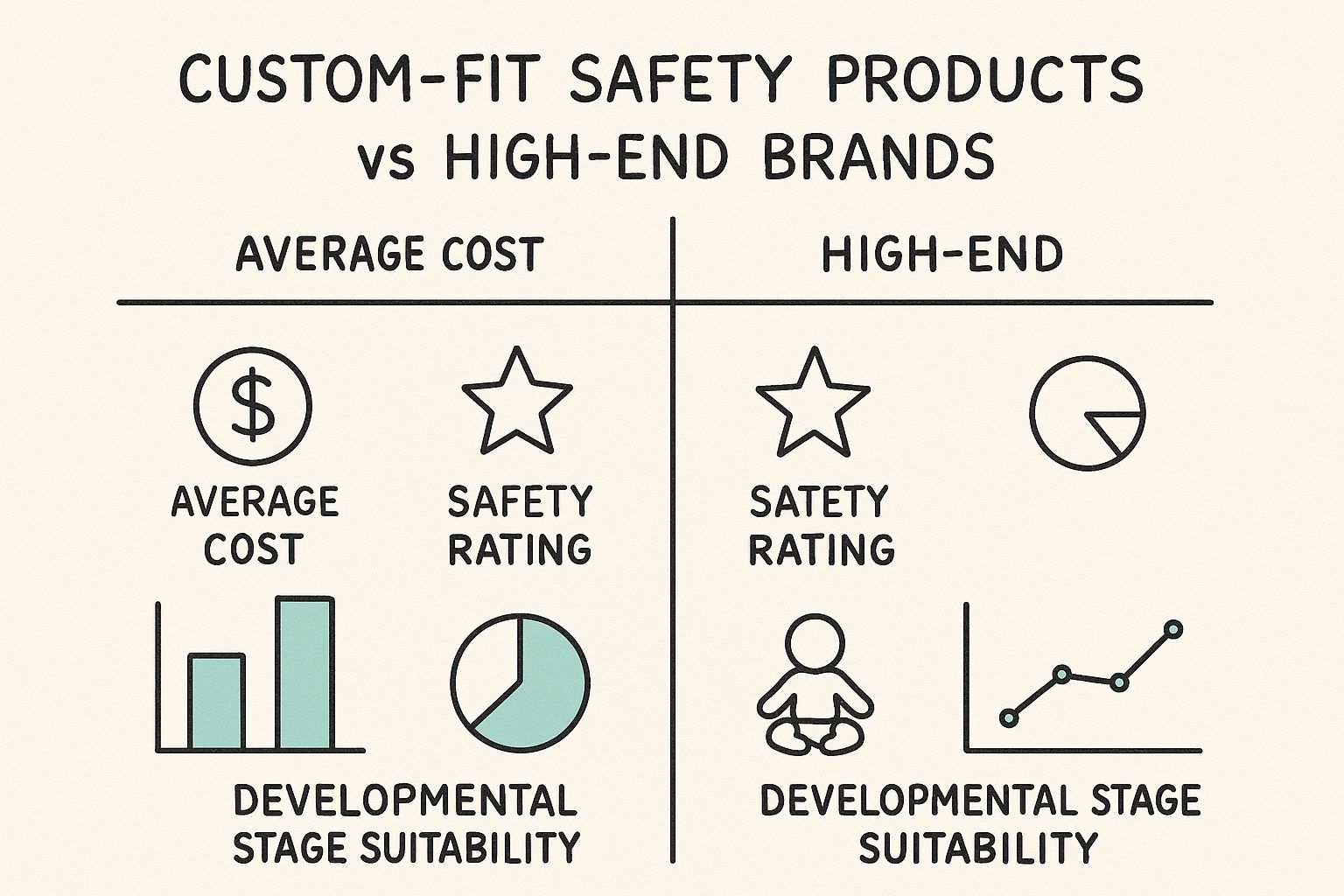
As you can see, a product's effectiveness has more to do with its correct use and suitability for your child's developmental stage than its price tag. This idea extends beyond just safety gear and is a great way to approach your entire baby registry. You can get more ideas by checking out our complete essential baby items list.
The Goal: A safe environment isn't about eliminating every single bump or tumble—those are part of learning. It’s about preventing serious injuries by identifying and neutralizing the most significant risks.
At the end of the day, you are the expert on your child and your home. Our aim is to give you the information you need to make smart, effective choices that bring peace of mind and create a secure haven for your family to grow.
Choosing the Right Car Seat and Travel Safety Gear
Of all the gear you'll buy for your child, the car seat is arguably the most critical. It’s not just a comfy spot for them to sit; it's a life-saving device engineered to protect your most precious cargo. But walking into a baby store and seeing the wall of options—from lightweight infant carriers to massive all-in-one seats—can feel overwhelming.
The good news? Every car seat sold in the U.S. has to pass rigorous federal safety standards. But just meeting the minimum isn't the goal. The real secret is finding the perfect fit for your child's size, your specific vehicle, and your family's lifestyle.
This intense focus on safety is driving a massive global trend. The baby safety product market is projected to hit $270.45 billion in 2025 and is on track to soar to nearly $461.86 billion by 2035. This boom is fueled by parents demanding better protection and by government regulations making car seats mandatory. If you're interested in the market forces behind these innovations, you can dig deeper into these trends on the Future Market Insights website.
Decoding Car Seat Lingo and Types
Let's cut through the jargon. You'll hear the term 5-point harness a lot, and for good reason. Think of it as your baby’s own high-tech racing harness. It secures them at their strongest points—the shoulders and hips, buckling at the crotch—to spread out any impact forces safely and evenly.
Another non-negotiable feature is side-impact protection. This usually means layers of energy-absorbing foam or special air-filled cushions built into the sides of the seat, right where your baby's head and chest are. It’s like a helmet and bodyguard all in one.
So, which seat should you choose? It really depends on your needs.
To make it easier, here's a quick breakdown of the main car seat types. This table can help you compare them at a glance to figure out what makes the most sense for your child's stage and your family's routine.
Comparing Car Seat Types
| Car Seat Type | Best For | Key Safety Feature | Typical Lifespan |
|---|---|---|---|
| Infant Car Seat | Newborns and small infants (first year) | Lightweight and portable; clicks into a base | 1 year (or until outgrown by height/weight) |
| Convertible Car Seat | Infants, toddlers, and preschoolers | Starts rear-facing and "converts" to forward-facing | 5-10 years |
| All-in-One Car Seat | The long haul (newborn to big kid) | Transitions from rear-facing to booster seat | 10+ years |
Each type has its pros and cons, but they all share one golden rule of safety.
Parenting Pro Tip: Keep your child rear-facing for as long as possible. It’s the single safest way for them to ride. Don't rush to turn them around; wait until they hit the absolute maximum height or weight limit for their seat's rear-facing mode.
On-the-Go Safety Beyond the Car
Of course, your safety checklist doesn't end when you turn off the engine. If you're flying or using multiple vehicles, you'll need a good plan. For a deep dive into that topic, check out our guide on traveling with car seats.
Once you're at your destination, other gear takes over.
Strollers and Baby Carriers
A good stroller is more than just a way to avoid carrying your toddler. Look for features like reliable locking wheels—a must-have for stopping the stroller from rolling away on a slope—and a sturdy frame that feels solid, not wobbly.
Baby carriers are a lifesaver for keeping your baby close while you keep your hands free. From a safety perspective, the gold standard is an ergonomic carrier. This means it supports your baby’s legs in a natural, frog-like "M" position, which is crucial for healthy hip development and ensures their airway stays open.
Ultimately, the best piece of safety gear is the one you use correctly, every single time. Take a few extra minutes to read the manual, watch the installation videos online, and even find a certified technician to double-check your car seat installation. That diligence is what turns a piece of plastic and foam into a true shield for your child.
Creating a Safe Nursery and Sleep Environment
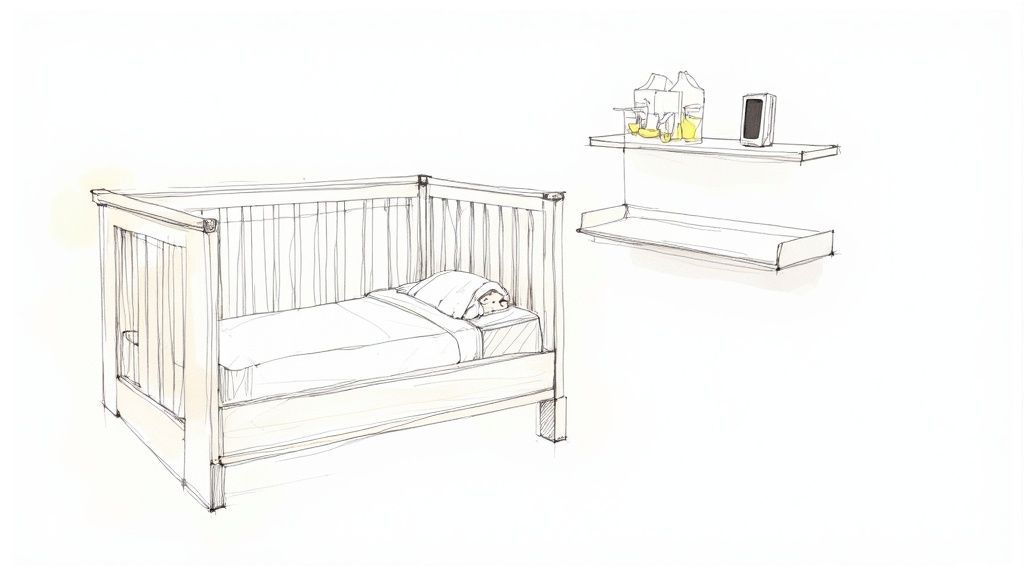
Your baby’s nursery is their first little world—a sanctuary where they’ll spend so much time sleeping, playing, and growing. Naturally, making it the safest room in the house is at the top of every parent's list, especially when it comes to sleep. The single most important principle to remember comes straight from the American Academy of Pediatrics (AAP): bare is best.
This simple rule is the gold standard for creating a safe sleep space. Think of it as minimalist design with a maximum safety payoff. All your baby really needs in their crib is a firm, flat mattress with a snug-fitting sheet. That means no bumpers, no pillows, no loose blankets, and definitely no cute stuffed animals—at least not in the crib.
This intense focus on safe sleep is part of a growing awareness among parents, particularly in North America, which now accounts for a dominant 33% share of the global baby safety market. Tragic risks like Sudden Infant Death Syndrome (SIDS), which was linked to about 1,400 fatalities annually in the U.S. in recent years, have spurred major innovation and education. You can dig deeper into these market trends and safety initiatives on the Precedence Research website.
Building on the Basics of Safe Sleep
So if blankets are out, how do you keep your little one warm and cozy? This is where a few brilliant products come into play, working with the bare-is-best rule, not against it.
- Wearable Blankets (Sleep Sacks): These are a game-changer. A sleep sack is basically a zippered blanket your baby wears, keeping them perfectly warm without any risk of the fabric covering their face.
- A Firm Crib Mattress: This one is absolutely non-negotiable. A mattress that's too soft can create indentations that increase the risk of suffocation if your baby rolls over. For a full rundown, check out our guide on finding the best crib mattresses for newborns.
- Video and Audio Monitors: Today’s monitors offer more than just a picture. Many now have temperature sensors to ensure the room isn't too hot or cold—another critical factor for safe sleep.
These essentials don't break the "bare is best" rule; they simply provide safer alternatives to traditional bedding.
Key Takeaway: A safe sleep environment is intentionally sparse. The goal is a space free from any potential airway obstructions, giving both you and your baby a more restful night.
Securing the Rest of the Nursery
Once the crib is set up safely, it's time to baby-proof the rest of the room. The moment your baby becomes mobile, their curiosity will lead them into every nook and cranny.
To a curious toddler, a tall dresser or changing table can look like a fantastic climbing gym. That's why it is absolutely crucial to anchor any heavy or tall furniture to the wall. Furniture anchors are inexpensive, surprisingly easy to install, and are one of the most effective ways to prevent a serious tip-over accident.
Finally, do a sweep for the smaller details that often hide significant risks.
- Window Blind Cords: Cords from blinds are a serious strangulation hazard. The safest move is to replace them entirely with cordless blinds or shades.
- Diaper Pail: Look for a model with a child-resistant lid. This keeps curious hands out and unpleasant odors in.
- Outlet Covers: Simple plastic plugs or sliding outlet covers are a must-have to prevent tiny fingers from finding their way into electrical sockets.
By tackling these key areas—the sleep space, furniture stability, and common room hazards—you'll transform the nursery from just a cute room into a true haven where your baby can sleep and play safely.
Mastering Home Safety for a Mobile Baby
The moment your baby starts crawling, your world—and theirs—changes forever. Suddenly, your cozy living room becomes an obstacle course filled with fascinating new things to touch, taste, and topple. This is your room-by-room playbook for making that new world of discovery a safe one.
Think of baby-proofing not as limiting your child's exploration, but as creating a secure playground where their curiosity can thrive. It’s all about staying one step ahead of that surprisingly fast crawl toward an open outlet or a wobbly piece of furniture.
Living Room and Common Areas
This is command central for family life, which means it’s packed with potential hazards hiding in plain sight. Your mission here is to see the room from their perspective—so get down on your hands and knees and have a look around.
First, let's tackle the low-hanging fruit that attracts curious little hands.
- Electrical Outlets: To a baby, these are just fascinating holes at their eye level. Simple outlet covers or shields are completely non-negotiable. For outlets you use often, like for the vacuum, sliding covers are a great, convenient option.
- Sharp Corners: The corners of coffee tables, media stands, and end tables are perfectly positioned to meet a wobbly new walker’s head. Corner guards are a lifesaver, softening those edges and turning a potential ER trip into a minor bump.
- Furniture Stability: That bookcase looks like the perfect thing to pull up on, doesn't it? Securing heavy furniture and televisions to the wall with anti-tip straps is one of the most critical safety steps you can take.
Parenting Pro Tip: Don’t just anchor the big items. Even a floor lamp can be a tipping hazard once your little one is on the move. Give everything a gentle wiggle to see how stable it really is.
The Heart of the Home: The Kitchen
The kitchen is a sensory wonderland for a baby—full of interesting smells, clanging sounds, and shiny handles to pull. It's also one of the most dangerous rooms in the house. The goal here is to create clear "no-go" zones for those little hands.
Start by securing every cabinet and drawer, especially those hiding cleaning supplies, sharp objects, or anything else you wouldn't want in your baby's mouth. Magnetic locks are fantastic because they're totally invisible from the outside, but simple latches also get the job done.
Beyond that, a few kitchen-specific products are worth their weight in gold:
- Stove Knob Covers: These clear plastic shields are a simple but effective way to stop your child from accidentally turning on a burner.
- Appliance Locks: A simple lock can secure the dishwasher, refrigerator, or oven door, preventing pinched fingers and keeping them out of unsafe areas.
Bathroom Safety Essentials
The bathroom presents its own unique set of challenges, mostly involving water and chemicals. Luckily, a few key products can make all the difference in this small but high-risk space.
A toilet lock is an absolute must-have. It keeps the lid securely shut, preventing your toddler from playing in the water (it happens!) and, more importantly, eliminating a serious drowning hazard.
Also, once your baby can sit up on their own, a non-slip mat for the bathtub is essential. It provides a secure surface during bath time, preventing scary slips and falls. While you're at it, grab a soft faucet cover to protect against bumps on the hard metal spout.
The Great Gate Debate: Pressure vs. Hardware-Mounted
Baby gates are the unsung heroes of home safety. They create secure zones where your child can play freely while you get things done. But not all gates are created equal, and choosing the right type for the right location is critical.
Pressure-mounted gates are held in place by, you guessed it, pressure against the doorframe or walls. They are fantastic for blocking off doorways between rooms or at the bottom of stairs. They're a breeze to install, require no drilling, and are easy to move around.
Hardware-mounted gates, on the other hand, are screwed directly into the wall or banister. This makes them far more secure and the only safe option for the top of a staircase. A pressure-mounted gate can be dislodged by a determined toddler, creating a catastrophic fall risk where it matters most.
Making your home a safe haven is an ongoing process, not a one-and-done task. Just when you think you've got it all covered, your baby will develop a new skill and find a new way to get into trouble. By starting with this room-by-room approach, you can confidently create an environment that empowers your little one to explore the world around them safely.
How Smart Technology Is Changing Baby Safety
Technology has found its way into the nursery, and it’s doing a whole lot more than just playing lullabies. The newest generation of the best baby safety products uses smart features to give parents a connection to their little one that was unimaginable just a few years ago.
These aren't just flashy gadgets. Think of them as an extra set of eyes and ears, designed to bring data-driven peace of mind. We're talking about advanced baby monitors that don't just show a grainy video feed but actually track your baby's breathing patterns and heart rate, sending an alert straight to your phone if anything seems off. It’s like having a digital guardian angel watching over the crib.
This fusion of tech with traditional safety gear is more than just a passing trend. By 2025, smart monitors and other sensor-based equipment are expected to account for roughly 24% of all new baby product launches. North America is really at the forefront of this shift, holding about 34.2% of the market, thanks to parents who are tech-savvy and a strong focus on safety standards. For a deeper dive into these numbers, you can explore more insights from Business Research Insights.
The Real-World Benefits of Smart Gear
So, what does all this tech actually mean for you on a frantic Tuesday morning? It’s about turning that low-level parental anxiety into useful, actionable information.
Connected car seats are a fantastic example. Some models have built-in sensors that talk to your phone or car’s dashboard. They can alert you if the chest clip is unbuckled mid-drive, or, even more crucially, if you’ve accidentally left your child in the car after you’ve walked away. On a hot day, that simple notification can be a literal lifesaver.
This same principle of smart, helpful alerts extends to other gear, too:
- Smart Socks and Wearables: These little devices track vital signs like oxygen levels and heart rate while your baby sleeps, offering a layer of continuous monitoring that a standard video monitor simply can't match.
- Smart Thermometers: You can get an instant, accurate temperature reading on a squirming baby and log the data in an app. This makes tracking a fever over time much easier, especially when you need to share precise information with your pediatrician.
The move towards smart technology is reshaping how we think about baby safety. Let's look at how these new tools stack up against their traditional counterparts.
Traditional vs Smart Baby Safety Gear
| Product Category | Traditional Product Example | Smart Product Example | Key Advantage of Smart Version |
|---|---|---|---|
| Monitors | Audio-only or basic video monitor | Monitor with breathing/heart rate tracking | Provides alerts for vital sign changes, not just sound or movement. |
| Car Seats | Standard convertible car seat | Car seat with chest clip sensor alerts | Notifies you if the clip is unbuckled or if the child is left in the car. |
| Health | Digital stick thermometer | Smart thermometer with app integration | Tracks fever history and symptoms automatically for easy sharing with a doctor. |
| Sleep | Basic sleep sack or swaddle | Smart wearable sock or band | Continuously tracks oxygen levels and heart rate during sleep for added peace of mind. |
As you can see, the "smart" advantage often comes down to proactive monitoring and instant communication, turning a passive safety item into an active one.
A Balanced Look at the Downsides
As incredible as this all sounds, it's not a perfect solution. With any connected device, you have to think about privacy and security. It's really important to stick with reputable brands that are transparent about their data encryption and privacy policies.
Then there’s the human side of things—the risk of becoming too plugged in. It’s easy to get fixated on watching numbers on a screen, which can sometimes wind up causing more stress than it relieves.
Key Insight: Smart baby safety products are powerful tools, but they are meant to supplement your parental intuition, not replace it. Your instincts and watchful eye will always be your baby's most important safety feature.
Ultimately, deciding whether to go smart comes down to what feels right for your family. It's a personal mix of your comfort level with technology, your budget, and your specific worries. These products can offer a wonderful layer of reassurance, but they work best when they're paired with good old-fashioned parental supervision.
Wrapping Up Your Safety Strategy
Creating a safe home for your baby is a marathon, not a sprint. It’s about making smart, intentional choices that fit your family and give you peace of mind. The goal isn’t to create a sterile, bubble-wrapped environment, but a secure space where your little one has the freedom to explore, learn, and yes, even take a few tumbles along the way.
Remember to trust your instincts. You know your child and your home better than anyone. Use this guide as a starting point, adapt it to your unique needs, and don’t be afraid to adjust your setup as your baby grows and discovers new ways to get into mischief. By staying one step ahead, you can spend less time worrying and more time enjoying every precious, chaotic, and wonderful moment.
What’s the one baby safety product you couldn’t live without? Share your must-haves in the comments below!
At Hiccapop, we believe the best safety products are the ones that fit seamlessly into your life, giving you security without adding stress. Our thoughtfully designed gear is rigorously tested to provide the confidence you need to relax and enjoy every precious moment. Explore our solutions at https://hiccapop.com.