


When Should I Start Setting Up the Baby Nursery
By week 36, the functional, safe sleep space should be ready. The decorative nursery can wait until after the baby arrives.
This is harder than it needs to be. "When should I start setting up the baby nursery?" is not really a decorating question. It is a readiness question, and those are two very different things. A room can look unfinished and still be fully prepared for a newborn. A room can look gorgeous and still miss the one thing that matters most: a safe place for the baby to sleep.
Disclosure: This article is published by Hiccapop, a maker of baby and nursery products.
Redefining Nursery Readiness Beyond Decoration
The pressure to finish a nursery early is mostly noise. What matters before birth is not matching wallpaper, themed baskets, or a perfect shelf edit. What matters is a safe sleep space, enough room for caregivers to move, and a setup that won't fall apart when everyone is tired.
The practical planning window starts in the third trimester, at about 28 weeks. World Health Organization antenatal care guidance includes birth-preparedness counseling during pregnancy and defines the third trimester as roughly 28 to 40 weeks. That timing makes sense. There is time to plan without rushing, and delivery is close enough that the room's layout starts to matter in real life, not just on a mood board. Decorating ideas, such as nursery wall decor, can come later, after the safety basics are handled.
Practical rule: If the room is safe, functional, and ready for sleep, it's ready enough.
Start with the nursery question that helps: what needs to be finished before the baby comes home, and what can wait? The answer is simple. Finish the sleep setup first, then deal with the cute stuff later.
The Hidden Timeline for Off-Gassing and Air Quality
Many parents miss this part entirely. New furniture, mattresses, paint, and textiles don't become neutral the same day they arrive in a room. They need time, ventilation, and a little common sense.
A 2024 study of typical daycare-center activities identified mattresses as notable VOC sources, and new mattresses in cool, dry conditions reached a reported total VOC concentration of 574 micrograms per cubic meter. The authors suggest ventilating new mattresses before use. That's a good reason to assemble major pieces early, then let the room air out before the baby sleeps there. The EPA's indoor air quality resources cover pollutant sources and ventilation in more depth. Air purification can be one part of the conversation, but it doesn't replace basic ventilation and sensible timing.
The low-cost approach is straightforward:
- Build early. Put together the crib, dresser, and any other major furniture well before the due date.
- Ventilate thoroughly. Open windows when weather allows and keep the room aired out after painting or installation.
- Keep fragrances out. Skip heavily scented cleaners and unnecessary soft furnishings.
- Delay baby exposure. Don't bring the baby into the room during painting, flooring work, or furniture assembly.
When buying materials, this phthalate-free guide is worth a look before loading the room with extra plastics and coatings that aren't needed.
Your Trimester-by-Trimester Setup Checklist
The smartest schedule is staged, not frantic. Don't try to do everything at once, and don't wait until it's too tiring to move a box.
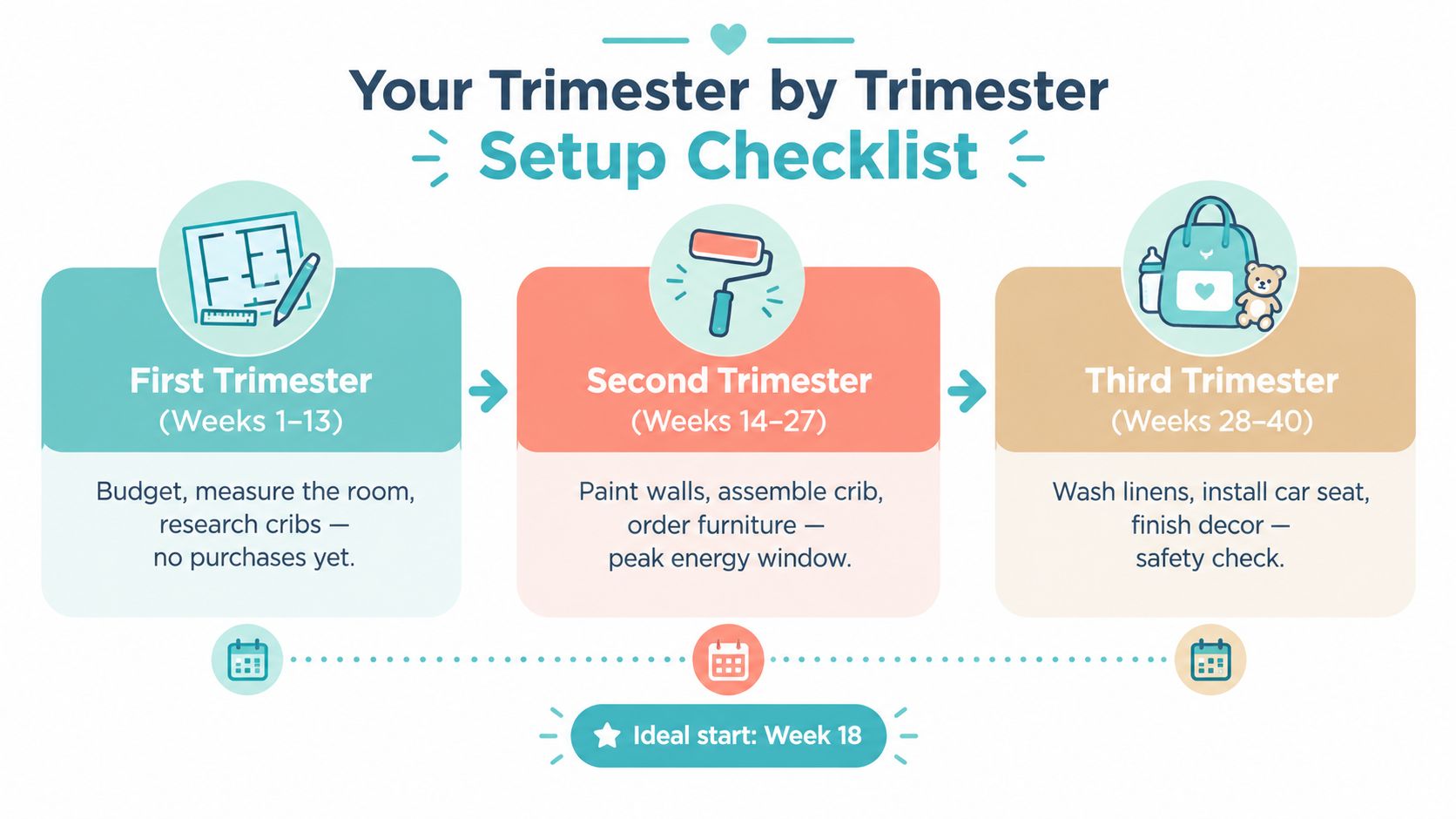
First Trimester
Start with the boring but useful stuff. Measure the room, sketch the layout, and decide where the crib and changing area might go. Avoid committing to oversized furniture before the space is mapped out.
Second Trimester
This is the sweet spot for planning and ordering. Major pieces can be selected now without the late-pregnancy scramble. When to buy nursery furniture matters because shipping delays and backorders are much easier to handle before the third trimester arrives.
Third Trimester
This is the execution phase. Begin the nursery's safety-critical setup by about 32 to 36 weeks, so there's time to assemble, inspect, and fix anything that's off before birth. If repainting is still on the list, choose low-VOC paint and keep the room well ventilated, but the bigger point is timing, not color choice.
Measuring and Inspecting the Safe Sleep Station
The crib is not a vibe. It's equipment, so treat it that way.
The U.S. Consumer Product Safety Commission says the mattress must fit tightly so a baby can't get trapped between the mattress and the crib sides. Crib slats must be no more than 2 3/8 inches apart, about the width of a soda can. If the fit is sloppy, the crib is not ready. If the hardware is loose, missing, or badly installed, the crib is not ready. If more than two fingers fit between the mattress and the crib side, the crib is not ready.
Safety beats style every single time.
A few more things deserve a hard look before the baby comes home. Corner posts should not extend more than 1/16 inch above the rail, and the headboard or footboard should have no cutouts that could trap a baby's head. For portable play yards, stick to the manufacturer's mattress and don't add cushions or extras. That's not being overcautious. It's avoiding an avoidable problem.
The shortest version is this: assemble the sleep surface early, inspect it slowly, and don't assume a box of parts means a finished setup.
Why the Main Nursery Might Not Be Used Immediately
Parents often assume the baby will sleep in the nursery from the start. Usually, that is not the practical setup. A bedside sleep space makes more sense in the early weeks, because it keeps the baby close and cuts down on middle-of-the-night stumbling.
The American Academy of Pediatrics recommends keeping the baby's sleep space in the parents' room, close to the parents' bed but on a separate infant sleep surface, ideally for at least the first 6 months. That puts a bassinet, bedside crib, or portable play yard ahead of a polished nursery. The room with the matching furniture can wait. The safe sleep spot beside the parents' bed cannot.
Focus on what helps right away:
- Sleep surface first. Use a crib, bassinet, or play yard in the parents' room.
- Comfort second. Set up a spot to feed, burp, and settle the baby without extra hassle.
- Decor last. Artwork, storage bins, and labels can wait.
A portable play yard can cover the gap while the main nursery is still coming together. For a practical overview, see what a play yard is used for. That setup is often more realistic than assuming the baby will move straight into the finished room.
Finalizing the Room Layout and Cord Safety
Once the main furniture is in place, stop thinking about decoration and start thinking like a mobile infant. That means cords, edges, reach, and movement. It also means taking the room seriously even before the baby can crawl.
The CPSC warns that window covering cords can strangle young children and advises moving cribs away from windows and window covering cords, with cordless window coverings as the option that eliminates the hazard. So the crib needs to be positioned away from reachable window coverings before birth, not after the baby has already moved in. The same logic applies to the rest of the room. Heavy furniture should be anchored, cords should be secured, and anything climbable should be treated as a future problem, because it is.
Simple is best here. A nursery doesn't need to look finished to be finished. It needs to be safe, usable, and calm enough to function in when everyone is tired.
For the crib itself, Hiccapop's Dual-Sided Foam Crib Mattress (52"x27.5"x6") is sized for standard cribs, with a firm infant side and a plush, softer toddler side, plus a waterproof cover with a zipper that allows removal for machine washing and drying. Use the firm infant side for babies under 12 months, with only a fitted sheet.
Related Products
-
![]()

- Regular price
- $149.99
- Sale price
- $149.99
- Regular price
-
- Unit price
- per
Sold out


Related Products
-
![]()
- Regular price
- $149.99
- Sale price
- $149.99
- Regular price
-
- Unit price
- per
Sold out