


Vibration Pad for Crib: Safety Rules and Real Benefits
A crib vibration pad is a soothing accessory with no proven SIDS protection, and it's only acceptable if the sleep surface stays firm, flat and clear. Being tucked beneath a mattress doesn't automatically make it safe.
Approximately 3,500 infants die annually in the United States from sleep-related causes, according to the American Academy of Pediatrics' 2022 safe-sleep recommendations. That's why the important question isn't how gently a product hums. It's what happens to the whole crib-and-mattress setup when you install it.
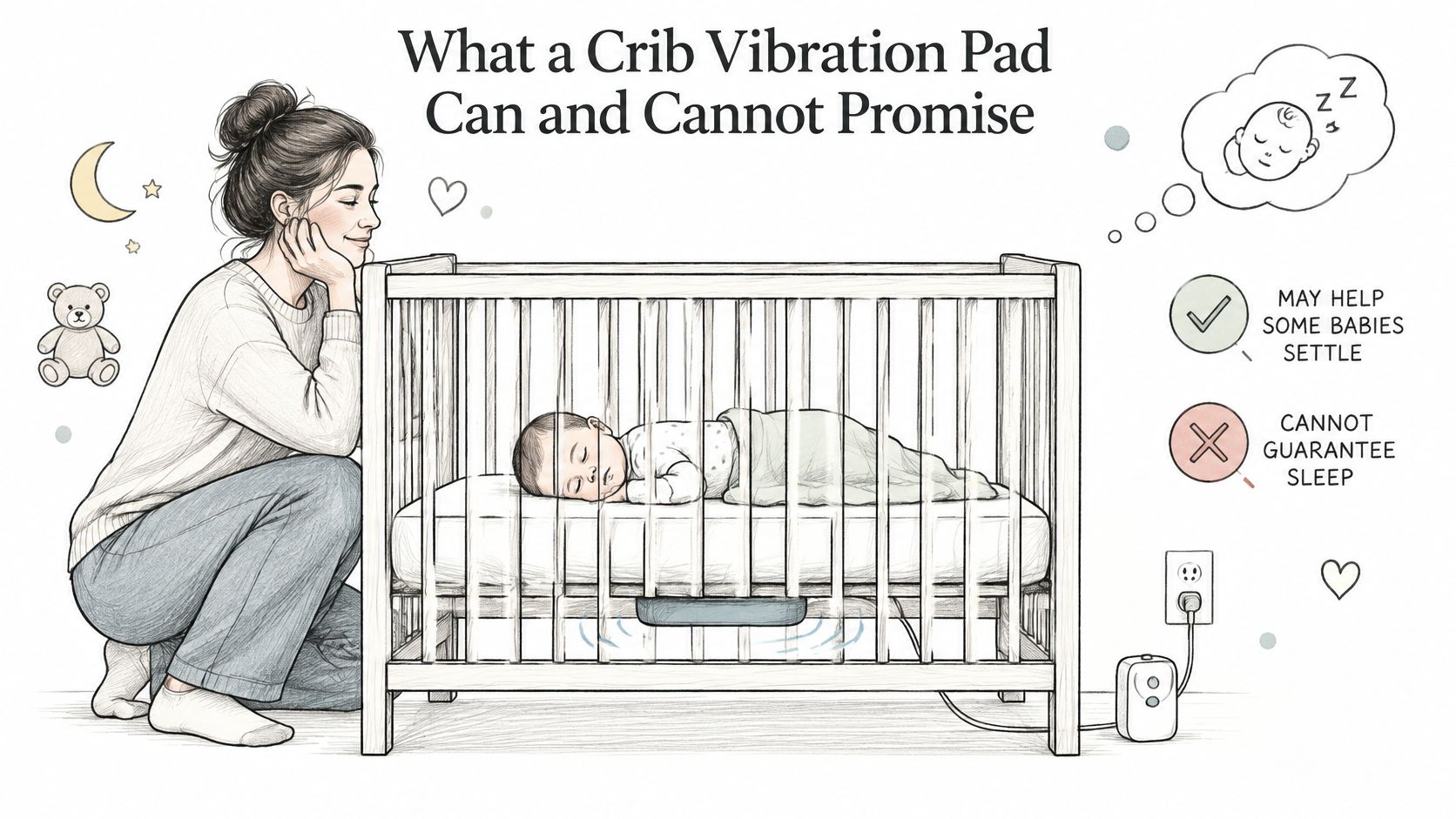
What a Crib Vibration Pad Can and Cannot Promise
A vibration pad for crib use is usually a battery-powered or plug-in unit installed beneath the mattress or crib base, according to its instructions. A motor produces repeated motion, sometimes with adjustable intensity and a timer. It isn't the same as an under-mattress movement monitor, which senses motion rather than creating it.
Parents may try one for fussiness or nap settling. Some babies find repeated motion calming, but that doesn't establish better sleep, guaranteed results or medical protection. A vibrating motor also isn't a substitute for a sound machine that masks household noise.
Read the claim, not just the label
- Reasonable wording: May help some babies settle, provided the manufacturer can support that claim.
- Ambiguous wording: Supports safer sleep suggests protection that soothing alone doesn't establish.
- Unacceptable wording: Reduces SIDS risk presents an unproven safety benefit.
The FDA warns that it isn't aware of clinical or scientific evidence that currently available baby products prevent or reduce SIDS. Its warning covers positioners, mattresses, monitors, crib tents, pillows and bedding. Positioners introduce additional concerns because babies can roll, scoot or become trapped.
The CPSC's full-size crib guidance provides the relevant crib-standard context, not proof that an accessory is suitable for your crib.
Safe-Sleep Checks and the Setup Routine
The baby's sleep space needs a firm, flat mattress with only a fitted sheet. The CPSC infant-sleep-product FAQ explains why incline, suffocation and airway obstruction matter when evaluating a sleep product.
Safe-sleep checks for any crib vibration pad
| Check | Acceptable | Red flag |
|---|---|---|
| Position | Outside the mattress surface, never under the baby | Pad migrates into the sleep area |
| Mattress firmness | Firm and flat under pressure | Softening, dipping or bulging |
| Incline | Level from head to foot | Head end higher than feet |
| Sheets and bedding | Only a fitted sheet | Pillows, blankets or extra layers |
| Cords and controls | Outside the crib and unreachable | Reachable cords or buttons |
| Movement | Secure at every setting | Shifting, creeping or crib movement |
| Gaps | Correct mattress fit, no new openings | Space where a baby could wedge |
| Damage | Intact, dry and securely fastened | Frayed, wet, loose or cracked parts |
Run the checks with the crib empty
- Confirm that the crib or bassinet and mattress are compatible, compliant models.
- Remove bumpers, pillows, blankets and other loose items.
- Install only where both manufacturers permit, with cords and controls out of reach.
- Press the mattress at its center and corners. Sight along it for tilt and inspect every edge for new gaps.
- Run permitted settings, including the highest, while watching for creeping, rattling or shifting. Look for documented displacement protection that stops operation if the unit moves.
- Use a timer if available, and switch the pad off before unsupervised sleep.
These checks cannot certify an incompatible accessory as safe. Stop for any shifting, new gap, reachable component, moisture or damage, and repeat checks after moving the crib or changing settings.
For broader preparation, use our safe sleep environment guide. If you're considering mattress protection, Protect-A-Bed's guide to baby mattress protection offers additional context, but don't add layers contrary to your mattress instructions.
A child climbing out needs a toddler bed, such as our inflatable toddler bed, rather than another crib accessory.
How the Vibration Works and Why Placement Matters
Pushing a swing at the right rhythm builds height, and pushing at the wrong moment does nothing or throws you off. A vibration pad similarly transfers repeated motion through connected parts.
The actuator moves, but the mattress support, crib frame and floor respond together. Resonance happens when the motor's rhythm matches the structure's natural rhythm, potentially amplifying movement, noise and loosening. Motor speed alone therefore tells you little about the assembled setup.
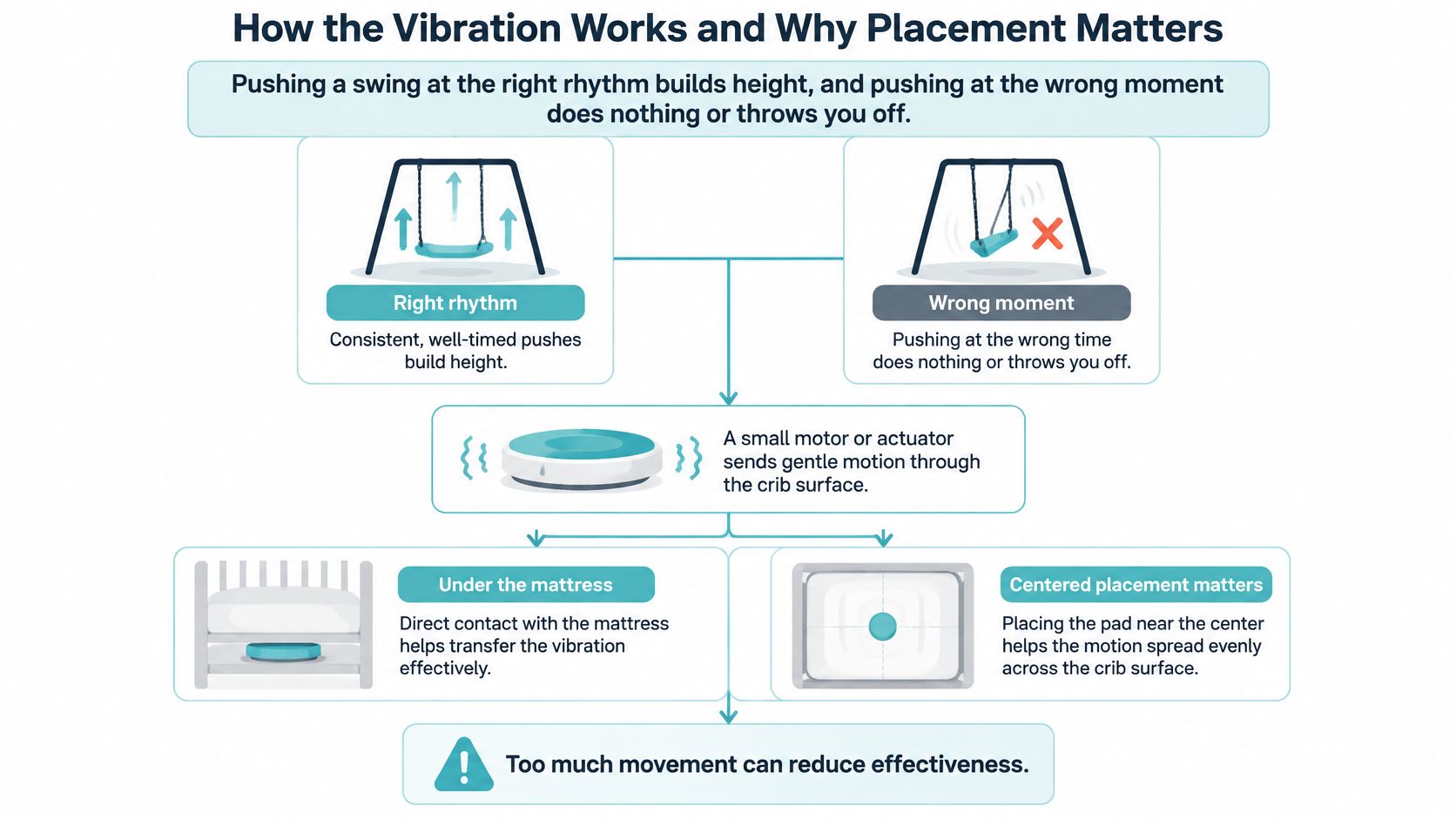
Placement rule: A diagram showing an under-mattress position isn't permission to use that position with every crib.
Ask the manufacturer for testing across the operating range: acceleration at the mattress support, frame and floor; unloaded and occupied-equivalent conditions; worst-case placement; durability; sliding and tipping resistance; sound; and heat buildup.
Our infant soother vibration guide provides additional product context. Keep the AAP's parent guide to safe sleep as the safety benchmark, not the strength of the sensation.
Age, Setup and When to Stop Using a Pad
The CPSC infant sleep products guidance defines the relevant category as sleeping accommodations for infants up to 5 months old that aren't already covered by another mandatory sleep-product regulation. That definition isn't a universal accessory approval or an automatic expiration date for every pad.
Pad use by child age and sleep setup
| Case | Vibration pad use | Notes |
|---|---|---|
| Infant below that threshold in a crib | Only with documented compatibility and an unchanged surface | Follow both manufacturers' instructions |
| Infant at or above that threshold | Only within the device's labeled age limits | Crib standards still apply |
| Playard or Pack ’n Play | Only with explicit playard compatibility and no gaps | Playard requirements apply |
| Bassinet or cradle | Only with compatible fit and no mattress raising | Bassinet and cradle requirements apply |
| Crawling or pulling up | Stop use | Reaching and manipulation create new concerns |
| Climbing out | Stop use | Transition to a toddler bed |
Don't add a blanket or bumper to “improve” the effect. Bed bumpers aren't for infants; children should remain in a crib as long as appropriate, generally around two years or until they start climbing out, subject to the crib's limits.
Development can end a product's usefulness before its labeled maximum age.
Stop or replace the setup when the child's age, abilities or sleep accommodation no longer matches the instructions.
Pros, Cons and Alternatives Compared
A pad may appeal to a baby who enjoys steady motion during supervised settling. The trade-off is more equipment to inspect, without a guaranteed sleep benefit.
- Setup burden: Installation and compatibility require attention.
- Mechanical hazards: A drifting unit can change fit or create openings.
- Accessible components: Cords and controls need ongoing checks.
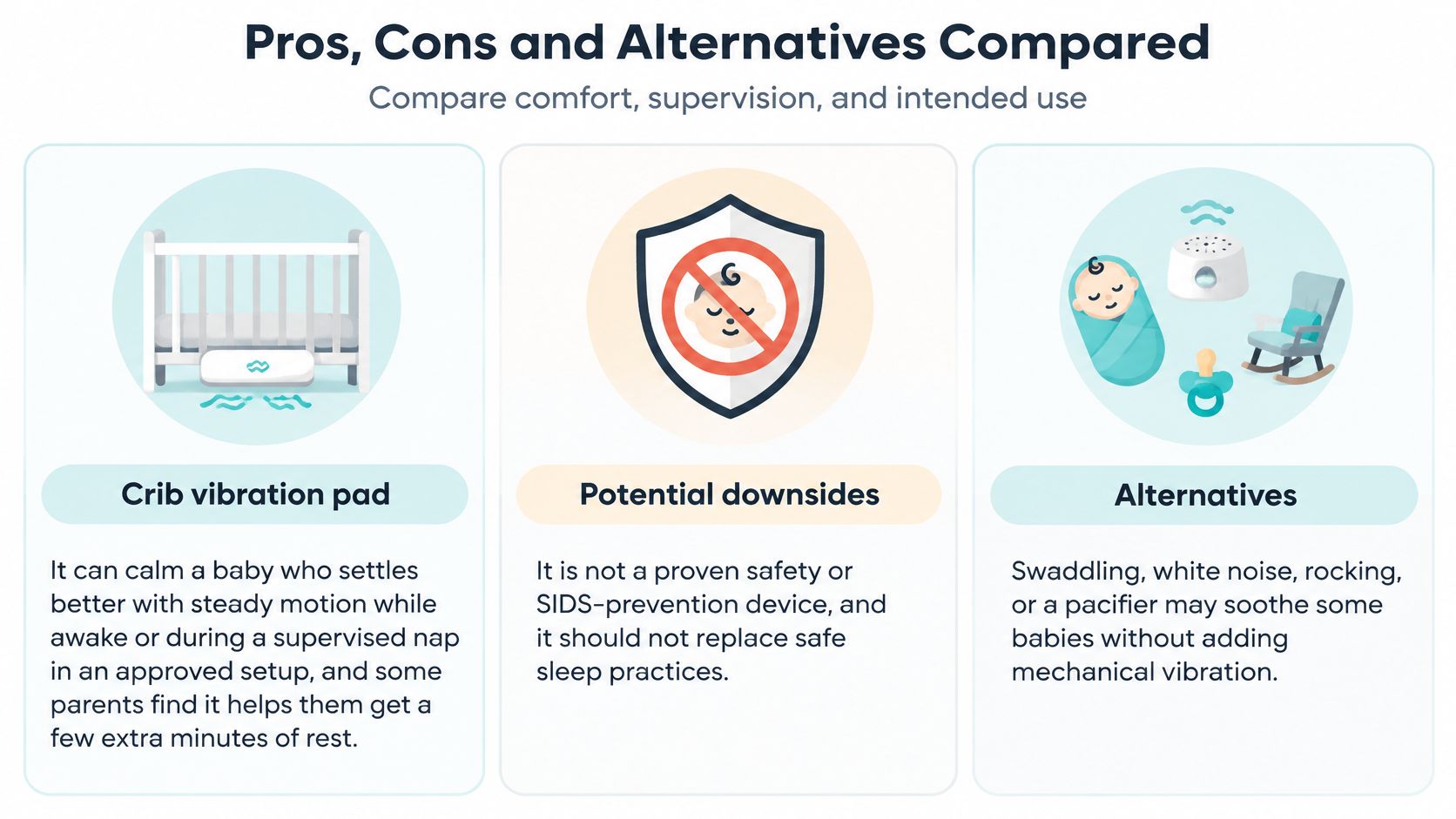
Crib vibration pad vs common soothing alternatives
| Option | Soothing effect | Safe-sleep fit | Best use |
|---|---|---|---|
| Crib vibration pad | Individual response, no assured sleep improvement | Conditional on compatible installation | Supervised settling |
| White noise machine | Masks household sounds | Outside the crib, with inaccessible cords and low volume | Noisy homes |
| Swing | Motion may soothe while awake | Not a sleep place | Awake, supervised soothing |
| Rocking or holding | Close contact may calm | Transfer sleeping baby onto their back in the crib | Settling before transfer |
Our sound machine for sleeping guide explores the sound-based option. Don't assume a universal distance or volume setting suits every machine.
If you swaddle, stop when your baby shows signs of rolling. The CPSC and AAP advise keeping bumpers and loose bedding out of infant sleep spaces, whichever soothing approach you choose.
Recalls and Warning Signs Before You Buy
A recall check should cover the exact product, not just its category. That matters for soothing products described as sleep-supportive, too.
Consumer Reports' coverage of Bright Starts rockers summarized reports to the CPSC associating at least one infant death in 2019 with a Bright Starts rocker. Separately, Consumer Reports reported the Fisher-Price Snuga Infant Swings recall, including a $25 refund in 2024.
These examples do not establish that vibration pads share those products' defects. They do show why it helps to check the brand and model before buying, including when shopping secondhand.
- Search CPSC recall listings for the brand and model.
- Register the product for safety notices.
- Stop using it if a recall is issued or a component is damaged.
- Keep swings and rockers for awake, supervised soothing, not sleep.
- Save the instructions, model number and identifying packaging information.
Choose one check to do tonight, and share it with anyone who puts your baby to bed. Ask your pediatrician about persistent settling difficulties or concerns about your baby's sleep.
Hiccapop offers crib mattresses, nursery organizers and toddler travel beds for different stages of family life. Visit Hiccapop to review age-appropriate options and product instructions as you plan your nursery setup.