


A Parent's Guide to a Safe Sleep Environment for Infants
When you bring your baby home, suddenly everything revolves around them, especially when they’re sleeping. As a new parent, creating a safe sleep environment for your infant is probably one of the things you think about most. It all comes down to a simple, life-saving mantra I tell every new parent: Alone, on their Back, in a Crib.
This "ABC" method isn't just a catchy phrase; it's the gold standard for keeping your little one safe and sound while they rest.
The Foundation of Safe Infant Sleep
The flood of baby advice can be overwhelming, but on the topic of sleep, the experts are crystal clear. The ABCs of safe sleep aren't just gentle suggestions; they're proven practices that have dramatically reduced sleep-related infant deaths across the globe.
Let's break down what this really means for you, day-to-day, and why each part is so critical for every nap and every night.
This approach is rooted in decades of research. The game-changer was the 'Back to Sleep' campaign, which kicked off in the U.S. back in 1994. It completely changed how parents put their babies to bed and is credited with a massive drop in Sudden Unexpected Infant Death (SUID). The results speak for themselves: after hospitals implement these educational programs, audits show that over 94% of infants are documented in safe sleep positions.
What the ABCs Really Mean
It's one thing to remember the acronym, but truly understanding the "why" behind each letter gives you the confidence to create the safest space for your baby. Think of this as your core rulebook—the one that lets you breathe a little easier during those quiet hours.
-
A is for Alone: This is a big one. Your baby needs to sleep alone in their own dedicated space, like a crib or bassinet. That means no sharing a bed with parents, siblings, or pets. It also means their sleep space is completely clear—no blankets, pillows, bumpers, or soft toys. As cute as they are, these items are serious suffocation and entrapment hazards.
-
B is for Back: Always, always place your baby on their back to sleep for every sleep until they are one year old. This is the single most effective thing you can do to lower the risk of SIDS because it keeps their airway open. A common worry is spit-up, but healthy babies will instinctively turn their heads to clear their mouths.
-
C is for Crib: The surface your baby sleeps on matters immensely. A crib, bassinet, or portable play yard that meets current CPSC safety standards is non-negotiable. It must have a firm, flat surface with nothing more than a tightly fitted sheet. Soft surfaces—like your bed, a sofa, or an inclined sleeper—are dangerous because they can cause an infant's head to slump forward, cutting off their breathing.
The goal isn't to create a cold, sterile box. It's about creating a space that is predictably safe. By removing variables like loose bedding and soft surfaces, you're getting rid of the most common and preventable sleep-related dangers.
For a quick reference, here's a simple breakdown of these core principles.
Quick Guide to the ABCs of Safe Sleep
This table summarizes the foundational rules for every time you put your baby down to sleep.
| Principle | What It Means | Why It's Critical |
|---|---|---|
| A - Alone | Baby sleeps in their own crib or bassinet. No bed-sharing. The crib is empty of all items: no blankets, pillows, bumpers, or toys. | Prevents accidental suffocation, strangulation, and entrapment from soft bedding or another person rolling over. |
| B - Back | Baby is always placed on their back to sleep for naps and at night until they are 1 year old. | Keeps the airway clear and open. This is the single most effective way to reduce the risk of SIDS. |
| C - Crib | Baby sleeps on a firm, flat surface in a safety-approved crib, bassinet, or play yard with a tight-fitting sheet. | A firm surface prevents the baby's head from sinking into a dangerous position that could obstruct their airway. |
Following these guidelines is the cornerstone of baby-proofing your home. It might feel a little strange at first to put your baby in what looks like an empty crib, but remember this: simplicity is safety. You're giving them exactly what they need to rest and grow securely.
For more tips on creating a safe space for your little one, check out our guide on finding the best baby safety products for your home.
Building the Ideal Safe Sleep Space
Now that we've covered the ABCs, let's get our hands dirty and actually set up your baby's sleep space. This isn't about creating a Pinterest-perfect nursery—it's about building a safe zone. Think simple, boring, and wonderfully secure.
Your first decision is the foundation: the bed itself. This has to be a product specifically designed and tested for infant sleep.
You've got three main choices here: a crib, a bassinet, or a portable play yard. The non-negotiable part is ensuring it meets the latest safety standards from the Consumer Product Safety Commission (CPSC). These standards are what guarantee things like proper slat spacing and a sturdy frame, preventing any risk of accidental entrapment.
The Only Things Allowed in the Crib
Once you have a CPSC-approved bed, the next rule is even simpler: keep it completely bare. Seriously. The only things that should be in there are a firm mattress and a tightly fitted sheet. That's it.
A firm, flat sleep surface is absolutely critical. It might not feel very cozy to you, but it's exactly what an infant's developing body needs. Soft surfaces, like memory foam or cushy toppers, are dangerous because they can create a pocket around a baby's face, increasing the risk of suffocation. If you're stuck on what to choose, our guide on the best crib mattresses for newborns can walk you through the options.
This infographic does a great job of boiling it all down, reinforcing that core "Alone, on their Back, in a Crib" message.
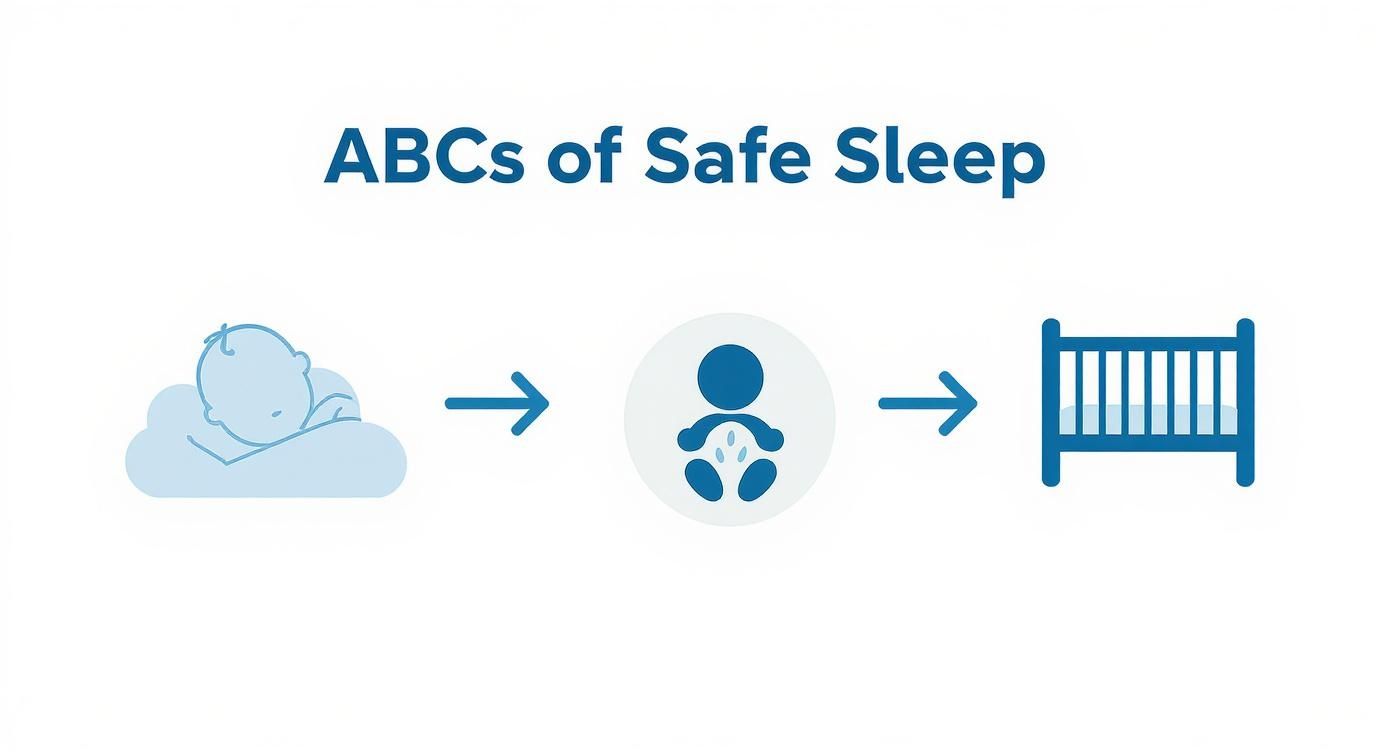
Think of it as a simple, visual checklist: baby is alone, placed on their back, and the crib is totally clear. Each step is an essential piece of the safety puzzle.
Banishing Common Crib Hazards
I get it—those coordinated nursery sets with plush bumpers and matching blankets are adorable. But when it comes to the crib, they're straight-up hazardous. It’s time to be ruthless and remove anything that isn't the mattress and fitted sheet.
Here’s what needs to go:
- Pillows: Even the small, decorative ones are a major suffocation risk.
- Blankets: Any loose bedding can easily cover a baby's face. Stick to wearable blankets or sleep sacks for warmth.
- Crib Bumpers: Despite being marketed as "safety" products for decades, bumpers are incredibly dangerous. They pose risks for suffocation, entrapment, and even strangulation. They were officially banned for sale in the U.S. back in 2022.
- Stuffed Animals and Toys: A cute teddy bear is great for playtime, but it has no place in the crib during sleep.
- Wedges or Positioners: These products are not safe and can get in the way of a baby’s breathing. The surface should always be completely flat.
The safest crib is an empty crib. It might look stark to our adult eyes, but for a baby, it’s a clear, open space that lets them breathe easily and move without getting tangled up.
Room-Sharing, Not Bed-Sharing
While your baby needs their own separate space for sleeping, they don't have to be in their own separate room. In fact, the American Academy of Pediatrics (AAP) strongly recommends room-sharing without bed-sharing for at least the first six months, and ideally for the first year.
This just means placing the baby's crib or bassinet in your bedroom, within arm's reach of your own bed. Studies have shown this simple setup can decrease the risk of SIDS by as much as 50%. As a bonus, it makes those middle-of-the-night feedings so much easier and gives you peace of mind knowing you can quickly check on them.
Setting the Right Temperature
Finally, let's talk about the room's atmosphere. Overheating is a known risk factor for SIDS, so keeping the nursery at a comfortable, stable temperature is key.
A good rule of thumb is to aim for a temperature that would feel comfortable to a lightly clothed adult—generally somewhere between 68° and 72°F (20° to 22.2°C).
Instead of guessing, just do a quick check by feeling the back of your baby's neck or their tummy. If they feel hot or sweaty, they're too warm. Don't worry if their hands and feet feel a bit cool to the touch; that's completely normal. By focusing on a bare crib and a comfortable room, you're setting the stage for the safest sleep possible.
Dressing Your Baby for Safe and Comfortable Sleep
Figuring out what your baby should wear to bed can feel like a high-stakes guessing game. You know that overheating is a risk factor for SIDS, but you also don't want your little one to be cold. The good news? It's much simpler than you think. You don't need any fancy gadgets—just a simple, time-tested rule of thumb.
The goal is to keep your baby comfortably warm, but never hot. A fantastic starting point is the "one extra layer" rule. Just dress your baby in one more layer of clothing than you’d wear to be comfortable in the same room. For example, if you're comfortable in light pajamas, a simple cotton onesie paired with a lightweight sleep sack is probably perfect for your baby.
This simple guideline helps prevent overheating while making sure they stay cozy. Always keep an eye out for signs of being too warm, like a sweaty neck, damp hair, flushed cheeks, or a heat rash. To get an accurate read on their temperature, feel the back of their neck or their tummy. Their little hands and feet are often naturally cooler, so they aren't a reliable indicator.
The Magic of Wearable Blankets
Since loose blankets are completely off-limits in the crib, what's the alternative? Enter the wearable blanket, also known as a sleep sack. These are the true heroes of safe infant sleep. A sleep sack is essentially a cozy sleeping bag your baby wears, keeping them warm without any risk of fabric accidentally covering their face.
They’re available in different fabrics and weights (often measured in TOG, or Thermal Overall Grade), so you can easily pick the right one for the season:
- Lightweight Cotton: Perfect for warmer rooms or summer nights.
- Fleece or Microfleece: Great for when the temperature drops.
- Muslin: Super breathable and excellent for layering.
Using a sleep sack means you don't need any other bedding, which keeps the crib clear and safe. As a bonus, it can also make it tougher for older babies to try and climb out of their crib!
Getting the clothing right is a huge part of creating a safe sleep environment for infants. If you're ever unsure, this guide on how to tell if your baby is too hot is a fantastic resource.
Swaddling The Right Way and Knowing When to Stop
For newborns, a good swaddle can be a game-changer. It recreates that snug, secure feeling of the womb and often helps them sleep more soundly. But doing it safely means following a few crucial rules—and knowing when its time is up.
A proper swaddle should be snug around the chest but always loose around the hips. This is non-negotiable for healthy hip development, as swaddling too tightly can lead to issues like hip dysplasia. Your baby’s legs need to have enough room to bend up and out into a natural "frog" position. You should also be able to easily slide a couple of fingers between the swaddle and your baby’s chest to make sure it isn’t restricting their breathing.
The most critical swaddling rule is this: you must stop as soon as your baby shows signs of trying to roll over. This milestone usually happens around 3 to 4 months old, but every baby is different.
Once a baby can roll, a swaddle becomes a serious danger. If they manage to roll onto their stomach while swaddled, their arms are trapped, and they can't push themselves up to breathe. When you see those first attempts to roll, it’s time to transition to a sleep sack with their arms out. It might take a few nights for them to get used to the freedom, but it's an absolutely vital step for their safety.
Navigating Common but Unsafe Sleep Scenarios
Parental exhaustion is a force of nature. In those blurry-eyed, middle-of-the-night moments, it’s completely understandable to feel like you’d do anything to get your baby (and yourself) a few minutes of rest. Let's talk about those tempting shortcuts with empathy, not judgment, because every parent has been there.
The goal isn't to add to your stress, but to help you navigate these tough spots without compromising on a safe sleep environment for infants.
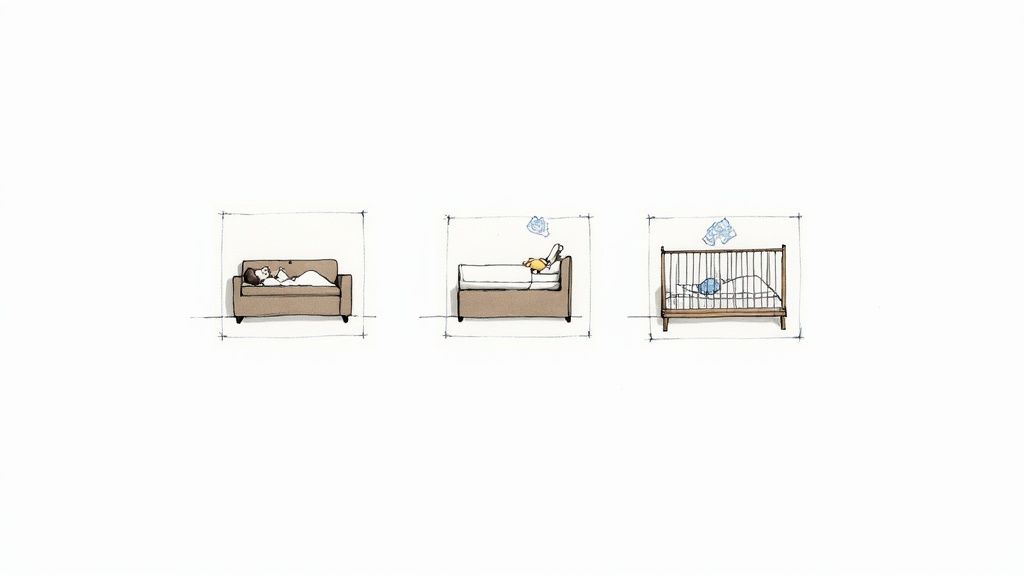
We're going to tackle the most common but risky scenarios—bed-sharing, dozing off on the couch, and using inclined sleepers—and offer safe, practical alternatives. This is about equipping you with better options, so you never feel forced to choose between your baby's safety and your own sanity.
The Reality of Bed-Sharing
Sharing a sleep surface with your baby, often called bed-sharing or co-sleeping, is a practice deeply ingrained in many cultures. It can feel like a natural way to bond and make nighttime feedings easier. However, adult beds are one of the most dangerous places for an infant to sleep.
The soft mattresses, plush pillows, and heavy blankets that we find so comfortable pose serious suffocation and entrapment risks for a baby. An adult can easily roll onto an infant, or a baby can get wedged between the mattress and a headboard or wall. These dangers are exactly why every major safe sleep authority in the U.S. advises against it.
Despite widespread public health campaigns, a recent survey revealed that 46% of parents in the U.S. still reported co-sleeping with their child. This shows a persistent gap between recommendations and what actually happens in tired homes at 3 a.m.
The Danger of Couches and Armchairs
If there's one place that's even more dangerous than an adult bed, it's a couch or armchair. It might seem harmless to doze off while cuddling your baby in a comfy chair, but the risk of death is incredibly high in these scenarios.
The soft cushions can create a pocket that obstructs a baby's breathing, and the very structure of the furniture makes it dangerously easy for an infant to become wedged between a cushion and the adult's body. Tragically, a heartbreaking number of sleep-related infant deaths occur on these surfaces.
If you feel yourself getting drowsy while holding your baby, that's a critical signal to act. Your safest move is to place the baby back in their own safe sleep space—the crib, bassinet, or play yard—before you drift off. It’s better to be awake and tired than to risk a tragedy.
Why Inclined Sleepers Are Unsafe
For years, products like inclined sleepers, rockers, and nappers were marketed to parents as miracle solutions for fussy babies. They seemed perfect for little ones with reflux or congestion. We now know these products are inherently dangerous for sleep.
When a baby is placed on an incline, their head can slump forward into a chin-to-chest position, which can partially or completely block their tiny airway. This is known as positional asphyxia.
Due to these severe risks, the sale of inclined sleepers for infants was officially banned in the United States in 2022. The only safe sleep surface is one that is completely firm and flat.
Safe Alternatives for Desperate Times
Okay, so we've covered what not to do. But what are the safe solutions when you're at your wit's end in the middle of the night?
- Bring the Baby to You, Safely: Room-sharing is the perfect compromise. Keep your baby's bassinet or a portable crib right next to your bed. You get the closeness and convenience for feedings without the risks of bed-sharing.
- Take Shifts: If you have a partner, this is the time to lean on them. Work out a system where one person is "on duty" for a few hours while the other gets uninterrupted sleep in a separate room. Even a solid three-hour block of sleep can make a world of difference.
- Create a Safe "Holding Zone": If your baby will only settle while being held, set yourself up for success. Sit somewhere you can't easily fall asleep, like the middle of the floor away from furniture. Put on a show, scroll on your phone—do what you need to do to stay awake. If you start to feel tired, it's time to put the baby back in their crib.
While avoiding common physical hazards, parents must also be vigilant about less obvious dangers. For instance, understanding what causes carbon monoxide poisoning is vital, as this poses a severe, silent threat to infants in any home environment. By addressing both visible and invisible risks, you create a truly secure space.
Understanding Disparities in Infant Sleep Deaths
It's tough to talk about infant sleep deaths, but it's a conversation we have to have. The data tells a painful story: some communities are hit much harder than others. So, when we discuss creating a safe sleep environment for infants, we also have to face the stark disparities that exist and the systemic problems fueling them.
This is never about blaming parents. It’s about understanding that a family’s ability to follow safe sleep recommendations is tangled up with much bigger social and economic realities. Things like access to good healthcare, culturally aware education, and even stable housing play a huge role in keeping a baby safe.
The Sobering Statistics
The burden of sleep-related infant deaths isn't shared equally. The latest data from 2018 to 2022 in the U.S. shows a devastating gap: the rate of Sudden Unexpected Infant Death (SUID) per 100,000 births was as low as 22 for Asian infants but skyrocketed to 238 for Black infants.
This isn't just a number; it's a reflection of how deeply social determinants of health—like access to education and medical care—affect families. Risk factors we can change, like stomach sleeping, soft bedding, and bed-sharing, are often more common where resources and support are stretched thin. You can learn more about these critical findings from the research.
Behind these statistics are real families and communities carrying an unfair share of grief. Indigenous and Black families, in particular, face higher rates of sleep-related infant deaths, a tragic reality tied to historical and ongoing systemic inequities.
Why Do These Disparities Exist?
The reasons for these gaps are complicated and deeply ingrained in our society. It has absolutely nothing to do with parents in one community caring less than parents in another. It's about an uneven playing field.
Here are a few of the key factors at play:
- Access to Healthcare: Getting good, consistent prenatal and postnatal care is essential. When families can't get insurance, don't have transportation, or can't easily see a pediatrician, they can miss out on critical safe sleep counseling.
- Culturally Competent Education: One-size-fits-all advice often fails. Safe sleep messaging might not land if it doesn't respect a community's cultural practices or traditions around infant care. The information has to come from trusted sources who get it.
- Housing and Economic Instability: Crowded or unstable living situations can make it nearly impossible to create a dedicated safe sleep space. A family struggling to pay for a proper crib might turn to less safe options simply because they have no other choice.
- Systemic Stress: The constant, grinding stress that comes with racism and financial hardship can take a toll on both a parent's and a baby's health, creating another layer of risk.
Acknowledging these disparities is the first real step toward making a difference. It moves the conversation from blaming individuals to finding community-wide solutions that give every family the support they need to keep their baby safe.
When we understand these social determinants of health, we can start pushing for better policies and support systems. That means fighting for better healthcare access, demanding public health campaigns that are culturally relevant, and backing programs that get resources like cribs and sleep sacks directly to the families who need them.
If we want to create a truly safe sleep environment for all babies, we have to tackle these deeper issues with compassion and a real commitment to equity.
Got Questions About Safe Sleep? We've Got Answers.
Even with the best-laid plans for the nursery and the ABCs of safe sleep committed to memory, questions are going to pop up. It’s completely normal. Most of the time, they surface in the middle of the night when you’re second-guessing everything. You’re not the first to wonder, and you won’t be the last.
Let’s walk through some of the most common concerns parents have. Think of this as your 3 AM lifeline.
What If My Baby Falls Asleep in a Car Seat or Swing?
It happens to all of us. You’re five minutes from home, and you glance in the rearview mirror to see your little one sound asleep. While it's perfectly fine for a supervised drive, devices like car seats, swings, bouncers, and strollers are not safe for routine sleep.
The problem is the incline. When a baby is propped up at an angle, their head can slump forward, potentially cutting off their tiny airway. This is a scary situation called positional asphyxia, and it's why a flat surface is non-negotiable for sleep.
The rule of thumb is simple: as soon as you can, move a sleeping baby from their car seat or swing to a crib, bassinet, or play yard. These products are lifesavers for travel and keeping an eye on your baby while you make dinner, but they should never be a substitute for a proper, flat sleep space.
Should We Use a Pacifier at Bedtime?
This is a fantastic question, and the answer from experts is a clear "yes." Offering a pacifier at both naptime and bedtime is consistently shown to reduce the risk of SIDS. Scientists aren't 100% sure why it helps, but it’s one of the simplest protective steps you can take.
Just offer it when you lay your baby down to sleep. If they're not into it, don't force it.
And if it falls out after they’ve drifted off? Don't worry about it. There's no need to tiptoe in and pop it back in their mouth. The protective benefit is already in effect for that sleep session. The most important thing is to use a simple, one-piece pacifier with no cords, clips, or stuffed animals attached—those are serious strangulation hazards.
A pacifier is a small thing that can make a big difference. Adding it to your sleep routine is an easy way to add another layer of safety for your baby.
Help! My Baby Keeps Rolling Onto Their Stomach!
First, take a deep breath and a moment to celebrate! Rolling over is a huge developmental milestone and a sign that your baby is getting stronger. It's also a cue that your safe sleep practices need a slight adjustment.
Once your baby can roll from back to front and front to back consistently and on their own, you don't have to stay up all night flipping them over. Their ability to move themselves means they can get into a position where they can breathe easily.
However—and this is critical—you must always place them on their back at the start of sleep for their entire first year. This new mobility also makes a completely empty crib more important than ever. For a baby who can roll and wiggle, any loose blankets, bumpers, or soft toys become much bigger risks.
Are Smart Socks and Breathing Monitors Worth the Money?
In the last few years, a flood of high-tech baby monitors has hit the market, promising to track everything from a baby's heart rate to their oxygen levels. For new parents navigating a sea of anxiety, these gadgets can feel like a must-have.
Here’s the reality: The American Academy of Pediatrics (AAP) does not recommend these consumer-grade monitors as a way to prevent SIDS. The reason is straightforward: there is no scientific evidence that they work.
These devices aren't medical-grade and are known to cause false alarms, which can send any parent into a panic. Even worse, they can create a false sense of security, which might lead parents to become a little less strict about following the proven safe sleep rules.
The best "monitor" is a caregiver who sticks to the ABCs of safe sleep every single time. A safe environment is far more protective than any gadget you can buy.
At Hiccapop, we believe peace of mind comes from knowing your baby is safe. From our rigorously tested crib mattresses to our smart, portable sleep solutions, we design every product to help you create the safest space for your little one so you can both rest a little easier. Explore our collection of parent-approved baby essentials at https://hiccapop.com.
We know this is a lot to take in, but you've got this. Every time you place your baby alone, on their back, in a clear crib, you’re doing the most important thing you can to protect them.
What's your biggest safe-sleep question? Drop it in the comments below—we're all in this together