


Your Guide to a Smooth Transition to One Nap
Deciding when your toddler should drop from two naps to one is a huge milestone—and honestly, it can feel like a bit of a guessing game. Most little ones make this shift somewhere between 13-18 months, but if there’s one piece of advice I can give, it’s this: don’t rush it. It's so easy to mistake a temporary sleep regression for a sign that they're ready, but sticking with two naps for as long as you can is almost always the best move.
Is It Really Time to Transition to One Nap?
So, how do you know for sure? You’re trying to solve a toddler-sized riddle: Is this a developmental leap, a classic sleep regression, or are they genuinely ready to consolidate their daytime sleep? Getting this right is the key to avoiding a premature switch that just leaves everyone overtired and cranky. While the average age is around 15 months, forget the calendar and focus on your child's unique cues.
This transition is a natural part of their development. A major sleep survey revealed that 80-90% of children make the one-nap switch between 13 and 18 months. This is when their bodies can handle longer stretches of awake time and their nighttime sleep starts getting more solid.
Before you make any big changes, use this quick checklist. Are you seeing these behaviors consistently, or are they just popping up on a random Tuesday? This will help you figure out if it's a true sign or just a phase.
Readiness Checklist: Is It Time for One Nap?
| Sign of Readiness | What It Looks Like in Action | Is It a True Sign? |
|---|---|---|
| Nap Refusal | Your child consistently refuses one nap, usually the afternoon one. They might play in their crib for an hour or protest loudly, but sleep just doesn't happen. | Yes, if this happens for 1-2 weeks straight. An occasional skipped nap is normal. |
| Short Naps | The second nap, which used to be a solid hour or more, has turned into a 20-30 minute power nap that leaves them grumpy. | Yes, especially if they aren't tired enough to take a full nap but are too tired to skip it. |
| Bedtime Battles | Suddenly, bedtime is a struggle. You're fitting in two naps, but your toddler isn't tired until 8:30 or 9:00 PM. | This is a strong indicator. It means their daytime sleep is starting to steal from their nighttime sleep. |
| Early Waking | Your toddler is suddenly waking for the day at 5 AM. Consistently. | Yes, this is a classic sign their sleep schedule is off-balance. |
| General Fussiness | They're just cranky and seem overtired, but you can't figure out why. | Maybe. This could also be a sign of a sleep regression, teething, or illness. Look for other signs too. |
Remember, the key here is consistency. A few off-days don't mean you need to overhaul your entire routine. Wait until you see a clear, undeniable pattern before making a move.
Consistent Signs Your Toddler Is Ready
One bad nap day doesn't mean it's time to change everything. True readiness isn't a fluke; it's a pattern that shows up for at least one to two weeks. If you're nodding along to the points below day after day, it’s probably time to start planning the transition.
- Nap Refusals Become the Norm: The afternoon nap is almost always the first to go. Your toddler might be perfectly happy chatting to their stuffed animals in the crib, but they simply won't fall asleep.
- Naps Get Super Short: What was once a reliable, restorative nap is now a frustrating 30-minute catnap. Worse, they often wake up crying and clearly still tired.
- Bedtime Gets Pushed Way Too Late: After that second nap, your child is wired. You find yourself starting the bedtime routine later and later, sometimes not getting them down until 9:00 PM, which can really eat into their total overnight sleep.
- Early Morning Wakings Appear: The 5:00 AM wake-up call is a classic sign that their sleep schedule needs a reset. Too much daytime sleep is often the culprit.
Distinguishing Readiness from a Regression
It's incredibly easy to mistake a sleep regression for readiness to drop a nap. Regressions often rear their heads around major childhood development milestones, like when your toddler starts walking or has a language explosion. Their little brains are just too busy to sleep!
A regression is temporary, usually lasting a couple of weeks. If your toddler’s sleep issues resolve on their own, they weren’t ready to drop the nap. Stick with your two-nap schedule until the signs of readiness are unmistakable and consistent.
Getting a handle on your little one's changing sleep needs, especially their wake windows, is a huge piece of this puzzle. To get a better grasp on where they are developmentally, check out our detailed guide on wake windows by age. It can really help you see the bigger picture of their sleep patterns.
Crafting a Realistic One-Nap Schedule
Alright, you've spotted the signs and you're confident your toddler is ready to drop a nap. Now for the fun part: figuring out what your new day-to-day rhythm looks like. The whole point of this transition is to consolidate two shorter naps into one long, restorative midday sleep that powers them through until bedtime.
The biggest challenge? Stretching that morning wake window. It’s often the toughest piece of the puzzle.
On a two-nap schedule, your little one is used to shorter periods of being awake. To make the one-nap schedule work, you need to gradually push that first stretch of awake time to about 5-6 hours.
This timeline gives you a good visual for when most toddlers make this major sleep leap.
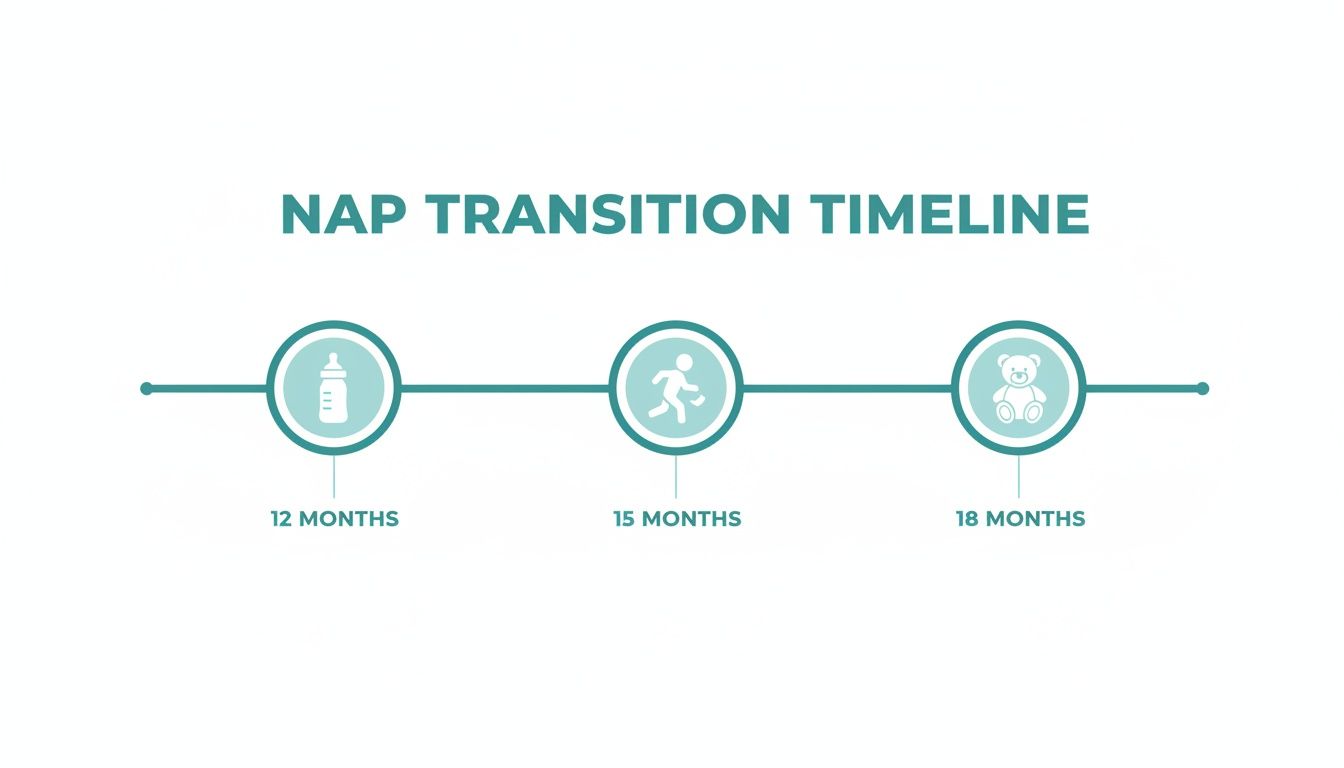
As you can see, while some early birds might be ready around 12 months, the real sweet spot for most is between 15 and 18 months. This gives their bodies and brains enough time to mature and handle those longer stretches of activity.
Finding Your Family's New Rhythm
If there’s one thing to remember, it’s this: be flexible. A great one-nap schedule isn't about staring at the clock. It's about reading your child’s cues while gently nudging them toward a new routine. Ultimately, you're aiming for a single nap that kicks off somewhere between 12:00 PM and 1:00 PM.
Let's walk through a real-life example. Imagine your 14-month-old's day used to look like this:
- Wakes Up: 7:00 AM
- Nap 1: 10:00 AM
- Nap 2: 2:30 PM
- Goes to Bed: 7:30 PM
The new goal schedule you're working toward might be something like this:
- Wakes Up: 7:00 AM
- Nap: 12:30 PM
- Goes to Bed: 7:00 PM
Getting from the old schedule to the new one takes time and a boatload of patience. You’ll be slowly inching that morning nap later and later, which can feel like an eternity when you have a fussy toddler on your hands. Understanding how wake windows change over time is a game-changer. For a little context on how much they change, check out our guide to 9-month-old wake windows.
The biggest enemy you'll face during this transition is overtiredness. Moving bedtime earlier isn't a failure—it's actually your secret weapon for preventing a sleep debt from piling up while their body adjusts.
Sample One-Nap Schedule
Every toddler is unique, but it helps to have a blueprint to start from. Think of this as a guide, and don't be afraid to tweak it based on your child's sleep cues and how long they actually nap.
Example Schedule for a 15- to 18-Month-Old:
- 7:00 AM: Good morning! Time to start the day.
- 7:30 AM: Breakfast
- 9:30 AM: Morning snack
- 11:45 AM: Lunch
- 12:30 PM - 2:30 PM: Nap time
- 3:00 PM: Afternoon snack
- 5:30 PM: Dinner
- 6:30 PM: Begin the wind-down and bedtime routine
- 7:00 PM: Asleep for the night
As you're finding your groove, if that midday nap ends up being short (think less than 90 minutes), pull bedtime forward. Seriously. A 6:00 or 6:30 PM bedtime can save the day and prevent the overtiredness that leads to rough nights and super early mornings. Once they get the hang of the new routine, their schedule will become much more predictable.
Proven Methods for Making the Switch
Once you’re sure your little one is ready to drop a nap, you’ve got two main roads you can take. There’s no single "right" way to handle the transition to one nap; the best method really comes down to your child’s personality and what feels right for your family.
Think of it as choosing between a slow, scenic route or a direct, high-speed expressway.
Some toddlers ease into a new routine beautifully with a gradual shift, while others actually do better with a quick, decisive change. Let’s walk through both of these parent-tested strategies.
The Gradual Approach: Slow and Steady
The gradual method is a popular go-to for a reason—it’s gentle and gives your toddler’s internal clock plenty of time to catch up. The whole idea is to slowly push that morning nap later and later, day by day, until it settles into one solid midday nap.
Here’s what that looks like in the real world:
- Days 1-3: Start by pushing the morning nap back by just 15-30 minutes. If they normally go down at 10:00 AM, you’ll aim for 10:15 or 10:30 AM.
- Days 4-6: Nudge it a little further, another 15-30 minutes. Now you're shooting for a 10:45 or 11:00 AM start time.
- Keep at it: Continue this pattern every few days until the nap naturally begins somewhere around 12:00 PM or 12:30 PM.
This slow-and-steady pace helps you avoid the dreaded overtired-meltdown cycle. As the first nap moves later, that second afternoon catnap will get shorter and eventually just fade away. An earlier bedtime is your best friend during this phase to help them make up for any lost daytime sleep.
The Cold Turkey Method: Just Rip the Band-Aid Off
If the gradual approach sounds like it would just prolong the pain, the "cold turkey" method might be a better fit. It’s exactly what it sounds like: you pick a day, and you just go for it, jumping straight to a one-nap schedule.
This strategy often works well for more adaptable, easy-going toddlers. It can also be a lifesaver if a gradual shift isn't practical, like when your child starts a new daycare that has a set nap time for their room.
The secret to success here is managing that first long stretch of awake time in the morning. You'll need to pull out all the stops to keep your toddler busy and happy. Think sensory bins, a trip to the park, or a playdate with a friend to distract them from feeling sleepy. They’ll likely be a bit cranky for a few days, but you might be surprised at how quickly their bodies adjust.
Comparing Nap Transition Methods
Deciding between a gradual shift and a quick change can be tough. This little cheat sheet breaks down which approach might be the best fit for your family's situation.
| Transition Method | Best For... | Potential Challenges |
|---|---|---|
| The Gradual Approach | Sensitive toddlers, parents who prefer a gentle process, or when you have a flexible schedule. | Can take several weeks; may involve a few days of awkward "in-between" schedules. |
| The Cold Turkey Method | Adaptable toddlers, families needing a quick change (e.g., new daycare), or when the gradual method isn't working. | Can lead to overtiredness and crankiness for the first few days; requires more intensive distraction. |
Ultimately, both paths lead to the same destination: a happy toddler on a solid one-nap schedule. Pick the one that feels the most manageable for you.
No matter which method you choose, a consistent sleep environment is crucial. A dark room signals to your toddler's brain that it's time for sleep, even if the sun is still up. For more ideas, you might consider options for creating a dark sleep environment with window film to make midday naps more successful.
Both of these methods are valid ways to guide your child through this major developmental step. If you're looking for more in-depth strategies, our guide on different toddler sleep training methods has some great insights. The most important thing is to stay consistent and have a plan for handling the inevitable bumps along the way.
How to Handle Common Nap Transition Problems
Even the most perfect plan can go sideways when you're dealing with a toddler's ever-changing sleep needs. The transition to one nap is notorious for throwing parents a few curveballs, but trust me—most of these bumps are temporary and totally fixable once you know what to do.
Think of this as your field guide for those tough days. Let's walk through the most common headaches I see parents run into and get you some practical solutions that actually work.
The Dreaded "Danger Nap"
You know exactly what I'm talking about. You're five minutes from home, you peek in the rearview mirror, and... yep. Your toddler is completely passed out in their car seat. This late-afternoon micro-snooze, lovingly called the “danger nap,” can absolutely wreck bedtime.
That little catnap is just enough to recharge their battery, making them ready to party for hours when they should be winding down for the night.
So, what do you do?
- Try to avoid it. If you can, schedule errands for earlier in the day when your little one isn't on the brink of exhaustion. If you have to be in the car, try cracking a window, singing loudly, or handing them a snack to keep them awake.
- Cap it if it happens. Sometimes, it's just unavoidable. If they do fall asleep, keep it incredibly short—we're talking 15-20 minutes, max. As soon as you're home, it's time to gently wake them up.
- Push bedtime back. A danger nap means you'll need to adjust. If they caught a 20-minute snooze at 4:30 PM, you'll probably need to delay bedtime by at least 30-45 minutes to give them a chance to get tired again.
When Their One Nap Is Too Short
A 45-minute nap just isn't going to get you through the afternoon. When your toddler pops up from their only nap of the day way too early—and they're clearly still tired and cranky—it can feel like the day will never end. This is a tell-tale sign that they were overtired going into the nap from stretching that morning wake window too far, too fast.
After a short nap, an extra-early bedtime is your absolute best friend. I know it sounds backward, but putting them to bed as early as 6:00 or 6:30 PM is the single best way to repay that sleep debt and stop a nasty cycle of bad naps and rough nights.
Seriously, don't hesitate to pull bedtime way, way up. Just one or two super-early nights can be the reset your child needs to get back to taking a long, restorative nap the following day.
Using Quiet Time as a Nap Substitute
Some days, the nap just isn't going to happen. No matter what you do, they’ll just protest, play, or chat with their stuffed animals in the crib. On these days, instead of fighting a losing battle, pivot to "quiet time."
Let your toddler hang out in their crib for about an hour with a few board books or a lovey. It’s not a punishment; it’s just a chance for their bodies and brains to get a low-stimulation break. Even without sleep, this downtime is incredibly helpful.
Of course, on a no-nap day, an early bedtime is absolutely non-negotiable.
Why an Earlier Bedtime Is Your Secret Weapon
I know it sounds completely backward. Your little one is sleeping less during the day, so shouldn't they go to bed later? It’s a logical thought, but in my experience, the single most powerful tool you have during the transition to one nap is actually a much earlier bedtime.
When your toddler drops that second nap, they're losing a big chunk of their total daily sleep. This almost always creates a temporary sleep debt—think of it as their sleep tank running on fumes. The only real way to refill that tank and avoid a meltdown-filled spiral into overtiredness is to tack on more sleep at night.
Overtiredness Is the Enemy
Here's the thing about overtired toddlers: they don't sleep better, they sleep worse. A whole lot worse. Their little bodies get flooded with cortisol, a stress hormone that works like a shot of adrenaline right when you want them to be winding down. This is the culprit behind those epic bedtime battles, frustrating middle-of-the-night wakeups, and the dreaded 5 AM "good morning."
Moving bedtime earlier isn't giving in—it's a smart, proactive strategy. You're getting them into bed before that cortisol wave hits, allowing them to get the deep, restorative sleep they desperately need to cope with their new schedule.
Don't be afraid to move bedtime up by a full 30-60 minutes during the first couple of weeks. It might feel ridiculously early, but it works wonders.
Putting an Earlier Bedtime Into Practice
So, what does this actually look like on a day-to-day basis? It's pretty straightforward. If bedtime was normally 7:30 PM, you’ll now want to aim for somewhere between 6:30 and 7:00 PM for a while.
Watch for their cues and be flexible. Here are a couple of common scenarios:
- The nap was a bust: If that one and only nap was a short one (less than 90 minutes), an extra-early bedtime is a must. I’m talking 6:00 or 6:30 PM to help them catch up on that lost rest.
- They're a mess by dinner: Is your toddler rubbing their eyes and melting down at the dinner table? Don’t try to push them through to the old bedtime. That's your signal. Start your wind-down routine right then and there.
For example, if your 15-month-old used to sleep from 8:00 PM to 7:00 AM on two naps, shifting to a 7:00 PM bedtime can be a game-changer. This temporary schedule gives them a solid 12-13 hours of overnight sleep, which is often exactly what their body needs to handle those longer wake windows the next day without crashing.
Once their single nap starts getting longer and more reliable, you can slowly nudge bedtime back toward your old normal. But for now, lean into the early night. It's truly the key to a smoother, less tear-filled transition for everyone.
Common Questions About the One-Nap Transition
Moving to one nap can feel like navigating a minefield of "what-ifs." It's a tricky phase, and it’s completely normal to have a ton of questions. Let’s walk through some of the most common concerns I hear from parents so you can feel more confident, even when the days get a little bumpy.
How Long Does This Transition Usually Take?
Honestly, every little one is different, but you can generally expect this whole adjustment to take anywhere from two to four weeks. Don't be surprised if it's a bit of a dance—a few one-nap days, then a day where they absolutely need a second nap to make it through.
That's totally normal. You might have three fantastic one-nap days in a row, only for your toddler to be a wreck on day four, requiring a little catnap in the afternoon.
The key is being consistent but not rigid. If you've been trying for a solid month and things are still a mess, it might just mean your toddler wasn't quite there yet. There's no harm in pressing pause and trying again in a few weeks.
What Do I Do if They Wake Up Early from Their Only Nap?
Ugh, the short nap. It can feel like it completely derails the rest of your day. If your toddler is up and grumpy after just 45 minutes, the first thing to do is wait. Give them about 10 to 15 minutes to see if they can connect their sleep cycles and fall back asleep on their own. You'd be surprised how often they just need a quiet moment to drift back off.
If it's clear they're up for good, your new game plan is a super calm, low-key afternoon. This is not the day for errands or a chaotic playdate. Your main goal is to help them conserve whatever energy they have left.
Then, and this is the most important part, aim for a much earlier bedtime. I’m talking as early as 6:00 or 6:30 PM. This is your single best tool for preventing a nasty cycle of overtiredness and helping them make up for that lost daytime sleep.
My Daycare Is Switching My 12-Month-Old to One Nap, but I Don't Think They're Ready.
This is an incredibly common—and stressful—situation. For logistical reasons, many daycares have to move the whole classroom to a single nap schedule, often before every child is truly ready for it.
First, talk to the daycare director or your child's main caregiver. Share your concerns calmly and ask if there’s any wiggle room. Could they possibly let your little one have a quick morning catnap in a swing or a quiet corner? Sometimes they can accommodate, sometimes they can't.
If their policy is firm, shift your focus to what you can control at home.
Here’s how to handle it:
- On daycare days: An extra-early bedtime is your new best friend. Make it non-negotiable. This is how you'll compensate for the sleep they're missing during the day.
- On weekends and days off: You've got a choice. You can either stick with one nap to keep things consistent with their daycare schedule, or you can offer two naps if your child is clearly wiped out.
Often, a few weeks of bridging the gap with more night sleep is all it takes for them to finally adapt to the daycare routine.
At Hiccapop, we know that every sleep transition brings its own unique challenges. We design our products to help create the safest, most comfortable sleep space possible, giving your little one the restorative rest they need to grow and thrive. You can explore our collection of nursery essentials at https://hiccapop.com to help make every nap a little easier.