


Sleep Safe Mattress Cover for Infants and Toddlers
You find a wet crib sheet in the middle of the night. Your baby needs a dry place to sleep, you need clean pajamas, and the thick quilted pad in the drawer suddenly looks like a sensible solution. Before you reach for it, pause: protecting the mattress and protecting the sleep surface aren't quite the same job.
Disclosure: Hiccapop makes and sells crib mattresses and travel beds. This post is general information, not medical advice.
When a Leak Makes Padding Look Like the Answer
A leak creates an immediate problem you can see and feel. Added cushioning creates a different question: what happens to the mattress once that extra layer goes on? A plush liner might absorb moisture while also changing the surface your baby sleeps on.
That's why a baby mattress cover should be evaluated as part of the finished bed, not as a piece of fabric on its own. The mattress, cover, fitted sheet, and sleep-space frame need to work together. A tidy package photo can't show how those pieces will fit in your home.
Protection Isn't Padding
Think of a cover as a protective wrapper, not a miniature comforter. Its job is to help manage moisture without turning the mattress into something softer, thicker, or uneven. The CDC's infant sleep guidance recommends a firm, flat, level sleep surface covered by a fitted sheet, rather than a cushioned sleeping area.
For expecting parents, this distinction helps narrow a confusing shopping list. For caregivers and babysitters, it explains why adding a blanket underneath the sheet isn't a harmless shortcut. For gift buyers, it means a beautifully quilted accessory may be less useful than a correctly sized, low-profile protector.
Practical rule: Choose protection that preserves the sleep surface, not padding that changes it.
Keep general bedding comparisons separate from infant-specific guidance. A product that sounds comfortable for an adult bed isn't automatically suitable for a crib.
Look Beyond the Waterproof Label
The useful questions are concrete:
- Surface: Does the installed cover add cushion or leave raised folds?
- Compatibility: Is it intended for this mattress and sleep space?
- Finished fit: Does the fitted sheet stay secure once the cover is underneath?
These checks help you decide whether an existing cover should stay or go without relying on claims that any cover prevents sleep-related death. Waterproofing is useful only after firmness, flatness, and fit survive the added layer.
What the Right Cover Really Means
A cover doesn't need to improve an infant mattress's comfort. It needs to preserve the mattress's intended sleep surface. For babies, the adult preference for a soft, nest-like bed points in the wrong direction.
The American Academy of Pediatrics' infant sleep guidance recommends placing infants on their backs in their own sleep space, on a firm, flat mattress with a fitted sheet. Blankets, pillows, toys, bumpers, and other soft objects stay out.
Firm, Flat, and Fitted Have Different Jobs
Firm means the surface maintains its shape rather than forming a pocket around the baby's head. Flat means there's no incline or hammock-like contour. Fitted means the material stays secure instead of gathering into loose folds.
Missouri's explanation of the AAP recommendations describes why softness matters: a face-conforming indentation can contribute to rebreathing or suffocation risk. A thin cover that stays taut is therefore a more appropriate design direction than a plush pad that changes the surface.
The relationship is easier to see as a whole system:

Why Compatibility Deserves Attention
This isn't just a matter of bedding preference. The CPSC's crib-mattress safety announcement describes 494 incidents between January 2010 and April 2021, including 139 fatalities and 355 nonfatal incidents. In January 2022, the agency approved a standard addressing excessive softness, poor fit, coil-spring injuries, and inadequate safety information.
Those incidents weren't evidence that mattress covers caused each problem. They explain why mattress characteristics and compatibility deserve more attention than a waterproof label.
- Keep the intended shape: A cover shouldn't pull the mattress into a curve.
- Preserve the surface: Skip added padding, toppers, and loose material.
- Respect the instructions: Compatibility includes the mattress and fitted sheet, not just the cover's dimensions.
A protector can help with housekeeping, but it can't fix an unsuitable sleep environment.
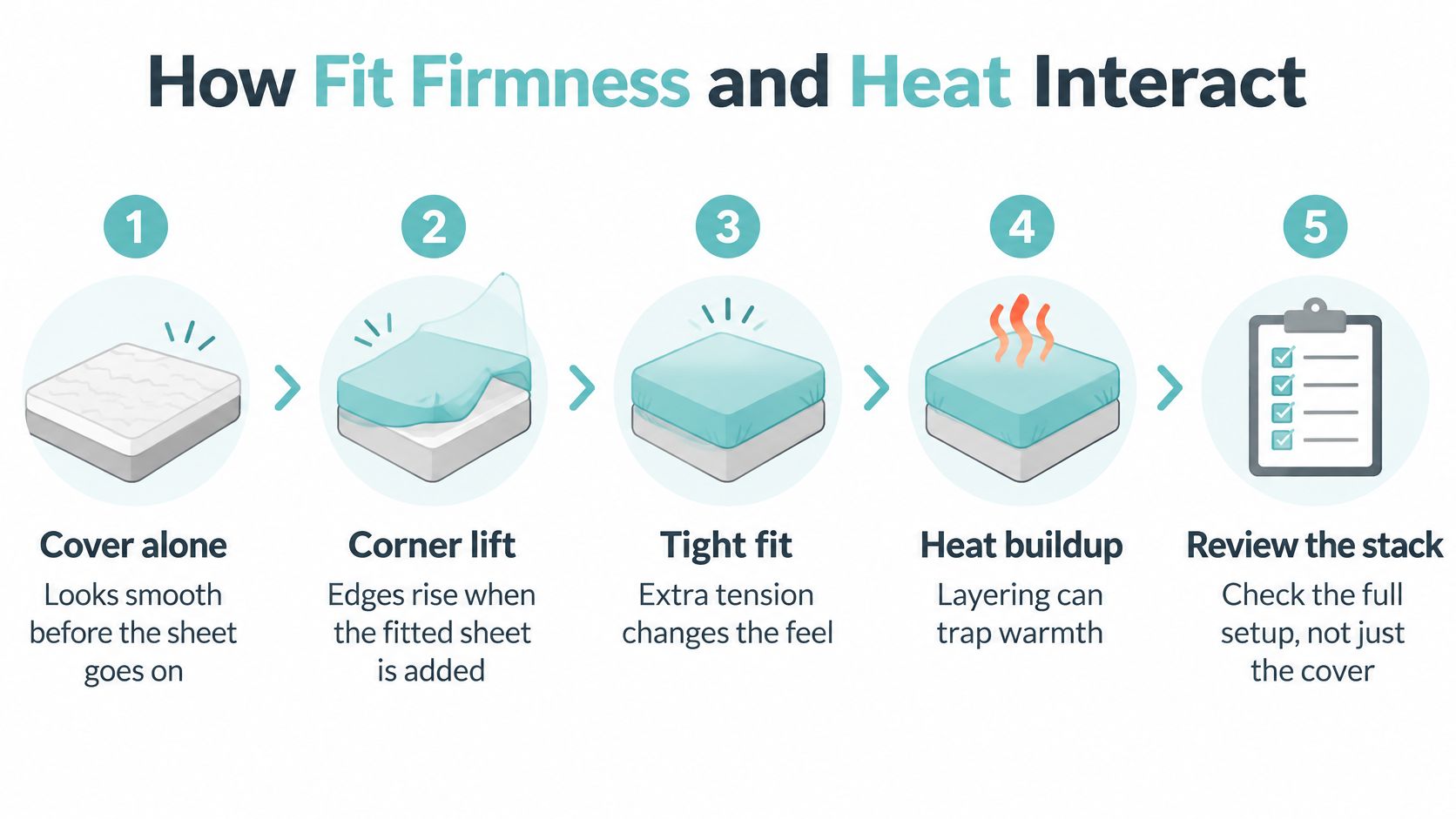
How Fit, Firmness, and Heat Interact
A cover can look smooth before the sheet goes on and still fail the finished-setup check. Imagine fitting the cover neatly, then stretching a tight sheet over it. A mattress corner rises, the rim curls inward, or the sheet slips back from the underside.
Those aren't separate cosmetic annoyances. They're clues that the added layer has changed how the pieces interact.
Inspect the Finished Stack
Start with the bare mattress positioned as its instructions require. Add the compatible cover, then the fitted sheet, watching for changes at each stage. Don't accept a corner that stays down only while you're holding it.
For a common full-size U.S. crib, CPSC defines the interior as about 28 by 52 3/8 inches, and it says all 139 deaths in its crib-mattress rule were potentially related to compatibility factors such as firmness, fit, and thickness. Push the mattress firmly into one corner and look at the opposite side. If the gap looks large or the mattress slides easily, it may not match the crib, so check both labels before the next sleep. This is a home check, not a lab test, and it doesn't apply to play yards or other portable sleep products.
Look for these interactions when the bed is fully made:
Include Warmth Without Guessing at Materials
“Breathable” doesn't establish that a cover is a better choice, and “waterproof” doesn't tell you how the complete bedding arrangement will feel. Compare the actual construction and instructions rather than assuming either label settles the question.
The AAP’s 2022 policy on sleep-related infant deaths identifies overheating as a SIDS risk factor and advises checking for signs such as sweating, flushed skin, or a hot chest. You can also review baby room temperature considerations, while remembering that room conditions don't excuse excessive clothing or bedding.
- Mattress first: Check its position and original shape.
- Cover next: Look for edge compression, wrinkles, or lifted corners.
- Sheet last: Confirm that it grips securely without distorting anything underneath.
- Baby's comfort: Watch for overheating during use rather than trusting fabric marketing.
A smooth cover isn't enough. The finished bed needs to stay smooth after the sheet is on.
If you see bunching, pocketing, or a changed edge gap, stop and reset the setup. Adding another layer won't correct an incompatible one.
Checking Real Cribs, Play Yards, and Toddler Beds
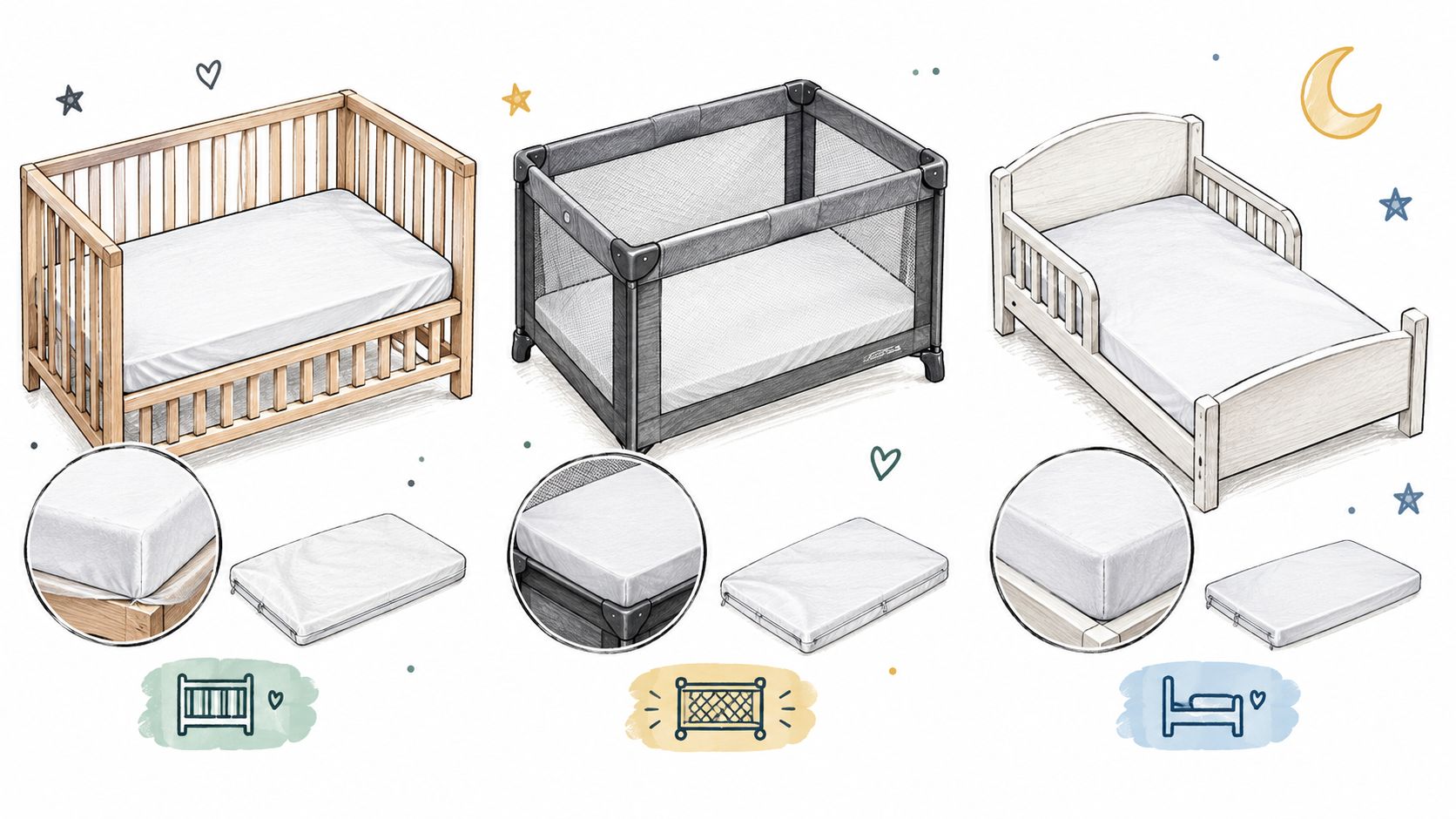
The same cover shouldn't automatically move between every bed in the house. A rigid crib mattress, a portable play-yard surface, and a toddler bed may look similar in a shopping listing, but their instructions and fit requirements can differ.
These examples show where to focus your inspection:
A Full-Size Crib at Home
Consider a thin protector made for the exact crib mattress. After installing it, the caregiver pulls the fitted sheet over the corners so it overlaps the underside. Nothing sits above the sheet.
The decision comes from inspection, not appearance alone. Check whether a corner has lifted, whether fabric gathers where the baby's face might rest, and whether the crib gap remains acceptable using the check described earlier. If the cover only stays smooth when tucked or folded into place, it isn't a workable match.
A Play Yard Away From Home
Now consider packing that crib protector for a visit to grandparents. Similar length and width don't establish compatibility with a play yard. Flexible sides make the relationship between the pad, thickness, and perimeter especially important, which is why CPSC's 2022 crib mattress standard also addressed gaps against flexible play-yard sides.
Follow the sleep product's compatibility instructions. Don't add a second mattress or folded blanket to make an accessory fit, and don't assume a cover permitted on a crib mattress is permitted here.
For a closer look at portable-sleep decisions, use the play-yard mattress safety guide.
A Toddler Transition and a Gift Purchase
A toddler moving to a different bed needs bedding appropriate to that child's development and the bed's instructions. Don't use an older child's comfort preferences to decide what belongs in an infant's sleep space, even when the children share a room.
For a shower gift, exact compatibility beats decorative quilting. Ask which mattress the family owns before buying a protector, or let the parents choose the size.
- Keep it: The accessory is permitted, fits correctly, and passes the finished-setup inspection.
- Remove it: It needs improvised stuffing, changes the surface, or won't stay secure.
- Recheck it: Repeat the inspection after laundering and after another caregiver remakes the bed.
These are illustrative setups, not product tests. A home inspection can reveal a problem, but it can't verify an accessory against a standard.
Cleaning Covers Without Losing the Fit
A wet sheet calls for a cleaning routine, not an improvised absorbent layer. Remove the soiled bedding and inspect underneath before rebuilding the bed. If moisture reached the mattress, changing only the sheet leaves part of the job unfinished.
San Francisco's infant sleeping equipment guidance provides a useful model for shared-care settings. It calls for firm, flat mattresses sized to the crib, moisture-resistant coverings without exposed foam or coils, and fitted sheets that stay tight and overlap the underside. It also requires suitable disinfection daily and whenever mattresses are soiled or wet, using a product that doesn't worsen asthma or other respiratory conditions.
A Repeatable Cleanup Routine
- Remove and inspect: Take off the wet sheet and cover. Check the mattress for moisture and visible damage.
- Follow the care label: Use the cover's specified washing and drying methods. Don't assume hotter is better.
- Clean underneath when needed: Follow mattress instructions and cleaning-product labels, including directions for residue and drying.
- Rebuild only when dry: Inspect the cover's shape and elastic before putting the fitted sheet back on.
For daycare-style turnover, keep care instructions available to whoever handles laundry. A cover that returns clean but shrunken, loose, or damaged isn't ready just because it smells freshly washed.
Laundry checkpoint: Cleanliness doesn't cancel a fit problem. Inspect the cover again before putting it back into service.
What Washing Can't Promise
Washing removes soil according to the product's care process. It doesn't prove that a coating is free of every chemical, and unsuitable heat may damage some waterproof membranes. Without product-specific testing, you can't infer long-term waterproof performance from the first wash.
A peer-reviewed study published in 2025 reported that children may experience increased exposure to semivolatile organic compounds in their sleeping microenvironment, including compounds associated with plasticizers and flame-retardant-related materials. That finding does not establish that a particular mattress cover is harmful, or that washing eliminates the exposures studied.
It does support asking careful questions about coatings, material disclosure, emissions testing, and what a material or emissions label actually covers. Odor alone doesn't identify a chemical or measure risk, but a strong or persistent smell is a sensible reason to pause use and contact the manufacturer.
Air out strong-smelling items before use according to their instructions. Retire a cover that cracks, peels, loses its fit, or retains an odor after appropriate care. Never use a towel beneath the baby as a shortcut dryer or extra absorber.
How to Choose a Baby Mattress Cover
A parent picks up a cover labeled "universal fit," stretches it over the crib mattress at home, and the corners of the mattress curl slightly upward. The cover fit. The mattress shape changed. That small difference is exactly what shopping for a crib mattress cover is about.
Start with the sleep product's own instructions, then measure the actual mattress rather than trusting size labels. "Standard" and "universal" describe marketing categories, not a match to your bed. A promising material can still be the wrong product for your setup.
The CPSC's crib mattress safety standard explains that dimensional requirements exist to prevent entrapment gaps between mattress and crib wall. For shopping, the question isn't whether a cover stretches over the mattress. It's whether the mattress keeps its intended shape once the cover is on.
Cover Choices by Real-World Behavior
Thin fitted waterproof cover
- Fit and thickness: Match the exact mattress; avoid added loft.
- Sheet and heat check: Confirm secure sheet grip and review warmth during use.
- Choose or reject: Consider when permitted and the complete setup remains unchanged.
Breathable laminated cover
- Fit and thickness: Check construction rather than relying on the label.
- Sheet and heat check: Inspect sheet grip; breathable isn't a verdict on its own.
- Choose or reject: Consider only with confirmed compatibility.
Quilted or padded liner
- Fit and thickness: May introduce cushioning or extra thickness.
- Sheet and heat check: A smooth sheet doesn't cancel softness underneath.
- Choose or reject: Reject for an infant if it adds cushioning.
No separate cover, fitted sheet only
- Fit and thickness: Adds no protective accessory.
- Sheet and heat check: Check sheet fit and follow mattress care instructions.
- Choose or reject: Consider when consistent with the mattress instructions.
Ask for Specific Answers
Before buying, check what the seller can tell you about the actual product:
- Compatibility: Which mattress dimensions and sleep products is it intended for?
- Construction: Does it add cushioning, and what forms the waterproof barrier?
- Care: What laundering methods are permitted, and what damage means replacement?
- Evidence: Does testing address materials, emissions, waterproofing, or the complete mattress assembly?
Each question answers a different risk. A material label doesn't tell you whether the cover fits your crib. Regulatory compliance doesn't prove a cover reduces SIDS risk. And the chemical-exposure research discussed earlier can't rank one cover against another without product-specific testing.
Keep your match list short: exact size, permitted use, low profile, secure fit, and a fitted sheet that stays in place. Reject any option that needs extra padding or changes the mattress to make it work.
A Better Setup Before Bedtime
Tonight's check starts with the bed your baby will use, assembled the way it will be at 2 a.m. A cover earns its place only if the whole surface still behaves the way the mattress was designed to: flat, firm, and holding the sheet in place. If the maker of your crib, play yard, or toddler bed permits a cover, keep the layers to the mattress, that approved cover, and a fitted sheet. Folded towels, pads, or extra blankets change the surface in ways no label can predict.
Run the check with your hands and eyes together. If it’s a full-size crib, do the corner-and-gap test. For a play yard or toddler bed, follow that product’s fit instructions. Then press a flat hand across the middle and the edges. Feel for new cushioning, fabric bunching under the sheet, or a cover pulling the mattress corners upward. Your palm is not a firmness meter, so a surface that feels fine still has to match the manufacturer's compatibility instructions.
When the Setup Tells You Something
- The cover shifts or bunches: remove it and recheck the instructions before the next sleep.
- Damage or odor stays after washing: retire the cover instead of layering over the problem.
- Your baby wakes sweaty: adjust clothing and room temperature, since a breathable claim is not a thermometer.
- You are still shopping: measure the mattress first and confirm the exact product pairing before ordering.
AAP, CDC, and CPSC guidance stays your reference point. Product pages and guarantees can help you buy, and that is where their usefulness ends. None of them is evidence about SIDS risk or chemical exposure.
Hand the check to anyone who remakes the bed. Show the grandparent or sitter which cover belongs on which mattress and what a poor fit looks like, because a cover swapped between sleep spaces can pass a quick glance and still fail the fit check.
Which surface are you setting tonight: a full-size crib, a play yard, or a toddler bed? Name it first, then run the check on that one.
If you’re choosing a mattress for a standard full-size crib, start with fit. Hiccapop’s Dual-Sided Foam Crib Mattress lists its dimensions (52 by 27.5 by 6 inches) and has a waterproof cover that unzips for machine washing, so cleanup doesn’t call for an extra layer. Check the dimensions against your crib’s instructions, then run the corner-and-gap test the night it arrives. See the mattress details and sizing before you order.
Related Products
-
![]()

- Regular price
- $154.99
- Sale price
- $154.99
- Regular price
-
- Unit price
- per
Sold out -
![Grey mesh playard (TravelPod) with a sleeping baby inside, shown next to its compact grey travel bag/backpack.]()

- Regular price
- $149.99
- Sale price
- $149.99
- Regular price
-
$199.99 - Unit price
- per
Sold out


Related Products
-
![]()
- Regular price
- $154.99
- Sale price
- $154.99
- Regular price
-
- Unit price
- per
Sold out -
![Grey mesh playard (TravelPod) with a sleeping baby inside, shown next to its compact grey travel bag/backpack.]()
- Regular price
- $149.99
- Sale price
- $149.99
- Regular price
-
$199.99 - Unit price
- per
Sold out