


Infant Travel Bed for Airplane: 2026 Fit Guide
The popular advice is to buy a plane bed so your baby can stretch out and everyone can sleep. That skips the question that matters most: what will protect your baby when the aircraft moves unexpectedly? A comfortable-looking nest and an approved child restraint can appear in the same shopping results. They don't do the same job.
Shopping for an infant travel bed for airplane use should start with airline fit and permission, not a photo of a sleeping baby. Then comes the seat and restraint plan. The cute carrying bag can wait.
Disclosure: Hiccapop makes the Inflatable Toddler Travel Bed with Safety Bumpers mentioned in this post.
A Bed Is Not a Safety Seat
An airline bassinet is a cabin service, not a miniature safety seat. The European Union Aviation Safety Agency's bassinet FAQ explains that bassinets relieve a parent from holding a lap-held baby on long flights, aren't fitted on every aircraft, and can swing during turbulence. It also states: "Baby bassinet is not a child restraint device. Baby bassinets are not certified for taxi, take-off, landing and turbulent weather conditions."
That distinction also matters when you bring something from home. A soft travel bed might offer a resting surface where the airline permits it. Its flat shape, raised sides, or reassuring product name don't make it an approved child restraint system, commonly shortened to CRS.
A bed is for sleep. A restraint is for movement.
Comfort and Protection Are Separate Decisions
Parents need answers to separate questions: where may the baby rest during permitted conditions, and how will the baby be secured when the crew requires it? Buying a comfort accessory doesn't answer the second question.
Supervision also doesn't turn an unsuitable surface into an appropriate infant sleep space. A padded lounger, toddler inflatable, and infant bassinet aren't interchangeable. Use a firm, flat, appropriate infant sleep surface with no loose bedding, and review the basics of an infant sleep environment before choosing destination equipment.
Start by laying your baby flat on an appropriate surface and measuring their length. Then investigate the airline's actual equipment and your product's intended use.
Check dimensions, flight-phase restrictions, product construction, and stowage separately. Rules differ by airline and country, and the operating carrier's current answer beats a retailer's airplane-compatible claim.
Airline Bassinet Sizes You Must Match
Airline bassinets are narrow, shallow spaces, not miniature cribs. Compare the baby's length and weight with the carrier's limits, then check whether the bassinet is available on the specific flight.
Qantas
- Published size: About 71 × 31 × 26 cm
- Infant limit: Under 11 kg and must lie comfortably flat
- Availability catch: Request ahead; inventory is limited
Cathay Pacific
- Published size: 76.2 × 38.1 × 20.32 cm
- Infant limit: 12 kg maximum
- Availability catch: Shallow depth leaves little room for bulky inserts
Qantas's infant-travel information lists a bassinet of about 71 × 31 × 26 cm and an under-11-kg limit; the infant must be able to lie comfortably flat. Cathay Pacific's bassinet information lists dimensions of 76.2 × 38.1 × 20.32 cm and a 12 kg maximum. For LOT, Delta, and American Airlines, check the specific flight's bassinet size and infant limits with the airline rather than assuming one published figure applies across its aircraft.
Availability is separate from fit. A bassinet request in your booking doesn't mean one is reserved at your seat. Confirm the flight's equipment and allocation directly with the airline.
Compare the Right Measurements
Use the usable interior length and width to judge whether your baby fits. Subtract padded ends and bolsters from the measurements on a product listing. The outside dimensions matter too if you plan to place a travel product inside the airline bassinet: the interior must fit your baby, while the exterior must fit the permitted space.
- Measure the baby flat: Record head-to-heel length without stretching their legs.
- Allow comfortable clearance: The baby's head and feet should not press against the ends.
- Check each carrier: Connecting flights may use different aircraft and equipment.
- Ask about inserts: Do not assume an extra mattress, nest, or pad is allowed.
A shallow bassinet leaves little room for added padding. Thick inserts raise the sleeping surface and reduce the space below the sides. Don't add padding to solve a comfort concern.
Aircraft Compatibility Comes Before Packing
A product that fits one airline's bassinet may be unusable on a flight without one. A bulkhead seat does not guarantee that a bassinet is available.
Save the airline's current policy and your flight details. Reconfirm the aircraft and cabin close to departure, especially after an equipment change. A screenshot helps you ask a precise question, but it cannot prevent a plane swap.
What Is Allowed in Each Flight Phase
A travel bed is a comfort option, not a restraint. The placement rules change with the phase of flight, so have a clear plan before the aircraft moves.
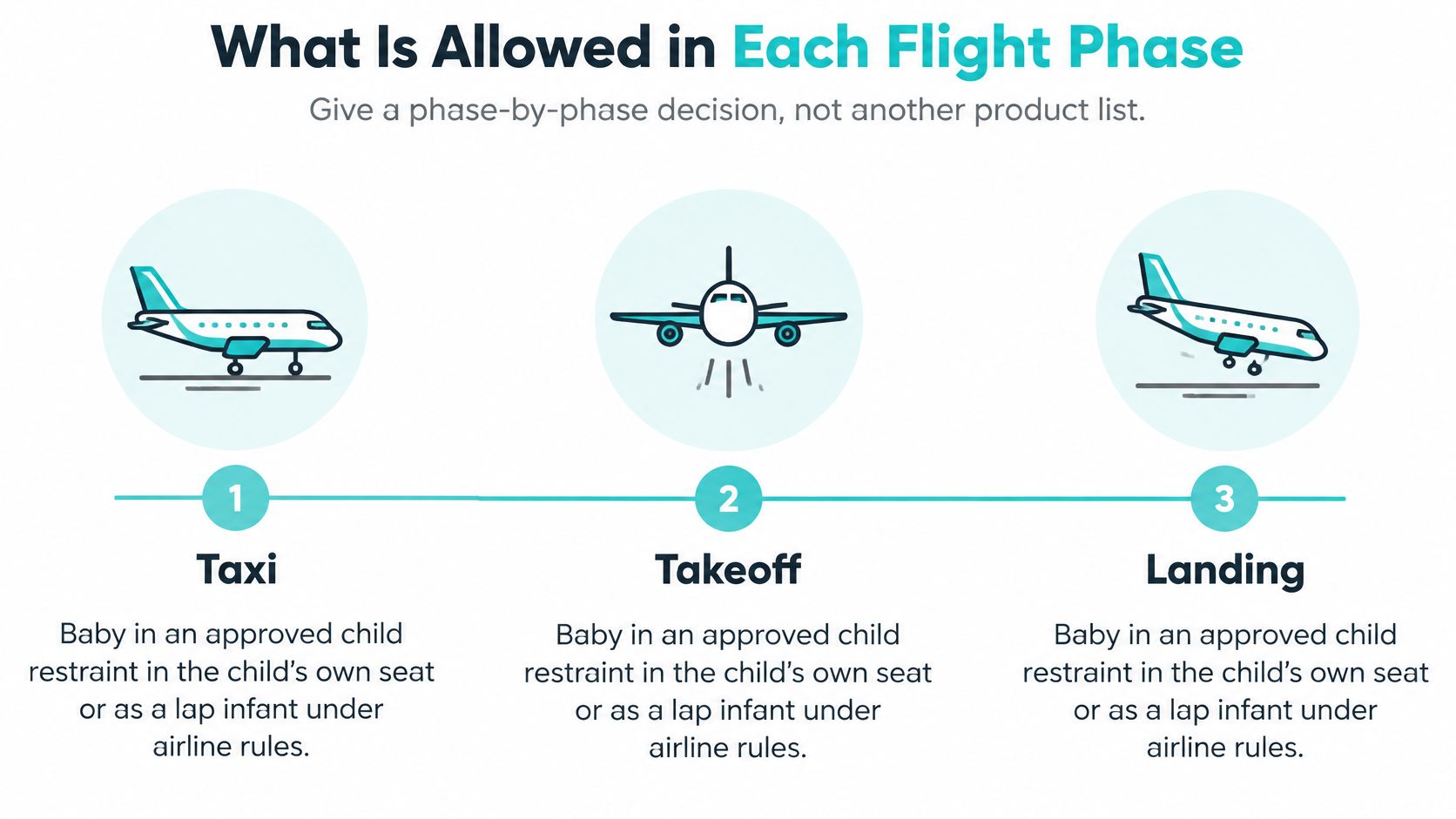
Taxi, Takeoff, and Landing
The FAA's guidance for children "strongly urges you to secure your child in an approved CRS or other approved device for the entirety of your flight." The CRS must carry the appropriate aircraft-use labeling and be used within the manufacturer's size limits.
Under U.S. seating guidance in Advisory Circular AC 120-87C, a child younger than two may be held by an adult or, where permitted, sit in a passenger seat using its regular belt during takeoff and landing. The FAA strongly discourages lap travel. That allowance does not make an adult seat belt an infant restraint.
Taxi, takeoff, landing
- Where the baby goes: Approved CRS in the child's own seat, or lap infant where rules allow
- Bed use: None; portable bed stowed
- Source rule: FAA guidance
Cruise, seat-belt sign off
- Where the baby goes: Approved CRS, or crew-approved bassinet or permitted soft bed
- Bed use: Supervised rest only where the carrier allows it
- Source rule: Carrier policy and FAA guidance
Turbulence or sign on
- Where the baby goes: Approved CRS or permitted hold immediately
- Bed use: Remove baby; stow portable accessories as directed
- Source rule: EASA bassinet FAQ and crew instructions
Lap-held or chest carrier device
- Where the baby goes: Not a substitute for an approved restraint
- Bed use: Not applicable
- Source rule: FAA guidance
Cruise and Unexpected Movement
A switched-off seat-belt sign does not automatically make a travel bed acceptable. Ask the crew whether that specific product is allowed in that seat. If your child is in a CRS, keeping them secured there remains the stronger arrangement.
The FAA's child safety seat tips say baby carriers, booster seats, and backless restraints can't be used during ground movement, takeoff, or landing, and the FAA's guidance for children says that during cruise their use is up to the airline. A carrier may help in the airport, but it doesn't replace an approved aircraft restraint.
Practical test: You should be able to lift the baby out promptly, without untangling straps, shifting a pump, or digging through toys.
For the rest of the trip, use these tips for flying with an infant.
Travel Beds Compared by How You Fly
The word bed covers products with very different purposes. Some are airline equipment, some belong at your destination, and some seat extenders are designed for older children rather than infants.
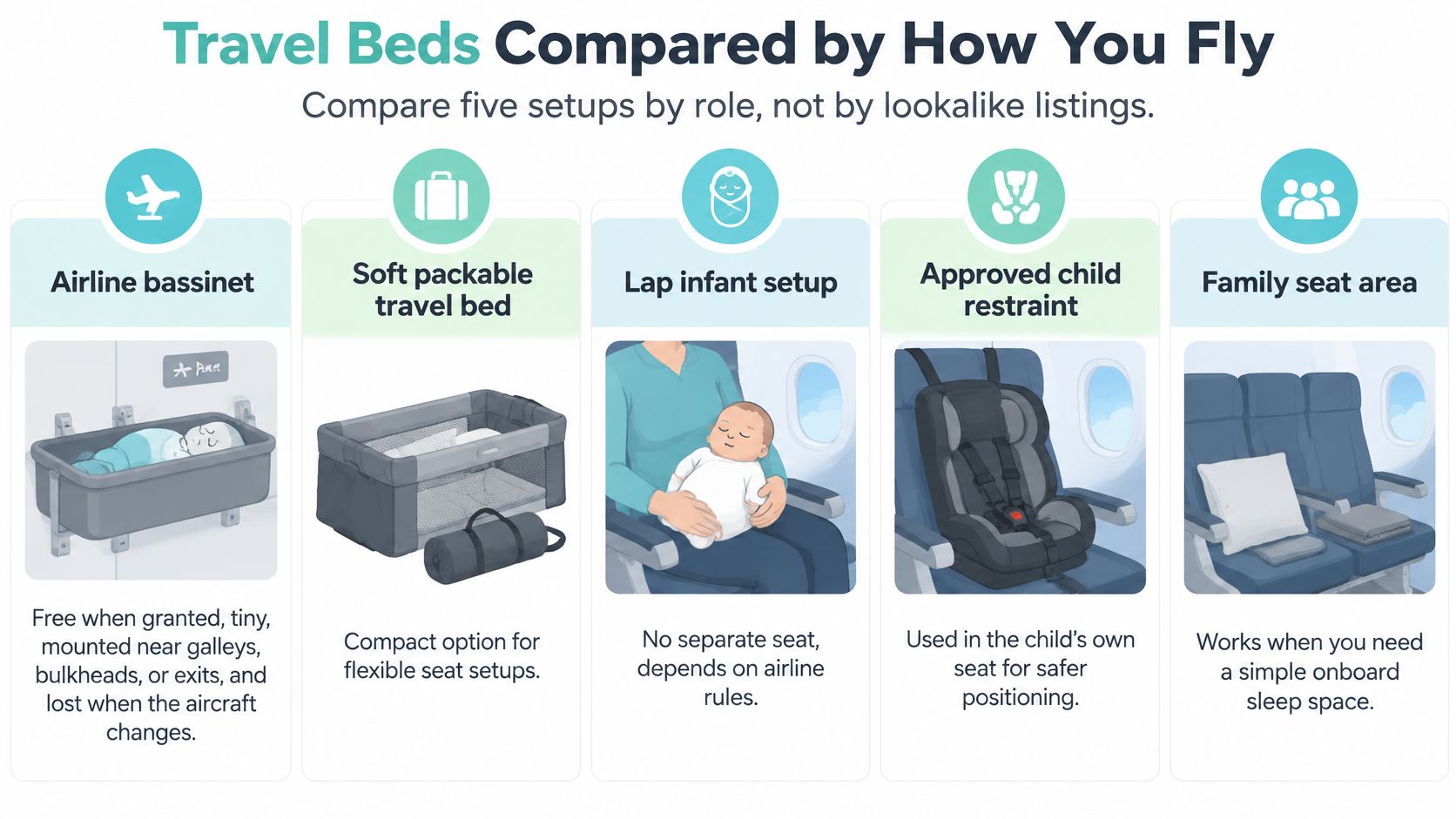
Compare the Job, Not the Photograph
Airline bassinet
- Job on the trip: Supervised rest in cruise
- Realistic on board: Only if aircraft, seat, weight, and developmental criteria qualify
- Carry burden: No separate equipment to carry
- Failure mode: Request denied or baby outgrows it
Soft packable travel bed
- Job on the trip: Portable resting surface, mainly on the ground
- Realistic on board: Only if the airline permits that product in that seat
- Carry burden: Small packed volume for some models
- Failure mode: Not a restraint; suitability for infant sleep must be checked
Inflatable seat-span bed
- Job on the trip: Extends a row's resting area
- Realistic on board: Often restricted or subject to crew approval
- Carry burden: Pump plus packed bulk
- Failure mode: Slow deflation; may be intended for older children
Travel play yard sold as carry-on
- Job on the trip: Destination sleep
- Realistic on board: Rarely fits a coach bassinet; carriage isn't permission to assemble it
- Carry burden: Must meet the carrier's baggage rules
- Failure mode: Too large for the bassinet or cabin storage
Approved CRS in baby's seat
- Job on the trip: Protection throughout the flight
- Realistic on board: In a suitable aircraft seat when correctly labeled and installed
- Carry burden: Car-seat weight through the airport
- Failure mode: No guaranteed installation space with a lap-infant booking
Airline bassinet verdict: Useful when assigned, but you're borrowing an installation rather than choosing a portable sleep system. Ask about charges instead of assuming every carrier provides it free, and consider whether the location near cabin activity will suit your baby.
Soft packable bed verdict: Judge its actual classification before its convenience. A flexible nest with soft sides may be a supervised lounging product, not an approved overnight infant sleep space.
Inflatable seat-span verdict: Treat this as a seat accessory requiring explicit permission, not as a universal baby bed. A product built for toddler legs doesn't become appropriate for an infant because the infant fits on top.
Destination Gear Has a Different Test
Travel play yard verdict: Often the more relevant choice when your real concern is hotel sleep. Its ability to travel in a bag says nothing about whether you may erect it aboard the aircraft.
Approved CRS verdict: The only category here designed to perform the restraint job. Select it for the child's size, aircraft installation method, and labeling rather than expecting it to behave like a flat bassinet.
Comfort products and restraints aren't interchangeable, even when both appear in searches for baby airplane beds.
Don't combine categories casually. Placing a soft bed over an installed restraint, threading an adult belt through a nest, or stacking a pad inside an airline bassinet creates a setup neither manufacturer may have intended.
For a meaningful comparison, write down the job you need done: protected seating, permitted cruise rest, or suitable destination sleep. A family may need separate equipment for those jobs. That's less tidy than an all-in-one marketing promise, but much clearer at the gate.
What to Check on the Bed Itself
Bring a tape measure and the product instructions to this decision. Product photos are excellent at hiding how much sleeping space disappears into bolsters.
Fit and Construction
- Usable interior: Measure between the padded edges, not across them. Compare that space with your baby's flat measurements and any applicable airline limits.
- Exterior footprint: If the airline permits placement inside its bassinet, check the assembled outside dimensions too. Never force a soft product into a smaller box.
- Sidewall height: Inspect the supplied configuration without adding a topper. Extra padding can raise the baby above the intended protective rim.
- Packed burden: Weigh the complete package with its case and accessories. Test whether your personal item still closes with feeding and changing supplies inside.
Setup and Cleanup
- Clearance: Rehearse removing the baby and clearing the product. Nothing should obstruct a seat belt, CRS harness, aisle, or neighboring passenger.
- Parts: Set it up at home and identify every required component. Loose panels and separate inserts are easy to misplace during a connection.
- Stability: Use only locations and support surfaces authorized by the manufacturer and airline. A tray table isn't an infant bed platform, and an airplane seat isn't automatically a suitable base.
- Cleaning: Check whether the cover comes off, whether the fill can be washed, and how everything dries. Spit-up doesn't respect travel schedules.
Read the intended age and developmental range before considering convenience features. A product suitable for a toddler may be inappropriate for a baby who can't reposition independently.
Supervised doesn't mean suitable for sleep. Don't use "supervised" to excuse soft padding, an incline, loose bedding, or a product that isn't intended for infant sleep.
Finally, separate comfort claims from aircraft-use approval. Washable fabric, a compact fold, and a reassuring product name don't establish restraint approval.
This checklist helps you assess a comfort product. It doesn't replace the airline's permission or the need for an appropriate infant sleep surface at your destination.
How to Measure, Pack, and Stow It
Make the routine boring at home so it doesn't become exciting in the boarding lane. Keep a tape measure, your phone, and the product manual together while checking the setup.
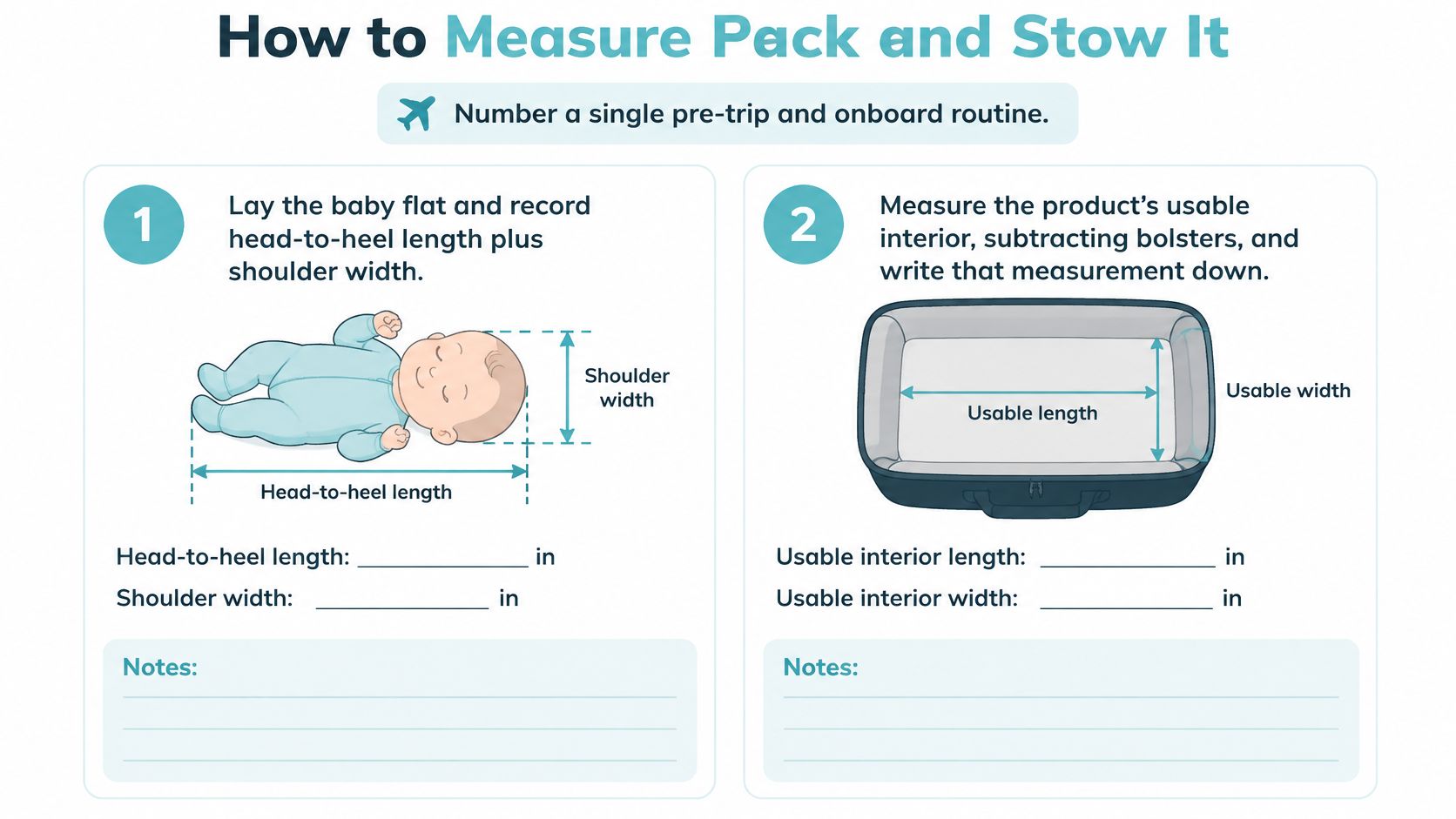
Before Leaving Home
- Record the baby's measurements. Lay your baby flat on an appropriate surface and measure head to heel plus shoulder width. Don't substitute clothing size or a measurement taken while they're curled against your chest.
- Record the product's usable space. Subtract bolsters and shaped ends, then write the interior dimensions beside the strictest carrier requirements on your itinerary. Record exterior dimensions separately if you're asking permission to place it within airline equipment.
- Pack for access and stowage. Keep a permitted compact accessory in your cabin bag rather than beneath a stroller that may be gate-checked. Contain toys and accessories separately so they can't roll into the aisle; use the guide to airline-approved carry-on luggage to organize the baggage check.
- Ask the operating airline directly. Contact it well before departure with the aircraft type, seat location, bassinet request, and product name. Ask whether the product may be used during cruise in your seats and when it must be stowed, then save the reply.
An answer about carrying an item aboard isn't an answer about using it. Ask both questions, especially if the product listing uses broad terms such as portable crib or airplane bed.
At the Gate and On Board
- Reconfirm the aircraft. Ask whether an equipment change affected your bassinet or seating assignment. Don't assume an earlier request survived the swap.
- Install the restraint first. If you've booked your child a seat, install the approved CRS according to its instructions and the crew's requirements. Don't start assembling or inflating a comfort accessory during taxi.
- Wait for explicit permission. Only set up a permitted rest product after the crew agrees and conditions allow it. Stay buckled yourself, keep access clear, and don't position an item where it interferes with another passenger's exit or seat operation.
- Move the baby before the equipment. When instructed or when the sign returns, secure the baby promptly in the approved arrangement. Then collapse and stow portable equipment as directed; don't remove an aircraft-mounted bassinet yourself.
Common slip: A written approval for a product doesn't override a crew instruction about conditions on the day.
Practice the physical sequence without the baby before traveling. If clearing the bed requires hunting for a valve beneath someone's legs, choose a simpler arrangement.
Avoid clipping an unapproved harness to the adult belt, inflating a bed after pushback, or treating an empty neighboring seat as guaranteed space. Done looks straightforward: baby secured for movement, portable equipment permitted or stowed, and destination sleep gear you can assemble correctly while tired.
Plan the Fallback and Choose Your Setup
A backup plan should survive a different aircraft, a growing baby, and a bad night. A portable bed can help with logistics, but it can't take over the restraint job when something changes.
The product's intended age, sleep suitability, and the carrier's instructions still decide what you may use.
When the Original Plan Falls Apart
Say your widebody changes to a narrowbody and the bulkhead bassinet disappears. Your next move is to confirm seating and restraint arrangements, not spread a soft bed across an unapproved space.
Or your baby starts sitting independently between booking and departure. The American Academy of Pediatrics' flying-with-baby guidance notes that many airlines limit bassinets to babies under roughly six months or 20 pounds who can't sit independently. A booking request can remain in your reservation after your baby has stopped qualifying.
Then there's the perfectly usable bassinet your baby refuses to tolerate. At the hotel late that night, you need an appropriate infant crib or bassinet, not a creative arrangement of cushions.
Choose by the Problem You Need to Solve
- If your baby qualifies and the long flight offers bassinets: Request one early, verify the seat assignment, and arrange suitable destination sleep equipment. Don't interpret a denied bassinet request as permission to use a portable substitute aboard.
- If your baby is approaching the carrier's limits or already sitting: Prioritize a separately ticketed seat and an approved CRS rather than relying on an allocation the crew may have to refuse.
- If destination packing is the problem: Compare a hotel crib, an appropriate portable play yard, and equipment suited to an older child. Hiccapop's Inflatable Toddler Travel Bed with Safety Bumpers is a destination option for an age-appropriate toddler, not an infant airplane bed or aviation restraint.
Decline a lap harness or chest carrier presented as a substitute for an approved aviation restraint. Convenience isn't evidence that a device can protect your child.
The FAA's guidance for children says "the safest place for your child under the age of two on a U.S. airplane is in approved child restraint system (CRS) or device, not in your lap," and that buying a ticket for your child is the only way to guarantee you can use one. Make that booking decision before buying comfort accessories.
For a final policy check, consult the EASA bassinet FAQ and FAA guidance for children, then confirm the operating carrier's current requirements.
Share your airline, baby's length and weight, and proposed product in the comments for a fit-focused discussion. Include whether you need onboard rest or destination sleep, because those require different answers.
Hiccapop offers baby and toddler gear, including travel beds for age-appropriate destination use. Visit Hiccapop to compare product dimensions and intended-use instructions, and choose your hotel sleep setup separately from your baby's airplane restraint.