


Airline Approved Carry On Luggage Made Simple
Let's be honest: traveling with kids can feel like orchestrating a small military operation. The first piece of that puzzle? The luggage. And here’s the inside scoop that many travelers learn the hard way: there is no single, universal size for airline approved carry on luggage.
A bag that sails through security with Delta might get you hit with a surprise fee on an international carrier. Every airline, it seems, plays by its own set of rules. This guide will help you decode the system, pack smarter, and avoid those dreaded gate-side fees.
What "Airline Approved Carry On" Actually Means
Let’s cut through the confusion. When an airline talks about your baggage allowance for the cabin, they're almost always talking about two different things: your carry-on and your personal item.
Getting the difference between these two is the secret to avoiding those frantic, last-minute repacking dramas at the gate. Think of it like a toolbox and your favorite wrench. Both are essential, but one is for the heavy lifting, and the other needs to be within arm's reach.
This isn't just semantics, either. Budget airlines, in particular, are notoriously strict about this. Mixing them up can be a costly mistake that turns a smooth travel day sour.
Carry-On vs. Personal Item: The Real Difference
The two bags you're allowed to bring on board have very different jobs and, more importantly, designated storage spots on the plane.
-
Your Carry-On Bag: This is the big one—usually a small roller suitcase or a weekend-style backpack. Its home is in the overhead bin above your seat. This is where you pack the bulk of your stuff, like clothes, extra shoes, and anything you won’t need to grab mid-flight. For most U.S. airlines, the magic number is around 22 x 14 x 9 inches, but as we'll see, it's crucial to always double-check.
-
Your Personal Item: This is your smaller, more accessible bag. We're talking about a purse, a laptop bag, a diaper bag, or a compact backpack. The defining rule is that it must fit completely under the seat in front of you. This bag is your flight-survival kit, holding everything you need on-demand: snacks, your kid's tablet, a spare outfit for the baby, your wallet, and travel documents.
Here's the golden rule: If it doesn't fit under the seat, it's not a personal item. Airlines are strict about this to keep the aisles clear for safety and to make sure there’s enough room in the overhead bins for everyone’s larger carry-on.
Why This Is a Game-Changer for Families
For parents, understanding this distinction is a travel superpower. Your personal item is your command center, ready to deploy snacks and distractions at a moment's notice to prevent a meltdown. Meanwhile, your main carry-on is safely stowed in the overhead bin, packed and out of the way until you land.
Airlines also have different fees for each. Most standard tickets include one of each for free. But with the rise of "Basic Economy" fares, some airlines now charge for a carry-on that goes in the overhead bin, only allowing a free personal item.
Knowing an airline's policy before you even think about packing is the first step toward a calm, confident travel day. Consider this your roadmap to navigating every airline's rules without the stress.
Why Carry-On Rules Are So Inconsistent
Ever had that sinking feeling at the gate when you realize your trusty carry-on, the one that’s flown a dozen times without a problem, is suddenly too big? You're not alone. The frustrating inconsistency in carry-on rules isn't random—it's a direct result of aviation history and the simple physics of aircraft design.
The patchwork of rules we all have to navigate today has its roots in safety mandates. The problem is, these regulations prioritized passenger well-being but left the fine print—the actual dimensions of your bag—up to individual airlines. This created the very system where a bag that's perfect for one flight might get you dinged with a checked-bag fee on the next.
The FAA Sets The Stage, But Not The Specifics
This all started back in the 1960s as air travel really began to take off. The Federal Aviation Administration (FAA) stepped in to create rules, but their main concern wasn't your bag's exact measurements. Their focus was pure safety: making sure baggage was stowed securely to prevent it from becoming a hazard.
A landmark rule in 1987 forced airlines to get serious about their carry-on programs, all in the name of reducing injuries from falling bags and keeping aisles clear for emergencies. But here’s the crucial part: the FAA delegated the specific size and weight limits to the airlines themselves. This is the single biggest reason for the varied policies we see today. You can actually explore the historical details of these FAA regulations to see how these foundational rules were established.
Think of it this way: the government mandated that all cars must have seatbelts but let each manufacturer decide the exact size, shape, and placement. It was a logical approach at the time, but it set us up for decades of confusion.
Different Planes, Different Problems
So why did the FAA let airlines make their own rules? It all comes down to the planes themselves. An airline's fleet is a mixed bag, with everything from massive jumbo jets on international routes to tiny regional aircraft that hop between smaller cities.
The overhead bin space on a Boeing 777 is vastly different from the space on a 50-seat Bombardier CRJ200. A single, universal carry-on size would either be too small for big planes (wasting space) or too large for small ones (creating safety hazards).
This is exactly why you'll often hear a gate agent announce that a flight is "full" and they need to start gate-checking bags, even when there are empty seats. They aren't talking about passengers; they're talking about the limited real estate in the overhead bins.
The Bottom Line: Check Every Time
Because each airline tailors its rules to its specific fleet, a one-size-fits-all approach to packing just doesn't work. The airline-approved carry-on luggage for your Delta flight to Orlando might be too big for the budget European carrier you’re taking on vacation next month.
Here’s what this means for you, especially when you're juggling kids and gear:
- Connecting Flights: If your trip involves multiple airlines, you have to follow the rules of the most restrictive carrier on your itinerary.
- Codeshare Flights: You might book through United but end up on a smaller plane operated by a regional partner with much tighter limits. Always check the operating carrier for every leg of your journey.
- International vs. Domestic: Airlines outside the U.S., particularly in Europe and Asia, are often much stricter about weight limits in addition to the size constraints.
Knowing the why behind the rules doesn't make them less annoying, but it does make them less mysterious. It transforms the seemingly random policies into a logical, if complicated, system. This knowledge is your best defense against surprise fees and travel-day stress, empowering you to do the one thing that always works: check the rules for every single flight, every single time.
How to Measure Your Luggage Like a Pro
We’ve all seen it: the traveler at the gate, frantically trying to shove an oversized bag into that unforgiving metal sizer. You can almost feel the stress. But you don't have to be that person.
Learning how to measure your bag at home is simple, and it's the single best way to avoid those surprise baggage fees. Think of yourself as the gate agent—if you can pass your own inspection, you'll breeze through the real one. For your bag to be considered airline approved carry on luggage, it needs to fit, no questions asked.
When you measure, the golden rule is that everything counts. It's like trying to fit a car into a tight garage; you can't just measure the main body. You have to account for the bumpers and side mirrors, too. Airlines think the exact same way—they care about the total space your bag will take up.
The Anatomy of a Proper Measurement
Ready to get it right? Grab a tape measure and let’s walk through this. It’s not just about the main compartment; it’s about every little part that sticks out.
-
Measure the Height: Stand your bag up straight. Start your measurement at the very bottom of the wheels and go all the way to the top of the handle, even when it’s pushed down. Those few inches from the wheels and handle are often what trip people up.
-
Measure the Width: Now, lay the suitcase flat on its back. Measure from its widest point on one side to the widest on the other. Make sure you include any side handles or pockets that jut out.
-
Measure the Depth: Finally, measure from the back to the front. This is where people often get into trouble. You have to include any front pockets, even if they're empty. If you have a soft-sided bag, pack it first! It can bulge out and easily add an inch or two you didn't plan for.
The biggest mistake people make is measuring only the main rectangular part of their suitcase. Airlines don’t care about the packing space—they care about the total physical space the bag occupies in their bin. Always include wheels, handles, and pockets.
Soft-Shell vs. Hard-Shell Considerations
Your measuring technique might need a slight tweak depending on what kind of bag you have.
- Hard-Shell Luggage: These are pretty straightforward. Their dimensions are fixed, so what you measure is what you get. The downside? There’s zero wiggle room. If it's even half an inch too big, you can't just squish it in.
- Soft-Shell Luggage: The flexibility here can be both a blessing and a curse. It's great for squeezing in one last thing, but it’s also easy to overpack the front pockets until the bag is way too deep. My advice? Always measure your soft-shell bag after it’s fully packed for the trip.
Don’t Forget About the Weight
Getting the size right is only half the battle. Many airlines, especially budget and international carriers, are also serious about carry-on weight limits. Your bag might slide into the sizer perfectly, but if it’s too heavy, they can still force you to check it.
A small digital luggage scale is one of the best and cheapest investments a traveling parent can make. Weighing your bag at home means you can adjust, shifting heavier items into a personal item or a checked bag. It’s a simple step that saves you from that mortifying moment of opening your suitcase on the airport floor, trying to decide what to sacrifice. Get both the size and weight right, and you're set for a smooth start to your trip.
Major Airline Carry-On Size and Weight Limits
Trying to figure out airline carry-on rules can feel like a game where the rules change with every ticket you buy. What flies free on one airline might get you hit with a surprise gate-check fee on another. This is your cheat sheet to the most common carry-on rules in the sky.
Think of this as your quick-glance guide. I've lined up the policies for major US carriers like Delta and United, budget airlines like Spirit, and a few international players so you can see the differences side-by-side. The moment you see the numbers, it becomes crystal clear why checking the specific rules for your flight is non-negotiable.
A Look at Domestic and International Carriers
The differences in carry-on allowances can be subtle, but they matter. You'll find a constant tug-of-war between what's convenient for us travelers and what physically fits on the plane. For example, Southwest is famously generous, allowing bags up to 24 x 16 x 10 inches. Delta, on the other hand, sticks to the more standard 22 x 14 x 9 inches and has no official weight limit—but you might still have to gate-check it on smaller regional flights.
Budget carriers are a whole different beast. Airlines like Frontier have strict limits and often incentivize their gate agents to find and charge for oversized bags.
Once you start flying internationally, the rules shift again. Many overseas airlines use a standard of around 22 x 15 x 10 inches, but the real catch is the weight limit, which often drops to a much lighter 22 pounds (10 kg). This detailed guide to U.S. airline policies really highlights just how much these rules can vary from one airline to the next.
This image shows a bird's-eye view of a perfectly packed carry-on. It’s a great visual reminder that how you pack is just as important as the size of your bag.
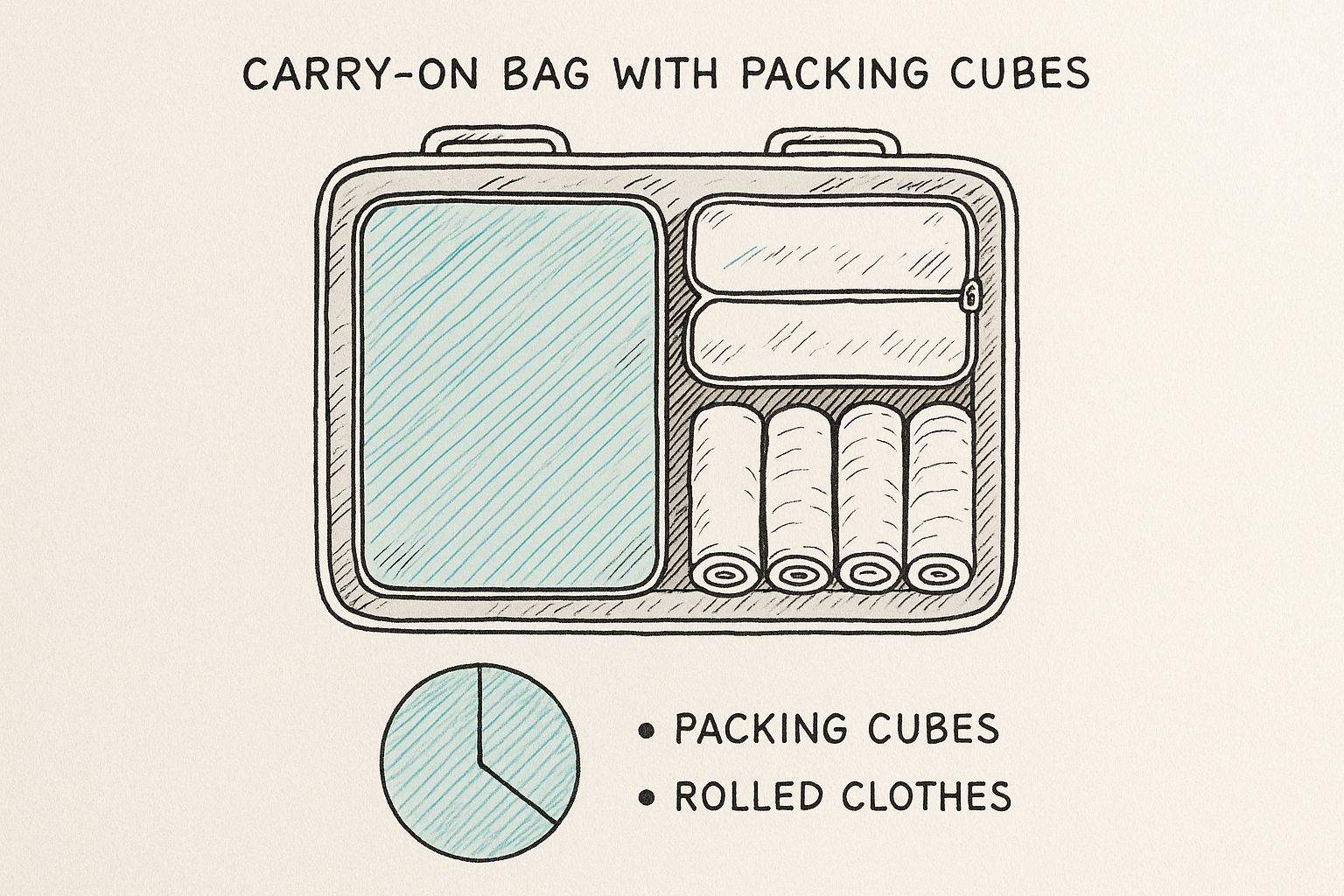
As you can see, using packing cubes and rolling your clothes doesn't just keep you organized—it helps prevent your bag from bulging and getting rejected by that unforgiving sizer at the gate.
Major Airline Carry-On Luggage Size and Weight Limits
A comparative guide to the carry-on baggage allowances for popular domestic and international airlines. All dimensions include wheels and handles.
| Airline | Max Dimensions (Inches) | Max Dimensions (cm) | Max Weight |
|---|---|---|---|
| Delta Air Lines | 22 x 14 x 9 | 56 x 35 x 23 | Not specified for most routes |
| United Airlines | 22 x 14 x 9 | 56 x 35 x 23 | Not specified for most routes |
| American Airlines | 22 x 14 x 9 | 56 x 35 x 23 | Not specified for most routes |
| Southwest Airlines | 24 x 16 x 10 | 61 x 41 x 28 | Not specified |
| Spirit Airlines | 22 x 18 x 10 | 56 x 46 x 25 | Paid item; 40 lbs (18 kg) |
| British Airways | 22 x 18 x 10 | 56 x 45 x 25 | 51 lbs (23 kg) |
| Lufthansa | 22 x 16 x 9 | 55 x 40 x 23 | 17.6 lbs (8 kg) |
| Emirates | 22 x 15 x 8 | 55 x 38 x 20 | 15 lbs (7 kg) |
Note: Policies can change and may vary by ticket class (e.g., Basic Economy). Always confirm with your airline's official website before you fly.
Key Takeaways from the Data
Looking at this chart, a few things jump out, especially for traveling families trying to keep costs down.
The most common airline-approved carry-on luggage size for major U.S. carriers is 22 x 14 x 9 inches. If you buy a bag that fits these dimensions, you’ll be safe on the vast majority of domestic flights.
International travel, however, is where things get tricky. Notice the strict weight limits from Lufthansa (17.6 lbs) and Emirates (15 lbs). A bag you packed for a domestic flight could easily be twice that weight, which means you'll be paying hefty fees to check it at the gate. This is where a little digital luggage scale can be an absolute lifesaver.
Budget airlines are another one to watch. Spirit allows a slightly bigger bag but makes you pay for it, and they have a hard 40 lbs weight limit. Southwest, on the other hand, lives up to its traveler-friendly reputation with one of the most generous allowances at 24 x 16 x 10 inches.
The big takeaway here is that there's no such thing as a "universal" carry-on. Grabbing your trusty bag without checking the rules for your specific flight is a gamble. For families trying to avoid stress and extra fees, spending five minutes on the airline's website before you pack is the best travel insurance you can get.
Strategic Packing for Families Using Only Carry-Ons
The idea of packing for your entire family using only carry-on bags can seem… ambitious. You might picture a clown car of luggage, but I promise you, it's not magic—it's just a smart strategy. With a few tricks up your sleeve, you can breeze past the baggage claim and save a small fortune on checked bag fees.
Forget just cramming things into a suitcase. This is about being clever and turning your luggage into a perfectly organized, space-saving machine. Think of it less like stuffing a bag and more like winning a game of Tetris. It all comes down to having the right plan.
Master Your Space with Packing Cubes
If you haven't jumped on the packing cube bandwagon yet, you're seriously missing out. They are, without a doubt, the single best packing tool for parents. These simple fabric organizers act like mini-drawers inside your suitcase, compressing clothes to free up precious real estate while keeping everything tidy.
- Color-Code for Each Kid: Assign a specific color of packing cubes to each child. It’s a game-changer for finding an outfit without detonating the entire suitcase.
- Bundle Complete Outfits: Pack a full day’s outfit—shirt, pants, socks, underwear—into a single cube. When it's time to get dressed, your kid just grabs their cube for the day. Done.
- Designate a Laundry Cube: Bring an extra, empty cube to serve as a mobile laundry hamper. It quarantines dirty clothes from the clean ones and makes unpacking at home a thousand times easier.
The Great Debate: Rolling vs. Folding
Ah, the age-old packing question: to roll or to fold? The truth is, you should be doing both! The best technique really just depends on the fabric.
For the vast majority of your clothes—think t-shirts, pajamas, and casual kidswear—rolling is the undisputed champion. When you roll clothes tightly, they take up way less room and are surprisingly less prone to getting deep, set-in wrinkles. But for items with more structure, like collared shirts, blazers, or dress pants, a neat, flat fold is the way to go to help them keep their shape.
The ultimate space-saving combo is to roll all the soft, flexible items first, then lay your folded, structured garments flat on top. This method lets you use every last inch of your bag.
Your Personal Item Is Mission Control
Don't think of your personal item as just another purse or backpack. For a traveling parent, it's your in-flight command center. This is the bag that stays with you, holding everything you need to access at a moment's notice without having to stand up and wrestle with the overhead bin.
Here's what your personal item lifeline should contain:
- Entertainment: A fully charged tablet with downloaded shows, headphones, and a couple of small, non-annoying toys.
- Snacks and Drinks: All of them. Never, ever underestimate the meltdown-preventing power of a well-timed snack.
- The "Just in Case" Outfit: Pack one full change of clothes for each kid (and maybe a clean shirt for yourself). Trust me, spills happen.
- Wipes and Sanitizer: For sticky fingers, messy faces, and those questionable airplane tray tables.
Getting the packing right is just one piece of the puzzle. For a deeper dive into keeping little ones happy and comfortable from takeoff to landing, check out our ultimate guide to traveling with young children.
Navigating TSA Liquids with Kids
The TSA's 3-1-1 liquid rule can feel like a major hurdle for parents, but there's good news: there are important exceptions for those traveling with children. Normally, liquids must be in containers of 3.4 ounces (100 milliliters) or less, and all those tiny bottles have to fit inside a single quart-sized bag.
However, the TSA makes a special allowance for medically necessary liquids, which includes formula, breast milk, and juice for toddlers. You're allowed to bring these items in quantities well over the standard 3.4-ounce limit. If you're planning an adventure, you might also find some great tips in this ultimate guide to traveling with kids.
Here’s the smoothest way to handle security:
- Separate Them: Keep your baby’s milk, formula, and any liquid medications in their own accessible spot, separate from your regular toiletries.
- Declare Them: As you approach the security checkpoint, pull these items out of your bag and let a TSA officer know you have them.
- Expect Extra Screening: They will likely need to screen these liquids separately. This might involve opening them or running a quick test, but it's a standard procedure.
Knowing about these exceptions ahead of time can make the whole security process feel a lot less stressful, letting you walk through with confidence and everything you need for the flight.
Choosing The Best Carry On Luggage For Your Family
Picking the right carry-on bag is a serious decision when you're traveling with family. Think about it—this bag is going to be your trusty sidekick through airport sprints, long layovers, and unpredictable adventures. The perfect airline approved carry on luggage isn't just a box on wheels; it's a partner that needs to work for you.
The first big choice you'll face is a classic one: Team Hard-Shell or Team Soft-Shell? Each has its own distinct personality, and the best fit really depends on how your family travels.
Hard-Shell vs Soft-Shell Luggage
Hard-shell luggage is like a personal bodyguard for your belongings. It’s tough, built to take a few hits, and can easily shrug off spills or a sudden downpour.
- Pros: It offers fantastic protection for fragile items and is way more water-resistant. Plus, they come in bright, glossy colors that are a breeze to spot on a crowded luggage carousel if you ever have to check it.
- Cons: What you see is what you get. There's no "just one more thing" with a hard-shell bag. If it doesn't close, it doesn't close.
On the flip side, soft-shell luggage is your flexible, easy-going travel buddy. It's much more forgiving when you just have to squeeze in that souvenir you bought at the last minute.
- Pros: Those external pockets are an absolute lifesaver for grabbing snacks, tablets, or charging cables without having to open the whole bag. The flexible fabric also has a little give, which can make all the difference when you're trying to wedge it into a packed overhead bin.
- Cons: It's not as protective against hard knocks and can be more prone to getting stained or snagged over time.
Features That Actually Matter For Parents
Beyond the hard vs. soft debate, a few specific features can genuinely make or break your airport experience. These aren't just fancy add-ons; they are sanity-savers when you're trying to manage kids, tickets, and your own coffee.
Spinner Wheels (360-Degree)
Seriously, if a bag only has two wheels, keep walking. Four spinner wheels that glide in any direction are an absolute must for parents. They let you effortlessly push the bag right alongside you, keeping one hand free to hold onto a little one or navigate a stroller. It’s a game-changer.
Durable Zippers
You're going to be zipping and unzipping this bag constantly. Look for heavy-duty, self-repairing zippers that won't buckle under the pressure of being slightly overstuffed. A busted zipper halfway through a trip is a travel nightmare you just don't need.
Baggage rules can feel like a moving target. Carry-on bags generally need to be around 22 x 18 x 10 inches, but some budget airlines have weight limits as low as 11 lbs. Even if your bag fits, a smaller regional jet might force you to gate-check it. It pays to know the little details—for example, safety regulations require lithium batteries to stay with you in the cabin.
Clever Luggage Options For Families
Ready to get strategic? A few innovative luggage designs are out there specifically to make family travel less of a hassle.
-
Ride-On Suitcases: These are pure genius. Part small hard-shell bag, part rideable toy, a ride-on suitcase gives your toddler a fun way to zoom through the airport while saving your back from carrying them.
-
Expandable Luggage: This is your secret weapon for the return trip. An expandable carry-on has a simple zipper that, when undone, releases a few extra inches of packing space. It's perfect for all those souvenirs and gifts. And for those long layovers, having a compact place for your little one to rest, like a portable baby travel bed, is invaluable.
When you're picking out your main carry-on, don't forget about your personal item. Pairing your suitcase with one of the best crossbody bags for travel can keep your essentials organized and accessible. By matching your luggage to your family's needs, you're not just buying a bag—you're investing in smoother, happier travels.
Your Top Carry-On Luggage Questions Answered
Even when you think you have it all figured out, a few last-minute questions always seem to pop up right as you're trying to zip up that overstuffed suitcase. Let’s clear up some of the most common head-scratchers about airline-approved carry-on luggage so you can finish packing with complete peace of mind.
Do Wheels and Handles Count in Measurements?
Yes, they absolutely do. When an airline gives you dimensions, they mean the total exterior size of your bag.
That measurement includes everything from the bottom of the wheels to the top of the handle (even when it’s pushed down!) and any bulky side pockets. It’s the single most common mistake travelers make, so be sure to measure the whole thing.
What Happens If My Bag Is Too Big?
If your bag doesn't fit in the sizer at the gate, you'll almost certainly have to check it. The gate agent will tag your bag, take it from you, and have it loaded into the cargo hold.
This isn't just an inconvenience; it almost always comes with a fee. And those last-minute gate-check fees are often way higher than what you would have paid to check the bag in the first place.
Can I Bring a Backpack and a Rolling Bag?
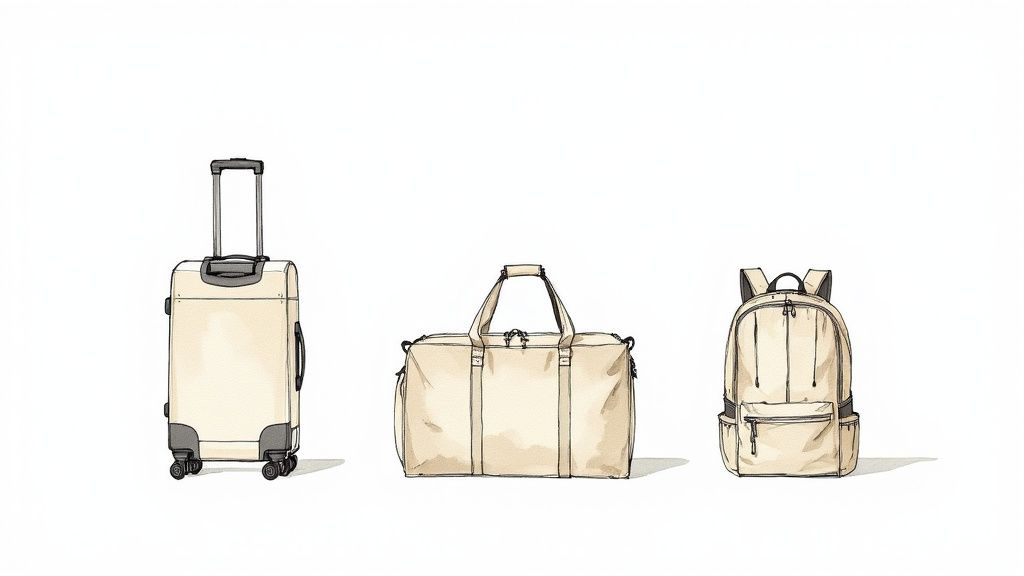
In most cases, yes. The rolling suitcase is your standard carry-on that goes in the overhead bin. A regular-sized backpack can then count as your personal item, which needs to fit completely under the seat in front of you.
Of course, juggling multiple bags and a little one through a busy airport is a skill all on its own. For more advice on that front, check out our guide on how to travel with infants.
Final Thoughts on Smooth Flying
Navigating the world of airline approved carry on luggage doesn’t have to be a source of stress. The secret is simple: know the rules for your specific airline, measure your bag correctly (wheels and all!), and pack strategically. A little bit of prep work at home can save you a world of hassle—and money—at the airport.
Now that you're armed with this knowledge, you can pack with confidence and focus on what really matters: making incredible memories with your family.
What are your go-to carry-on hacks for traveling with kids? Share your best tips in the comments below