


A Gentle Guide on How to Teach Baby to Self Soothe
Helping your baby learn to self-soothe is all about gently guiding them toward falling asleep on their own, a journey that typically begins around 4-6 months of age. The goal isn't to leave them to figure it all out alone. Instead, it’s about creating a predictable routine and giving them the space to discover their own little comfort tricks—like sucking on their hands or wiggling into the perfect spot in the crib.
It’s a foundational life skill that fosters emotional resilience and, let’s be honest, much better sleep for everyone.
Why Teaching Self-Soothing Matters for Your Baby (and You)
Before we jump into the how, let's get on the same page about the why. The phrase "self-soothing" sometimes gets a bad rap, bringing up images of strict schedules or leaving a baby to cry it out. But that’s a misconception. True self-soothing is about empowering your child with a skill for emotional regulation that will serve them for life. It’s not tough love; it’s nurturing independence.
Think of it this way: when your baby is upset, you comfort them and help regulate their emotions, guiding them from distress back to calm. Teaching them to self-soothe is simply the process of gently passing that baton, letting them find their own ways to feel secure. It’s a genuine game-changer for their development.
The Science Behind a Good Night's Sleep
When babies can settle themselves, they’re doing more than just making bedtime easier—they are fundamentally improving their health. Research consistently shows that babies who fall asleep independently get longer, more restorative stretches of sleep and wake less often during the night.
This boost in sleep quality is a huge win for their little bodies. It supports healthy growth and strengthens their immune system. On an emotional level, mastering this skill helps build long-term resilience, giving them tools to manage feelings that can lead to fewer sleep issues, less anxiety, and even fewer tantrums down the road.
Understanding the psychology here is also key. When you support your baby through this learning curve, you're actually reinforcing your secure bond. If you’re curious about the 'why' behind these crucial early connections, you can delve deeper into attachment theory to see how these first relationships shape a child's emotional world.
More Than Just Sleep for Your Baby
The benefits of self-soothing ripple far beyond the crib. A well-rested baby is a happier, more engaged baby during their waking hours. They tend to be more curious, patient, and better equipped to handle the tiny frustrations of baby life, like a toy that won't cooperate or having to wait a minute for a snack.
Here’s a glimpse of what you might notice as your baby gets the hang of it:
- Better Emotional Regulation: They start learning to manage minor frustrations without immediately going from zero to a full-blown meltdown.
- A Boost in Confidence: Every time they successfully settle themselves, it's a small victory that builds their sense of capability.
- Smoother Transitions: Things like naps, bedtime, and even being left with a babysitter can become less stressful because they feel secure in their own ability to find comfort.
A Game-Changer for Parents, Too
Let’s be real for a moment: this journey is just as much about you. The benefits for parents are enormous and absolutely worth celebrating. When your baby sleeps better, you sleep better. This isn’t a luxury—it’s a necessity for your physical health and mental well-being.
The quiet confidence you gain from empowering your child with a lifelong skill is incredible. It’s a gift to both of you, fostering peaceful nights and a more joyful, rested household.
Chronic sleep deprivation is no joke. It can impact everything from your mood to your relationships. Getting back those precious hours of rest allows you to be the parent you truly want to be: more patient, more present, and more engaged. It’s true that you can't pour from an empty cup, and making sleep a priority is a critical form of parenting self-care.
Ultimately, teaching self-soothing is a loving act. It helps you set a supportive, guilt-free tone for your family, equipping your child for life while giving you the rest you desperately need to enjoy every moment.
Creating the Perfect Environment for Sleep Success
Teaching a baby to self-soothe isn't something that just magically happens at 3 AM. It’s a skill, and like any skill, it's built on a solid foundation of consistency and predictability. By creating the right environment, you’re not just crossing your fingers and hoping for sleep—you're actively setting the stage for it.
Think of it this way: a calm day with a reliable rhythm almost always leads to a calmer night. You’re showing your baby what to expect, which makes the whole process of learning to sleep independently feel much safer and smoother for everyone involved.
Crafting a Calming Bedtime Routine
A predictable bedtime routine is probably the most powerful tool in your sleep arsenal. It’s not about being rigid; it's about creating a sequence of events that gently signals to your baby's brain and body that it’s time to wind down.
Your routine doesn't need to be long or complicated. In fact, a simple 20-30 minute wind-down can work wonders. Consistency, not complexity, is what truly matters here.
Here’s a sample routine you can make your own:
- Warm Bath: A soothing bath is a classic for a reason. It helps relax tired little muscles and gently lowers their body temperature, which is a natural trigger for sleep.
- Quiet Time: After the bath, move to their dimly lit nursery for a diaper change and to get into pajamas. Keep your voice soft and your movements slow and deliberate.
- A Gentle Book: Reading a familiar story in a calm, quiet voice is a perfect way to connect and help them settle down.
- Final Feed: Offer one last feeding in a quiet space. The goal is a calm, loving experience, not a frantic last call at the milk bar.
- A Soothing Song: A simple lullaby or a few minutes of gentle humming can be that final, clear cue that sleep is just around the corner.
For families looking for faith-based guidance, resources like this guide on A Gentle Islamic Bedtime Routine for Toddlers can offer wonderful, culturally specific ideas.
Optimizing the Sleep Space
Your baby's nursery should be a sanctuary for sleep—a space that is, frankly, a little bit boring. You want to minimize stimulation so that if they wake up in the middle of the night, there’s nothing interesting to see or do that might pull them into full wakefulness.
First, make the room as dark as you possibly can. I’m talking cave-dark. Even a sliver of light can disrupt the production of melatonin, the all-important sleep hormone. Blackout curtains are a non-negotiable.
Next, get the temperature right. A cool room is much better for sleep than a warm one. Most experts recommend keeping the nursery between 68 and 72 degrees Fahrenheit. Finally, introduce a white noise machine. It does an incredible job of blocking out disruptive household sounds (like the dog barking or an older sibling’s sudden burst of laughter) and mimics the constant whooshing they heard in the womb.
For a deep dive into setting up the perfect sleep haven, check out our complete guide to building a safe sleep environment for infants.
Learn Your Baby’s Unique Sleep Cues
One of the biggest obstacles to self-soothing is an overtired baby. When a baby is overtired, they become wired and fussy, making it so much harder for them to settle down. Your mission, should you choose to accept it, is to get them into their crib before they hit that point of no return.
To do this, you have to become a sleep-cue detective. Every baby sends out their own unique signals that they’re getting sleepy.
An overtired baby isn't just a little tired; they're flooded with cortisol, a stress hormone that acts like an adrenaline shot. This is why they fight sleep so hard—their body is in high-alert mode, making it almost impossible to relax.
Start looking for these early signs of drowsiness:
- A far-off, "zoned out" stare
- Slightly red-rimmed eyes or eyebrows
- Rubbing their eyes or pulling on their ears
- Becoming less engaged or social
- Small, quiet yawns (not the big, dramatic ones!)
The moment you spot these early cues, it’s time to start the wind-down routine. If you wait for frantic crying or intense fussiness, you’ve probably missed your window. Responding to their earliest sleepy signals is one of the most proactive things you can do to make falling asleep—and learning to self-soothe—infinitely easier.
Gentle Self-Soothing Methods for Every Age and Temperament
So, you’ve created that perfect sleep sanctuary and can spot a tired cue from across the room. Now for the main event: gently guiding your baby toward falling asleep on their own.
Let's be clear: there’s no single magic bullet here. The best method is the one that feels right for your family, your baby’s unique personality, and where they are developmentally. This isn't about a rigid, one-size-fits-all plan but about having a few proven, gentle strategies you can adapt to your needs.
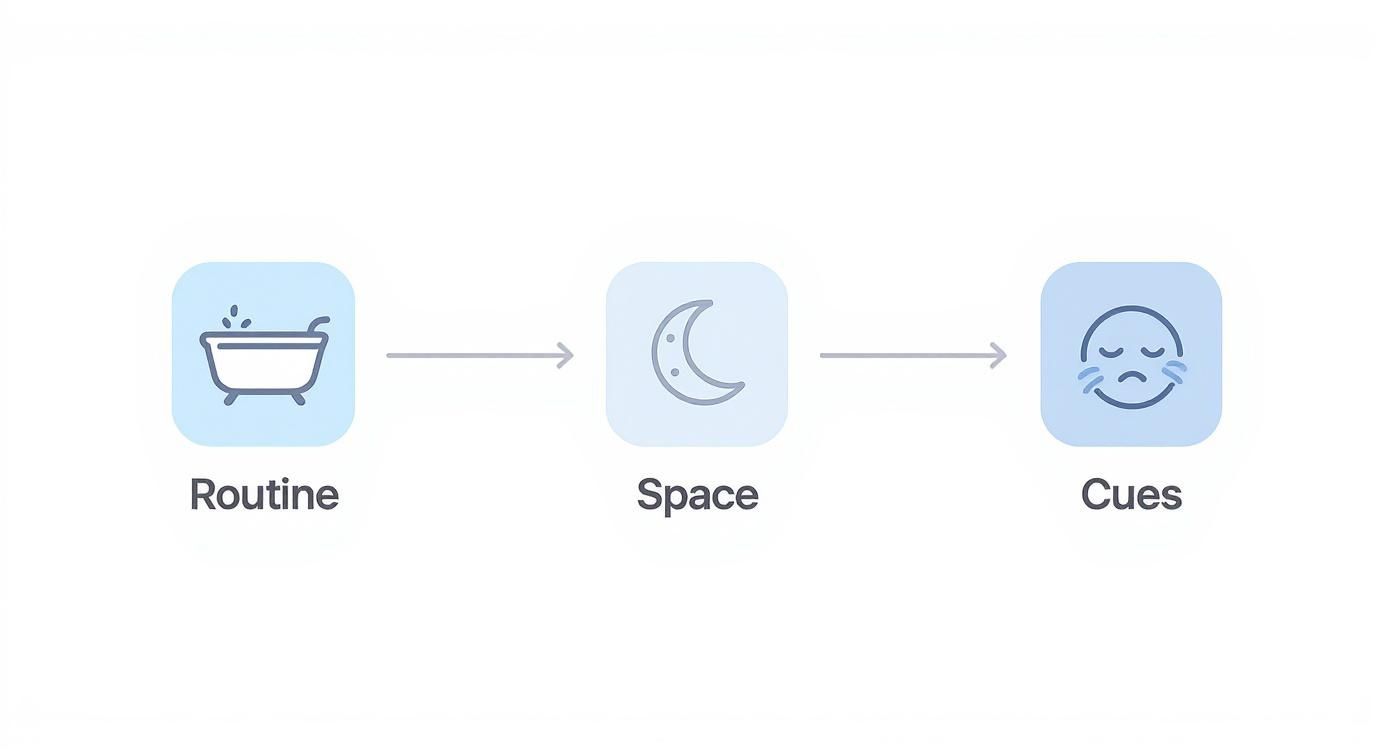
This visual breaks it down beautifully—a predictable routine, a calm space, and your intuitive response to their cues all work together. Each step builds on the last, turning bedtime into a process that helps your baby feel secure enough to self-soothe.
For parents looking for a gentle approach, several methods stand out. Each one emphasizes responsiveness and comfort while still encouraging independence.
To help you compare, here's a quick look at some of the most popular gentle methods.
Gentle Self Soothing Methods at a Glance
| Method | Ideal Age | Parent's Role | Best For Babies Who... |
|---|---|---|---|
| Pick-Up-Put-Down | 4-8 months | Hands-on comforting, but places baby down awake. | Are younger and need frequent physical reassurance to calm down. |
| Gradual Withdrawal (Chair Method) | 6+ months | Provides a comforting presence that slowly fades. | Are older and find a parent's presence calming, not distracting. |
| Responsive Settling | All ages | Responds to cues with the least invasive comfort needed. | Are sensitive; allows parents to tailor their approach moment by moment. |
These methods offer a framework, not a rigid script. The key is to choose one that aligns with your parenting style and your baby's temperament, and then stick with it consistently.
The Pick-Up-Put-Down Method (For Younger Infants)
Perfect for babies around 4-8 months old, the Pick-Up-Put-Down method is all about offering immediate reassurance without creating a habit where your baby needs to be held to sleep. It strikes a beautiful balance between being responsive and giving your little one space to practice.
The process is exactly what it sounds like. After your calming bedtime routine, you’ll place your baby in their crib while they are still awake but drowsy. If they start to cry, you pick them up to offer comfort.
The moment they’re calm—but not asleep—you gently place them back in the crib. You repeat this cycle as many times as it takes. The first few nights might feel like a workout with all the reps, but consistency is your best friend here.
For example, you put your 5-month-old down. He fusses, then starts to cry. You pick him up, whisper, "It's okay, time for sleep," and hold him just until he calms. Then, you place him back down. He might start crying again right away. That’s okay. You just repeat the process. The goal is for him to eventually drift off to sleep in his crib, not in your arms.
The Gradual Withdrawal Method (For Older Babies)
For slightly older babies (6 months and up) who are much more aware of your presence, Gradual Withdrawal—often called the "Chair Method"—can be a game-changer. This approach is all about slowly and systematically fading out your presence, empowering your baby to fall asleep more independently over time.
You're essentially taking small, deliberate steps back. Here’s a typical progression:
- Nights 1-3: Put a chair right next to the crib. After your routine, place your baby down awake and sit in the chair. You can offer a gentle hand on their back or soft shushing, but try to avoid picking them up unless they’re truly distressed.
- Nights 4-6: Scoot the chair a few feet away. You’re still present and can offer verbal comfort, but you’re starting to reduce physical touch.
- Nights 7-9: Move the chair to the middle of the room. Your presence is still reassuring, but the distance reinforces that they can do this on their own.
- And so on... Keep moving the chair further away every few nights until it’s in the doorway, and then, finally, out in the hall.
This method requires patience, but it’s a wonderful choice for parents who want to stay in the room and offer comfort while still encouraging independence.
The Power of Responsive Settling
No matter which method you lean toward, a responsive approach is what makes it both gentle and effective. It's not about ignoring your baby but about responding in a way that guides them toward their own comforting skills.
In one major study, babies whose parents used responsive techniques—like offering a pacifier or a gentle touch instead of immediately rocking them—slept an average of 40 minutes longer per night. They also fell asleep faster, often within 15 minutes.
This is where truly knowing your baby comes in. Understanding their unique cues and respecting their wake windows by age is critical. A baby who is perfectly tired has a much easier time settling than one who is overtired and wired.
Ultimately, teaching your baby to self-soothe is about finding a rhythm that works for your family. Be prepared for a few challenging nights as you introduce a new routine, but stay confident. You're giving your child an incredible gift: the skill of peaceful, independent sleep.
Navigating Setbacks Without Losing Your Cool
Let's be real: teaching a baby to self-soothe is never a straight line, no matter how perfect your plan is. You're going to have bumps, regressions, and those 3 AM moments that make you question everything. That’s not just normal, it's expected.
Progress isn't about perfection. It’s about building resilience—for both you and your little one. The trick is having a game plan for when things go sideways so you can respond confidently without undoing all your hard work.
The Power of the Pause
One of the most effective tools you can master is simply pausing before you rush in. The second you hear a cry, your instinct is to fix it. I get it. But not all cries are created equal, and sometimes, giving your baby a moment is exactly what they need to figure it out on their own.
It’s as simple as it sounds. When your baby starts to fuss, just wait a minute or two. Listen. Is it a brief, whimpering protest, or a full-blown, “I need you now!” wail? Babies are noisy sleepers, and they often make little sounds as they drift between sleep cycles. Rushing in can actually wake them up more, disrupting their natural process of learning to connect those cycles.
That brief pause gives your baby a chance to try their own tricks first. You'd be amazed how often a little wiggle or finding their thumb is all it takes to drift back to sleep. This isn't about ignoring them; it's about giving them space to practice.
Decoding Your Baby’s Cries
Learning to interpret your baby's cries is like learning a new language. At first, it all sounds the same, but you’ll quickly become an expert. Knowing the difference between a "just settling" sound and a genuine "I need you" cry is the key to teaching self-soothing without causing distress.
Here’s a quick guide to help you tune in:
- The Protest Cry: Often a short, choppy cry right after you put them down. It’s their way of saying, "Hey, I was comfortable where I was!" This is the perfect time to try the pause.
- The Hunger Cry: This one is usually rhythmic and insistent, maybe with some lip-smacking or head-turning. It's a clear signal that a real need must be met.
- The Discomfort Cry: A whiny, continuous cry could mean a wet diaper, gas pains, or an itchy tag. It’s less about protest and more about a specific physical issue.
- The "I'm Overtired" Cry: This is often the most intense—a high-pitched, frantic cry that’s hard to soothe. It's a sign you may have missed their ideal sleep window.
Understanding these nuances helps you respond appropriately. You can't expect a baby to self-soothe through genuine hunger or pain, so always address those needs first.
Handling Sleep Regressions, Teething, and Other Curveballs
Just when you think you’ve nailed it, a sleep regression hits. These are temporary setbacks often tied to major developmental milestones—learning to roll, crawl, or pull up. Sickness and teething can also throw a massive wrench into your routine.
During these phases, the goal is to offer extra comfort without creating new, unsustainable habits. It's absolutely okay to provide more soothing for a teething baby, but try to avoid falling back on old sleep crutches like rocking or feeding to sleep every single time.
For example, if teething is the culprit, you might go in, offer a cold teether and a few comforting words, but then give them a chance to settle back down in their crib. The key is to be supportive through the temporary disruption while still gently holding the boundary that their crib is for sleep. Once that tooth pops through or the fever breaks, you can get right back to your consistent routine.
When to Talk to a Professional About Your Baby’s Sleep
Most sleep struggles are a completely normal—if totally exhausting—part of your baby's development. Teething, growth spurts, and the excitement of learning new skills can all throw a wrench into your nighttime routine.
But sometimes, a sleep problem just won't go away, and it might be a sign that something else is going on. No amount of sleep training can fix an underlying issue that needs a doctor's attention.
Your intuition as a parent is your best guide. If something just doesn't feel right, it’s always worth looking into. Knowing when to call in a professional is key to taking care of your child and, honestly, your own sanity.
Trusting Your Gut and Knowing the Red Flags
Every baby is unique, but certain signs should prompt a conversation with your pediatrician to make sure there isn’t a medical reason for the sleep struggles. These issues are a step beyond typical fussiness and can make it nearly impossible for a baby to settle, no matter how consistent you are with your routine.
Keep an eye out for these potential red flags:
- Poor Weight Gain: If your baby isn't gaining weight as they should or is dropping down on the growth chart percentiles, you need to talk to your doctor. Sleep and feeding are intertwined, and a problem with one almost always affects the other.
- Signs of Discomfort or Pain: Does your baby constantly arch their back? Do they seem unusually gassy or get extremely fussy right after a feeding? This could point to reflux, which makes lying down painful and sleep a real battle.
- Breathing Irregularities: Little sighs and short pauses in breathing are normal for infants. But loud snoring, gasping for air, or long, noticeable pauses in breathing are not. These could be signs of sleep apnea and should always be mentioned to your pediatrician.
- Extreme Fussiness: If your baby’s crying feels constant and inconsolable, and nothing you try seems to bring them any comfort, it might be more than just a fussy phase.
When a Sleep Consultant Can Help
So, you’ve talked to your pediatrician and ruled out any medical problems, but you still feel like you’re spinning your wheels. This is where a certified pediatric sleep consultant can be a game-changer. They live and breathe this stuff and can create a personalized plan that fits your family’s specific situation and parenting style.
Think of a sleep consultant as a coach. They have an outside perspective and can spot things you might miss—like wake windows that are just a bit too long or a feeding schedule that needs tweaking. They offer support and accountability to help you stick with the plan and finally see results.
For example, maybe you've been trying a gentle, in-the-room method, but your presence only seems to make your baby more upset. A good consultant might recognize that your baby has a more sensitive temperament and would actually do better with a different approach. They’re there to help you troubleshoot and adjust as you go.
Ultimately, asking for help is a sign of strength, not weakness. Whether you turn to your doctor or a sleep expert, getting support equips you with the right tools and information. It gives you the confidence to move forward with a plan that is safe, effective, and helps everyone in the family get the rest they desperately need.
Your Self-Soothing Questions Answered
Even when you have a plan you feel good about, teaching your baby to self-soothe can feel like a big puzzle. It’s a journey, and it’s completely normal to have questions pop up along the way. Let's walk through some of the most common things parents ask, so you can move forward with a bit more confidence.
Is Crying It Out the Only Way to Teach Self-Soothing?
Absolutely not. While "cry it out" gets a lot of attention, it's just one end of a very wide spectrum. The approaches in this guide are all about being gentle and responsive. You’re always present and supportive.
The goal isn't to leave your baby to figure it all out alone. It's about giving them just enough space to practice a new skill, while always letting them know you're right there. You're simply reducing your intervention, not your presence or your love. The best method is always the one that feels right for you and your baby.
When Is the Best Age to Start Teaching Self-Soothing?
Most sleep experts agree that the sweet spot is somewhere between 4 and 6 months old. By this point, a baby's internal clock (their circadian rhythm) is more developed, they're past the early newborn reflexes, and they’re developmentally ready to start learning.
Of course, you can lay the groundwork much earlier by establishing a great routine and practicing putting them down drowsy but awake. But for more structured methods, it's often best to wait until after the 4-month sleep regression has settled, as they’ll be better able to connect their sleep cycles.
The ability to self-soothe is a learned behavior. Because of this, the earlier you begin to gently encourage it, the easier and faster your child will likely acquire the skill.
Does a Pacifier Interfere with Self-Soothing?
This is a great question. A pacifier can actually be a fantastic self-soothing tool! The sucking reflex is incredibly calming for babies, and pacifier use at sleep time is even linked to a reduced risk of SIDS. When your baby can find and pop it back in their mouth on their own (a skill that usually shows up around 6-7 months), it’s a game-changer for independent sleep.
The real challenge comes when you become the designated pacifier-replacer, jumping up all night to put it back in. If that’s your reality, you have a couple of options:
- Teach the Skill: Help them learn to find it on their own. Scatter a few pacifiers around the crib so there’s always one within reach.
- Gently Wean: If the pacifier is causing more disruption than comfort, you can decide to gently wean them off it altogether.
How Long Does It Really Take for This to Work?
Ah, the million-dollar question! The honest answer is that every single baby is different. That said, with a consistent approach, most families see real, noticeable improvement within 3 to 7 nights. For the new habits to become second nature, it might take closer to two weeks.
Just remember, progress isn't always a straight line. You’ll have amazing nights followed by ones that feel like a step backward. That's totally normal. Consistency is truly the most important ingredient, so try not to get discouraged by a rough patch. Celebrate the little wins and trust the process.
At Hiccapop, we believe a good night's sleep is a gift for the whole family. Our thoughtfully designed products, from safe and comfortable crib mattresses to blackout curtains, are here to support you in creating the perfect sleep environment. Explore our collection and find the tools you need for a more peaceful night.