


Crib Mattress on Floor: Is It Safe for Your Child?
A crib mattress on the floor doesn't make an infant sleep setup safe; it's only an acceptable toddler transition when the room is fully baby-proofed and the mattress passes size and firmness checks. The popular advice to lower the mattress overlooks the bigger question: what can your child reach once they're out of bed?
Where a Floor Crib Mattress Is and Isn't Safe
A low mattress can reduce the distance a toddler might fall, but fall height is only one part of the decision. The room must also contain the child, and the mattress must fit without openings where a child could become trapped.
For infants, use a compliant crib, bassinet or portable play yard with a firm, flat mattress and fitted sheet, as described in the AAP's safe-sleep guidance. An exposed floor mattress is not a substitute for those sleep spaces.
Floor placement by child age and situation
| Situation | Floor placement | Conditions that must hold |
|---|---|---|
| Infant, any age | Not an approved sleep setup | Use a compliant crib, bassinet or play yard with a firm, flat mattress and fitted sheet |
| Toddler who climbs out of the crib | Possible transition | Use a firm crib mattress in a fully baby-proofed room |
| Toddler whose parents worry about falls, not yet climbing | Possible with controls | Check room containment, supervision and gaps; keep loose bedding out |
| Room with open stairs, loose cords or unsecured windows | Not recommended until fixed | Remove each hazard before using a floor mattress |
| Toddler without a toddler bed available | Possible temporary step | Use the mattress only in a fully baby-proofed room until a toddler bed is ready |
A floor mattress may serve as a temporary step while a toddler bed is being prepared, provided the room is fully baby-proofed. The AAP's crib guidance discusses floor mattresses in relation to fall concerns.
Lowering the sleep surface addresses fall distance. It does not prevent suffocation or entrapment if the mattress is soft, poorly fitted or pressed against furniture.
Find your situation first: Infant sleep safety and toddler bed transitions call for different setups.
Why Infants Need a Regulated Sleep Surface
A regulated sleep product controls hazards that parents can't judge by height alone. Mattress firmness, fit and the surrounding enclosure work together.
The CPSC crib-mattress guidance explains that 16 C.F.R. Part 1241 incorporates ASTM F2933. It addresses excessive softness, poor fit, entrapment, dimensions, thickness, exposed springs, sharp edges, toxic substances and suffocation and SIDS labeling. A compatible mattress must lie flat and contact its intended support or product floor. “Floor” in that context doesn't mean any bedroom floor.
The AAP's Alone, Back, Crib framework means a separate, firm, flat surface without soft bedding. Its 2022 evidence review reported that more than 40% of U.S. infants were placed on or under bedding such as thick blankets, quilts and pillows, as discussed in this AAP publication.
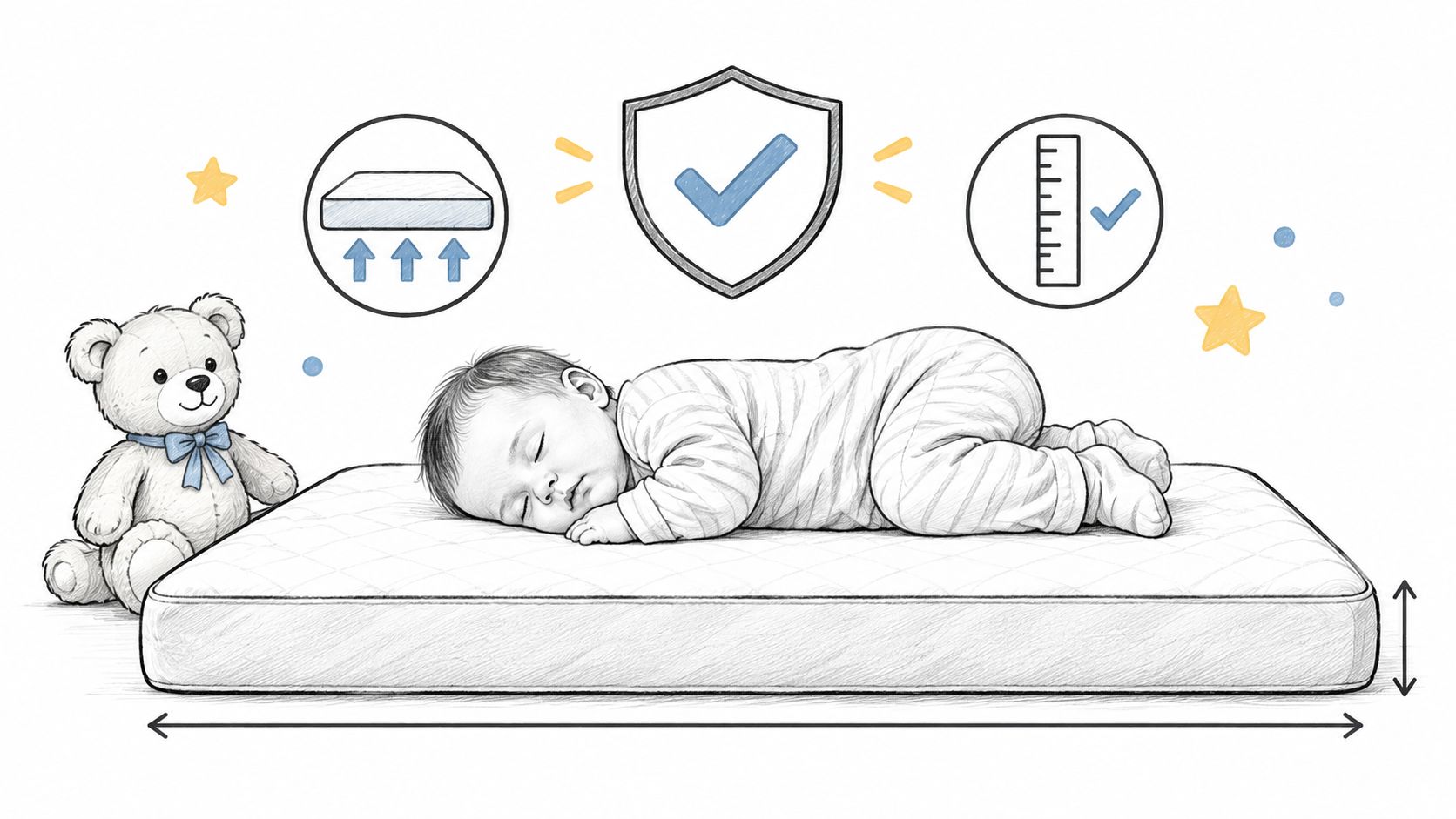
Keep the teddy bear outside the actual sleep space. Canadian public-health guidance reinforces the need to prevent airway obstruction, including from pillows, toppers and plush toys.
Use our safe sleep environment guide to assess the complete arrangement. If chewing prompts you to compare teething rail covers through Quote My Wall, treat that as a separate accessory decision, not a reason to add padding or alter the crib.
How to Check Size, Firmness and Fit
Bring a tape measure, inspect the mattress uncovered, and distinguish a full-size crib mattress from an adult full-size mattress. These aren't interchangeable.
The dimensional benchmarks below come from the CPSC's full-size crib guidance: the standard interior is 52 3/8 by 28 inches, ±5/8 inch, while the mattress must be at least 27 1/4 by 51 1/4 inches and no more than 6 inches thick.
Crib mattress size, firmness and fit requirements
| Check | Requirement | Why it matters |
|---|---|---|
| Crib interior, standard full-size | Dimensions stated above | Sets the space the mattress must fill |
| Minimum mattress size | Full-size minimum stated above | Undersized mattresses leave head-entrapment gaps |
| Maximum thickness | Maximum stated above | Excess thickness changes the intended sleep space |
| Firmness | No pillow-like give or deep indentation | Soft surfaces can form pockets around the face |
| Support contact | Flat, without propping or folding | Uneven placement creates gaps and steps |
Inspect before and after moving
- Measure length and width. Compare actual measurements with the minimum, not the packaging name.
- Measure thickness at the centre so you aren't relying on a compressed edge.
- Press the centre and corners. Deep dents or pillow-like give warrant stopping; this isn't a substitute for compliance testing.
- Fit the cover and sheet snugly. Loose fabric or distorted corners mean the fit needs attention.
- Place it flat on a clear floor. Don't prop, fold or stack mattresses.
CPSC firmness materials explain why soft, conforming surfaces can obstruct breathing. Don't add memory foam, a topper or cushioning underneath that changes the surface.
A 2026 analysis of U.S. PRAMS data found that only 36% of mothers followed the firm infant sleep-surface recommendation, using 2016–2022 data. Recheck after moving: compressed covers and newly distorted edges can change fit.
How to Baby-Proof the Room Around the Mattress
Get down on hands and knees. An adult notices the lamp; a mobile child can reach its cord, the outlet and whatever rolled beneath the dresser.
CPSC mattress guidance emphasizes compatible fit and flat support. For a floor sleeper, extend that inspection beyond the mattress to everything within reach.
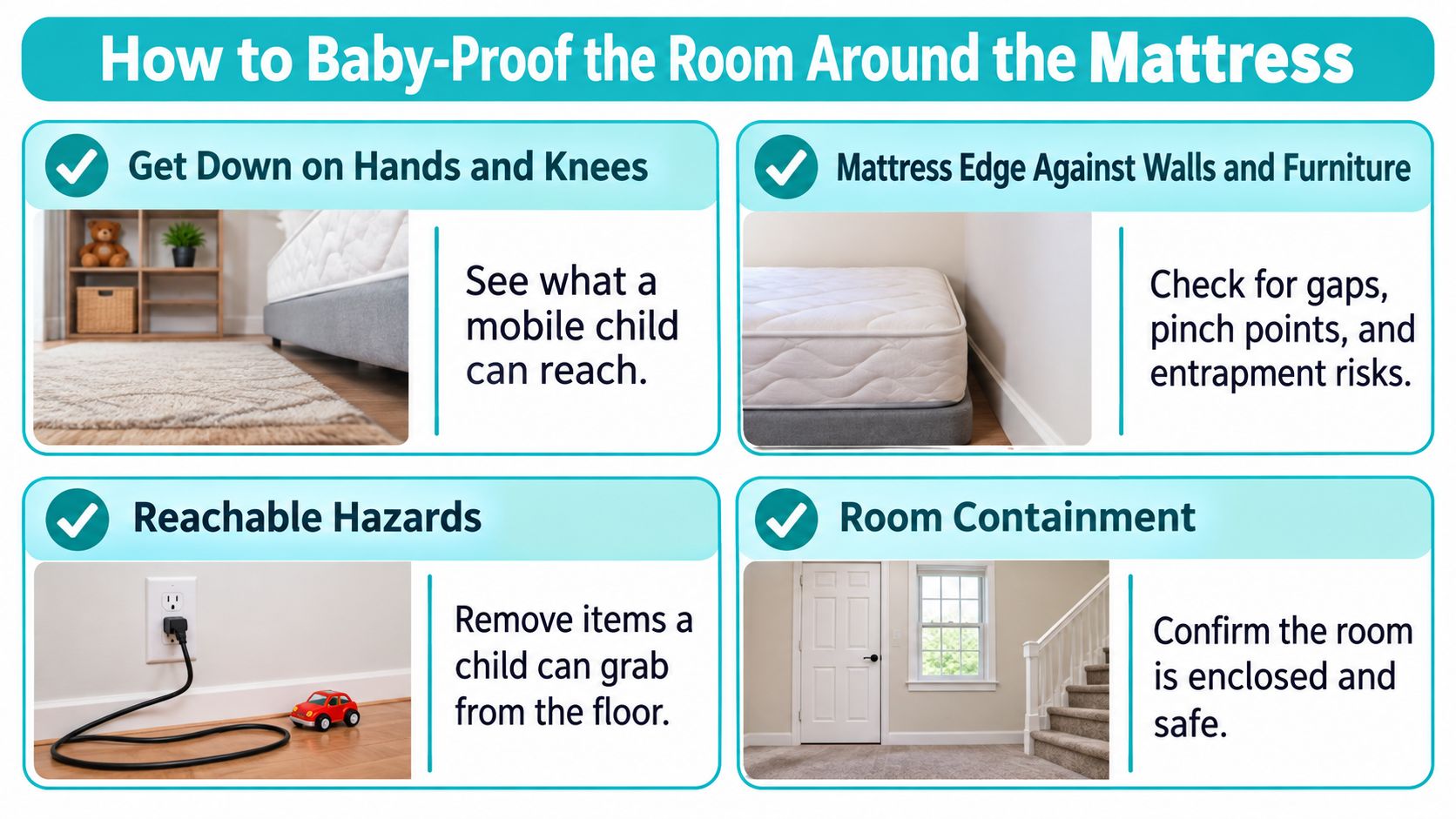
Room hazards and fixes for a floor sleeper
| Area | Hazard | Fix |
|---|---|---|
| Mattress edge and walls | Gaps and wedges beside furniture | Keep the mattress flat and clear of trapping gaps; don't wedge it against furniture |
| Window and blind cords | Strangulation loops | Use cordless blinds and secure window access |
| Outlets and loose cords | Shock and chewing | Cover outlets and route cords out of reach |
| Furniture and shelves | Climbing and tipping | Anchor furniture and clear nearby climbing aids |
| Doors and stairs | Night wandering | Gate stairs and use child-resistant containment that adults can open quickly |
| Bedding and plush toys | Suffocation | Clear pillows, quilts and toys from the sleep area |
| Pets and siblings | Unsupervised contact | Keep pets out and supervise shared play |
Keep the route to the door clear and preserve immediate adult access. Don't use a lock that could delay reaching your child.
Repeat the audit with the main lights off and a nightlight on. Check the wider home with our childproofing guide; after a breakage, Canes Cleaners' guide to removing glass shards from carpet offers a focused cleanup resource before children return.
Pros, Cons and Alternatives to a Floor Mattress
A floor mattress can be inexpensive when you already own a suitable crib mattress. It can also provide a gentle first step out of the crib without buying furniture immediately.
The trade-off is access. A child who can leave the mattress can explore the room, so you're choosing a containment arrangement, not just a lower bed.
| Option | Benefit | Limitation or condition |
|---|---|---|
| Floor crib mattress | Lower fall height; may reuse existing equipment | Requires complete room baby-proofing and careful gap checks |
| Toddler bed with compatible guard rails | Defined bed boundary for a climbing toddler | Correct assembly and mattress fit remain essential |
| Low toddler frame | Low entry height | Frame and mattress must be compatible |
| Convertible crib in toddler mode | Reuses furniture | Follow the manufacturer's conversion and readiness instructions |
| Compliant crib, bassinet or play yard | Appropriate infant alternative | Use its intended firm, flat mattress and fitted sheet |
Don't make a floor bed “cosier” by adding padding. The CPSC infant sleep-product rule reinforces keeping soft products and loose fabric out of infant sleep areas.
Choose for your child's age, climbing and accessible surroundings, not fall height alone.
Check Readiness and Choose the Setup
Before a crib-to-bed transition, assess climbing attempts, nighttime mobility, wandering, supervision, secured windows, stair protection and emergency access. A birthday doesn't complete those checks for you.
Our guidance keeps infants in a crib as long as appropriate, generally around two years or until they start climbing out, and never uses bed bumpers for infants. Climbing overrides waiting for an age milestone.
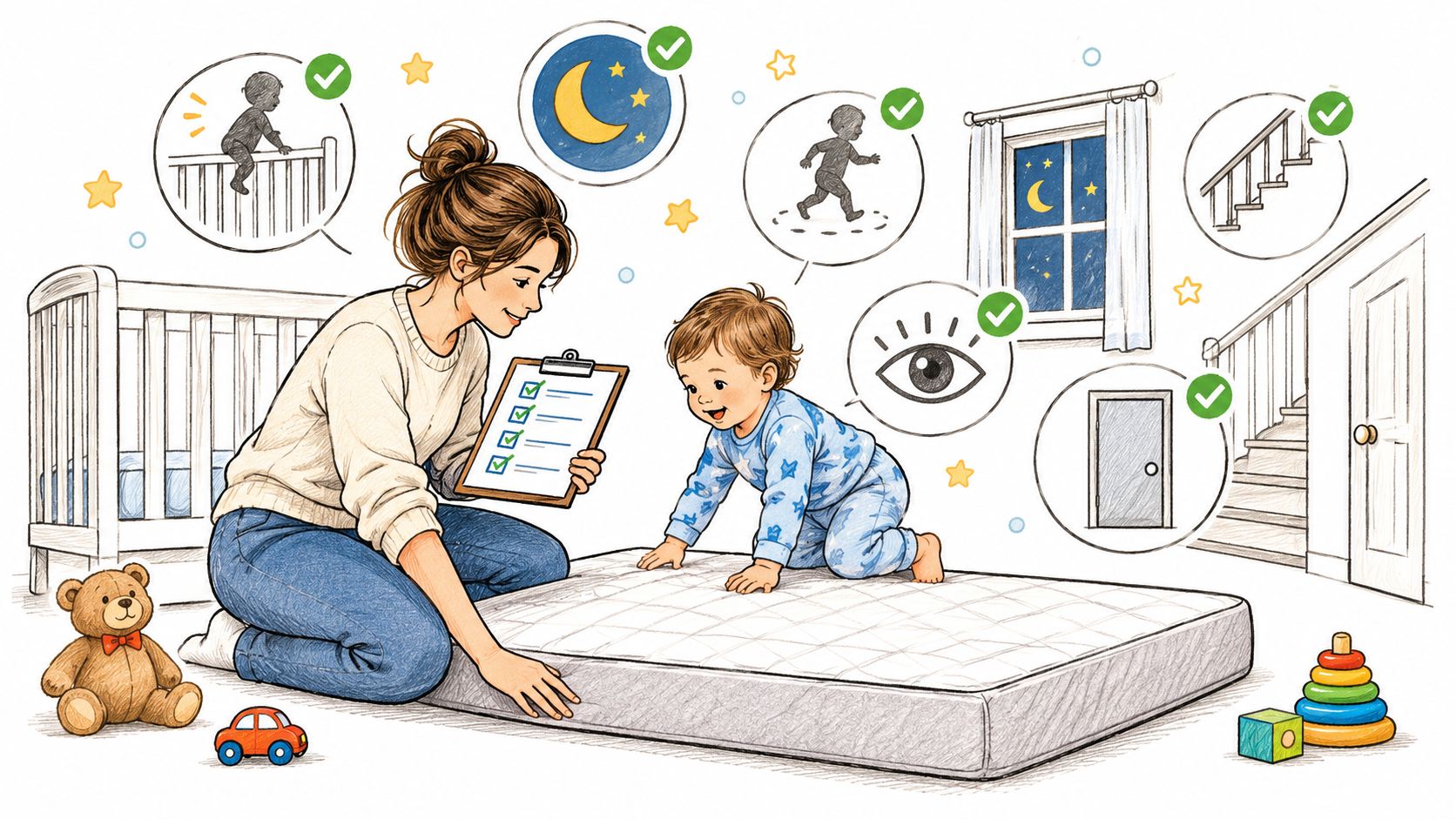
Make the decision together
- Confirm age and climbing ability, including emerging attempts.
- For an infant, choose a compliant crib, bassinet or play yard.
- Move a crib-climbing toddler to a toddler bed, such as our inflatable toddler bed.
- If choosing a temporary floor mattress, complete the mattress inspection and room audit first.
- Use a firm, flat surface with a snug sheet, no added padding or loose bedding, and recheck after moving.
For children who roll out of a 2-foot bumper wall, we recommend a floor mattress to avoid unnecessary head bumps, provided the toddler setup passes those checks.
If an infant shares the room, their own sleep space must remain protected from toddler access. A toddler's transition never makes an exposed mattress suitable for the infant.
Wait on the floor setup if containment or emergency access is unresolved. Use our crib-to-bed transition guide, and share your child's age, climbing behaviour and room setup in the comments.
Hiccapop offers crib mattresses, toddler travel beds and toddler bed rails for different stages of sleep. Visit Hiccapop to explore options for your child's stage, then match your choice to the mattress-fit and room-safety checks before bedtime.