


Breathable Waterproof Crib Mattress Pad: A Buyer's Guide
Scroll through any baby registry forum and you'll hear the same confident advice on repeat: buy a breathable waterproof crib mattress pad, toss it under the sheet, and stop worrying about overheating or nighttime leaks. That pitch sounds comforting at 11 p.m. when you're comparing dozens of nursery essentials. It's also backwards.
The word "breathable" on a mattress pad listing is a materials claim, not a safety promise. No federal rule defines what counts as breathable, and no protector turns an unsafe crib setup into a safe one. What decides whether a pad belongs in your baby's crib has far less to do with marketing buzzwords and everything to do with exact fit, minimal thickness, and keeping the sleep surface flat.
The foundation of safe infant sleep is a firm, flat, correctly fitted mattress with no added soft bedding or padding. The U.S. Consumer Product Safety Commission's crib mattress FAQ reminds consumers not to purchase or use supplemental padding in infant sleep spaces. A thin protective pad can still be a real help when diaper leaks and spit-up hit at 2 a.m., provided you know what the label words mean and which measurements matter before you click buy.
Breathable and Waterproof Mean Two Different Jobs
Put the two words side by side and you'll spot the engineering tension right away. Waterproof means a continuous liquid barrier that stops urine, spit-up, and spilled milk from soaking into the mattress core. Breathable is much fuzzier. One brand uses it to describe open airflow through a mesh top, another points to moisture-vapor transfer through a thin membrane, and a third relies on its own in-house test.
Think of the difference between a rain poncho and a basketball jersey. A heavy poncho keeps every drop of rain off your shirt, yet it traps your body heat and sweat inside within ten minutes. A mesh jersey lets a cool breeze pass right through, yet one spilled juice box soaks straight to your skin. A well-built breathable waterproof crib mattress pad tries to behave like both at once by pairing a thin, vapor-permeable upper layer with a tight liquid barrier directly underneath.

Why Surface Humidity Matters for Babies
Babies spend hours lying flat with a large share of their skin pressed straight against the sleep surface. When heat and perspiration have nowhere to escape, the microclimate under the sheet turns sticky fast. A review of infant mattress design hosted by the National Library of Medicine notes that because infants sleep with a large portion of their body in contact with the mattress, they are particularly prone to skin dampness and heat retention.
The same review points to porous materials, such as three-dimensional fiber mesh, as one way to limit heat and moisture buildup, and to moisture absorption as a property worth weighing. Even with smart fabric engineering, trapped wetness changes the equation immediately. Washing and drying the pad right after a leak keeps dampness from building up before the next nap.
How Each Pad Layer Works From Bottom to Top
Most parents only read the outer fabric name on the box, even though every layer in the stack changes how the pad sleeps and fits.
| Layer | What it does | Trade-off to check |
|---|---|---|
| Top fabric (jersey, bamboo viscose, microfiber) | Sets softness and how moisture feels against skin | Some blends pill or stretch out after repeated washing |
| Waterproof membrane (polyurethane or TPU) | Blocks urine and spills from reaching the core | Thicker membranes trap more heat |
| Mesh or spacer knit | Creates an air gap for airflow | Adds bulk if the layer is too deep |
| Moisture-absorbing fiber | Pulls dampness away from the surface | Needs prompt washing to keep working |
| Grip backing | Keeps the pad from shifting on the mattress | Textured or elastic-skirted grips can wear out after hot drying cycles |
Practical rule: Treat "breathable" as a comfort and materials description, not a medical safeguard. Before trusting either word on a product page, look for standardized water-resistance and moisture-vapor-transmission test methods rather than vague airflow slogans.
Mattress Pad vs. Protector vs. Waterproof Cover
Product listings use these three names loosely, so it helps to sort them by what each one actually does.
- Mattress pad: On adult beds, a pad is usually a cushioned layer. In crib listings, the word often just means a thin waterproof layer, so check that nothing is quilted, padded, or pillow-topped, since soft layers don't belong under a sleeping baby.
- Mattress protector: A thin waterproof layer, usually with an elastic skirt, that guards the mattress against leaks without adding cushioning.
- Waterproof cover: A cover that comes on the mattress itself. The Dual-Sided Foam Crib Mattress, for example, has a waterproof cover that unzips for machine washing and drying, so a separate pad may not be needed.
Whichever one you use, the American Academy of Pediatrics' 2022 safe-sleep policy statement still applies: "If a mattress cover is used to protect against wetness, it should be tightly fitting and thin." Only a fitted sheet goes over it.
Crib Measurements That Decide Whether a Pad Fits
Mattress geometry isn't a picky furniture detail. The CPSC's crib-hazard history report traces mandatory federal crib standards back to 1973 for full-size cribs and 1976 for non-full-size models, followed by a 1982 amendment banning hazardous end-panel cutouts. Voluntary ASTM standards followed in 1986 for corner-post entanglement, in 1988 for structural and mechanical failures of full-size cribs, and in 1997 for non-full-size cribs, and a 1999 revision of the full-size standard added improved slat requirements. The same report documents infant deaths from entrapment between the mattress and the side of the crib, which is why even a small edge gap matters.
Any pad you wrap around a mattress has to preserve the sleep system's exact dimensions. If elastic pulls the corners inward or extra fabric bunches along one rail, the mattress stops sitting flush where it belongs.
Full-Size vs. Non-Full-Size Fit Rules
Full-size cribs and non-full-size cribs (such as mini cribs and portable models) operate under distinct federal measurement thresholds. Under the CPSC crib mattress FAQ, a full-size crib measures 52 3/8 inches long by 28 inches wide, each with a tolerance of plus or minus 5/8 inch. The federal crib mattress rule, 16 CFR part 1241, adds that a full-size crib mattress must measure at least 27 1/4 inches wide by 51 5/8 inches long, and that the corner gap can be no more than 3.15 inches (80 mm) when the mattress, with a test sheet on, is placed against the sides and into a corner of the crib.
Non-full-size cribs follow tighter clearance and perimeter rules spelled out in the CPSC non-full-size baby crib FAQ. At the lowest support setting, there must be at least 20 inches from the uncompressed mattress top to the top of the side or end panel, and at least 3 inches at the highest setting. Centered inside the frame, the perimeter gap can be no more than 1/2 inch anywhere, and pressed against one side, the gap can be no more than 1 inch.
| Measurement | Required value | What it means for the pad |
|---|---|---|
| Full-size crib nominal size | 52 3/8 in long x 28 in wide, tolerance +/- 5/8 in | Pad must be sized to the crib, not the word standard |
| Full-size mattress minimum | 27 1/4 in wide x 51 5/8 in long | Pad must not push the mattress out of this range |
| Full-size corner gap | 3.15 in (80 mm) maximum | A bunched or shifted pad can open a gap at the corner |
| Non-full-size clearance, lowest support | 20 in from mattress top to crib side top | Pad height must not reduce this clearance |
| Non-full-size clearance, highest support | 3 in from mattress top to crib side top | Thick pads can cut into this margin |
| Non-full-size perimeter gap, centered | 1/2 in maximum at any point | Pad must sit flat and centered |
| Non-full-size perimeter gap, pressed | 1 in maximum against the perimeter | Pad must not create a gap when pressed |
Measure Your Own Mattress Before Ordering
Picture a parent who grabs a popular 52 x 28 inch pad because the listing calls it "standard size." On a true full-size crib mattress, that pad hugs the corners cleanly. Drop that same pad onto a smaller mini crib mattress, and extra fabric immediately folds under the sheet or tugs the thinner core into a slight taco shape.
Grab a tape measure before you shop. Write down your mattress's exact length, width, and thickness, and double-check the crib label to confirm whether you own a full-size or non-full-size model. For a fuller breakdown of how mattress sizing works across nursery frames, see the guide to crib mattress size dimensions, and for at-home firmness and corner gap checks, see How Firm Should a Crib Mattress Be? Test Firmness and Fit. Buy strictly by measured inches and crib category, never by the phrase "standard size."
Safe-Sleep Limits Every Pad Must Respect
One simple boundary governs everything inside an infant sleep space: a crib should hold only a tightly fitted sheet. A waterproof mattress pad sits underneath that sheet as a thin protective barrier, never on top as extra cushioning or a plush topper.
The CPSC's crib mattress FAQ reminds consumers not to purchase or use supplemental padding in infant sleep spaces. Federal rules also separate comfort marketing from regulated mattress requirements. Per the same FAQ, mattresses must not create a char length greater than 2 inches in the smoldering (cigarette) test, set out in 16 CFR part 1632. Under the open-flame standard, 16 CFR part 1633, the peak rate of heat release can be no more than 200 kW at any time in the 30-minute test, and total heat release can be no more than 15 MJ in the first 10 minutes. The federal crib mattress rule, 16 CFR part 1241, incorporates ASTM F2933, the standard for full-size, non-full-size, and aftermarket play yard mattresses. Adding a bulky or loose pad can compromise the fit and firmness those rules were written to protect.

Why Softness and Extra Layers Backfire
The stakes behind these rules aren't theoretical. In a 2018 CDC Vital Signs release, the CDC reported about 3,500 sleep-related infant deaths each year in the United States. In 2015 survey data from the states included in that analysis, 38.5% of mothers reported using any soft bedding in the baby's sleep area and 61.4% reported any bed sharing. Separately, the AAP's 2022 policy statement calls for a thin, tightly fitting cover if you use one for wetness.
A paper-thin pad that wrinkles, lifts at the corners, or loosens your fitted sheet causes more problems than a slightly firmer, flat-lying protector that stays drum-tight after washing.
Clear Boundaries for Everyday Use
Keep these paired habits front and center every time you make the crib, and review the full safe sleep environment guide for infants as your baby grows.
- Keep it taut and singular, never stacked: Pull one flat pad smoothly over the mattress corners under the fitted sheet. Do not layer a second waterproof pad, a quilted topper, or a folded bath towel underneath for "extra insurance."
- Preserve the mattress's real firmness: Let the crib mattress itself supply the flat, firm surface. Never buy a padded cover to soften a firm infant side or prop up an aging mattress that has begun to sag.
- Inspect after every laundry cycle: Check corners and seams for shrinkage or curling before snapping the fitted sheet back on. Do not assume a pad keeps its original fit after hot washing and drying, and never assume an aftermarket pad changes or upgrades how the mattress meets federal requirements.
- Keep the rest of the crib bare: Leave blankets, pillows, bumpers, and stuffed animals out of the sleep space. Waterproofing saves you from scrubbing foam, yet safe-sleep rules always outrank convenience, and no pad makes stomach sleeping safe.
Pros and Cons of Breathable Waterproof Pads
Parents buy waterproof protectors for a wonderfully unglamorous reason: babies are tiny leak machines. When a diaper gives out at 3 a.m., a continuous liquid barrier stops urine and spit-up from reaching the mattress interior. Instead of wrestling a soaked mattress core out of the crib frame, you peel off two layers, snap on clean backups, and get everyone back to sleep in five minutes.
Everyday upkeep gets simpler too. Most modern pads wipe down quickly after minor messes and go straight into the washing machine.
The Real Trade-Offs Behind the Convenience
Every upside comes with a counterweight worth weighing before you add a pad to your cart.
- Liquid protection vs. heat buildup: Thick polyurethane or vinyl-style backing blocks leaks reliably, yet denser barriers hold warmth against a baby's back even when the top cloth feels cool to your hand at bedtime.
- Soft knit feel vs. wash durability: Plush cotton jersey or bamboo-viscose surfaces feel gentle under a sheet, while some fabric blends pill, thin out, or stretch loose around the skirt after a couple dozen laundry cycles.
- Extra airflow spacing vs. fitted-sheet tension: Spacer meshes create breathing room above the waterproof film, yet every millimeter of added thickness lifts the sleep surface and can change how tightly your fitted sheet anchors underneath the corners.
- Reassuring label vs. real meaning: Seeing "breathable" on the package feels reassuring, yet without a single regulated definition, shoppers can mistakenly believe the pad prevents overheating or lowers SIDS risk.
A Fast Way to Score Any Pad
Skip the five-star reviews praising how "cloud-soft" a pad feels. That adjective is a warning sign for infant sleep. Score every option on four plain checkpoints: reliable waterproof coverage, quick machine cleanup, minimal heat retention, and tight dimensional fit backed by a named test method.
A well-chosen pad suits parents living in warm climates, households swapping crib sheets several times a week, and caregivers who want dependable stain protection without adding squishy padding.
What Changes as Price Goes Up
Crib mattress protectors range from budget multipacks to pricier single pads, and the gap can make new parents wonder whether the lower-cost pick cuts corners. A higher price usually pays for one or more of the differences below, and none of them replaces a snug fit and clear test data.
- Membrane thickness and type: Thinner polyurethane or TPU films tend to feel less plasticky and hold less heat, while thicker films and vinyl-style backings block leaks reliably but can trap warmth. Look for the membrane type on the listing, not a comfort adjective.
- Top knit and fiber: Cotton jersey, bamboo viscose, and microfiber feel and wear differently. Spacer-knit tops add an air layer, but they also add height under the fitted sheet.
- Care rules: Some pads can go in the dryer, while others need low heat or line drying. A pad that can't be machine dried is slower to turn around during a stomach bug.
- Return policy: A clear return window matters if the corners pull loose on your mattress after the first wash.
Matching a Pad to Your Nursery Scenario
Paying more doesn't automatically buy better airflow or a safer crib. A higher tag may pay for thicker spacer mesh, heavier fabric, or brand packaging, none of which substitutes for clear testing data and a snug fit.
Think through how your family will use the pad:
- Say you travel often with a play yard: Leave the crib pad at home. A play yard should use only the mattress made for it, with no extra pad or padding added. On the Hiccapop TravelPod Playard, the pad slips into a pocket in the play yard floor, which helps keep baby's arms and legs from getting trapped.
- Say you're bringing home a summer baby in a warm bedroom: Paying extra for a thin spacer-knit surface that publishes its moisture-transfer performance makes sense, provided your fitted sheet still pulls taut over the added depth.
- Say you want backup pads for middle-of-the-night swaps: Buying two straightforward, tightly fitting budget protectors often beats owning one expensive pad that leaves your mattress bare while it's in the wash.
Compare every listing on four disclosures: exact thickness or mattress-depth capacity, published testing methods, clear washing and drying rules, and a hassle-free return policy in case the corners pull loose on your mattress.
Buying Checklist for Parents and Caregivers
Standing in a baby-gear aisle or scrolling product thumbnails makes every white rectangle look identical. Run through this sequence in order so you filter out poorly sized or vague listings before you spend a dime.
Start with a quick visual overview of six core checkpoints, then work through the full list of eight below. In the graphic, "Check value" comes down to the practical side of value: care rules, the return policy or warranty, and how many pads you need for sheet changes.
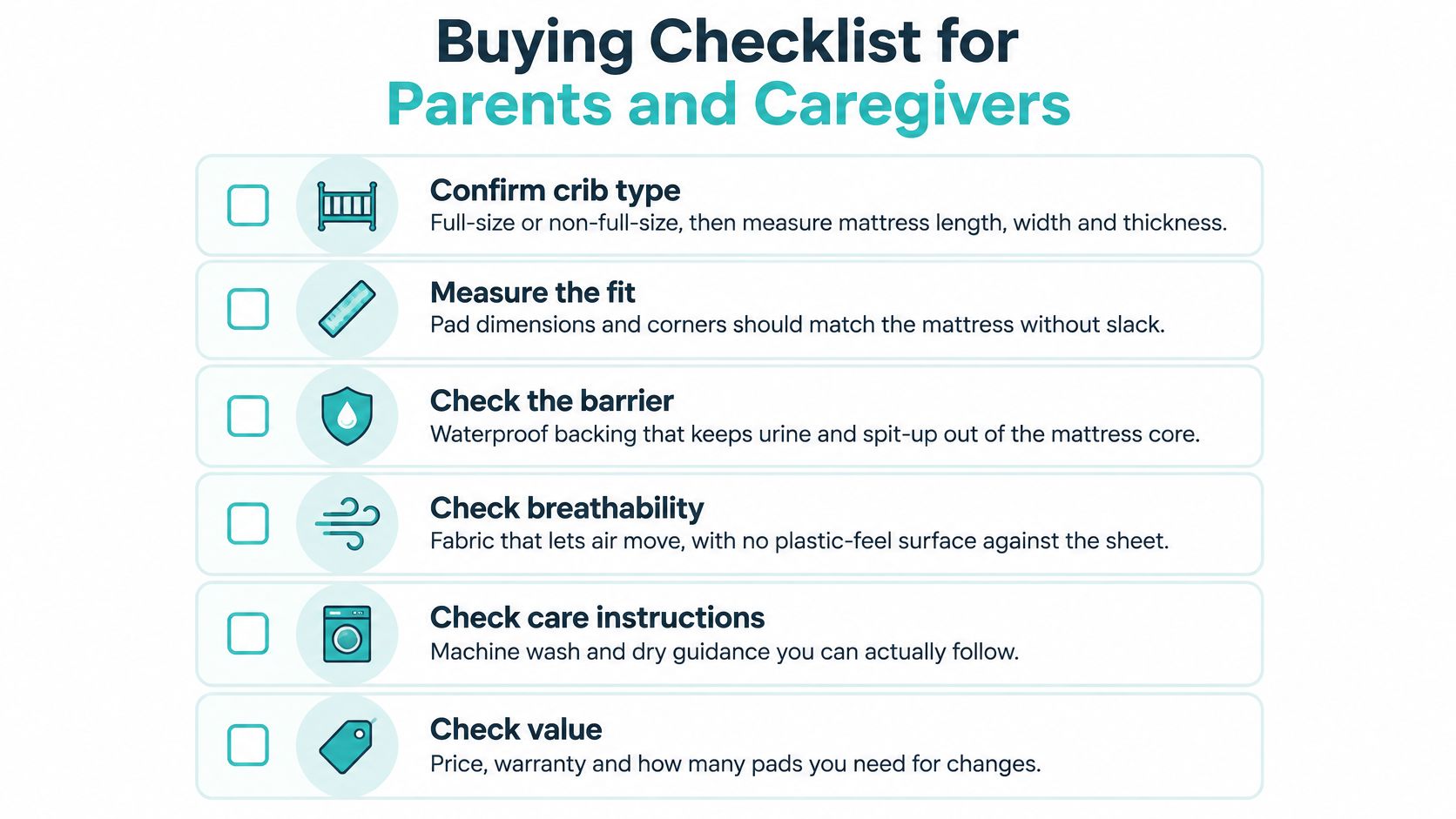
Eight Checks to Run Before Clicking Buy
- Confirm your crib category and grab real measurements: Check the crib's permanent label to see whether it's a full-size or non-full-size model, then measure your mattress length, width, and thickness yourself.
- Match the pad's listed dimensions to your tape measure: Look for exact inch measurements and maximum mattress depth on the product page, not a generic "fits most cribs" claim.
- Verify a thin, under-sheet design: Make sure the pad sits flat beneath a fitted sheet with no plush quilting, raised borders, or pillow-top batting.
- Look for named lab test methods: Check whether the brand identifies standardized water-resistance and moisture-vapor-transmission testing instead of leaning solely on the word "breathable."
- Inspect the top fabric and laundry label: Confirm the upper textile is machine washable and check whether it requires line drying or low heat, since slow-drying pads stall out quickly during a stomach bug.
- Check total added height: Note any extra thickness from a spacer knit or backing so you know your existing crib sheets won't pop off the corners.
- Read both compatibility manuals: Check your crib manufacturer's and mattress manufacturer's instructions to make sure an aftermarket protector is permitted with your exact model.
- Review the return policy and published disclosures: Favor brands that publish clear material specs and accept returns if the fit shifts once installed.
A Crucial Compatibility Note for Play Yards and Travel Cribs
Traveling families run into fit traps faster than anyone else. As noted in the CPSC Final Rule on the Safety Standard for Crib Mattresses, babies have suffocated in gaps involving incorrectly sized mattresses or extra padding, and federal requirements for certain aftermarket play-yard mattresses require the mattress to be at least as large as the original and lie flat in contact with the support structure.
Never fold a full-size crib pad under a smaller portable mattress to "make it work." In a play yard or travel crib, use only the mattress made for that model, with no extra pad, topper, or padding added. For more on why the original pad matters, see Mattress for a Travel Crib: Why the Original Pad Matters.
If a product listing can't give you exact measurements, maximum mattress thickness, and care instructions, close the tab and move on.
How to Fit, Wash, and Replace Your Pad
A pad that fits well works like a tucked-in shirt: the fabric stays flat because every edge is held in place. A pad that twists, curls, or shrinks can interrupt that smooth surface. Use the same order each time you change the crib, and you will spot fit problems before bedtime instead of after your baby is already down.
Here is the complete seven-step routine, followed by why each step counts.
Step-by-Step Setup and Care Routine
- Strip the crib and inspect the bare mattress: Pull off the old sheet and run your palm across the mattress surface to make sure it remains firm, flat, and free of dents or trapped moisture.
- Seat the pad smoothly from center to edges: Lay the waterproof pad flat, sweep out every wrinkle toward the corners, and tuck the skirt neatly underneath so no fabric folds along the perimeter.
- Pull the fitted sheet taut over both layers: Stretch your fitted crib sheet tightly over the pad and anchor every corner firmly beneath the mattress. The sheet does the heavy lifting of holding the pad flat and stationary.
- Press the corners and trace the entire perimeter: Push down firmly on all four corners and slide your hand along every rail to confirm zero lifting, bunching, or edge gaps. The goal is a surface that stays flat after the sheet is on, not one that merely looks smooth before the corners are secured.
- Re-check the surface once your baby settles in: After laying your baby down on their back, glance along the sheet edges to make sure movement hasn't pulled a corner loose, and remove any layer that shifts.
- Wash promptly after soiling and dry completely: Follow the care tag using mild detergent and the recommended temperature. For extra detail on fabric prep, drying, and stain care, read these mattress cover washing instructions before using heat, since high heat can damage a waterproof membrane.
- Retire the pad at the first sign of structural wear: Replace it right away if the fabric lumps, tears, shrinks away from the corners, peels along the waterproof film, or lets liquid seep through.
The Drying Slip Most Exhausted Parents Make
At midnight, it's tempting to pull a mostly dry pad from the laundry basket and slap a dry sheet over it. Resist that shortcut. Waterproof membranes slow evaporation along the inner layer, so a pad that feels dry on top can still trap hidden dampness underneath. That moisture builds humidity under the fitted sheet and can encourage odor or mildew.
Fit checks matter just as much as washing. A clean pad that bunches at the corners still creates the same surface problems as a dirty one, so smooth it again after every wash and check the skirt before replacing the sheet.
When everything is fitted right, the finished crib looks almost boring: dead flat across the center, drum-tight at every corner, flush against the rails with zero gaps, and nothing else sitting on top.
Frequently Asked Questions About Breathable Waterproof Pads
Does a breathable waterproof pad prevent SIDS or overheating?
No. Breathability is a fabric-and-airflow claim, not a proven medical safeguard. Real protection comes from placing your baby on their back on a firm, flat, properly sized mattress covered only with a tightly fitted sheet inside a bare crib, while dressing your baby appropriately for the room temperature.
Can you stack two pads for faster midnight sheet changes?
No. Stacking pads adds height and softness that go directly against CPSC warnings against extra padding in infant sleep spaces. Keep one thin pad under one fitted sheet, and store your clean backup pad in the nursery dresser instead of layering it on the mattress.
Can you use a waterproof pad in a portable crib or play yard?
No. The CPSC's crib mattress FAQ reminds consumers not to purchase or use supplemental padding in play yards and other infant sleep spaces, and warns that using an aftermarket mattress as a topper or supplemental padding presents a significant hazard. Use only the mattress made for that play yard model, with nothing added under or over it.
Do you need a pad if your crib mattress is already waterproof?
Not always. If the mattress already has a waterproof cover, a separate pad may not be needed, so check the mattress care instructions first. The Dual-Sided Foam Crib Mattress, for example, has a waterproof cover that unzips for machine washing and drying. If you add a pad anyway for faster changes, keep it thin and tightly fitted under a single fitted sheet.
How often should you wash it, and how should you dry it?
Wash the pad promptly after any leak, spit-up, or spill according to its care tag, and dry it completely before putting it back on the crib. Reusing a slightly damp protector traps moisture beneath the fitted sheet and undermines thermal comfort during sleep.
When should you replace a crib mattress pad?
Swap it out as soon as it develops lumps, rips, stretched elastic, peeling waterproof backing, or shrinkage that stops it from lying flat and tight. A warped pad no longer protects the mattress properly and can interfere with fitted-sheet tension.
Whenever a product listing makes a bold safety promise, check it straight against official CPSC safe-sleep guidance and the ASTM F2933 crib-mattress standard rather than relying on packaging claims alone.
Confirm Fit Before You Buy
Before you compare a single price tag or fabric weave, grab a tape measure and record your mattress's length, width, and thickness. Confirm whether your nursery holds a full-size crib or a non-full-size sleep space, and match the pad strictly to those numbers.
Keep three plain rules in your back pocket while shopping:
- Waterproof means liquid barrier: It protects the mattress core from messes, nothing more.
- Breathable means nothing without proof: Demand a named airflow or moisture-vapor test method, not a buzzword.
- Safe sleep always comes first: No protector replaces a firm, flat, tightly fitted mattress with a single fitted sheet and a completely bare crib.
Hiccapop designs its sleep gear around exact fit. The Dual-Sided Foam Crib Mattress fits standard full-size cribs at 52 × 27.5 × 6 inches and has a waterproof cover that unzips for machine washing and drying. For travel, the Hiccapop TravelPod Playard has a mattress pad that slips into a pocket in the play yard floor, which helps keep baby's arms and legs from getting trapped. If that pad ever needs replacing, the Hiccapop Replacement Playard Mattress Pad with Carry Bag — Exclusively for Hiccapop TravelPod Models (HP-TRAVELPOD Series Only) is made only for TravelPod models and is not a replacement pad for any other play yard.
Pull out your crib manual and mattress care instructions before ordering, and re-check current product pages, since prices and specs change over time. Verify safety claims directly through the CPSC, CDC, and AAP guidance cited throughout this guide, and keep every blanket and soft item out of the crib.
Looking for a crib mattress with the waterproof cover built in? See the Dual-Sided Foam Crib Mattress.
Disclosure
This article is published by Hiccapop, which makes the Dual-Sided Foam Crib Mattress, the Hiccapop TravelPod Playard, and the Hiccapop Replacement Playard Mattress Pad with Carry Bag mentioned in this article.