


A Parent's Guide to the Best Mattress for a Travel Crib: Safe Sleep on Every Trip
Let’s be real for a second. That flimsy, hard-as-a-rock pad that came with your travel crib? It's less of a mattress and more of a glorified placemat. A dedicated mattress for a travel crib isn't some fancy, over-the-top upgrade—it's one of the best things you can do for your baby’s sleep, and your own sanity, when you’re away from home.
It transforms a basic portable cot into a genuinely cozy and safe sleep space, giving you peace of mind no matter where your family adventures take you.
Why Your Travel Crib Needs a Better Mattress
Traveling with a baby often feels like an exercise in controlled chaos. One of the few things you can actually control is creating a familiar and comfortable place for them to sleep. But the standard-issue pad in most travel cribs just doesn't cut it. It’s usually too thin, too stiff, and offers next to no real support. The result? Restless nights for your baby, which means restless nights for you.
Putting a real travel mattress in there solves this problem instantly. It's not just about adding a bit of cushiness; it's about creating consistency. A proper mattress provides that firm-but-comfortable surface your baby is used to in their crib at home. That familiar feeling is a powerful signal that even in a new place, this is a safe spot for a good, long sleep.
The Rise of Travel-Friendly Sleep Solutions
Modern families are on the move more than ever, and parenting gear is finally catching up. As travel roars back, with over 1.4 billion international trips happening, parents are looking for smarter solutions. Here in North America, this trend is huge—the baby mattress market is expected to reach US$1.34 billion by 2025. What's driving that? Parents who need lightweight, foldable options that don't compromise on safety.
This isn't just about convenience. It shows that parents are done accepting mediocre sleep just because they aren't at home. They want products that are easy to pack and safe for their kids.
It's More Than Just a Padded Board
The difference between the pad that comes with your travel crib and a true mattress is night and day. The original pad is like a temporary floor covering; a dedicated mattress is the foundation for genuinely restorative sleep.
A real mattress provides:
- Proper Support: A firm surface is non-negotiable for infant safety, as it helps reduce the risk of SIDS.
- Real Comfort: A high-quality foam core supports your baby’s body perfectly, encouraging longer and more peaceful stretches of sleep.
- A Cleaner Sleep Space: Let's face it, accidents happen. Most aftermarket mattresses come with waterproof, washable covers—an absolute must-have.
Upgrading is a simple move that pays off big time in the form of a happy, well-rested baby (and therefore, happy, well-rested parents). If you want to get into the nitty-gritty, you can learn more from our guide on what a Pack n Play mattress is and see why the details really matter.
Mastering the Non-Negotiables of Mattress Safety
When you’re picking out a mattress for your travel crib, nothing—and I mean nothing—is more important than safety. Let's cut through the confusing jargon and get straight to what actually matters for keeping your baby safe and sound, whether you're at a hotel or visiting Grandma. These are the absolute must-haves.
Think of it this way: a cranky, sleep-deprived baby is a problem. The right mattress is the solution that leads to a peaceful, sleeping baby. It’s that simple.
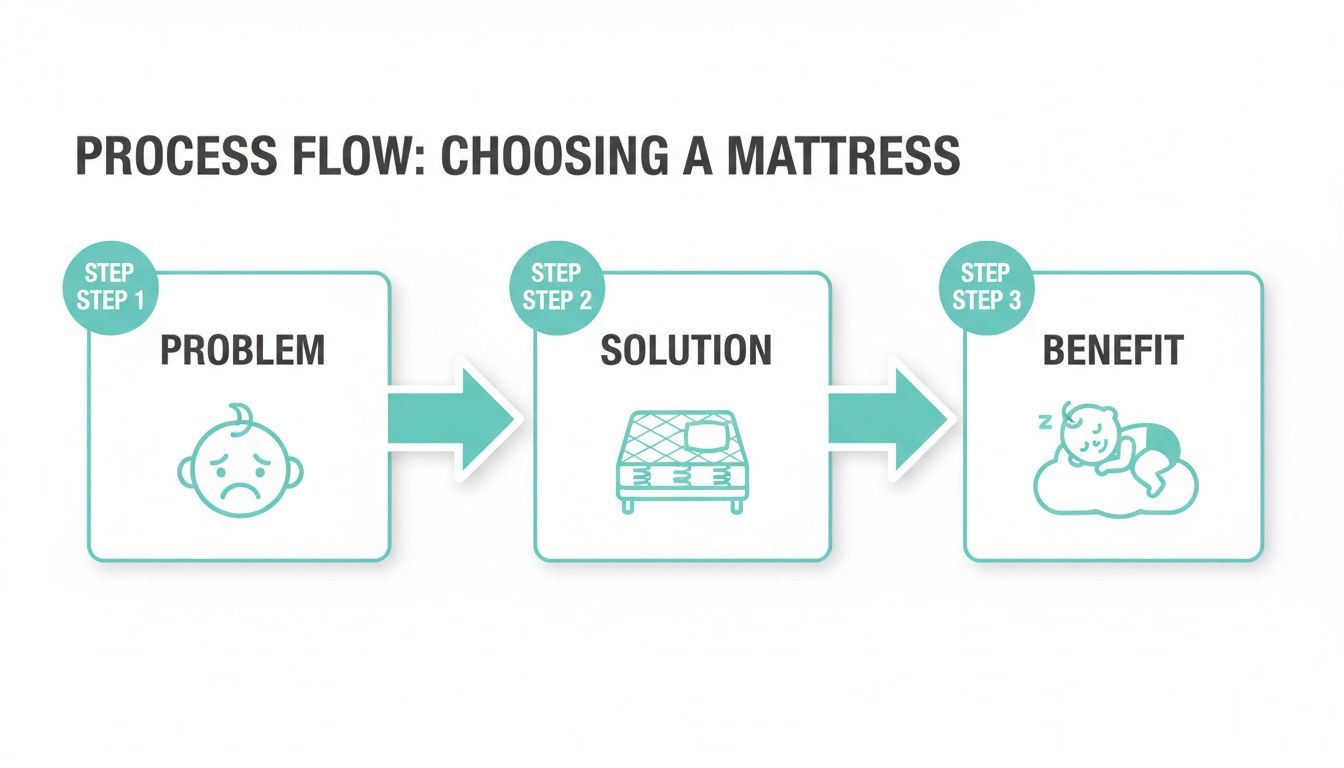
Ultimately, upgrading from that flimsy, board-like pad to a quality mattress is how you turn restless nights into genuinely restorative sleep for your little one.
The Firmness Test and Why It Matters
The American Academy of Pediatrics (AAP) is crystal clear on this: babies need to sleep on a firm, flat surface to reduce the risk of SIDS. But what does "firm" actually feel like? It’s way firmer than what you or I would find comfortable.
Here’s a good way to think about it. A firm baby mattress is like packed, wet sand right at the water's edge—it has a little give, but it holds its shape. A soft mattress is more like dry, fluffy sand that creates dips and valleys. For a baby, those little indentations can be a real danger.
You can do a quick check yourself. Press your hand down firmly in the middle of the mattress, then along the edges. When you lift your hand, the surface should snap right back, leaving almost no imprint. If it holds the shape of your hand for even a second, it's too soft.
Decoding Safety Certifications
You'll see a lot of labels slapped on baby products, but a couple of them are really important when it comes to mattresses. These aren't just marketing fluff; they are your proof that the mattress is free from a cocktail of nasty chemicals.
- GREENGUARD Gold: This is the one you really want to see. It’s the gold standard for air quality, certifying that a product has met some of the world's most rigorous standards for chemical emissions. This is a huge deal when your baby spends hours with their face right next to the mattress.
- CertiPUR-US®: This label applies specifically to the foam inside the mattress. It’s an assurance that the foam was made without ozone depleters, heavy metals, formaldehyde, or certain phthalates. Basically, it means a healthier, non-toxic foam core.
Seeing these certifications gives you real peace of mind, confirming your baby isn’t breathing in harmful volatile organic compounds (VOCs) while they sleep.
The Critical Importance of a Snug Fit
This is a safety rule with zero wiggle room: the mattress must fit the travel crib perfectly. Any gap between the edge of the mattress and the side of the crib is a serious entrapment and suffocation hazard.
A poor mattress fit is a silent danger. The goal is to leave absolutely no room for little arms, legs, or heads to get wedged in the sides. A snug fit is a safe fit—period.
To be sure, use the two-finger rule. Try to push your fingers between the mattress edge and the crib frame. If you can fit more than two fingers in that gap, the mattress is too small and is unsafe to use.
This is why you should always, always measure the inside of your travel crib before buying a mattress. Don't just trust the brand name, as different models can have slightly different dimensions. A few minutes with a tape measure can prevent a terrible accident. It's also worth understanding the best practices for preventing mold in mattresses, which is a key part of keeping your baby's sleep space safe and clean.
Parents' focus on sleep quality has become a major force in the market. A poor mattress is linked to a 20% higher SIDS risk, making firm, breathable travel options with GREENGUARD certification non-negotiable. At Hiccapop, our products feature non-toxic foams that exceed U.S. CPSC standards, which is perfect for families on the go. This is especially true now that 65% of millennial parents are actively seeking out chemical-free products for their kids.
Materials, Comfort, and Why Cleanliness Is King
Beyond the perfect fit, what a travel crib mattress is made of directly impacts your baby’s comfort and, just as importantly, your sanity when it comes to cleanups. When you’re away from home, the last thing you need is a fussy baby or a complicated cleaning process. Let’s look inside and see what makes a great travel mattress.
It’s no surprise that parents are investing more in quality sleep solutions. The global crib mattress market was valued at USD 1.5 billion and is expected to more than double to USD 3.2 billion by 2033. Foam mattresses are leading the charge, holding the biggest market share because they hit the sweet spot of being affordable, comfortable, and light enough for easy travel.
The Core of the Matter: Foam, Organics, and More
The inside of the mattress—the core—is what provides that crucial support. The material used here determines the mattress's weight, firmness, and even its breathability.
You’ll generally find a few common materials, each with its own set of pros and cons for travel. Choosing the right one often comes down to balancing your family's priorities, whether that's sticking to a budget, traveling light, or opting for eco-friendly materials.
Travel Crib Mattress Material Comparison
A side-by-side look at common mattress materials to help you choose the best option based on your family's priorities like cost, weight, and eco-friendliness.
| Material Type | Pros for Travel | Cons for Travel | Best For |
|---|---|---|---|
| High-Density Foam | Extremely lightweight, affordable, durable, and provides firm, even support. | Can be less breathable than other materials; quality varies significantly. | Most traveling families who need a reliable, easy-to-carry, and budget-friendly option. |
| Organic Cotton/Wool | Naturally breathable, hypoallergenic, and chemical-free. Great for sensitive skin. | Heavier than foam, significantly more expensive, and may not be waterproof without a cover. | Health-conscious families who prioritize natural materials and don't mind the extra weight or cost. |
| Innerspring (Coils) | Very durable and supportive. | Far too heavy and bulky for practical travel. Not a common or recommended option for portable cribs. | At-home cribs, not travel. |
While options exist, high-density foam is almost always the winner for travel. It's engineered to provide that firm, flat surface recommended by the AAP without adding a bunch of weight to your luggage. It’s light, resilient, and gets the job done safely.
Your First Line of Defense: The Waterproof Cover
Let's be real: diaper blowouts and spit-up are a part of life. A good mattress core is important, but the cover is what stands between a small mess and a ruined mattress.
This is where a waterproof cover becomes absolutely essential. It’s not just a feature; it’s a necessity. It blocks any and all moisture from reaching the foam core, preventing the growth of mold, mildew, and unpleasant odors.
But not just any waterproof cover will do. You need one that is:
- Genuinely Waterproof: It has to withstand a serious leak, not just a small dribble.
- Quiet: Cheap vinyl covers can make a crinkly, distracting noise every time your baby moves. Look for soft, fabric-like materials that are silent.
- Breathable: A good cover should still allow for airflow to keep your baby from overheating.
- Washable: This is the big one. A cover that you can easily zip off and throw in the washing machine makes cleanups on the road quick and painless.
Even with a great cover, knowing how to clean a mattress like a pro will help you keep your baby’s sleep space fresh and hygienic for many trips to come.
Designing for True Portability and Convenience
A fantastic mattress that’s a nightmare to pack is, simply put, a travel fail. Once you’ve ticked the boxes for safety and comfort, the next make-or-break feature is pure, simple practicality. How easy is this thing to get from your home to your destination and set up when you’re exhausted and your baby is… well, let’s just say, over it?
This is where smart design makes all the difference. The best mattress for a travel crib is one you barely have to think about. It should be lightweight enough to grab without a second thought and fold down small enough to disappear into your car trunk.
Folding Designs: The Trifold Advantage
The real magic of a great travel mattress often lies in how it folds. While some roll up, the trifold design is king for a very good reason. Think about folding a letter to slide it into an envelope—that’s the simple, space-saving efficiency you get with a trifold mattress.
This design folds into three neat sections, creating a slim, rectangular package that’s incredibly easy to manage. It slides into the car next to suitcases or can even fit into the overhead bin on some airplanes. More importantly, it’s fast. Unfolding it takes just seconds, which is a total lifesaver when you arrive late and just need to get your little one to sleep.
The Unsung Hero: The Carry Bag
Never underestimate the importance of a good carry bag. A flimsy, poorly designed bag can turn a brilliant mattress into a travel headache. A high-quality carry bag isn't just a dust cover; it's a legitimate piece of functional travel gear.
Look for these key features:
- Durable Fabric: The bag should be tough enough to handle being checked as luggage or tossed in a packed trunk without ripping.
- A Sturdy Handle: A reinforced, comfortable handle makes that trek from the car to the hotel room so much easier.
- A Smooth Zipper: There's nothing more frustrating than a zipper that snags or breaks. A high-quality zipper means you can pack and unpack without a fight.
A well-made bag keeps your baby’s mattress clean and protected, but its real job is making the whole process of hauling it around feel effortless.
Real-World Travel Scenarios
How you pack your mattress can change depending on how you're traveling. A little planning ahead can save you a lot of stress down the road.
Convenience isn't just a luxury; it's a core feature. A mattress that sets up in seconds and packs away just as fast gives you more time to focus on what matters—enjoying your trip with your family.
For road trips, a trifold mattress is a packing dream. Its flat, compact shape can be slipped into almost any available space, making it much easier to Tetris into your car than a bulky rolled mattress. For air travel, always check your airline’s policy. Many trifold mattresses in their carry bags meet carry-on size restrictions, but it’s always wise to measure and confirm beforehand. For more advice on navigating travel with a baby, our guide on choosing a portable baby bed for travel has some great tips.
Ultimately, you want a mattress that simplifies your travel routine, not complicates it. A design that prioritizes a quick setup and easy transport is a direct investment in a less stressful, more enjoyable family vacation.
Your Top Questions About Travel Crib Mattresses, Answered
Even after you've done your homework, a few questions always linger. Let's clear up some of the most common ones we hear from parents. Think of this as the final check to make sure you're feeling completely confident in your choice.
Is It Really Safe to Add a Separate Mattress to a Travel Crib?
Yes, it's not only safe, but it's often a huge upgrade in both safety and comfort—as long as you follow two golden rules. First, the mattress has to be firm. No exceptions. Second, it needs to fit perfectly snug inside the travel crib, leaving zero dangerous gaps around the edges.
Let’s be honest, the "mattress" that comes with most travel cribs is little more than a flimsy, thinly padded board. A dedicated, well-fitting mattress provides the support your baby actually needs for safe sleep. Just be sure to do the "two-finger test" every time: if you can fit more than two fingers between the side of the mattress and the crib wall, it's too small and poses a safety risk.
Can I Just Use My Regular Crib Mattress in the Travel Crib?
Absolutely not. You should never try to squeeze a standard-sized crib mattress into a portable travel crib. They are built for full-size, heavy-duty cribs and are simply way too big and thick for a travel crib's lighter frame.
Trying to make it work creates some serious safety issues. A mattress that's too tall could give a curious toddler the boost they need to climb out. Even more concerning, a mattress that’s the wrong size can push against the soft, flexible walls of a travel crib, causing them to bow out and create dangerous gaps where a baby could get trapped. Stick with a mattress made specifically for the dimensions of your travel crib.
How Do I Clean a Travel Crib Mattress When We're Traveling?
This is where a little planning makes a world of difference. The single most important feature for easy on-the-go cleaning is a removable, machine-washable, and waterproof cover. It's a total game-changer for dealing with the inevitable spit-up or diaper leak.
For small messes, a quick wipe-down with a damp cloth is usually all you need. But for those middle-of-the-night disasters, you can just zip the cover off and toss it in the hotel's washing machine (or even wash it by hand in the sink). The waterproof layer is your best friend here, protecting the foam core from moisture that can breed mold and bacteria. Pro tip: always pack at least one extra fitted sheet.
What's the Difference Between a Pack n Play Mattress and a Travel Crib Mattress?
This is a classic source of confusion, so let's clear it up. The terms get thrown around a lot, but "Pack 'n Play" is actually the brand name for a popular line of playards made by Graco. "Travel crib" is the general, catch-all term for any portable crib.
While many travel cribs and Pack 'n Plays have similar dimensions, they aren't all identical. There can be small but significant differences from one brand to another, or even between different models from the same brand. That’s why the best thing you can do is pull out a tape measure and get the exact interior dimensions of your specific travel crib before you buy a mattress. It's the only way to be 100% sure you're getting that perfect, snug, and safe fit.
Choosing the right mattress for your travel crib boils down to three essentials: uncompromising safety, real comfort, and travel-ready convenience. By prioritizing a firm, perfectly fitting mattress with a washable cover, you’re not just buying a piece of gear—you're investing in peaceful nights and happier family adventures. Now you’re ready to find the perfect sleep solution that will help your little one (and you!) rest easy, no matter how far you roam. Check our full range of parent-approved solutions.
What's the one travel baby product you can't live without? Share your must-haves in the comments below.