


Booster Seat vs High Chair: Which Fits Your Child?
Why do so many parents pick a baby feeding seat by reading the age printed on the box instead of watching how their child sits at the table? When families debate a booster seat vs high chair, the product label often steals the spotlight from the factor that keeps mealtime safe.
A child who can't sit upright on their own, or whose feet dangle midair from an adult dining chair, isn't well matched to that seat no matter what the carton promises. Developmental readiness and seated posture decide which option works long before brand style or tray size ever should.
This guide covers dining booster seats, the kind that attach to an adult chair at the table. For the car kind, see Hiccapop's guide on how to use a booster seat.
Disclosure: Hiccapop makes the OmniBoost and ErgoBoost booster seats mentioned in this post.
Booster Seat vs High Chair at a Glance
| Feature | High chair | Booster seat |
|---|---|---|
| Structure | Freestanding, with its own legs and frame | Attaches to an adult dining chair |
| U.S. standard | ASTM F404 | ASTM F2640 |
| Typical age range | Up to 3 years (CPSC definition) | Up to 5 years under ASTM F2640 scope; Hiccapop OmniBoost and ErgoBoost labeled 6 months to 3 years |
| Seating height | Seat more than 15 inches above floor | Raises child to standard table height |
| Footprint | Permanent floor space | Uses existing dining chair |
| Portability | Bulky, rarely moved | Light, packs into a bag |
| Tray | Built in, often removable | Often none or a small tray |
| Main risk | Tip-over, tray disengagement, standing | Attachment failure, pushing off the table |
The name on the box matters far less than your child's current size and the product's stated limits. Both formats are only as safe as the habits you bring to every meal.
Check the age and weight range on the product label before comparing a single extra feature.
Structure, Space and Everyday Use
Start your evaluation with the dining chair, not the booster. Because a booster borrows its stability from whatever adult chair sits beneath it, a well-built booster strapped to a wobbly folding chair is less stable than a freestanding high chair with a wide base.
Under the CPSC high chair FAQ, a high chair is a freestanding chair for a child up to 3 years old with a seating surface more than 15 inches above the floor. Under the CPSC booster seat FAQ, a booster seat is a juvenile chair placed on an adult chair to raise a child to standard dining-table height, for children up to 5 years old. Comparing stated limits beats guessing by category name.
How Chairs Fit Real Life
Attachment hardware decides where a booster can go. The Hiccapop OmniBoost Travel Booster Seat attaches to a dining chair with its seat straps, using one strap around the chair seat and one around the chair back, so the host chair needs a solid, compatible frame. Always test outdoor or camp seating first. Some dual-use seats also extend their lifespan by starting on the floor, and when a child grows too tall to use the OmniBoost on the floor, it can still be used on an adult chair.
Floor space pushes many families toward compact gear. A freestanding chair claims a permanent corner near your table, whereas a booster adds zero extra footprint beyond the dining chair you already own. If your kitchen doubles as a hallway, see Hiccapop's guide to choosing a high chair for small spaces.
Think through three real settings: a restaurant booth, a picnic table, and a grandparent's dining room. The heavy freestanding chair stays home, while a go-anywhere booster chair like the Hiccapop OmniBoost packs cleanly for grandma's, picnics, restaurants, camping, and more. You're trading a stay-put built-in tray for a seat that pulls right up to the adult table. Ask yourself one deciding question: will this seat stay in one dining room, shuttle between homes, or travel with you most weeks?
Age and Readiness Milestones for Each Seat
Developmental readiness always outranks a calendar birthday or a maximum limit printed on the box. In CPSC's summary of ASTM's revised high chair standard, approximately 6 months is the age when a baby is generally expected to sit upright without help. Reclined-seat high chairs are for younger infants who can't sit upright unassisted or who weigh 20 pounds or less.

| Age stage | Readiness sign | Usual fit |
|---|---|---|
| Birth to about 6 months | Cannot sit upright without help | Neither; wait until the child sits unaided |
| About 6 months to 1 year | Sits upright unaided | High chair, or a booster labeled for this age, with full harness |
| 1 to 2 years | Steady sitter, reaches food without leaning | High chair, or booster on a sturdy chair |
| 2 to 3 years | Sits steadily, may try to climb or stand | Booster on a sturdy chair, with supervision; high chair if within limits |
| 3 to 5 years | Beyond the high chair age range | Booster rated for the child's age and weight |
Every stage brings different feeding skills, and you can pair seat transitions with Hiccapop's age-by-age feeding tips for babies, toddlers, and kids. Even if your toddler looks eager for a big-kid seat, check the exact model limits first. For instance, the Hiccapop OmniBoost is labeled for children ages 6 months to 3 years, so older preschoolers still need a seat rated for their stage. As solid meals expand, reading snack labels also helps you match textures and ingredients to your child's stage.
Quick Readiness Checklist
Before moving your child into either seat tonight, verify four concrete signs at the table:
- Steady upright sitting: Your child holds their torso straight without slumping sideways or propping on pillows.
- No table shoving: They don't brace their feet or knees to push backward off the dining table.
- Supported feet: Their soles rest on a footrest or chair rung instead of dangling freely.
- Snug belt fit: Every supplied harness strap sits flat and secure across their body.
Safety Checks and the Pre-Meal Routine
Numbers explain why restraint habits matter more than cup holders or wipe-clean cushions. A Nationwide Children's Hospital study of U.S. children age 3 and younger treated in emergency departments from 2003 to 2010 estimated more than 9,400 high-chair- or booster-seat-related cases per year, roughly one child per hour nationally. Falls accounted for 93% of those injuries, and among cases recording the child's activity right before the fall, approximately two-thirds involved climbing or standing.
As the CPSC high-chair safety standard announcement makes clear, incident counts aren't direct product-to-product failure rates because exposure and daily use differ across homes, though the scale of injuries prompted a federal high-chair standard that took effect in 2019. Whatever the price, every seat depends on the same habits: buckle the harness every time and stay within arm's reach.
Restraint rule: Nationwide Children's Hospital injury researchers stress that the tray was not designed as a restraint. Only the harness does that job.
Each seat type carries specific hardware checks. According to federal high-chair rulemaking records, high chairs must include a passive crotch restraint with two separate bounded leg openings and a three-point restraint system, along with pull tests for removable trays. Always confirm the tray locks cleanly when your model requires it and keep the base level on the floor. For boosters, the CPSC booster-seat standard release requires an active means of attaching to an adult chair and a retail package that lists the minimum adult-chair dimensions, plus warnings to make sure the booster is securely fastened before each use and to stop children from pushing away from the table.
Your Six-Step Pre-Meal Routine
- Confirm your child's age and weight fall within the seat's printed label limits.
- Check that your child sits upright unaided with feet supported.
- Measure the adult dining chair against the packaging minimums before mounting a booster.
- Fasten every attachment strap and child harness buckle snugly, including the crotch strap.
- Inspect buckles, straps, tray locks, and the frame for cracks, fraying, or loose parts.
- Stay within arm's reach and keep your child seated throughout the meal.
Which Seat Fits Your Situation
When families weigh a booster seat vs high chair for their own kitchen, daily routine usually narrows the field quickly.
| Situation | Better fit | Why |
|---|---|---|
| Infant who sits unaided and needs a dedicated base | High chair | Freestanding frame and full harness |
| Small apartment or tight dining room | Booster seat | Uses an existing chair and stores flat |
| Restaurant, picnic or grandparent's house | Booster seat | Packs in a bag and attaches to the available chair |
| Toddler who stands or climbs in the seat | High chair with full restraints, under supervision | Freestanding base avoids host-chair tipping, but standing is not fully prevented |
| Child over 3 years | Booster seat | Past the high chair age range |
This side-by-side graphic summarizes how those everyday trade-offs line up for parents.
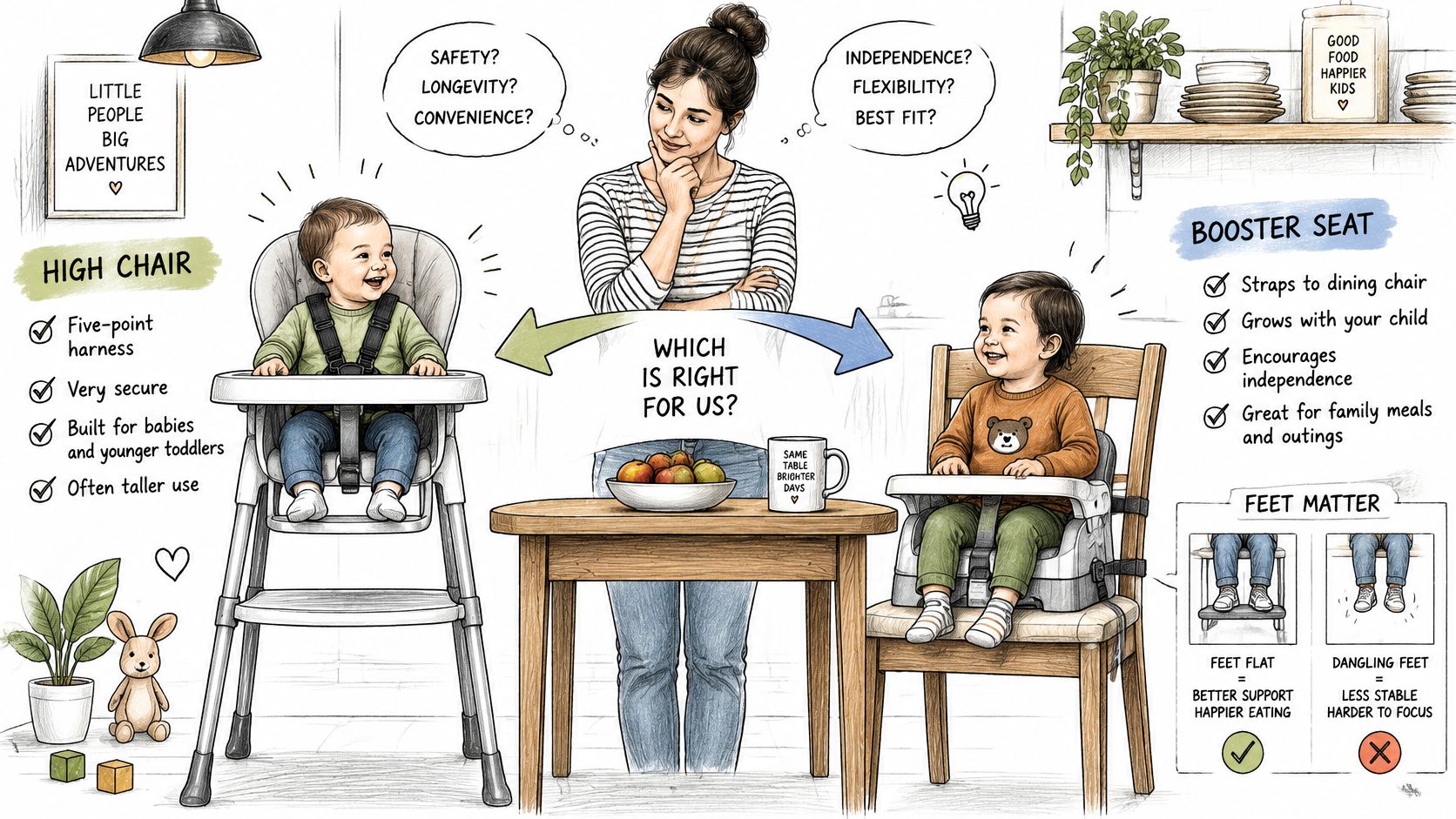
Why Posture Breaks the Tie
When two seats both fit your home, seated geometry breaks the tie. In its mealtime positioning handouts, Australia's Child and Adolescent Health Service recommends keeping a child's hips, knees, and ankles close to 90 degrees, with an upright supported back, stable feet, and arms resting comfortably at the tray or table. The CDC's choking guidance also says to have children sit up while eating, with no lying down, crawling, or walking.
A lower booster only beats a high chair for an older toddler when it gives better whole-body stability. Picture an 18-month-old perched on a sleek booster where the seat cushion is too deep and their feet swing in midair. Without foot support, they slump backward, strain to reach their bowl, and fidget nonstop. Sliding a sturdy step stool under their soles or switching to a better-proportioned height immediately steadies their core and makes bringing your toddler into family dinnertime calmer for everyone. Also check both age and weight specs together. The Hiccapop ErgoBoost is labeled for ages 6 months to 3 years, so follow the age label, not the frame's strength.
If your child sits unaided, either a high chair or a booster labeled for their age can work. Let your table, space, and travel plans decide.
Booster Seat vs High Chair FAQs
When should you switch from a high chair to a booster?
There's no single switch date. Switch when your child reaches any limit printed on the high chair's label, or sooner if a booster labeled for their age and weight fits your table and dining chair better. The CPSC defines high chairs for children up to 3 years old and dining boosters for children up to 5.
Can a 6-month-old use a booster?
Yes, if the booster is labeled for that age and your baby sits upright without help. CPSC's summary of ASTM's revised high chair standard puts that milestone at about 6 months. Some dining boosters, including the Hiccapop OmniBoost, are labeled from 6 months. Strap the booster to a sturdy adult chair and buckle the harness every time.
Is a booster or high chair better for safety?
Neither type is safer by category. Each has its own federal standard: ASTM F404 for high chairs and ASTM F2640 for boosters. In a Nationwide Children's Hospital study, 93% of high chair and booster seat injuries involved a fall, and in cases that recorded the child's activity, about two-thirds of children were climbing or standing. A seat that fits your child and chair, a harness buckled every time, and an adult within arm's reach matter more than the seat type.
Will a booster fit any dining chair?
No. Under the federal booster seat standard, the retail package must list the minimum dimensions of the adult chair the booster fits. Measure your chair's seat before you buy, and use a sturdy, stable chair the booster can strap to as its instructions describe. Skip wobbly folding chairs and stools.
Sources and Your Next Step
The right feeding seat isn't the trendiest one on your registry. It's the seat your child physically fits today, your dining table accepts cleanly, and every caregiver in your home buckles properly without shortcuts. Let your child's readiness and the printed product label guide the choice before you look at the name on the box.
Which seat ended up working best at your table, and what finally tipped your decision? Drop your experience in the comments so other parents weighing the same choice can learn from it.
- CPSC high chair and booster seat guidance: Definitions and federal requirements in the high chair FAQ and booster seat FAQ, plus the summary of ASTM's revised high chair standard.
- ASTM F404 and ASTM F2640: U.S. voluntary standards incorporated into the federal high chair and booster seat rules (CPSC, 2018), with high chair restraint details in the Federal Register final rule.
- Nationwide Children's Hospital emergency department study (2003 to 2010): Fall and climbing patterns, and the reminder that the tray is not a restraint.
- CDC choking guidance: Choking hazards for infants and toddlers, including sitting up while eating.
- Australian public-health posture guidance: Child and Adolescent Health Service mealtime positioning handouts on 90-degree alignment.
Whichever seat you choose, the same checks apply: the label, the chair, and the harness. Need a seat that travels? The OmniBoost Travel Booster Seat straps to an adult dining chair, is labeled for ages 6 months to 3 years, and folds into its own carry bag.