


The Ultimate Parent's Guide to Finding the Best Highchair for Small Spaces
Finding the best highchair for small spaces usually boils down to three make-or-break features: a slim fold, a small footprint, and multi-functionality. The real winners are the models that collapse flat enough to slide beside the fridge, clamp-on chairs that don't take up an inch of floor space, or convertible highchairs that adapt as your child grows, saving you from buying more gear down the line.
Navigating The Small Space Highchair Dilemma
Welcome to the reality of parenting in a modern home, where floor space is a luxury but love certainly isn't. If you're in a cozy apartment, a compact condo, or just trying to make the most of a smaller house, you're already a master at the strategic game of fitting essential baby gear into your life without constantly tripping over it.
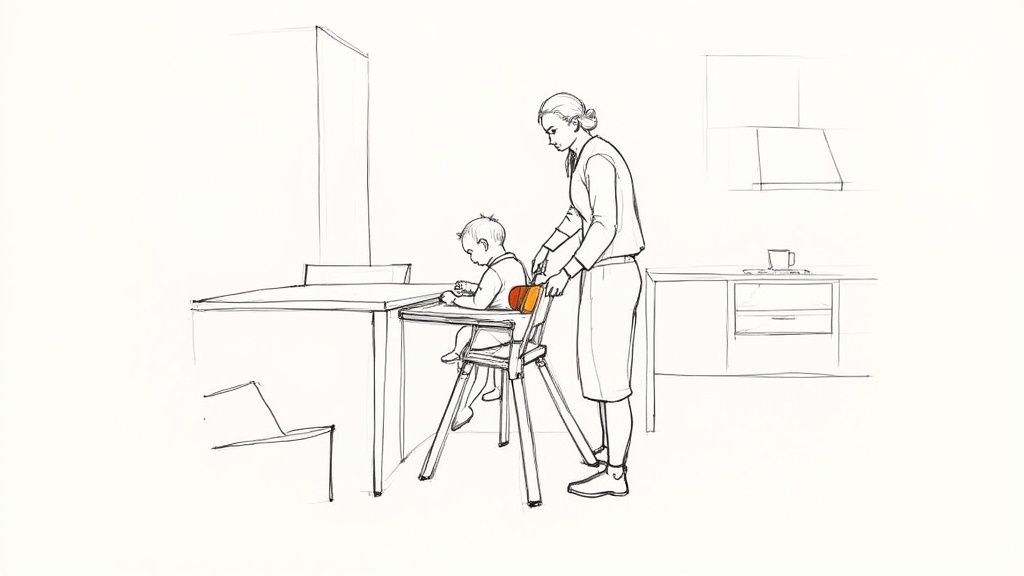
Adding a highchair to this mix can feel like playing a game of Tetris you’re doomed to lose. This isn't just about finding a spot for your baby to eat; it's about reclaiming your home. A traditional highchair, with its wide, sprawling legs, can quickly become a permanent and frustrating obstacle in a tight kitchen. The hunt for the right one becomes a mission to make every square inch count.
The Rise of Smart, Compact Designs
Thankfully, baby gear designers have caught on. The demand for highchairs built for small spaces has exploded, reflecting the way so many of us live now. This isn't a tiny niche anymore; it’s a huge part of the industry’s focus.
The global baby high chair market was valued at USD 2.05 billion in 2022 and is expected to climb to USD 3.19 billion by 2030. A major reason for this jump? The soaring popularity of space-saving designs, especially in cities where every foot of floor space matters.
This guide is all about practical, stress-free advice to help you find a highchair that feels like it was designed just for your home. We're going to reframe what makes a highchair "best"—it's not just about the bells and whistles, but about how seamlessly it fits into your family's life and living space.
Choosing the right highchair for a small space isn’t about sacrifice; it’s about smart selection. It’s finding a product that works with your home, not against it.
Let's dive in and find a highchair that makes mealtimes easier and more joyful, all without gobbling up your precious living area. We'll give you the tools to make a confident choice, ensuring your new highchair is a perfect fit from day one.
How To Measure Your Space Before You Buy
Before you get your heart set on that perfect highchair online, you need to have a serious talk with your tape measure. Trust me, just eyeballing it is a recipe for disaster. Taking a few minutes to measure first will ensure the highchair you pick is a perfect fit for your home, not just for your baby.
And we're not just talking about finding an empty corner. We need to think about how you actually live and move around in that space every single day. Let's walk through it.
The Static Footprint Is Only Half The Story
First, find the spot where the highchair will spend most of its time—maybe tucked into a kitchen nook or at the end of the dining table. Go ahead and measure the width and depth of that specific area. This is what I call the Static Footprint, which is just the space the highchair takes up when it’s sitting there, not being used.
Jot those numbers down. You’ll see that most manufacturers list a highchair's dimensions (like 22" W x 28" D) right on the product page. Your static measurement is your first reality check; if the chair's base is too big for the spot, it’s an instant dealbreaker.
But here’s a common mistake: stopping there. A highchair is never just sitting still.
Calculating Your Dynamic Footprint
Okay, now let’s get real. The Dynamic Footprint is the space you actually need to use the highchair without losing your mind. It accounts for all the wiggling, the walking around it, and the inevitable mealtime chaos. Think of it as the chair’s own personal bubble.
Here’s how to figure it out:
-
Pull-Out Space: Stand in the spot where you plan to put the highchair. Now, grab a dining chair and pull it out like you’re about to put a toddler in it. See how much room that takes? You’ll want to add at least 18-24 inches to your static depth measurement. This is your wiggle room, so you aren't backed up against a wall or another piece of furniture.
-
Parent Maneuvering Room: You’ve got to be able to walk around the highchair, bend down to strap your little one in, and clean them up afterward. A good rule of thumb is to leave about 24 inches of clear walking space on at least one side.
-
The Cleanup Zone: Let’s face it, food is going to end up on the floor. You’ll need enough room to comfortably bend over and wipe down the area around the base. This space often overlaps with your maneuvering room, but it’s crucial to think about.
The goal isn't just to fit the highchair; it's to make it part of your home. The Dynamic Footprint is what keeps a helpful piece of baby gear from turning into a daily obstacle.
Your Pre-Purchase Measurement Checklist
Before you click "buy," grab your tape measure one last time and do a quick walkthrough. Think through these real-life scenarios:
- Door & Drawer Swing: Will the highchair block a cabinet, the pantry door, or the fridge from opening all the way?
- Walkway Traffic: Does the chair’s Dynamic Footprint create a bottleneck in a busy walkway, like the path from the kitchen to the living room?
- Table Height & Overhang: If you want to use the highchair right at the table, measure from the floor to the bottom of your tabletop. Make sure the highchair’s arms or tray can actually slide over it (or that the tray is easy to remove).
- Folded Storage Spot: Getting a folding highchair? Great! But where will you put it? Measure that slim spot next to the fridge or that tiny space in the closet to make sure the chair’s folded dimensions will fit.
Spending ten minutes on this now will save you the giant headache of trying to stuff a too-big box back into its packaging for a return. With these numbers in your back pocket, you can finally shop with confidence.
What To Look For In A Great Compact Highchair
When you start shopping for a highchair for a small space, you'll see words like "compact," "slim," and "space-saving" everywhere. But what does that really mean in practice? Let's get past the marketing buzz and break down the specific features that make a highchair a true small-space hero.
Not all compact designs are the same. Some are brilliant at folding away, while others have a sleek, minimal footprint that just takes up less room. Figuring out which type fits your home and daily routine is key to making the right choice.
The Magic Of A Smart Fold
For most of us living in tight quarters, a highchair’s best trick is its ability to simply disappear when mealtime is over. But a good fold is about more than just collapsing—it’s about how effortlessly and neatly it stores away.
You'll want to keep an eye out for these key folding features:
- One-Hand Fold: Picture this: you’re holding a fussy baby in one arm and trying to wrestle a complicated highchair with the other. A one-hand folding mechanism isn't a luxury; it’s a sanity-saver that makes tidying up so much faster.
- Self-Standing Storage: A chair that stands on its own when folded is a game-changer. It means you can tuck it into a corner, slide it next to the fridge, or hide it in a pantry without it tipping over or needing to be propped against a wall.
- Ultra-Slim Profile: Always check the folded dimensions. The goal is a chair that becomes impressively flat, thin enough to slip into narrow spaces you never even considered for storage.
Understanding the static, dynamic, and cleanup zones makes it clear why just looking at the base measurements isn't enough for a busy, real-life home.
Convertible Chairs That Grow With Your Child
A truly space-efficient highchair is one you don't have to replace every couple of years. Convertible models are masters of multitasking, adapting to your child's needs as they grow. This saves a ton of space and money in the long run.
These chairs often start as a traditional highchair, then transform into a toddler booster that straps to a dining chair, and some even become a small youth chair for older kids. By getting one piece of furniture that lasts for years, you avoid the clutter of storing multiple seats. Plus, it’s a wonderful milestone when your little one can finally join the family at the "big table." For more on that, check out our age-by-age tips for feeding babies and toddlers.
Practical Features That Make A Big Difference
Beyond just folding and converting, a few other design details can make a highchair so much more practical in a smaller home. When you see a chair that has these features, you know the designers were really thinking about the day-to-day reality of parenting.
Let's dive into some of the most helpful features and compare what they offer.
Comparing Space-Saving Highchair Features
| Feature | What It Is | Best For | Considerations |
|---|---|---|---|
| One-Hand Fold | A mechanism allowing you to collapse the chair with a single hand. | Busy parents who are often holding their baby while cleaning up. | Can sometimes add a bit of bulk or complexity to the frame. |
| Self-Standing Fold | The chair stands upright on its own when folded, no leaning required. | Homes with limited wall space or for storing in closets and pantries. | Make sure the folded footprint is still slim enough for your space. |
| Convertible Design | A multi-stage chair that transforms from a highchair to a booster or youth chair. | Families looking for long-term value and to reduce future clutter. | The initial cost is often higher, but it saves money over time. |
| Wipe-Clean Materials | Smooth, non-porous surfaces and fabrics that are easy to wipe down. | Absolutely everyone. This is a non-negotiable for easy cleanup. | Avoid fabrics with deep textures or lots of seams where food can get trapped. |
| On-Board Tray Storage | A designated spot, usually on the back legs, to clip the tray when folded. | Keeping all the parts together and preventing a lost or misplaced tray. | Check that the tray clicks on securely and doesn't rattle. |
| Slim A-Frame Base | Legs that form a narrow "A" shape, minimizing the floor footprint. | High-traffic areas like kitchens and dining nooks where tripping is a concern. | Ensure the base is still wide enough to be stable and not feel wobbly. |
These smart features aren't just about shrinking the footprint; they’re about maximizing convenience in every detail, making those daily tasks a little bit simpler and a whole lot quicker.
Take wipe-clean materials, for instance. When your dining room is also your living room, cleanup needs to be fast. Look for chairs with smooth surfaces and minimal cracks where crumbs can hide. And a slim A-frame profile is another huge win—some highchairs have sprawling legs that are a major tripping hazard. A narrower base saves precious floor space without sacrificing stability.
Rethinking The Highchair: Clever Alternatives For Small Spaces
Sometimes, the best highchair for a small home isn't a highchair at all. When every square inch of floor space counts, it’s time to get creative. These alternatives are perfect for anyone living in a compact apartment, families who travel often, or just those who prefer a more minimalist setup.
Let's look at a few brilliant, zero-footprint solutions that bring your baby right to the table without adding more clutter to your life. From seats that hook right onto your table to boosters that give your existing chairs a promotion, there's a smart fix for every tiny home.
Clamp-On Highchairs: The Zero-Footprint Wonder
Imagine a highchair that uses absolutely zero floor space. That’s the genius of a clamp-on highchair. Also called hook-on or table chairs, these seats attach directly to the edge of your dining table using a system of super-sturdy, rubberized clamps. This design lets your baby sit right with the family, becoming part of the action.
They are incredibly easy to take on the go. Most fold down flat and slip right into a tote bag, making them a game-changer for restaurant trips or visits to the grandparents' house. When you're home, just tuck it in a drawer or hang it in a closet.
But, there are a couple of things to keep in mind:
- Table Compatibility: These chairs aren't one-size-fits-all. They’re a no-go for glass-top, pedestal, card, or flimsy tables. Always double-check the manufacturer’s rules on required table thickness and material before buying.
- Weight Limits: Clamp-on seats generally have lower weight limits than traditional highchairs, so your little one might outgrow it a bit sooner.
For apartment dwellers and families constantly on the move, the space-saving perks are hard to beat—as long as your dining table is up to the task.
Booster Seats: The Ultimate Upgrade
Why bring in a whole new piece of furniture when you can just upgrade one you already have? A booster seat straps securely onto one of your dining chairs, instantly giving your child a safe, elevated spot at the table. It’s easily the most versatile and budget-friendly option out there.
Boosters come in all shapes and sizes, from simple molded plastic seats to more cushioned designs with all the bells and whistles. Many even come with their own removable tray, which makes cleanup a breeze and protects your dining chair from the daily mess. As your child gets older, you can often remove the backrest and tray, turning it into a simple booster for the toddler years.
The real beauty of a booster is its tiny footprint. It takes up no extra room. When you're done with it, you can stash it in a closet or simply leave it on the chair, ready for the next meal.
This approach is perfect for minimalists who want a solution that blends right in with their existing home decor. You can learn more about picking the right one in our guide to the best feeding booster seats.
Convertible Floor Seats: The Multi-Tasking Master
Here's another great option: the convertible floor seat. These start out as a safe, supportive seat for your baby to use on the floor during playtime. Then, as your child grows and starts solids, you can use the included straps to secure it to a dining chair, turning it into a booster seat.
That dual functionality is a massive win for small spaces. You’re essentially getting a play seat and a feeding seat in one tidy package, which means less baby gear to buy and store. While they don't give you the height of a traditional highchair, their adaptability makes them a really smart investment.
In the end, choosing an alternative is all about your family's lifestyle.
- The ultimate space-saver for a studio apartment? The clamp-on chair is brilliant.
- A budget-conscious minimalist? A booster seat is a no-brainer.
- A parent who loves multi-functional gear? A convertible floor seat is the perfect match.
By thinking beyond the standard four-legged highchair, you can find a feeding solution that respects your space, simplifies your life, and brings your baby to the table in style.
Your Non-Negotiable Safety Checklist
Finding a highchair that squeezes into your tight spot is the mission, but it can never, ever come at the cost of safety. A compact footprint is great, but a secure, stable chair for your child is absolutely non-negotiable.
Think of this as your pre-flight safety check before you buy. It’s a simple list that will help you bring home a chair that's as safe as it is space-savvy.
First, Look for the Stickers of Approval
Before you even start poking and prodding the chair itself, look for a couple of key certifications on the box or the product tag. These seals aren't just for show—they're the fastest way to know if a manufacturer is serious about safety.
-
JPMA (Juvenile Products Manufacturers Association): This is the one you really want to see. A JPMA seal means the highchair has been independently tested to meet (and often exceed) tough safety standards. It's a voluntary program, so when a brand goes through the trouble, you know they're committed.
-
ASTM International: This global organization sets the technical benchmarks for thousands of products, including highchairs. If a chair meets ASTM standards, it means it was built to a very specific and high-quality safety blueprint, covering everything from stability to the materials it's made from.
Spotting these logos is your first big green light. It tells you the best highchair for small spaces you're eyeing has already passed some serious tests.
The Anatomy of a Safe Highchair
Certifications are one thing, but you also need to be your own inspector. There are a few key parts of any highchair that do the real work of keeping your baby safe and sound while they're flinging spaghetti.
A truly safe highchair has a sturdy base, a reliable restraint system, and a smart design that anticipates common accidents. Don’t ever settle for less on these fundamentals.
Here’s what to get hands-on with:
-
A Solid, Stable Base: Give the highchair a gentle wobble (when it’s empty, of course). Does it feel tippy or top-heavy? A wide, stable base is critical for preventing tips, especially once your little one starts bouncing and wiggling. Even slim, A-frame designs should feel firmly planted.
-
A Secure 5-Point Harness: This is the gold standard, period. A 5-point harness has straps over both shoulders, both hips, and one between the legs. This setup is the only way to reliably stop a baby from standing up, wiggling out, or sliding down—all scary but common causes of falls.
-
A Passive Crotch Post: This is that little post that sits between the baby's legs, attached to the seat itself (not the tray). It’s a brilliant backup feature. Even if you get distracted for a split second before buckling the harness, this post helps prevent your child from slipping out from under the tray.
-
No Pinch Points: Run your hands along the folding mechanisms, hinges, and any adjustable parts. You're looking for any gaps or joints where tiny fingers could get pinched or trapped as you open, close, or adjust the chair.
Walking into a store with this checklist in mind helps you look past the clever folding design or stylish color. It ensures the chair you choose not only fits your home, but more importantly, creates the secure little bubble your child needs to safely explore the wonderful world of food.
Smart Placement And Storage Hacks For Your Home
So, you’ve done the measuring, read the reviews, and finally brought home that perfect compact highchair. Well done! But the real test is making it work in your space day-to-day. The best highchair for a small home is only as good as your plan for where to put it and how to store it.
With just a few clever tricks, your new highchair can feel like it truly belongs, not like another piece of baby gear taking over the house. These small adjustments can make a world of difference in keeping your home feeling organized, functional, and blessedly clutter-free.
Create Your Dedicated Baby Zone
Instead of letting the highchair drift aimlessly around your dining area, give it a designated "baby zone." This spot becomes its home base, preventing it from turning into a constant obstacle you have to shuffle around. The goal is to find a low-traffic corner that's still convenient for mealtimes.
Look for an underused corner in the kitchen or a nook in the dining room. This simple strategy keeps all the feeding supplies contained and stops the highchair from creating a bottleneck in a busy walkway. For more ideas on maximizing your layout, check out these essential furniture arrangement tips to help optimize the flow for your whole family.
The key is to make the highchair's location intentional. By carving out a specific spot, you maintain order and prevent your living space from feeling overwhelmed by baby items.
Ingenious Storage Hacks For When It’s Not In Use
The true magic of a space-saving highchair is its ability to practically disappear when mealtime is over. This is where you get to reclaim your floor space and keep your home feeling open and tidy. Don’t let it become a permanent fixture if it doesn’t have to be.
Here are a few tried-and-true storage hacks that really work:
- The Fridge Gap: That narrow, often-forgotten space between your refrigerator and the wall? It's the perfect hiding spot for an ultra-slim highchair.
- Behind the Door: Use a sturdy, over-the-door hook in a pantry or closet to hang a lightweight, foldable chair completely off the floor.
- Under the Bed or Sofa: If your furniture has a few inches of clearance, sliding the folded highchair underneath is the ultimate out-of-sight, out-of-mind solution.
- In the Closet: A self-standing model can be tucked into a sliver of space in a coat or utility closet in seconds, keeping your main living area clear.
For more brilliant ways to keep baby gear in check, our guide to nursery storage solutions is packed with tips that work all over the house. By putting these placement and storage ideas into practice, your compact highchair becomes a helpful tool that supports your lifestyle without disrupting it.
Your Burning Questions, Answered
It's completely normal to have questions when you're trying to find the right gear for a small space. Let's tackle some of the most common ones that pop up for parents on the hunt for the perfect compact highchair.
Are Clamp-On Highchairs Safe for All Tables?
Absolutely not, and this is a huge safety point to remember. Clamp-on highchairs are wonderfully safe, but only when they're used on the right kind of table. They should never be attached to glass-top, single-pedestal, card, or loose-top tables.
Always, always check the manufacturer’s instructions for the required table thickness and material. And before you place your baby in it, give the clamps a good, firm wiggle every single time to make sure they're locked down tight.
What’s the Best Way to Clean a Highchair in a Small Apartment?
When you don't have a lot of space, you have to get clever. For the daily wipe-downs, a simple spray bottle with a bit of soap and water and a microfiber cloth will be your go-to.
For those inevitable big messes, your bathtub or shower is the perfect cleaning station. You can easily wash the tray and any other removable parts in there. To save yourself a ton of hassle, look for a model with a machine-washable seat cover and a tray that can go straight into the dishwasher.
Pro Tip: Seek out highchairs with smooth, seamless designs. Fewer nooks and crannies mean fewer hiding spots for runaway peas and smeared applesauce, which can literally cut your cleaning time in half.
When Can My Baby Use a Booster Seat Instead of a Highchair?
Most little ones are ready to make the switch to a booster seat once they can sit up confidently on their own and have solid head and neck control. This usually happens around the 6-month mark.
That said, the manufacturer’s age and weight guidelines are the final word. The most crucial thing is that your child is developmentally ready to sit securely on a regular dining chair with that extra boost.
Do I Sacrifice Features by Choosing a Compact Highchair?
Not anymore! The days of choosing between features and a small footprint are pretty much over. Modern compact highchairs are often packed with smart design elements.
It's not hard to find convertible models that grow with your child, turning into a toddler booster or even a youth chair. While some ultra-minimalist travel highchairs are more basic, most everyday compact designs offer things like adjustable heights, recline settings, and removable trays without hogging your floor space.
Ready to find the perfect fit for your family and your home? Hiccapop designs innovative, parent-approved solutions that make life simpler without compromising on safety or style. Explore our collection of smart baby products today!