


Your Ultimate Guide to the 2 Nap Schedule
That magical moment when three naps become two is a huge milestone for you and your baby. But figuring out the right time to make the switch can feel like a confusing guessing game. Generally, this transition to a 2 nap schedule happens sometime between 6 and 9 months old.
The secret isn't just watching the calendar, though. It's about spotting consistent patterns that tell you your baby is truly ready for this big step.
Decoding the Signs Your Baby Is Ready for Two Naps
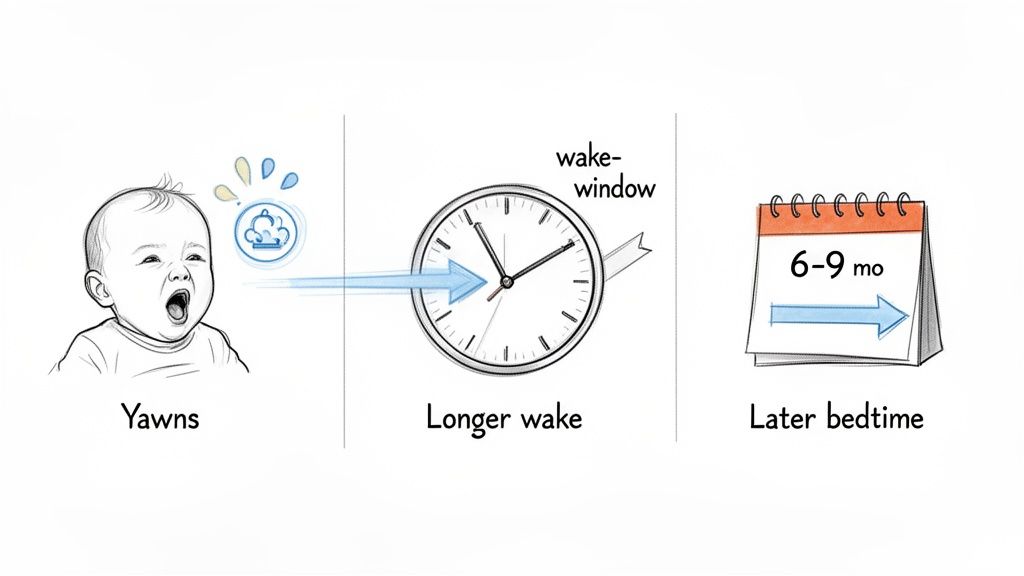
Is your baby suddenly fighting that third catnap of the day like it’s their job? Or maybe bedtime has turned into a drawn-out battle, pushing well past its usual hour. These aren't just random fussy phases. More often than not, they're the clearest signals that your little one's sleep needs are changing.
This shift is a fantastic sign of development. It means their sleep cycles are maturing and they can finally handle being awake for longer stretches.
Spotting the Readiness Cues
Before you start rearranging your entire day, make sure you're seeing a consistent pattern of these behaviors for at least a week, maybe even two. A single off day or one skipped nap doesn't mean it's time to drop it for good. True readiness shows up as repeated, predictable changes in their sleep habits.
Recognizing when it's time for a change can be tricky. This table breaks down the most common signs that your baby is gearing up to drop that third nap.
| Readiness Sign | What It Looks Like In Practice |
|---|---|
| Nap Resistance | Your baby consistently fights or completely refuses that late afternoon (third) nap. You might spend more time trying to get them to sleep than they actually sleep. |
| Suddenly Short Naps | The first two naps of the day might get shorter, or that third nap becomes a tiny 15-20 minute power nap that does more to disrupt bedtime than help. |
| Bedtime Battles | Despite seeming tired, your baby is wide awake and playful at bedtime, taking 30 minutes or more to finally fall asleep when it used to be much quicker. |
| New Early Wake-Ups | Your baby starts waking up for the day before 6:00 a.m. This can be a sign of too much total daytime sleep, which throws off their overnight rest. |
If you're nodding along to several of these points for more than a few days in a row, it’s probably time to start thinking about making the transition.
Why Age Is Just a Guideline
While the 6 to 9 month window is a solid benchmark, remember that every baby is on their own unique timeline. What’s really driving this change isn’t the date on the calendar, but their growing capacity for longer wake windows—that's the time they can comfortably stay awake between sleeps.
As babies mature, these windows naturally lengthen. A 4-month-old might only handle 1.5-2 hours of awake time, but a 7-month-old can often go 2.5-3 hours. This extra awake time naturally squeezes out the need for that third nap. For a deeper dive into this, check out our guide on wake windows by age.
This is exactly why observing your baby’s individual cues is so much more reliable than just following an age-based chart.
Building a 2-Nap Schedule That Actually Works for Your Family
Alright, so you’ve decided your little one is ready to drop that third nap. Now what? The goal isn't to create a rigid, minute-by-minute schedule but to find a daily rhythm that works for your baby and your life. Flexibility is everything.
A popular and incredibly helpful starting point is the "2-3-4" method. This isn't about staring at the clock, but rather paying attention to your baby's wake windows—the amount of time they can happily stay awake between sleeps.
The 2-3-4 Guideline: This framework suggests about 2 hours of awake time after waking up for the day, 3 hours of awake time between the two naps, and 4 hours of awake time before bedtime.
Think of this as your basic blueprint. It's a fantastic guide, but remember, some babies might need a little more or less time awake. The real magic happens when you pair this structure with your baby's own unique cues.
What This Looks Like: Sample 2-Nap Schedules
As your baby grows, their wake windows will naturally get longer. A 7-month-old's day looks quite different from a 12-month-old's, even when both are taking two naps.
Let’s look at a couple of real-world examples.
Example Schedule for a 7-Month-Old:
- 7:00 AM: Wake up for the day
- 9:15 AM - 10:45 AM: Nap 1 (after a wake window of about 2 hours and 15 minutes)
- 1:45 PM - 3:15 PM: Nap 2 (after a 3-hour wake window)
- 6:45 PM: Begin bedtime routine
- 7:15 PM: Bedtime (after a 4-hour wake window)
This gives you a predictable flow but has enough wiggle room if a nap runs a little short or long.
Example Schedule for an 11-Month-Old:
- 7:00 AM: Wake up for the day
- 10:00 AM - 11:30 AM: Nap 1 (after a 3-hour wake window)
- 3:00 PM - 4:00 PM: Nap 2 (after a 3.5-hour wake window)
- 7:30 PM: Begin bedtime routine
- 8:00 PM: Bedtime (after a 4-hour wake window)
See how the wake windows have stretched out? This naturally pushes naps and bedtime a bit later as they get older.
Tuning Into Your Baby’s Unique Rhythm
These sample schedules are just that—samples. Your baby is the true expert here. Learning to spot their specific "I'm getting sleepy" signals is the key to making any routine stick.
Keep an eye out for these classic cues:
- The big, obvious yawn
- Rubbing their eyes or pulling on their ears
- That far-away, glazed-over stare
- A sudden bout of fussiness or clinginess
When you spot these signs, it's go-time. Start your wind-down routine and get them settled for their nap. Catching that perfect sleepy wave is so much more effective than forcing a nap based on what the clock says.
This responsive approach helps you sidestep the dreaded overtired state—the number one cause of short naps and tough bedtimes. A consistent daily flow, anchored by a predictable morning wake-up and a soothing bedtime routine, gives your baby the structure they need to rest well.
How Two Naps Fuel Your Baby's Brain Development
A consistent 2-nap schedule does way more than just help you dodge a fussy, overtired baby—it’s actually a powerhouse for their brain development. It’s helpful to think of each nap as a dedicated work session for your baby's brain. During that quiet time, all the incredible new things they've learned get filed away, processed, and locked in for later.
This isn't just about getting rest; it's about active, essential brain-building. When your baby settles in for two distinct naps, they’re getting two separate, specialized opportunities to consolidate different kinds of memories. These naps aren’t just copies of each other; they serve unique and vital purposes for learning and even emotional processing.
The Power of Two Naps for Memory
Ever notice how your baby seems to nail a new physical skill right after their morning nap? That's not a coincidence. Researchers have found that the morning nap seems to be particularly important for cementing procedural memory—the "how-to" memories that govern physical skills.
This includes things like:
- Mastering the wobbly mechanics of crawling
- Finally getting the hang of clapping their hands
- Figuring out how to stack one block on top of another without it all tumbling down
The afternoon nap, on the other hand, plays a huge role in strengthening declarative memory. This is all about facts and events, like recognizing grandma's face on a video call, linking the word "dog" to the furry creature that licks their toes, or recalling experiences from their day. Skipping one of these naps means missing a key window for brain development.
A fascinating study on nine-month-olds showed just how crucial both naps are. It found that infants who got their full two naps had significantly better memory retention after learning a new task compared to those who skipped their morning nap. The researchers discovered that the combination of a morning and afternoon nap was the ticket to stronger declarative memory. You can dive deeper into how naps boost infant memory in the full study published in the National Library of Medicine.
More Than Just Memory
The benefits of a solid 2-nap schedule go far beyond just locking in memories. Well-timed sleep is fundamental to pretty much every aspect of your baby's growth.
A well-rested baby is a baby who is ready to learn. Protecting their two naps helps build the foundation for emotional regulation, language acquisition, and problem-solving skills.
Naps give their busy brains a much-needed break from the constant stimulation of being awake. This downtime is what helps prevent them from becoming completely overwhelmed, which in turn leads to better moods and a much greater capacity for engagement and learning when they are awake. While a healthy nap schedule is critical for your baby's cognitive growth, you can continue supporting their emotional development as they get older with tools like books that foster empathy, which also contributes to their overall well-being.
When you start to see naptime as an active part of your baby’s development—not just a break in the day—it reframes the whole experience. You aren't just managing fussiness; you're actively building your baby's brain, one nap at a time.
A Gentle Approach to Making the Nap Transition
Switching from three naps down to two doesn't have to feel like a week-long battle. The secret is to move slowly and ease your baby into their new routine, rather than making a sudden, jarring change that leaves everyone feeling exhausted and cranky. Think of it as gently stretching their wake windows, not yanking them.
The most effective way this works is by focusing on that first wake window of the day. Start by pushing it just a little bit longer—aim for an extra 15 minutes every couple of days. This small, incremental shift gives your baby’s internal clock time to adjust without pushing them straight into overtired meltdowns.
For instance, if their morning wake window is typically 2 hours, try stretching it to 2 hours and 15 minutes for a few days. Once that feels normal, push it again to 2 hours and 30 minutes. This slow-and-steady method is the foundation for a smooth, tear-free transition to a 2-nap schedule.
Gradual Nap Transition Plan
Here’s a sample week showing how this gradual shift might look. Remember, this is just a sample—watch your baby’s cues and adjust as needed!
| Day | Wake Window 1 | Wake Window 2 | Wake Window 3 | Bedtime Adjustment |
|---|---|---|---|---|
| 1 | 2 hours | 2.5 hours | 2.5 hours | Normal bedtime |
| 2 | 2 hours | 2.5 hours | 2.5 hours | Normal bedtime |
| 3 | 2.25 hours | 2.5 hours | 2.75 hours | Shift 15 mins earlier |
| 4 | 2.25 hours | 2.75 hours | 3 hours (Catnap drops) | Shift 30 mins earlier |
| 5 | 2.5 hours | 3 hours | 3 hours | Shift 30-45 mins earlier |
| 6 | 2.75 hours | 3 hours | 3.25 hours | Shift 15-30 mins earlier |
| 7 | 3 hours | 3 hours | 3.5 hours | Back to normal bedtime |
This table shows how small, daily adjustments can help you phase out that third nap without causing a major sleep disruption. The key is using that early bedtime to compensate for the lost daytime sleep initially.
Navigating the Fussy Afternoon Zone
Let's be real: one of the toughest parts of this transition is surviving that late afternoon stretch where the third catnap used to be. Your baby is almost guaranteed to be tired and fussy as their body adjusts. It's completely normal! The goal here isn't to force another nap but to find creative ways to bridge the gap to bedtime.
This is when a change of scenery or a simple, calming activity can be a lifesaver:
- Head outside. Even a quick walk around the block in the stroller or sitting on a blanket in the yard can work wonders. The fresh air and new things to look at are a fantastic distraction.
- Add water. You don't need a full bath. Just putting a shallow container of water and a few bath toys on a towel on the floor can be incredibly engaging for a fussy baby.
- Have a quiet cuddle. Sometimes, the best reset is just sitting together in a comfy chair, reading a book, or listening to some soft music.
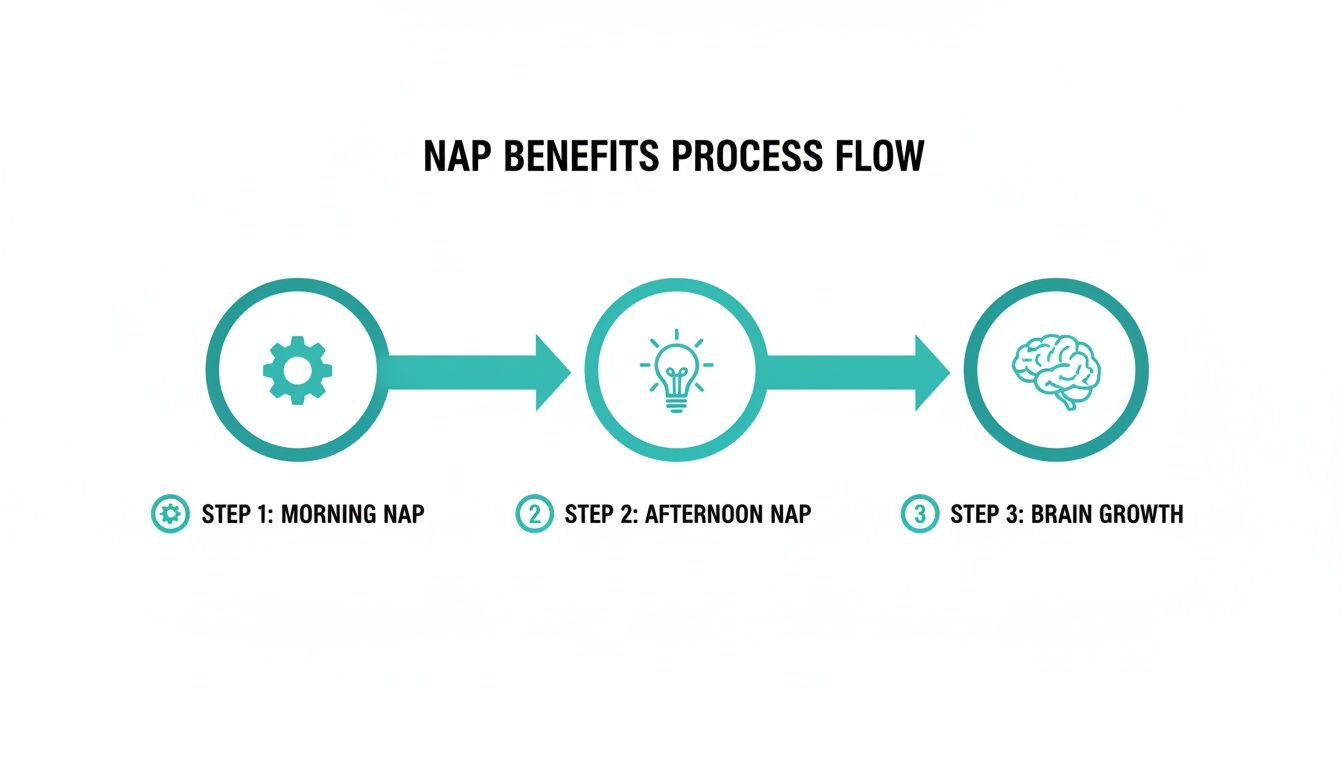
As you can see, both of those remaining naps play a huge role in your baby's development. Protecting them is what makes this transition so important.
Your Secret Weapon: The Early Bedtime
During this tricky in-between phase, overtiredness is your worst enemy. It’s what leads to those awful nights, multiple wake-ups, and super early mornings, and it can completely derail your progress. But you have a secret weapon: an early bedtime.
On days when naps fall short or that last wake window was a real struggle, don't even hesitate. Pull bedtime forward by 30-60 minutes. Think of it as a temporary "bridge to bedtime" that helps your baby catch up on lost sleep before a deficit builds up.
This isn't a permanent change! It's a flexible tool you can use on messy days to keep things from spiraling. Once your baby gets more comfortable with their longer wake windows, you can gradually push bedtime back to its normal time. If you find your baby is still wired even with an earlier bedtime, it might be a good time to explore ways to teach your baby to self-soothe, which can be a game-changer for winding down.
Troubleshooting Common 2 Nap Schedule Problems
Even with the best-laid plans, every parent hits a bump in the road with their baby's sleep. One day your 2 nap schedule is humming along beautifully, and the next, it's a mess of short naps, flat-out refusals, or shockingly early wake-ups. Don't panic! This is a completely normal part of the process.
When things go off the rails, it’s usually one of three culprits: your baby is either undertired, overtired, or something in their environment needs a little tweak. Let’s break down the most common nap frustrations and figure out how to get your routine back on track.
The Dreaded 30-Minute “Disaster Nap”
You put your baby down, they fall asleep beautifully, and then—bam—30 minutes later, they’re wide awake and crying. Sound familiar? This classic "disaster nap" is often the result of a baby not being able to link their sleep cycles together.
The most common cause is actually overtiredness. If the wake window before the nap was just a bit too long, your baby might crash hard but then struggle to transition into the next, deeper phase of sleep.
- Try this first: Shorten the wake window right before that nap by 15 minutes. It’s a small change, but putting them down slightly earlier can make all the difference in helping them connect those sleep cycles for a longer, more restorative rest.
- Also, check the room: Make the sleep environment pitch-black. I mean, so dark you can't see your hand in front of your face. Even a tiny bit of light peeking through can be enough to signal "time to wake up!" during that brief moment between cycles.
Remember, consistency is your friend. If you’re suddenly facing new sleep challenges, they could be signs of a developmental leap. It helps to know what to expect by reading up on the sleep regression timeline, as they often pop up around major milestones.
When One Nap Is Great and the Other Is a Struggle
It’s a classic parent puzzle: the morning nap is a glorious, two-hour dream, but the afternoon nap is a constant battle. This imbalance is incredibly common and usually points to a simple scheduling issue.
If the morning nap is too long, it can "steal" sleep from the afternoon nap, leaving your baby undertired when it’s time for their second rest. On the flip side, if the wake window between naps isn't long enough, they simply won't have built up enough sleep pressure to take a decent second nap.
- Cap the morning nap. I know, I know—waking a sleeping baby feels like a crime! But limiting that first nap to around 1.5 hours can help ensure they’re ready for a solid nap in the afternoon.
- Stretch the middle window. Gradually extend the wake window between the first and second nap. Try adding just 10-15 minutes of awake time for a few days to help build that sleep drive.
Getting Back on Track After an Off Day
Life happens. A doctor's appointment, travel, or a pesky cold can completely throw your 2 nap schedule into chaos. The key to recovering isn't to stress out, but to reset with confidence.
Don't try to force the old schedule if your baby is clearly out of sorts. The quickest way back to normalcy is often an early bedtime. Putting your baby down 30-60 minutes earlier than usual can help them catch up on any sleep debt they’ve accumulated. Usually, just one or two nights of this reset is all it takes to get back into your groove.
Answering Your 2-Nap Schedule Questions
Let's tackle some of those questions that have you scrolling through parenting forums at 2 a.m. Consider this your go-to guide for navigating the little curveballs that baby sleep will inevitably throw your way.
How Long Does The 2-Nap Schedule Last?
You can expect your little one to be on a 2-nap schedule for quite a while. Most babies stick with it until they're somewhere between 15 and 18 months old.
There’s absolutely no rush to drop down to one nap. Look for consistent signs that they’re ready for a change, like when the morning nap keeps getting pushed later and later, or they outright refuse the afternoon nap for several weeks straight. Only then is it time to start thinking about the next transition.
What If My Baby Wakes Up Early From The Second Nap?
A short second nap can be a real head-scratcher. It often creates a marathon wake window before bedtime, which is a recipe for an overtired, fussy baby.
Your best bet is to bring bedtime forward. Don't be afraid to move it up by 30–60 minutes to compensate. Whatever you do, resist the urge to squeeze in a third catnap—it almost always backfires at this age and can make bedtime a battle.
How Do I Manage Naps at Daycare?
This is probably one of the most common challenges parents face. The key is open and clear communication.
Chat with your daycare providers about your baby's ideal wake windows and nap times. It can be super helpful to give them a written-out version of your home schedule. Just remember, they're juggling multiple kids, so a bit of flexibility is necessary. Keeping things consistent at home on weekends and holidays will help keep their internal clock on track.
It's fascinating how napping culture varies across the globe. Data highlights Barcelona as a nap capital, where adults average two naps a week. This is a big contrast to the US and UK, where only about 15% of adults are regular nappers. You can read more about how napping habits differ around the world on ouraring.com.
Can We Still Go Out and Have a Life?
Yes, absolutely! While consistency is your best friend when it comes to baby sleep, you still have to live your life. The goal is to protect naps most of the time, not all of the time.
Try to plan your errands and outings during your baby's natural wake windows. If you have to be out during naptime, a nap on the go in a stroller or carrier is a perfect backup plan. One off-kilter day won't derail all your hard work. Just hop right back into your normal routine for the next sleep.
Navigating nap transitions is a journey, but you're more than capable of handling it. Remember to trust your baby's cues, be flexible, and lean on that early bedtime when you need it. You've got this! For all the moments in between—from travel days to cozy nights at home—having the right gear makes a world of difference. Hiccapop creates thoughtfully designed products, like our travel beds and nursery essentials, to support your family every step of the way. Explore our solutions at https://hiccapop.com.