


What is a sleep regression? Quick guide to ages, causes, and strategies
Just when you think you’ve finally cracked the code to your baby’s sleep schedule, they throw you a curveball. Suddenly, your little one who was sleeping soundly is waking up all night long or fighting naps with the strength of a tiny prize fighter.
If this sounds painfully familiar, you've probably hit your first sleep regression. Don't worry, you're not alone, and you haven't done anything wrong. Let's break down what's really happening.
Understanding Sleep Regressions
So, what exactly is going on? A sleep regression is a temporary disruption in your child's sleep patterns. It feels like a huge step backward, but it's actually the exact opposite—it’s a sign that your baby is hitting a major developmental milestone.
Think of it like their brain is getting a massive software update. Their mind and body are firing on all cylinders to master incredible new skills, whether it's rolling over, understanding you still exist when you leave the room (hello, object permanence!), or starting to babble. All this exciting work can throw their sleep completely out of whack for a little while.
A sleep regression is not your fault, nor is it a sign of a permanent problem. It's a positive, albeit exhausting, signal that your child is growing and developing exactly as they should be.
So, What's Really Going On?
During these phases, your baby’s entire sleep architecture changes, becoming much more like an adult's. This means they experience more distinct sleep cycles, which creates more opportunities to wake up between them. Instead of drifting smoothly into the next cycle, their busy brain might decide 2 AM is the perfect time to practice that new crawling skill.
These developmental leaps are amazing, but they often bring some challenging side effects:
- More Frequent Night Wakings: You might feel like you're back in the newborn days, up multiple times a night.
- Nap Strikes: Naps that were once a given can suddenly become a huge battle.
- Increased Fussiness: An overtired baby is rarely a happy baby. You'll likely notice more irritability during the day and night.
This isn't just anecdotal—it's backed by real data. A longitudinal survey found that a staggering 68% of parents reported a sleep regression right around the 4-month mark. During this time, affected infants woke up an average of 3.2 times per night, a huge jump from just 1.1 times before. That’s a 190% increase in nightly disruptions! You can dig deeper into the full findings on these sleep pattern shifts to learn more.
This timeline gives you a quick visual overview of when to expect these bumps in the road.
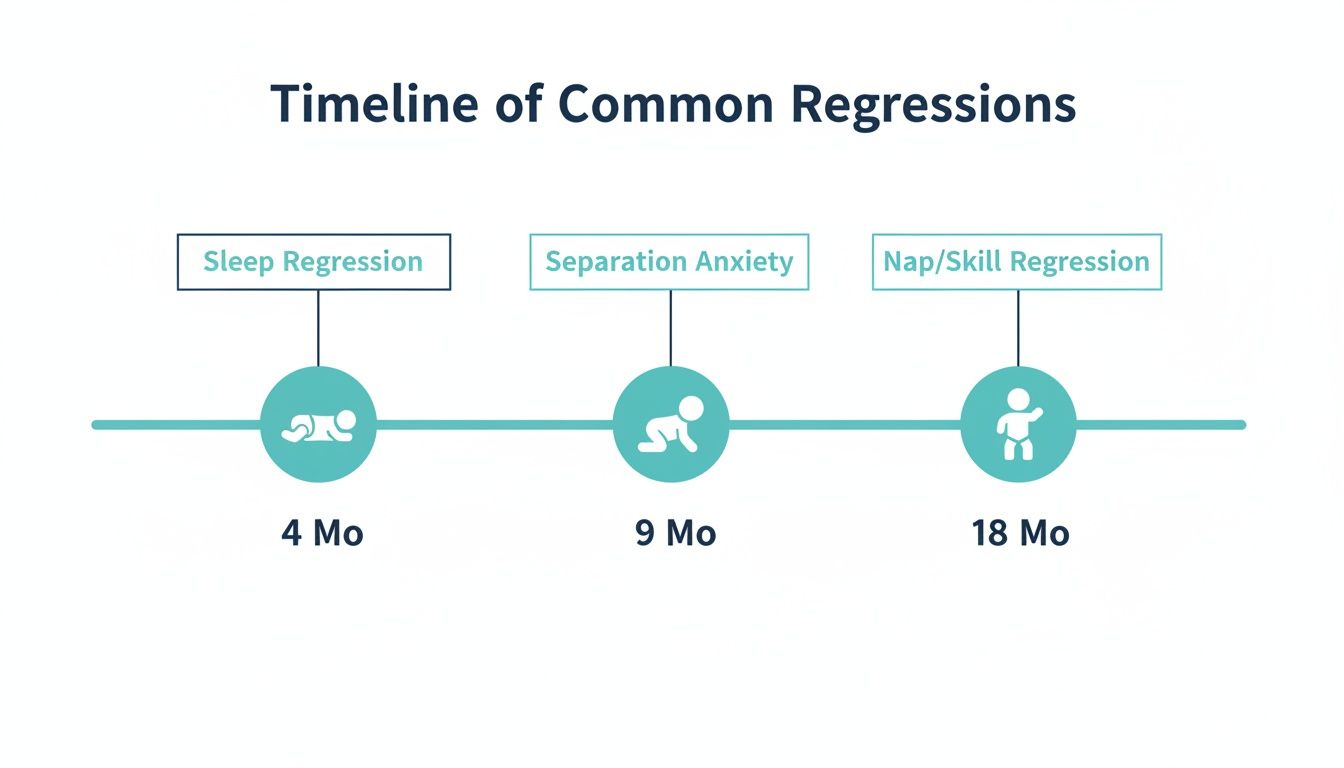
As you can see, these phases are predictable pit stops on your child’s developmental journey, not random setbacks. The most important thing to remember is that they are temporary, usually lasting anywhere from two to six weeks.
The table below offers a quick cheat sheet for the most common regressions you might encounter.
Common Sleep Regressions at a Glance
| Age | Primary Developmental Cause | Common Sleep Changes |
|---|---|---|
| 4 Months | Sleep cycle maturation; learning to roll | Frequent night wakings; short naps |
| 8-10 Months | Separation anxiety; crawling and pulling up | Resisting bedtime; waking and crying for you |
| 12 Months | Learning to walk; transitioning to one nap | Fighting the second nap; standing in the crib |
| 18 Months | Language explosion; independence/teething | Nap strikes; "NO!" becomes a favorite word |
| 2 Years | Potty training; moving to a bed; fears | Bedtime stalling; getting out of bed repeatedly |
The best way through a regression is to stay as consistent as you can with your routines, offer plenty of extra comfort, and remind yourself that this too shall pass. You’ll get through it, promise!
Why Your Baby Suddenly Stopped Sleeping
If your once-peaceful sleeper has abruptly decided that nighttime is the new playtime, you're probably asking yourself one thing: why? Let me assure you, it’s not a conspiracy to rob you of your sanity. The real reason is that your baby's brain and body are going through some truly incredible, world-altering developments.
These changes are the very reason sleep suddenly goes sideways. Picture your baby’s brain as a busy construction site that’s open 24/7. Huge projects are underway, and sometimes, all that noise and activity spills right over into the quiet hours of the night.
The Great Sleep Cycle Shake-Up
One of the biggest culprits behind a sleep regression is a fundamental change in your baby's sleep cycles. Newborns have it simple: they’re either asleep or they're awake. But right around four months, their entire sleep architecture evolves to look a lot more like an adult's.
This means they start cycling through distinct stages of light and deep sleep. The problem? With more complex cycles come more opportunities to wake up between them. While we might just roll over and drift back to sleep, a baby whose brain is buzzing might wake up completely and decide it's party time.
This shift from simple newborn sleep to complex, cyclical sleep is a permanent biological change. It’s not something that goes away—it's a sign your baby's brain is developing perfectly! The key is helping them learn to navigate these new cycles.
Cognitive Leaps and Mental Gymnastics
It's not just how your baby sleeps that's changing; it's how they see the entire world. These enormous cognitive leaps are a primary driver of sleep disruptions. Gaining a better sense of a baby's cognitive development in early childhood is key, as these mental milestones are often the root cause of sudden sleep struggles.
Here are a few of the mental gymnastics that can totally sabotage sleep:
- Object Permanence: Around 8-10 months, your baby has a massive "aha!" moment. They finally understand you still exist even when you’re not in the room. While this is a huge cognitive step forward, it’s also the spark that fuels separation anxiety. When they wake up alone, they know you're out there somewhere and will immediately call for you to come back.
- Cause and Effect: Toddlers, especially around 18 months, turn into little scientists. They learn that their actions get a reaction. If I stand up and yell, Mom or Dad comes back! If I throw my pacifier, someone will get it for me! This newfound power is way more exciting than just lying there and sleeping.
- Language Explosion: As your toddler’s vocabulary starts to take off, their brain is firing on all cylinders with new words and concepts. This mental activity doesn't just switch off at bedtime, often leading to late-night babbling sessions instead of snoozing.
Physical Milestones and The Urge to Practice
Just as their minds are expanding, their little bodies are learning to do incredible new things. And the irresistible urge to practice these skills often strikes at the most inconvenient times—like 3 AM.
Physical achievements are a massive part of a sleep regression because, to your baby, they take absolute priority over rest.
Common Sleep-Disrupting Skills:
- Rolling: Suddenly, your baby can flip onto their tummy... but can't quite figure out how to roll back. This often leads to frustration and waking until they master the two-way trip.
- Sitting, Crawling, and Pulling Up: The 8-10 month regression is famous for this. Your baby is so thrilled with their ability to pull up to a stand that they’ll do it the second you put them in the crib, often without a clear plan for getting back down.
- Walking: A newly mobile toddler has a whole world to explore. From their perspective, lying still in a crib can feel like a major case of FOMO (fear of missing out).
These developmental milestones aren't just isolated events; they're all connected. A cognitive leap might fuel the desire to practice a new physical skill, creating the perfect storm for a sleepless night. It’s a busy, exciting, and, yes, exhausting time for your little one—and unfortunately, for you too.
Navigating the 8 to 10 Month Sleep Regression
Just when you thought you’d finally hit a smooth patch, the 8 to 10-month sleep regression shows up. Parents often call this one the "perfect storm," and for good reason. It’s a powerful mashup of massive physical and cognitive leaps that can turn even the best little sleeper into a crib-partying protestor overnight.
This phase is uniquely tough because two major developments collide at once: newfound mobility and a sharp peak in separation anxiety. Your baby is suddenly learning to crawl, pull up to a stand, and maybe even cruise around the crib—skills that are way more exciting than sleeping.
At the same time, their brain fully grasps object permanence. It’s no longer "out of sight, out of mind." They don't just miss you; they know you exist somewhere else and will use their powerful new voice to summon you back.
Why This Age Is So Tricky
The 8, 9, and 10-month window is a total whirlwind. Your baby is no longer a passive observer but an active explorer, and that drive to practice their new moves doesn't just switch off at bedtime. In fact, the quiet, distraction-free crib often becomes their personal gymnasium.
This regression is famous for its intensity. A 2021 report highlighted by the American Academy of Pediatrics found that a staggering 62% of infants in the US and Canada go through this phase. It’s marked by a huge jump in night wakings, from an average of 1.5 to 4.7 per night—that's a 213% surge. Naps also take a big hit, with total daytime sleep dropping from around 3 hours to just 1.8 for many babies.
This combination of physical practice and separation anxiety creates a few signature challenges:
- The Crib Stand-Off: You put your baby down, and they immediately pop back up, often crying because they can't figure out how to get back down.
- Bedtime Battles: The once-calm bedtime routine now ends in tears the second you try to leave the room.
- Frequent Night Wakings: They wake up between sleep cycles, realize they're alone, and immediately sound the alarm for you.
Actionable Strategies for Survival
Getting through this phase means tackling two things at once: satisfying their need for movement during the day and soothing their separation fears at night. The goal is to offer reassurance without creating new, unsustainable sleep habits.
1. Dedicate Ample Floor Time
Give them as much time as possible on the floor during their awake windows. Let them practice crawling, pulling up, and cruising to their heart's content. The more they master these skills during the day, the less compelled they'll feel to practice at 2 AM.
2. Practice Getting Down
When your baby pulls up to a stand, don't just pick them up. Gently show them how to bend their knees to get back down safely. Turn it into a fun game during the day so it becomes a skill they can use on their own in the crib.
3. Master the Nap Transition
This is often when babies are ready to drop that third nap and move to a two-nap schedule. This transition can be bumpy and cause overtiredness, which almost always makes night sleep worse. For a detailed guide on handling this crucial change, check out our complete sleep regression timeline.
4. Create a Consistent Goodbye Ritual
To ease that powerful separation anxiety, make your exit predictable and loving.
Your goodbye ritual doesn't have to be long, but it must be consistent. A quick routine like "I love you, you're safe, I'll see you in the morning" signals that it's time for sleep and that you are confidently leaving.
Playing games like peek-a-boo during the day also gently reinforces the idea that you always come back. This builds the trust and security they need to feel safe enough to fall asleep alone.
Tackling the Tough 18-Month Toddler Regression
If you thought the 8-month regression was a perfect storm, buckle up. The 18-month regression is more like a full-blown toddler tornado. This phase isn't so much about new physical skills as it is about a massive cognitive explosion. Suddenly, your toddler has discovered their sense of self, their fierce desire for independence, and their new favorite word: "No!"
This particular regression feels so intense because several developmental forces are colliding at once. Their language skills are taking off, they're testing boundaries with incredible determination, and separation anxiety often makes a dramatic comeback. Throw in the fun of teething molars, and you’ve got the perfect recipe for epic bedtime standoffs and nap strikes.
The Battle for Independence
At 18 months, your toddler is no longer a passive baby. They are a little person with big opinions, and they want to exert some control over their world. Bedtime and naptime often become the primary battlegrounds for this power struggle, mainly because it’s one of the few times they can truly resist your agenda.
This phase catches a lot of parents completely off guard. You're not alone in this—research shows that a staggering 74% of 18-month-olds in the US go through this regression. Their total sleep can plummet from around 13.5 hours to just 11.2 hours daily. And that nap strike? It's real. In the UK and Australia, 42% of toddlers this age began resisting naps altogether, leading to an average of 3.4 night wakings compared to just 1.2 beforehand.
The challenge here isn’t to squash their independence, but to give them a sense of control without sacrificing the boundaries they desperately need to feel secure.
Practical Strategies for Toddler-Sized Feelings
Navigating this regression requires a whole different playbook. You're not just dealing with a baby who can't connect sleep cycles anymore; you're reasoning with a tiny, determined, and surprisingly clever human. Consistency is still king, but how you implement it needs to adapt to their budding independence.
1. Offer Simple, Empowering Choices
Your toddler’s desire for control is unstoppable, so you might as well lean into it. The trick is to offer choices where you're happy with either outcome. This gives them a wonderful feeling of power while you maintain the essential structure they need.
- "Do you want to wear your red pajamas or your blue pajamas tonight?"
- "Which book should we read first, the one about the bear or the one about the truck?"
- "Do you want to climb into your crib all by yourself or have Daddy help you?"
2. Set Firm but Loving Limits
While choices are great, some things are simply non-negotiable—and the fact that bedtime is happening is one of them. When they push back (and they will), it's crucial to hold the line calmly and confidently.
Toddlers test boundaries to understand the rules of their world. When you set a clear, consistent limit, you are not being mean; you are providing the security and predictability they crave, even if they protest it loudly.
If they throw their lovey out of the crib, calmly return it just once and say, "Lovey stays in the crib for sleep." If they do it again, the boundary has been set. The key is to avoid getting drawn into a prolonged battle of wills. For a deeper dive, our guide on toddler sleep training methods provides some fantastic, age-appropriate techniques.
3. Stick to a Predictable Routine
A solid bedtime routine is your best friend during any regression, but it's absolutely vital now. The predictability helps your toddler understand what’s coming next and signals to their busy little brain that it's time to start winding down. Keep the routine simple, calming, and consistent every single night. It becomes an anchor for them when their internal world feels a bit chaotic.
By acknowledging their need for independence and setting clear, loving boundaries, you can guide your toddler through this tough but temporary phase and finally bring some peace back to your evenings.
Your Survival Guide for Any Sleep Regression
When you’re in the thick of a sleep regression, it can feel like the sleepless nights are going to last forever. But here’s the thing: while every regression brings its own unique flavor of exhaustion, the core strategies for getting through them are remarkably consistent. This is your playbook—a set of go-to moves you can pull out to bring some calm back to your nights, no matter how old your little one is.
The trick isn't to fight the developmental leap that’s causing all the chaos. Instead, you want to provide a solid, predictable foundation that helps your child navigate the change. By focusing on a few key areas, you offer the security they’re craving while gently guiding them back toward their good sleep habits. Think of yourself as their calm, steady anchor in a stormy sea of developmental firsts.
Double Down on Your Bedtime Routine
Has your bedtime routine gotten a little… loose? Now is the perfect time to dial it in. A predictable sequence of events is one of the most powerful tools you have. It sends a series of clear, calming signals to your child's brain, letting them know that sleep is just around the corner.
A great routine doesn't have to be complicated, but it absolutely must be consistent.
- Order Matters: Do the same things in the same order, every single night. For example: bath, pajamas, brushing teeth, reading two books, then one final cuddle.
- Keep it Calm: Ditch the screens and rowdy play for at least an hour before you even start the routine. The goal is to lower stimulation, not fire it up.
- Set the Mood: Dim the lights and start speaking in a softer voice as you move through the steps. This helps their body's natural melatonin production get going.
This predictability is incredibly reassuring for a child whose internal world feels like it’s in upheaval. It tells them, "Even though my brain is busy and I’m learning so much, I know exactly what comes next, and I am safe."
Create the Perfect Sleep Cave
Your child's bedroom environment plays a huge role in how easily they can fall—and stay—asleep. During a regression, they’re waking more easily between sleep cycles, so optimizing their room can make a world of difference. Your mission is to make it as boring and sleep-friendly as possible.
Think dark, cool, and quiet.
A pitch-black room can be a game-changer for sleep quality. Even a tiny sliver of light from under the door or a streetlamp can be enough to signal to a child's brain that it's time to be awake.
Use blackout curtains to block every bit of light, cover those little electronic LEDs on monitors or sound machines, and make sure the room is a comfortable temperature, usually somewhere between 68-72°F (20-22°C). A white noise machine is also a lifesaver for many families, as it drowns out the sudden household sounds that can startle a baby awake.
Respond with Consistent Comfort
How you handle those middle-of-the-night wakings is probably the most critical—and most difficult—part of surviving a regression. The goal is to offer comfort and reassurance without accidentally creating a new habit you’ll have to break later. To better navigate these periods, it's crucial to have effective strategies to help kids fall asleep.
Get on the same page with your partner about your plan and stick to it. Whether you decide on brief check-ins, quiet verbal reassurance from the doorway, or sitting by the crib for a few minutes, consistency is what matters most. It prevents confusion and reinforces the expectation: nighttime is for sleeping.
This is also a great time to focus on independent sleep skills. If your child relies on being rocked, fed, or held to fall asleep at bedtime, they’ll almost certainly need you again every time they stir overnight. Our guide on how to teach a baby to self-soothe offers some practical, gentle methods to help your little one master this crucial skill.
Finally, make sure they're getting enough to eat during the day. Sometimes, a growth spurt comes along with a regression, which means they're genuinely hungrier. Offering an extra snack before bed or a slightly larger dinner can rule out hunger as the reason for waking, letting you focus on the behavioral and developmental stuff.
When to Call Your Pediatrician
Sleep regressions are a totally normal, if not completely exhausting, part of your baby’s development. But as a parent, your intuition is your most powerful tool. While most of these sleep disruptions are just temporary phases, it’s important to know when something more might be going on. Trusting that gut feeling is key.
Most of the time, the extra fussiness and night wakings are just classic signs of a sleep regression. However, if those sleep troubles are showing up with other worrying symptoms, it’s time to rule out any underlying medical problems.
Red Flags That Warrant a Doctor's Visit
Think of it this way: a sleep regression should really only affect sleep and your child's general mood (because they're tired!). If you start noticing symptoms that go beyond that, it’s a good idea to check in with your pediatrician. They can help you figure out if this is just a developmental hiccup or a potential health concern.
Here’s a quick checklist of signs that should definitely prompt a call to the doctor:
- Breathing Difficulties: This one is non-negotiable. Any snoring, gasping for air, or noticeable pauses in breathing during sleep should be addressed immediately to rule out issues like sleep apnea.
- Poor Weight Gain or Appetite Changes: A tired baby might be a bit pickier, but a sleep regression shouldn't cause a major drop in appetite or lead to poor weight gain. Consistent refusal to eat is a definite concern.
- Extreme Mood Swings: We expect some crankiness, but extreme irritability that lasts all day, inconsolable crying, or unusual sleepiness and lethargy are red flags.
- Signs of Sickness: If the bad sleep is paired with a fever, rash, vomiting, or other clear signs of illness, it’s almost certainly more than just a regression.
- No Improvement After Several Weeks: Most regressions run their course in two to six weeks. If your child's sleep is still getting worse or hasn't improved at all after that time, a check-up can help uncover other possible causes.
Your pediatrician is your partner in all of this. Never, ever hesitate to reach out with concerns—no question is too small when it’s about your child’s well-being.
Keeping these signs in mind will help you navigate your little one’s sleep challenges with confidence, knowing when to ride it out and when it’s time to call in the experts.
Common Questions About Sleep Regressions
When you’re up for the third time before midnight, your mind starts racing. We get it. Here are some straightforward answers to the questions that pop into every parent's head when a sleep regression hits.
How Long Does a Sleep Regression Last?
Here’s some good news: this phase won't last forever. Most sleep regressions stick around for two to six weeks.
The exact timeline really depends on your child, the specific developmental leap they’re working through, and how you handle it. Your best bet for getting through it faster? Consistency. Sticking to your established routines is key to avoiding new, not-so-great sleep habits that you’ll have to break later. If things haven't improved after six weeks, or if your gut tells you something else might be going on, it's never a bad idea to check in with your pediatrician.
Should I Sleep Train During a Regression?
It's tempting to try anything when you're desperate, but most experts agree: don't start a formal sleep training program right in the middle of a regression. Your baby is already dealing with some pretty big changes in their brain and body. Adding the stress of a new sleep strategy on top of that can just make things harder for everyone.
The best approach is to focus on comfort and routine. Offer extra reassurance, stick to your bedtime rituals, and just ride the wave. Once you’re on the other side and sleep has started to settle down again, that’s a much better time to introduce a new sleep training plan if you still feel you need one.
Can I Prevent a Sleep Regression?
The short answer is no—and that's actually a good thing! You can't stop a sleep regression because they're a direct sign of your baby's healthy development. Trying to prevent one would be like trying to stop them from learning to crawl.
You can’t prevent a sleep regression, but you can definitely soften the blow. Think of it like preparing for a storm: you can't stop the rain, but you can have a sturdy umbrella ready.
Having a solid, consistent sleep routine in place before a regression hits can make the disruption much shorter and way less intense for the whole family. Hang in there—you’ve got this! How have you survived sleep regressions? Share your best tips in the comments below!
At Hiccapop, we know that parenting is a journey full of twists and turns. Our thoughtfully designed baby and toddler products are here to make that journey a little smoother, providing the safety and comfort your family deserves, whether at home or on the go. Explore our solutions at https://hiccapop.com.