


Travel Crib Sheets That Fit Right and Keep Baby Safe
You've arrived at a hotel after a long drive, your baby is overtired, and the portable crib supplied by the front desk is waiting beside the bed. The mattress looks small, the sheet looks oversized, and nobody can tell you which model the crib is. That's the moment a travel crib sheet stops being a cute accessory and becomes part of the sleep-safety system.
The right sheet should fit the exact mattress, stay attached through normal movement, and work with a firm, flat, approved sleep surface. Softness matters for comfort, but a perfect fit matters more.
Disclosure: This article is published by Hiccapop, and the Inflatable Toddler Travel Bed mentioned below is ours.
What a Travel Crib Sheet Actually Is
A travel crib sheet is a fitted sheet made for a portable crib, play yard, or compact sleep space. It covers the mattress without excess fabric, keeps the baby's sleep surface clean, and creates a familiar layer when your child sleeps in a hotel, rental, or grandparent's house.
The name covers several different products, which is where many shopping mistakes begin:
- Full-size portable cribs, which use a larger mattress and need a full-size crib sheet or the manufacturer’s model-specific sheet.
- Standard play yards, which use a smaller mattress than a full-size crib.
- Mini or compact cribs, which may resemble travel cribs but have different dimensions and corner shapes.
These categories aren't interchangeable. The U.S. Consumer Product Safety Commission has warned that loose or oversized sheets in a baby's crib can create suffocation and entanglement hazards.
A sheet also provides a practical barrier between your baby and an unfamiliar mattress surface. That can be useful in a hotel or rental, but it doesn't sanitize a questionable crib or make an unsuitable mattress safe. Parents still need to inspect the entire sleep setup.
Practical rule: Buy for the mattress and model, not for the word “travel” on the package.
Before shopping, identify the exact product your child will use. If you're comparing options, this guide to travel bed sheets can help clarify the difference between fitted travel bedding and general crib sheets.
Sizing and Fit Across Common Travel Crib Types
A sheet that looks close enough can still fail at the corners. Portable sleep products often look similar in a suitcase, but their mattresses vary in length, width, thickness, and corner construction.
These are useful starting categories, not permission to skip measuring:
| Travel Sleep Product | Typical Mattress Size (inches) | Sheet Category to Buy |
|---|---|---|
| Full-size portable crib | Around 28 by 52 | Full-size crib or model-specific travel sheet |
| Standard play yard | Around 27 by 36 to 27 by 39, depending on the model. | Play-yard sheet |
| Mini or compact crib | Around 24 by 38 | Mini-crib sheet |
A full-size crib sheet can pool on a play-yard mattress. A mini-crib sheet may have the wrong pocket depth for a compact travel crib. Even two play yards with similar-looking frames can require different sheets because the mattress edges and corners aren't shaped the same way.
Manufacturers can also revise mattress specifications between model years. A hand-me-down sheet from the same brand may fit differently on a newer crib. That's why the safest buying process is boring but reliable: read the manual, measure the mattress, and check the sheet's stated dimensions.
Measure the mattress, not the crib frame
Measure the mattress's length, width, and thickness. Don't measure the folded frame, fabric enclosure, or outside dimensions. The sheet needs to grip the mattress, and the mattress needs to sit properly inside the crib.
Look for stated dimensions rather than vague “fits most” wording. A label without measurements doesn't confirm the corner depth, elastic tension, or compatibility with your particular sleep product. Use the manufacturer's model information alongside your measurements, and use this breakdown of play yard dimensions when you're checking play-yard terminology.
How to Test a Sheet for Proper Fit
A good sheet should pass a simple hands-on test before your baby sleeps on it. Do this at home, before the trip, rather than discovering a problem beside a dark hotel crib.
The 60-second fit test
- Stretch the elastic. Check that the elastic has enough tension to grip the mattress without forcing the fabric into a strained, twisted position.
- Push every corner fully into place. The sheet should cover the mattress edges completely, with no corner sitting halfway on or riding toward the center.
- Pull each corner from outside the crib. Tug firmly on each corner and along the perimeter. If a corner lifts, slides, or pops free, reject the sheet.
The CPSC advises caregivers to ensure that a crib sheet fits snugly and overlaps the mattress enough that pulling a corner won't dislodge it. The agency also warns against using an adult-sized sheet on a crib mattress, as explained in its crib sheet safety guidance.
A sheet can look tidy during setup and still fail after washing or movement. Watch for bunching in the middle, loose fabric along the sides, stretched elastic, or seams that pull away from the corners. Thread count won't rescue a sheet that shifts. Deep corner coverage and secure elastic do the actual work.
Materials and Fabrics Worth Considering
Fit comes first. Once the sheet fits correctly, fabric determines how it feels in warm rooms, how quickly it dries, and how pleasantly it survives a suitcase.
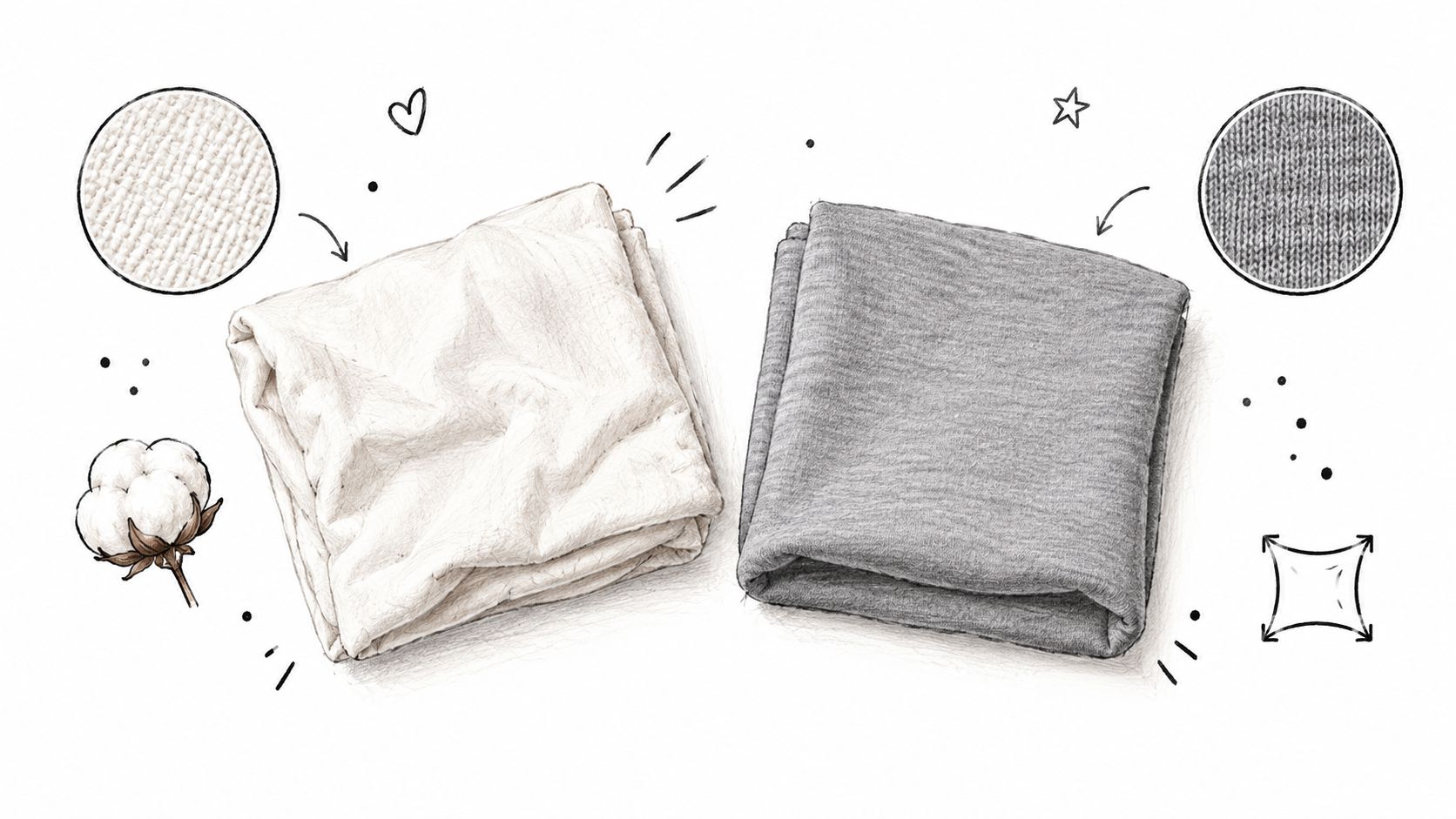
100% cotton is breathable and soft, but it can wrinkle and take longer to dry. It's a strong choice for warm or humid destinations, especially when the room may not have powerful air conditioning.
Jersey knit stretches more easily than woven cotton and can be forgiving during setup. It tends to feel warmer, which makes it a sensible everyday choice in moderate climates but less appealing for a hot room.
Muslin packs lightly and dries quickly. It works well for warm trips, although its looser weave means you should inspect the fabric and elastic regularly for stretching or damage.
Microfiber polyester blends resist wrinkles and tolerate rough packing. They're practical for a checked bag, but they're generally less breathable than cotton or muslin.
Choose by trip rather than chasing a universal winner:
- Warm or humid destination: cotton or muslin.
- Regular weekend travel: jersey knit.
- Heavy packing and frequent washing: a durable synthetic blend.
- Sensitive skin: a verifiable certification such as OEKO-TEX or GOTS may help with material selection, but it doesn't replace correct sizing.
Skip unnecessary finishes and avoid treating “premium” fabric as a safety feature. A plain, washable sheet with reliable elastic beats a luxurious sheet that loosens at bedtime.
Safety Rules Beyond the Sheet Itself
A fitted sheet can't fix a soft mattress, an inclined surface, or a padded sleep space. The American Academy of Pediatrics recommends placing babies under 1 year old on their backs on a firm, flat sleep surface with a fitted sheet only and no blankets, pillows, bumpers, stuffed toys, or other loose items, as explained in its HealthyChildren.org guide to keeping a sleeping baby safe.
Keep the sleep space simple:
- Firm mattress: It shouldn't indent under the baby.
- Flat surface: Don't use an inclined setup. The AAP identifies surfaces inclined more than 10 degrees as unsafe for infant sleep.
- Bare enclosure: Leave out pillows, blankets, toys, bumpers, quilts, and comforters.
- Correct mattress: In a play yard or portable crib, use the mattress specified for that model. In a full-size crib, use a standard crib mattress that fits snugly with no gaps at the edges.
- No added toppers or padding: Don't add a mattress topper, foam pad, or extra padding on top of the mattress. Added padding can change the tested geometry and create gaps beside the mattress.
Warmth should come from clothing or an appropriate wearable sleep layer, not loose bedding.
For a broader equipment checklist, see Hiccapop's guide to travel crib safety. The central point remains simple: the sheet is one component of a verified sleep system.
Inspecting the Sleep Space at Your Destination
Hotels and vacation rentals often create a false sense of reassurance. A crib may be available, but the mattress can be damaged, the sheet can be the wrong size, or parts can be missing.
At arrival, identify the equipment before unpacking your baby. Is it a play yard, a portable crib, or a bassinet, and is it set up as the manufacturer's instructions describe? Check the model, look for recall information, and read the manufacturer's limits for your child.
A practical arrival inspection
- Check the frame and locks. Every joint should engage fully, with no loose rail, bent part, or unexplained movement.
- Inspect mesh and fabric. Reject tears, detached seams, exposed hardware, or damaged corners.
- Press the mattress. It should feel firm, flat, and level rather than soft or sagging.
- Check the fit. Pull the supplied sheet at each corner. Replace it with your own only if your sheet is designed for that exact mattress.
- Remove extras. Take out toppers, cushions, pillows, blankets, and padding.
The CDC advises caregivers traveling internationally with infants and children to plan a safe sleeping environment in advance because cribs in some locations might not meet U.S. safety standards, according to its international travel guidance for infants and children.
If the supplied crib fails inspection, ask for a different one or use your own portable crib or play yard, set up as its instructions describe. A familiar sheet can improve logistics, but it cannot make a damaged frame or unsuitable mattress safe.
Washing, Packing, and Replacing Travel Crib Sheets
Wash a new sheet before the first use with fragrance-free detergent. One wash removes manufacturing residues and gives you a chance to see whether the elastic changes shape.
For travel, pack at least one clean spare. If you're away for more than a few nights or traveling frequently, carrying an additional spare is sensible because spit-up and diaper leaks don't respect checkout times.
A middle-of-the-night accident doesn't require a full laundry room. Rinse the affected area with cool water, blot rather than scrub, and hang the sheet where air can circulate. Pack the clean replacement separately so you're not searching through a damp, chaotic diaper bag.
Retire a sheet when:
- Elastic stretches: The corners no longer grip securely.
- Seams tear: Especially around the corners or fitted edge.
- Fabric rides up: It shifts during ordinary movement.
- Stains persist: Washing no longer restores a hygienic surface.
Fold a dry spare, roll it, and place it inside a clean gallon zip bag. It stays compact, protected, and easy to locate when the room is dark and everyone is tired.
Common Questions Parents Ask About Travel Crib Sheets
Can you use a regular crib sheet on a play yard?
Usually, no. A standard crib sheet is cut for a larger mattress, while a play yard has different length, width, and elastic-depth requirements. Match the sheet to the exact play-yard mattress, then tug each corner firmly. Any corner that lifts or slides needs a different sheet.
Do you need a sheet if the mattress has a cover?
Yes. The cover is part of the mattress, not a replacement for a fitted, washable sheet. Use the correct mattress for that product, along with a sheet that stays attached across the entire sleep surface. Do not place an extra pad underneath it, since added layers can change the fit.
Are organic or bamboo sheets safer?
Fabric labels do not determine safety. Organic and bamboo materials may suit your texture or material preferences, but fit and sleep-surface compatibility matter more. A loose organic sheet can bunch just like any other loose sheet. Choose the sheet that remains tight, flat, and compatible with the mattress.
How many travel crib sheets should you own?
Two is the practical minimum, one in use and one available after an accident or wash. Three is better for longer trips or frequent travel, especially when laundry access is limited.
Use this quick departure checklist:
- Confirm the crib type and model.
- Verify the mattress length, width, and thickness.
- Pack a fitted sheet made for that exact mattress.
- Inspect the sleep space after arrival.
- Keep the enclosure bare except for the fitted sheet.
- Replace any sheet that loosens, bunches, or has damaged elastic.
Fit, a firm flat surface, and inspected equipment matter more than softness, familiar branding, or fit claims that don't state dimensions.
For toddlers who have outgrown the crib, the Hiccapop Inflatable Toddler Travel Bed fits all standard crib sheets, so the snug-fit check above works the same way. See the Inflatable Toddler Travel Bed →
Related Products
-
![]()

- Regular price
- $109.99
- Sale price
- $109.99
- Regular price
-
$149.99 - Unit price
- per
Sold out -
![Inflatable toddler travel bed featuring a white four-bumper frame, navy blue inflatable mattress, electric air pump, and blue carry bag.]()

- Regular price
- $99.99
- Sale price
- $99.99
- Regular price
-
$99.99 - Unit price
- per
Sold out -
![Grey mesh playard (TravelPod) with a sleeping baby inside, shown next to its compact grey travel bag/backpack.]()

- Regular price
- $144.99
- Sale price
- $144.99
- Regular price
-
$199.99 - Unit price
- per
Sold out


Related Products
-
![]()
- Regular price
- $109.99
- Sale price
- $109.99
- Regular price
-
$149.99 - Unit price
- per
Sold out -
![Inflatable toddler travel bed featuring a white four-bumper frame, navy blue inflatable mattress, electric air pump, and blue carry bag.]()
- Regular price
- $99.99
- Sale price
- $99.99
- Regular price
-
$99.99 - Unit price
- per
Sold out -
![Grey mesh playard (TravelPod) with a sleeping baby inside, shown next to its compact grey travel bag/backpack.]()
- Regular price
- $144.99
- Sale price
- $144.99
- Regular price
-
$199.99 - Unit price
- per
Sold out