


Travel Crib Carry on: Airline Rules and Size Limits
A travel crib usually isn't guaranteed carry-on, because airlines may treat it as a regular bag, and cabin acceptance depends on the carrier's size limit and available space. For American Airlines, that means fitting within 22 × 14 × 9 inches, including handles and wheels, not merely having “airline-friendly” printed on the bag.
The surprising part? A stroller may get special handling while the portable crib beside it counts as ordinary luggage. Before you buy the lightest model or haul a play yard through security, decide how it'll travel if the cabin plan falls apart.
Disclosure: Hiccapop makes and sells travel sleep products, including the TravelPod Playard and the Inflatable Toddler Travel Bed.
Do Travel Cribs Count as Carry-On?
A travel crib counts as a carry-on only if its packed size fits the carrier's cabin limit and there's room for it onboard. For example, American Airlines' published limit is 22 × 14 × 9 inches, including handles and wheels. The product label does not determine acceptance.
Parents and sellers use terms such as travel crib, portable crib, play yard, and bassinet interchangeably. Airlines may classify these items differently, so check the policy for the specific item you're bringing.
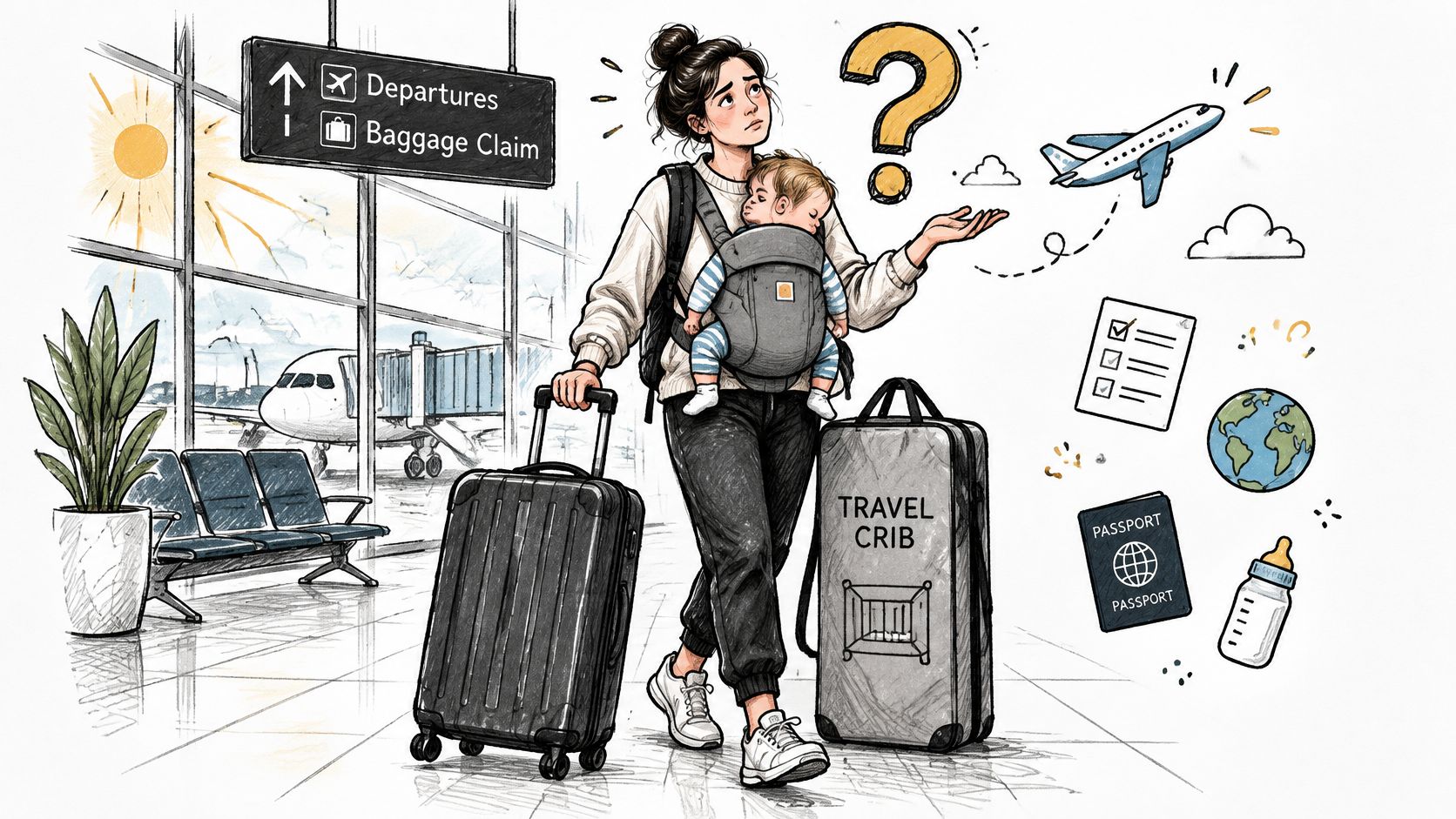
Your fare or infant's ticket status may affect the baggage allowance, and available cabin storage can change whether an otherwise compliant bag is accepted. Staff make the final decision. If overhead space is full, the crib may need to be checked.
Strollers are handled separately by some carriers, but that treatment does not automatically apply to cribs. Check the airline's published cabin dimensions, baggage allowance, and policy for portable cribs before packing.
Measure the crib in its travel case, including handles, wheels, and bulging pockets. Compare the packed dimensions with the carrier's limit, then have a checking plan in case it cannot stay in the cabin.
Airline Rules and Size Limits at a Glance
A product label does not decide whether a travel crib can go in the cabin. The airline's published size limit and available onboard space do. Check the packed case, then make a backup plan in case staff require it to be checked.
IATA reference, voluntary
- Cabin size limit: 56 × 45 × 25 cm (22 × 18 × 10 in), including wheels and handles
- Travel crib treatment: Reference guidance, not a crib rule; airlines set their own limits
- What to verify: Your carrier's published limit
IATA Cabin OK guideline, same reference
- Cabin size limit: 55 × 35 × 20 cm (21.5 × 13.5 × 7.5 in)
- Travel crib treatment: Voluntary guideline, not a mandatory maximum
- What to verify: Whether your carrier follows it
Common airline benchmark, not an FAA limit
- Cabin size limit: 45 linear inches, height + width + depth
- Travel crib treatment: Depends on the airline
- What to verify: Total packed dimensions and individual side limits
American Airlines carry-on policy
- Cabin size limit: 22 × 14 × 9 in (56 × 36 × 23 cm), including handles and wheels
- Travel crib treatment: Regular baggage treatment; see infant allowance below
- What to verify: Fare allowance and infant-baggage eligibility
Southwest child-items policy
- Cabin size limit: Verify current cabin dimensions
- Travel crib treatment: Portable cribs and play yards are regular bags under checked-baggage rules
- What to verify: Strollers and child-restraint seats receive separate treatment
Delta
- Cabin size limit: Not applicable; must be checked
- Travel crib treatment: Portable cribs, playpens, and wagons count toward the checked baggage allowance and should be checked before security
- What to verify: Fare-based allowance; a child flying free has no separate allowance
Emirates infant allowance
- Cabin size limit: For an infant under two: 22 × 15 × 8 in (55 × 38 × 22 cm), up to 5 kg (11 lb)
- Travel crib treatment: Portable infant bassinet accepted onboard only when space permits
- What to verify: Ask at check-in
Reference sizes aren't boarding permission
IATA's Cabin OK initiative, introduced in 2015, is voluntary guidance. It does not require an airline to accept a bag of those dimensions. The FAA also does not set a universal carry-on size limit. Some airlines use a 45-linear-inch benchmark, but that total can hide a problem: a long, narrow crib bag may exceed the carrier's limit for one side.
Infant allowances need a separate check
American classifies cribs, play yards, and playpens as regular bags that may incur fees. For international lap-infant travel, its traveling-with-children policy allows one free checked infant bag processed by an airport agent, capped at 25 lb (11 kg) and 22 × 14 × 9 in (56 × 36 × 23 cm). It also permits one carry-on diaper bag per child.
Checked-baggage treatment is not the same as free stroller handling. Emirates separates its infant cabin-bag allowance from its bassinet, which is accepted only when space permits. Confirm whether the crib qualifies before relying on it.
For codeshares, check each operating carrier, not only the airline that sold the ticket. Recheck the rules before departure, especially if the aircraft or itinerary changes.
Why a Travel Crib Is Not a Child Seat
A travel crib provides destination sleep space. An approved restraint protects your child during flight. Packing one doesn't solve the need for the other.
U.S. seating rules and restraint recommendations depend on the child's age. The FAA's child safety tips say the "safest place" for a child under two is an approved car seat or device, and suggest buying the child a ticket so you can use one.
Under two years
- Seating under U.S. rules: Lap-infant travel generally allowed
- Restraint guidance: FAA calls an approved restraint the "safest" option but doesn't require one
- Role of the travel crib: Destination sleep only
From the second birthday
- Seating under U.S. rules: Own aircraft seat required
- Restraint guidance: Check the aircraft-certification label, fit, and the child's size limits
- Role of the travel crib: Destination sleep only
Separate CRS packed for the trip
- Seating under U.S. rules: Use in an appropriate passenger seat or stow when unused
- Restraint guidance: Verify labeling and compatibility before boarding
- Role of the travel crib: Never replaces the restraint
Check the restraint itself
The FAA's child-restraint guidance calls for an aircraft-certification label on the restraint.
Check your child's size limits, the aircraft seat width, and seat availability. Read the manual to confirm the restraint can be secured in an airplane seat. If it can't, you may be asked to check it as baggage.
Sleep gear and flight restraints solve different problems. A crib never replaces a seat belt or approved restraint during taxi, takeoff, landing, or turbulence.
How to Measure, Pack and Gate-Check a Travel Crib
Pack as though you might need to check the crib, even when you hope to carry it onboard. That approach saves frantic repacking while someone announces boarding behind you.

Before you leave home
- Measure the finished package. Fold the crib according to its manual, zip the case, and measure the outermost points, including pockets, handles, and wheels. Add height, width, and depth for the linear total.
- Compare each side, not just the sum. Use your carrier's current dimensions and the reference sizes in the table. Don't squeeze the bag with your knee and call that its normal size.
- Secure the sleep components. Remove only attachments the manufacturer says to remove, and contain loose pieces in a labeled pouch. Keep the approved mattress and fitted sheet clean in a dedicated bag or compartment without separating essential parts unnecessarily.
- Protect the frame for checking. Use the manufacturer's transport arrangement and an appropriate protective case. A slightly heavier, better-protected setup may be the more practical choice when the crib won't stay with you.
- Document its condition. Photograph the folded crib and case, and save the model information somewhere accessible. That gives you a useful record if you need to discuss damage.
The guide to airline-approved carry-on luggage can help organize the baggage comparison. Keep any separately packed CRS within its own stowage plan, following the restraint guidance above.
At the airport and after landing
- Ask before assuming gate-checking is available. Confirm whether the crib must go through the regular bag-drop process or can be accepted at the gate. If staff authorize gate-checking, obtain the tag and ask where you'll collect it; jet-bridge return isn't something to assume.
- Inspect before assembly. After collection, examine the bag, seams, frame joints, locks, and essential parts. Don't use a crib with cracks, missing components, or a locking mechanism that won't engage correctly.
The lightest crib isn't automatically the smartest flying choice. Carrying comfort matters, but so does having an intact sleep space at the other end.
Setting Up a Travel Crib at Your Destination
Start with a firm, flat mattress, a fitted sheet, and nothing else. The American Academy of Pediatrics' infant sleep guidance identifies appropriate cribs, bassinets, and portable play yards as infant sleep environments, without soft objects or loose bedding.
A tired parent may be tempted to improve a thin-looking mattress. Don't add comfort with pillows, blankets, bumpers, toppers, aftermarket inserts, or a hotel mattress. Use only the manufacturer-supplied or specifically approved sleep components.

Run a destination sleep audit
- Confirm the mattress. Match it to the product's instructions and check its intended fit.
- Engage every lock. Follow the full assembly sequence, even if the frame looks open already.
- Choose a stable location. Use a level floor, not a bed, sofa, or uneven rug.
- Account for every part. Check that nothing disappeared during transport.
- Inspect the structure. Examine seams, frame joints, and locking components before putting your child inside.
- Clear the surroundings. Keep the setup away from cords, curtains, and reachable furniture.
- Reject substitute sleep surfaces. A sofa, armchair, or inclined seating device isn't the backup crib.
Follow the product's developmental limits. Bassinet inserts may need to be discontinued when a baby begins pushing or pulling up, according to their instructions; a child who can climb out needs a different sleep arrangement. Pulling up alone isn't a universal stop-use rule for every full-depth play yard.
The travel crib safety guide can help you prepare before leaving. At bedtime, check the surface, locks, contents, and surroundings again, and show every caregiver the same setup.
Choosing a Carry-On-Friendly Travel Crib
The airline's published limit and the space available on the day decide whether a crib can travel in the cabin. A product label cannot promise acceptance, and a lightweight crib may still need a checked-baggage plan if its packed dimensions exceed the carrier's limit.
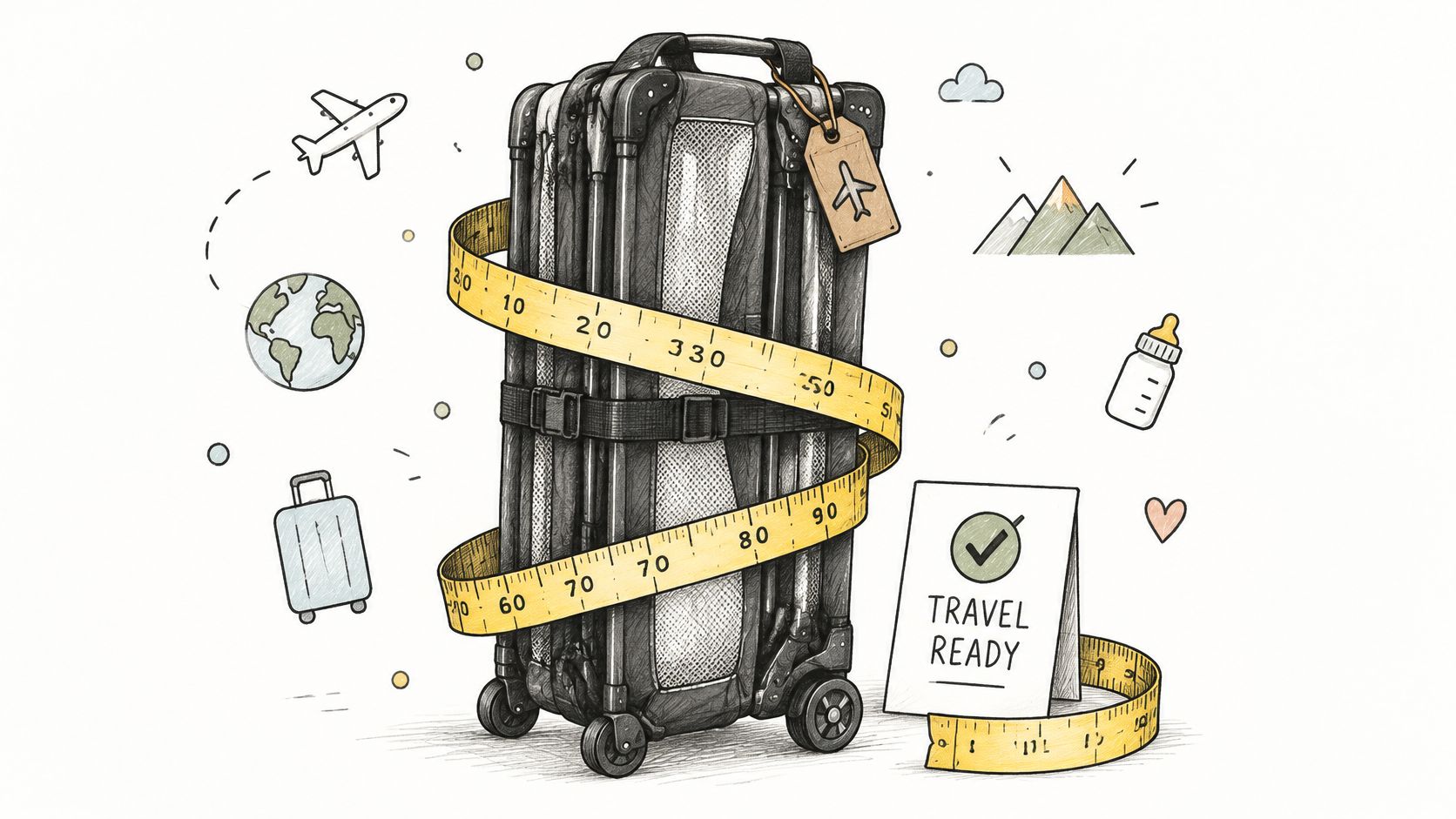
Compare products in this order:
- Packed size. Measure the crib inside its closed carry bag. Check whether listed dimensions include handles and other protruding parts, then compare them with each airline's published limit.
- Weight and construction. Low weight helps when carrying the crib through the airport. If you may need to check it, consider whether the frame and case can handle baggage handling.
- Fold and carry design. Look for a simple fold, usable handles, and parts that stay together. Try packing it at home, not during the bedtime scramble.
- Sleep-surface compatibility. Check which mattress comes with the crib and which fitted sheet the instructions allow. Don't assume a sheet is included.
- Safety documentation. Review the product's classification, CPSC conformance information, instructions, and any evidence supporting claims about testing beyond federal requirements.
Match the product to the child
Hiccapop makes the TravelPod Playard. Check its product page for packed dimensions, age and weight limits, and instructions, then compare them with your airline's published limits.
An infant crib and a travel bed intended for an older toddler are not interchangeable. A compact tent or nest does not become a suitable overnight sleep space for an infant just because it packs neatly.
Airline acceptance answers a baggage question. It does not settle whether the crib is a suitable infant sleep space.
The AAP's “A Parent's Guide to Safe Sleep” explains why an appropriate sleep surface matters. A crib that fits the cabin still needs to meet that separate requirement.
If carrying your own setup causes more trouble than it solves, ask about a hotel crib or destination rental. Confirm what equipment will be provided and inspect it before use.
Choose Your Crib Plan Before You Book
If the packed crib fits and your allowance permits it, plan to carry it onboard while keeping a checking contingency ready. Store its essential sleep components together so an unexpected handover doesn't scatter your setup.
If it exceeds the limit, arrange checked transport in advance. Ask whether gate-checking is permitted rather than arriving at the aircraft door with an oversized surprise.
If the trip is short or the package is awkward, consider requesting a hotel crib or reserving a suitable rental. Confirm availability, the model or product type, and the supplied mattress before relying on it.
Make the decision before airport day
- Identify every operating carrier. Check each carrier's baggage treatment, including connecting flights.
- Record packed measurements. Save a photo of the measurements with the crib inside its transport case.
- Check infant allowances. Ask whether the crib counts as ordinary baggage and whether your child's ticket status changes the allowance.
- Choose carry-on, check, or rent. Include possible fees and collection arrangements in that decision.
- Keep restraint planning separate. Resolve the aircraft-seat and CRS arrangements independently.
- Set a policy reminder. Recheck close to departure and after itinerary changes.
For the wider travel-day plan, use the guide to traveling with an infant. Keep written policy details accessible, but understand that storage availability can still affect what staff permit onboard.
A successful travel crib carry on plan isn't about winning an argument at the gate. It's about arriving with a usable, appropriate sleep setup and no last-minute guessing.
Share your airline, packed crib dimensions, and whether it traveled in the cabin or hold in the comments. Include the route and when you flew so other parents can judge how relevant your experience is.
Before you book, check the TravelPod Playard product page for packed dimensions and limits.