


Travel Cot Mattress 120 X 60 Size and Fit Guide
The usual advice is to match the mattress size to the travel cot's label, then choose something thick enough to feel comfortable. That skips the important bit. A mattress labeled 120 x 60 isn't interchangeable with every travel cot carrying that description, and extra softness isn't an upgrade for a baby's sleep surface.
The cot's actual base, its approved mattress specifications, and the way the mattress behaves after unfolding matter more than the shop listing. A tape measure helps, but it can't replace the manufacturer's compatibility instructions.
Disclosure: Hiccapop makes the TravelPod Playard mentioned in this post.
What 120 x 60 Measures in Real Units
A 120 x 60 cm travel-cot mattress measures about 47.2 by 23.6 inches, a nominal sleeping area of 7,200 cm².
Similar names don't mean similar sleeping spaces
European cot dimensions and American crib dimensions aren't interchangeable. The U.S. Consumer Product Safety Commission specifies full-size crib interiors at 1330 ± 16 mm by 711 ± 16 mm, approximately 133 x 71 cm, making the nominal interior roughly 13 cm longer and 11 cm wider than this travel-cot mattress.
A standard full-size crib mattress therefore isn't a substitute. It's too large for this smaller sleeping space and may curl or buckle rather than resting flat.
120 x 60 travel cot mattress against nearby sleep sizes
Travel cot mattress 120 x 60
- Nominal size: 120 cm long by 60 cm wide
- Imperial or gap: About 47.2 in by 23.6 in
- What it does and does not mean: Sleeping area about 7,200 cm² or 0.72 m²; label is length times width
US full-size crib interior
- Nominal size: 1330 ± 16 mm by 711 ± 16 mm
- Imperial or gap: About 13 cm longer and 11 cm wider than 120 x 60
- What it does and does not mean: A standard crib mattress will not fit this travel cot
Measure the support, not the silhouette
The outside frame includes fabric, rails, feet, and other parts that don't tell you the usable mattress dimensions. Measure where the mattress rests, with the cot fully assembled.
Practical rule: Treat the label as a search filter. Treat the cot's instructions and internal base as the compatibility check.
The table helps eliminate the wrong neighboring sizes. Your next measurement belongs inside the cot, not across its outer frame.
Check the Cot Base Before You Trust the Label
Matching labels don't establish a proper fit. The NHS baby-equipment guidance says a cot mattress should fit snugly, without gaps where a baby's head could become trapped.
A rectangular label doesn't describe every corner, taper, or flexible side. That's why you need to inspect the assembled combination, not just compare packaging.
Keep the fit checks visible while you set up.
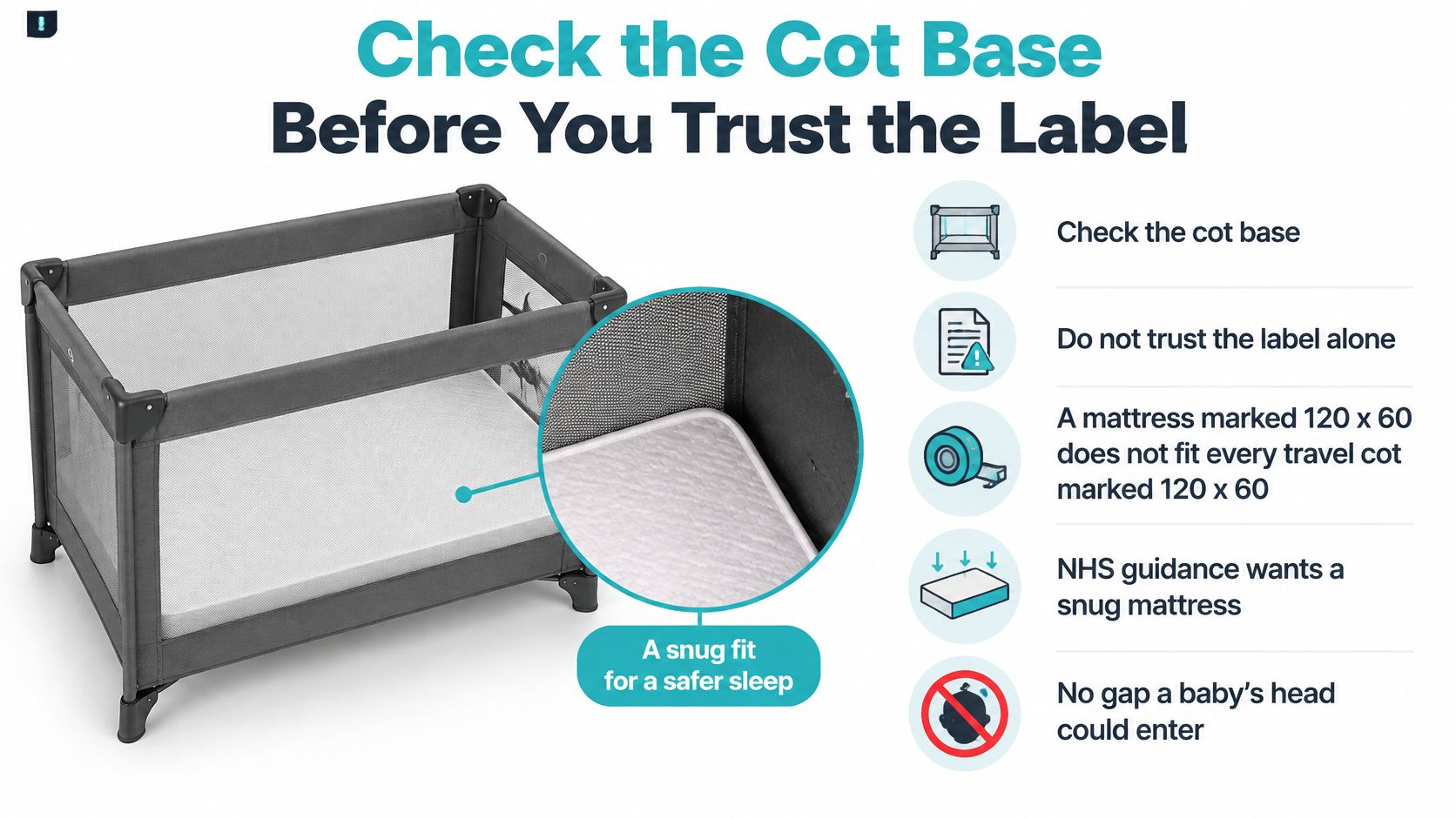
Work through the actual fit
- Assemble the cot completely. Lock the frame and install the support exactly as instructed. A partially opened cot isn't a reliable measuring template.
- Measure the usable interior. Use a tape measure inside edge to inside edge. Check across the head, middle, and foot, and inspect rounded or tapered ends.
- Measure the unfolded mattress. Take it out of its bag and allow any permitted recovery time before judging its shape.
- Check every edge. Seat the mattress, then run your hand around the perimeter. Look closely at the corners rather than assuming straight sides guarantee a match.
- Press the center. Watch for sideways movement, curling, rocking, or a corner lifting away from the support.
A hand check is a practical warning check, not a laboratory gap test. Passing it doesn't override an instruction that prohibits that replacement mattress.
Fit results after the mattress is in the cot
Edges meet the base with no gap a finger can enter
- Why it matters: Helps prevent head, neck, or torso entrapment
- Use it?: Yes, if also approved, firm, and flat
Gap along a side, corner, or tapered end
- Why it matters: The nominal size can still be too small for that base
- Use it?: No; don't fill the gap
Mattress buckles, curls, or won't lie flat
- Why it matters: Too large or incompatible with the cot's construction
- Use it?: No
Mattress shifts when pressed
- Why it matters: Can open a gap during sleep
- Use it?: No
Sleeping surface sits high and side walls feel short
- Why it matters: A thick replacement can make climbing out easier
- Use it?: No, unless that model approves the thickness
Hotel or second-hand cot with no approved size
- Why it matters: Model-specific fit can't be confirmed from the label alone
- Use it?: Don't guess
Stop rather than improvise
Don't pack an edge with foam, a towel, a folded blanket, or a rolled sheet. Those fillers can move, and they don't turn an incompatible mattress into an approved one.
For gift buyers, the useful question is the cot's exact model, not merely its advertised size. For borrowed or accommodation-provided cots, stop if you can't establish the approved mattress specification.
Firm Flat and Waterproof Beats Thick and Soft
Choose a firm, flat, waterproof sleeping surface, keep soft accessories away, and place your baby on their back. The NHS sleep advice explains that a baby's head shouldn't sink into the mattress by more than a few millimeters, and warns that an overly soft mattress can make heat loss harder and increase overheating risk.
That's a different goal from choosing an adult mattress. You're not looking for a plush surface that hugs the body. You're looking for stable support without a hollow around the face.
This visual summarizes the clear-cot principle. Thickness itself isn't the deciding factor; unapproved extra thickness is the concern.
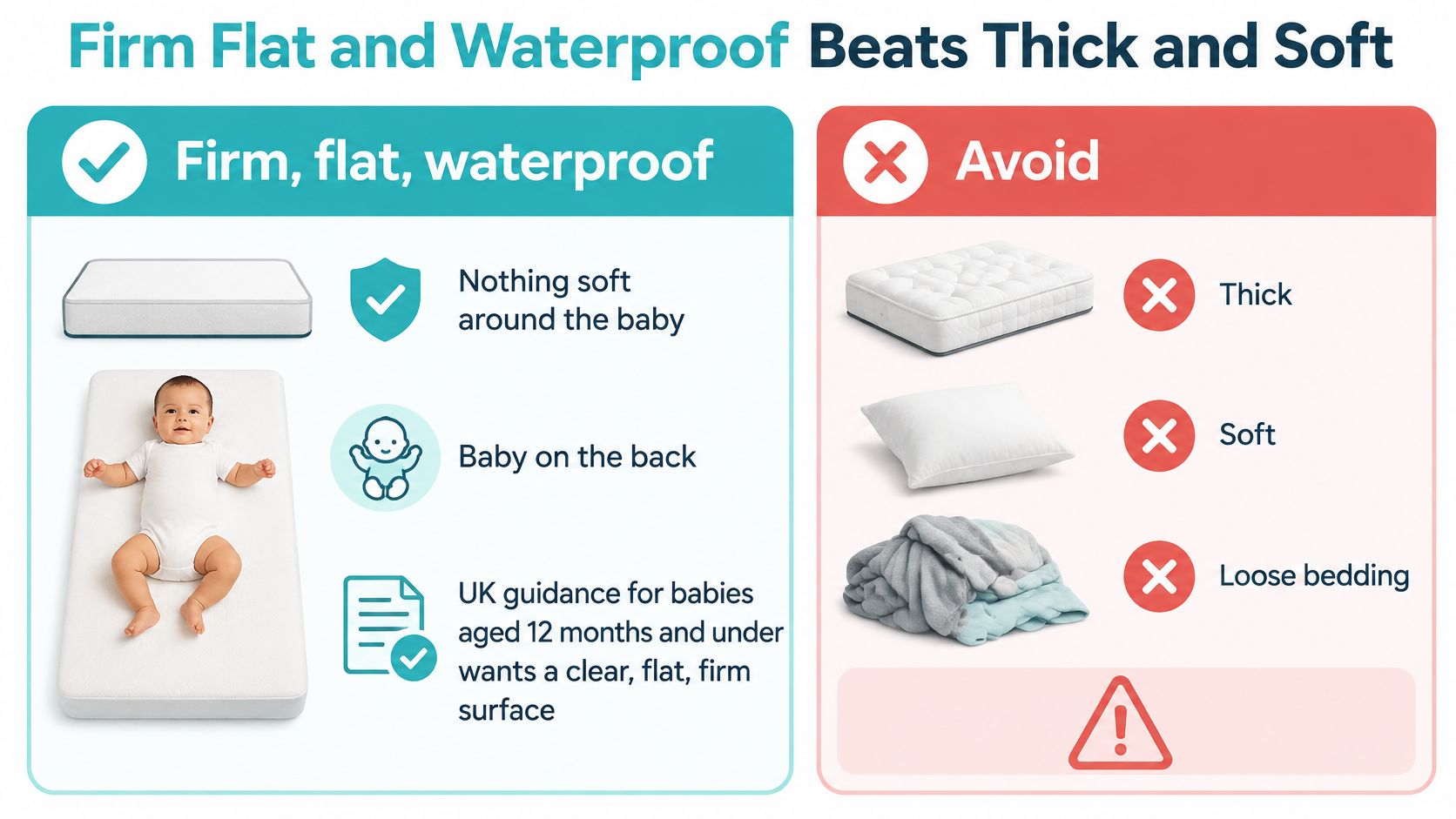
Thin can be intentional
The Lullaby Trust's advice for sleep away from home explains that travel-cot mattresses are much thinner than ordinary cot mattresses but can still be suitable when they're firm, flat, waterproof, and properly fitted.
The thin folding pad can look underwhelming next to a deep nursery mattress. Resist the urge to improve it with a quilt beneath the sheet. That changes the surface the baby sleeps on and can introduce movement, softness, or an uneven edge.
A mattress that feels nicer to an adult hand isn't necessarily a better infant sleep surface.
The Lullaby Trust's clear-cot guidance identifies BS EN 16890:2017+A1:2021 as the relevant mattress standard and advises against soft raised edges, bumpers, wedges, and positioning devices.
A home press check can't reproduce laboratory testing. It can help you spot deterioration, but it cannot prove compliance or make an unapproved product suitable.
Separate sleep surface, comfort, and compatibility
These are different questions, and the answers shouldn't get muddled.
- Suitable for sleep means the intended surface remains firm, flat, and free from hazardous hollows or gaps.
- Comfortable for this child concerns how they settle and sleep. A restless night doesn't establish that the mattress needs padding.
- Compatible with this cot means the mattress matches the model's instructions, including depth, attachments, and intended side-wall height.
The American Academy of Pediatrics' sleep guidance supports a firm, flat mattress with a fitted sheet and no soft items or added padding. Don't add soft materials to modify an infant travel cot.
When shopping, inspect the whole sleeping plane. It should recover promptly after pressure, have no sagging or exposed foam, and remain flat once the fitted sheet is attached. A waterproof or wipeable cover should be intact rather than split at a fold.
If an approved mattress develops a permanent dent, smells of mold, or stops lying flat, replace it with the appropriate approved replacement. Padding isn't a repair.
How to Seat the Mattress and Pack It Again
Seat the mattress only after compatibility and fit have been established. For European context, see the European Commission decision on children's mattress requirements, but your cot maker's instructions decide what fits your model.
Keep your model's assembly instructions beside you. Our guide to how to put up a travel cot can help you understand the setup sequence, but the maker's locking and fastening instructions take priority.
Use this visual as a reminder to check the mattress before use.
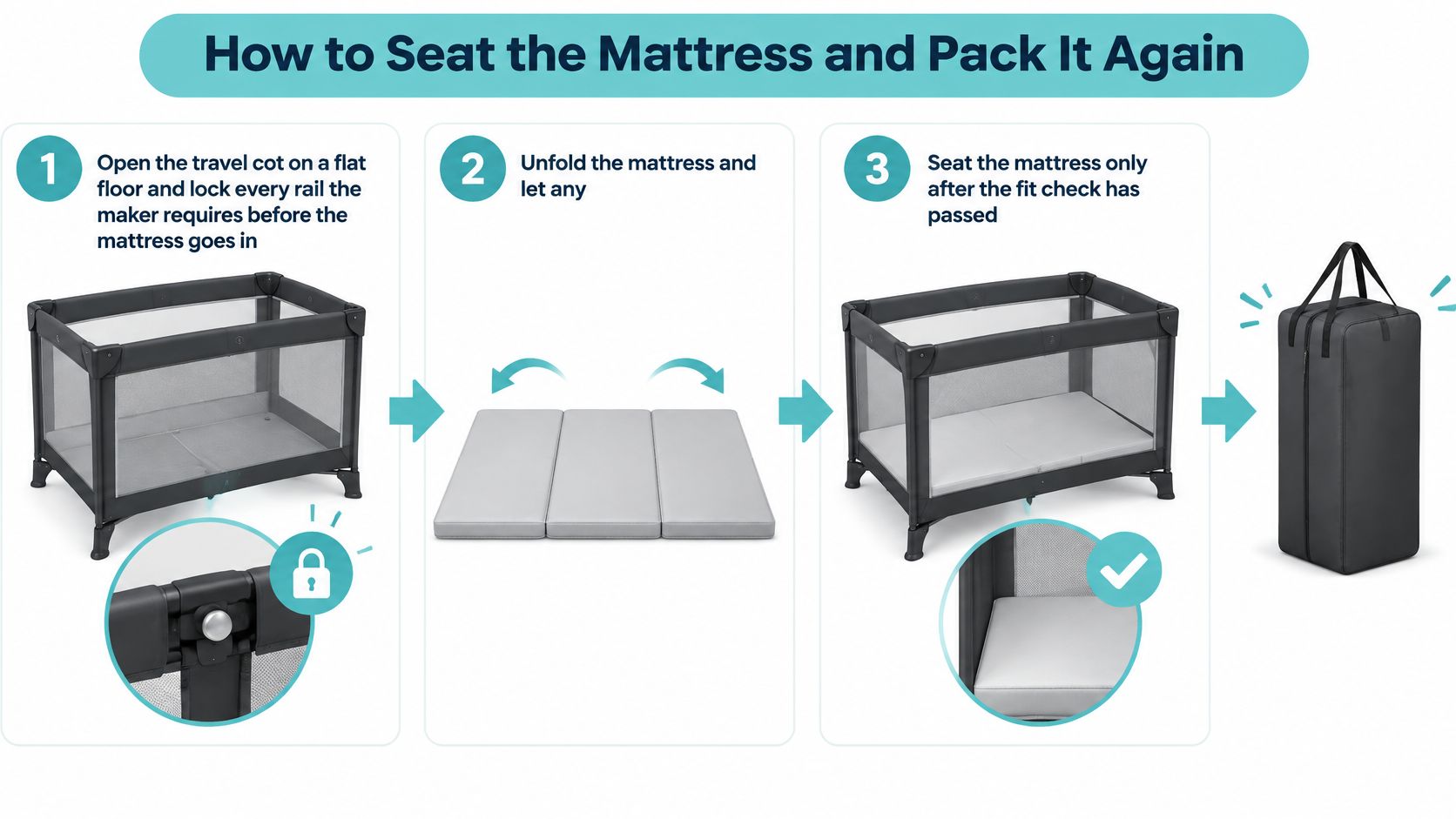
From locked frame to smooth sheet
- Open on a flat floor. Lock every required rail and support before installing the mattress.
- Unfold without forcing. Allow the mattress to settle according to its instructions. Don't hold a curled corner down with bedding.
- Use the designated sleep side. Follow any markings and secure the manufacturer's attachments. Check that the mattress contacts its support throughout.
- Fit the sheet smoothly. Keep elastic underneath, without pulling the corners upward or leaving loose fabric.
- Clear the sleep space. Remove toys, nests, bumpers, wedges, and blanket rolls.
- Place baby on their back. If using an appropriate lightweight blanket, keep it below the shoulders, securely tucked, with feet toward the cot's foot.
Pack without creating the next problem
Remove the sheet in the morning and inspect the cover before wiping it. Let the mattress and cover dry completely before enclosing them in the travel bag.
Fold only where the product is designed to fold. Forcing a different crease can damage the construction and leave an uneven surface at the next setup.
If the cot or carrying system won't close as instructed, stop and check compatibility and the packing sequence. Excess thickness is a possible problem, not a reason to bend the mattress harder.
Before the next nap: Recheck the frame locks, mattress seating, and edges whenever a borrowed or rented cot is rebuilt.
Don't use a mattress that remains bowed after unpacking. A hurried bedtime doesn't make a damaged fold acceptable.
Sheets Covers and a Wash Routine That Travels
The fitted sheet is part of the finished sleep surface, not just the cute bit. Choose one made for the mattress's stated length, width, and depth, then inspect it after fitting.
A sheet that's too loose can bunch; one that's too tight can pull up the mattress corners. A larger European cot sheet or full-size American crib sheet isn't an automatic substitute, even if you can tuck the extra fabric underneath.
Choose fabric that stays put
Stretch cotton jersey can be a practical choice when its elastic and depth suit the mattress. Don't substitute loose muslin and rely on elaborate tucking to hold it flat.
Our guide to travel crib sheets offers more help with sheet selection. Whatever the fabric, judge the result on the assembled mattress: smooth top, secure edges, no lifted corners.
- Pack a spare fitted sheet. Keep it with the sleep kit so a nighttime leak doesn't lead to improvised bedding.
- Check the waterproof surface. A sheet absorbs moisture; it doesn't replace an intact waterproof mattress cover.
- Inspect after washing. Shrinkage, stretched elastic, and damaged seams can change how the sheet fits.
Clean the cover before soaking the core
For everyday spills, use a cloth with mild soap and water if the care instructions permit it. Wipe away residue and dry the surface before replacing the sheet.
Don't assume a removable cover means the foam underneath is washable. Follow the cover's wash label separately from the core's instructions, and don't remove a permanently attached cover.
If the manufacturer explicitly permits hand-washing the foam, use the specified detergent and method. Where squeezing or rolling is allowed, remove excess water gently rather than twisting the core, then air-dry it completely.
A surface that feels dry can conceal moisture inside. Don't use or pack the mattress while its core is damp, and don't zip a wet mattress into a bag to deal with later.
Avoid essential-oil sprays on the sleeping surface. Skip fabric softener if it leaves residue or conflicts with the care label; a strong fragrance isn't evidence that the mattress is clean.
Keep the kit simple:
- Approved mattress with its intact waterproof cover.
- Fitted sheets with a clean spare.
- Small cleaning cloth and suitable mild soap.
Travel Cot Mattress 120 x 60 FAQs
Can I use a standard US crib mattress?
No. A full-size American crib mattress is larger than this travel-cot format. It may buckle or curl in the smaller frame rather than lying flat.
Can the smaller mattress go in a larger European cot?
No. It won't cover the larger base and can leave entrapment gaps. Don't center it and fill the edges with bedding.
Is a thin folding mattress suitable?
It can be, when it's the supplied or approved mattress and remains firm, flat, waterproof, and correctly fitted. Thinness alone neither proves nor disproves suitability.
Can I add a topper for comfort?
Don't add a topper, quilt, or folded blanket to an infant travel-cot mattress. A soft extra layer changes the intended sleep surface and may create hollows or gaps.
How often should I clean it?
Deal with milk, leaks, and other spills promptly, using the mattress's care instructions. Inspect it between trips and let every component dry fully before reuse or storage.
Which standards should I check?
Look for evidence of compliance with the relevant cot-mattress standard identified earlier, and check the cot maker's approved mattress specifications. A standards claim doesn't establish compatibility with an unrelated frame.
Where can I check infant sleep advice?
The Lullaby Trust, NHS sleep advice, and the US Safe to Sleep program provide caregiver guidance.
Pick the Setup That Matches This Trip
For a cot you own, order the replacement listed for that exact model. Keep its instructions and fitted sheets together so another caregiver doesn't have to reconstruct the setup from memory.
If the paperwork is missing, search for the model identification before shopping. Measuring is useful, but a snug-looking fit alone can't tell you whether a replacement has the right construction, attachments, or approved thickness.
Make the decision before departure
Go or no-go by cot situation
Owned travel cot with a known model name
- Mattress to use: Maker-listed replacement in the stated size and matching thickness
- Verdict: Go
Cot labeled 120 x 60 with paperwork lost
- Mattress to use: Confirm model approval and pass the four-edge and no-gap check
- Verdict: Conditional
Hotel, rental, or grandparent cot with no model name
- Mattress to use: Establish the model or choose a complete compatible setup
- Verdict: No guessing
Second-hand cot
- Mattress to use: Approved mattress, intact cover, unsagged foam, dry and flat; cot complete and sound
- Verdict: Conditional
Mattress that smells, stains through, bows, or leaves a gap
- Mattress to use: Retire it; don't fill the gap
- Verdict: No
US pack-and-play or inflatable toddler bed
- Mattress to use: Different geometry, not a substitute pad
- Verdict: No
Before relying on an accommodation's baby-equipment description, confirm the actual cot model and supplied mattress.
Our guide to where baby should sleep when traveling can help you plan an alternative if the accommodation can't establish what it provides.
Match the product, not the rounded size
The Hiccapop TravelPod Playard comes with its own fitted Travel PlayPad, so that pad isn't a replacement for a 120 x 60 European travel cot mattress. The U.S. Consumer Product Safety Commission says generic compatibility based on a size measurement can't meet its requirements for aftermarket play yard mattresses.
Second-hand equipment needs more than a tidy cover. Confirm the cot is complete and functional, and reject a mattress with persistent odor, soaked-through staining, sagging, or packing damage.
Measure your cot tonight, while there's time to resolve a mismatch. If the label and tape disagree, comment with the model name and inside length and width, without assuming another family's mattress recommendation will fit.
For more away-from-home sleep planning, browse Hiccapop's blog, and match any mattress to its intended product before you pack.