


Travel Cot Instructions That Keep Baby Safe Every Time
You've got the cot out in a hotel room, the baby is rubbing their eyes, and the room light is too bright by half. That's usually the moment people rush the setup and hope for the best. With travel cot instructions, hope isn't the safety plan. The manual is the safety plan, because the cot only works as intended when every lock, joint, and sleep surface is in the right place.
Disclosure: This article is published by Hiccapop, and the TravelPod Playard mentioned below is ours.
Why Travel Cot Instructions Are Real Safety Steps
A travel night changes everything. The room is unfamiliar, the baby is tired, and the cot might be borrowed, rented, or pulled from a closet after months of sitting still. That's exactly when small assembly mistakes creep in, especially if the floor is uneven or the setup happens while one adult is holding a fussy child.

Travel cot instructions are operational safety controls, not paperwork. Australia's national product-safety regulator says portable folding cots must have a secure locking device, child-resistant locks, a firm and flat mattress that touches the cot on every side, no entrapment gaps, and no footholds for climbing, with mandatory standards that took effect for suppliers on 19 January 2026 (portable folding cots guide). That matters because a cot is only ready for sleep when it's stable, fully locked, and free of hazards every single time it's used.
Practical rule: if the cot is only “mostly set up,” it's not ready for sleep.
The same logic applies whether the cot is brand new, handed down, or pulled from a storage bag for the first time in months. Age, size, and developmental limits matter too, because the manual's limits decide what's safe inside the cot. That's why travel crib safety needs to be treated like a safety habit, not a nice extra.
Assembling the Cot the Right Way
Start with the product label: confirm the model and check the recall status, then unfold the frame until every side rail locks into place. After that, install only the manufacturer-specified mattress in its intended position, not a “close enough” substitute.
The order matters because the lock points and mattress fit are part of the safety design. In the U.S., a mesh-sided folding travel cot is regulated as a play yard under 16 C.F.R. part 1221, which incorporates ASTM F406 and covers structural integrity, entrapment, labeling, and instructions. In plain language, the cot isn't finished just because it stands upright. It has to lock correctly and hold its shape under real use.
You can also use a quick hands-on test before the baby goes in.
- Push down on each rail: A rail that feels “up” but not fully locked is a warning sign, not a minor annoyance.
- Check the hinge and base: Any loose joint, shifting frame, or unstable base means stop and reset.
- Look for gaps: A visible gap at the mattress edge or frame is a reason to pause.
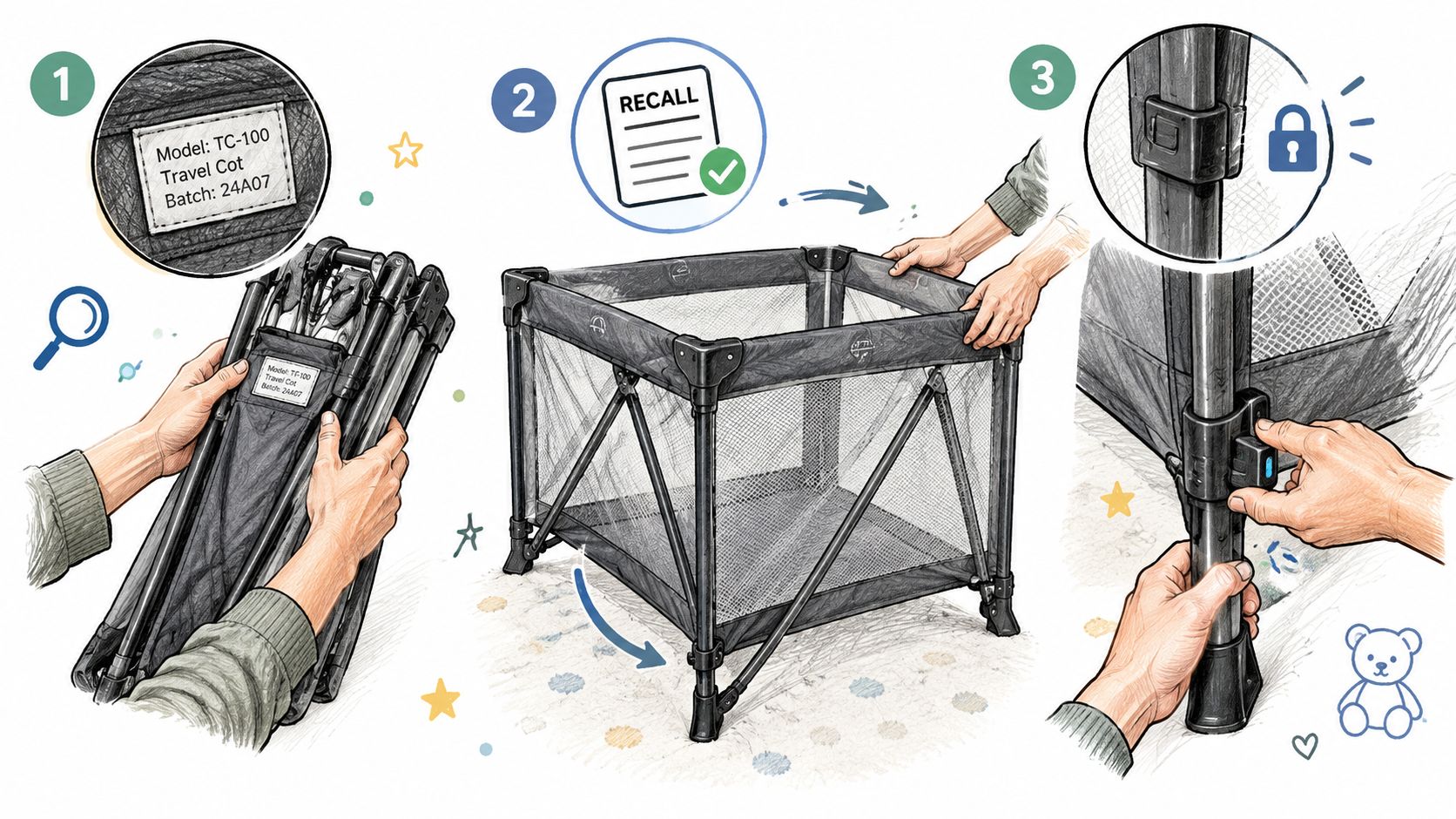
If a rail is only half-set, treat the cot like it's still in transit.
From Assembled to Sleep-Safe
A cot can be built and still not be sleep-safe. The sleep space needs to be flat, firm, and fitted with only the mattress made for that model, plus a sheet made for that play yard, because extra layers change the way the surface behaves under a baby's body.
Here's where parent instinct can mislead people. A topper feels cozy. A folded blanket under the mattress feels supportive. A second mattress feels like a comfort upgrade. In safe-sleep terms, each of those can create gaps, soften the surface too much, or undermine the fit that the cot was designed to maintain. A federal safety rule for infant sleep products (16 CFR part 1236) caps the sleep-surface angle at 10 degrees, and Head Start states that tilted surfaces are unsafe for infant sleep (safe sleep for infants).
| Common Parent Move | Safe-Sleep Rule | Why It Fails |
|---|---|---|
| Adding a topper | Use the approved sleep surface only | It can make the cot too soft and change the fit |
| Putting a blanket under the mattress | Keep the mattress flat and correctly seated | It can create gaps or uneven pressure |
| Using a raised bassinet level too long | Follow the manual's weight and developmental limits for any raised level | It's only designed for babies within those limits |
| Tilting the cot for comfort | Keep the sleep surface flat | Tilted sleep isn't safe for infant sleep |
Stop using any raised bassinet level as soon as the baby reaches the limits in the manual. A flat sleep surface wins every time, even when a softer setup seems more comfortable. For a deeper mattress-specific check, play yard mattress safe-sleep guide is a useful companion read.
The Pre-Sleep Checklist for Any Room
A hotel, relative's house, or vacation rental all call for the same reset. The room may look clean and calm, but the cot still needs a quick check before every sleep.

Before you walk away, check these items:
- Correct product. Make sure the label matches the manual you're using.
- Current instructions and recall status. Use the latest manual and verify safety notices.
- Fully locked rails. Every side should be firmly engaged.
- Correctly seated original mattress. Only the supplied or approved mattress goes in.
- Back to sleep in a bare cot. Babies under 12 months go on their back on the firm, flat mattress with only a fitted sheet. No blankets, pillows, quilts, comforters, sheepskins, bumpers, or toys, as CPSC guidance says to keep soft items out of the crib (crib safety tips).
- Stable floor and clear surroundings. Keep the cot away from cords, windows, and blind strings.
- Age and weight within limits. Use the manufacturer's limits, and stop using any raised level as soon as the baby reaches the limits in the manual.
- Periodic recheck after moving the cot. Any relocation or folding deserves another hands-on inspection.
A travel cot should look boring at bedtime. No soft extras. No wobble. No guessing.
Packing, Storing, and Reusing on the Road
Packing matters because a folded cot can still pick up damage on the way to the next trip. Fold it without forcing the joints, and don't trap fabric between locking points. Before you zip it away, check the carry bag, base, and frame for wear that could point to stress or a crack.
Dry storage matters too. Foam and fabric don't like moisture, and a damp cot can become a bad surprise between trips. Once you arrive, set the cot up with the same discipline you used at home, then keep it away from windows and blind cords, and make sure the baby's head stays uncovered.
UK guidance for early years providers says babies 12 months and under who fall asleep while traveling must be moved to their cot once they're back, and that a travel cot used according to the manufacturer's instructions is among the safest places for them to sleep (safer sleep guidance). That rule closes a common travel loophole, because sleep that started somewhere else still needs to end in a proper cot.
For packing tips, see travel cot in a bag.
Troubleshooting Common Travel Cot Mistakes
The most common mistake is a rail that feels locked but hasn't fully locked. The fix is simple: push down firmly and confirm each rail is locked the way the manual shows before you move on. If the mattress lifts at one corner, stop and check whether it's seated exactly where the manual says it should be.
A wobbly base on carpet or uneven tile usually means the cot isn't sitting square. Reposition it on a flatter section of floor and recheck the legs and frame. Don't solve instability by adding padding underneath, because that changes the cot's safety assumptions instead of fixing the problem.
The other mistake is emotional, not mechanical. Parents sometimes add padding or strap a baby in because it feels more secure, but those moves can create suffocation, entrapment, or entanglement hazards. CPSC's 2023 nursery-products report estimated 59,500 emergency-department-treated injuries among U.S. children younger than five in 2022 and 81 deaths linked to playpens and play yards during 2018-2020, often involving blankets, pillows, or other soft bedding placed inside. That's why “more padding” and “more restraint” are not safety upgrades.
If a manufacturer or regulator notice affects the model, stop using it until the issue is resolved. Then run the full assembly and pre-sleep check again before the next nap or overnight stay.
For trips, the TravelPod Playard folds into its carry bag with a shoulder strap. Set it up exactly as its manual shows, with no extra layers. See the TravelPod Playard →