


Travel Cot in a Bag: A Safe & Practical Guide
You've finally reached the hotel after a long drive or flight. Your baby has fallen asleep in the car seat, the room's cot looks unfamiliar, and the soft “travel mattress” you packed suddenly seems tempting. This is exactly when a travel cot in a bag earns its place, but only if it's treated as a real sleep product, not as another piece of luggage.
A good cot gives your baby a familiar, separate sleep space at grandparents' homes, in hotels, or on family trips. The practical challenge is choosing the right size, assembling it correctly, handling sleep transitions, and resisting add-ons that can make the setup less safe.
Disclosure: This article is published by Hiccapop, and the TravelPod Playard and Inflatable Toddler Travel Bed mentioned below are ours.
Why Parents Need a Reliable Travel Cot in a Bag
Families rarely sleep in one place anymore. A baby may nap at home, spend a night with grandparents, and sleep in a hotel room during the same month. A portable crib makes those changes easier because the baby has a dedicated sleep surface instead of relying on an adult bed, sofa, stroller, or improvised floor space.
A U.S. survey study published in 2013 analyzed 18,986 participants and found that usual infant bed-sharing increased from 6.5% in 1993 to 13.5% in 2010. Overall, 11.2% reported bed-sharing as a usual practice. Among infants who usually slept alone, 71.8% slept in a crib, 15.7% in a bassinet, and 1.4% in a car seat, according to the JAMA Pediatrics analysis of infant sleep locations.
Those figures explain why a travel cot in a bag isn't just a convenient way to carry baby gear. It answers a real family problem: babies need a consistent, separate place to sleep even when the nursery stays at home.
Practical rule: Pack the cot because you need a safe sleep space, not because it happens to fold neatly.
At a relative's house, the cot can sit beside the caregiver's bed. In a hotel, it gives parents more control over the sleep environment. During a road trip, it removes the pressure to let a sleeping baby remain in a car seat after arrival. Convenience matters, but safety has to decide where the baby sleeps.
What Makes a Travel Cot in a Bag Work as a Sleep System
The bag is only the transport layer. The actual product is a portable infant sleep system made from a stable frame, a properly supported base, a suitable mattress or pad, and enclosed sides that keep the sleep area defined.
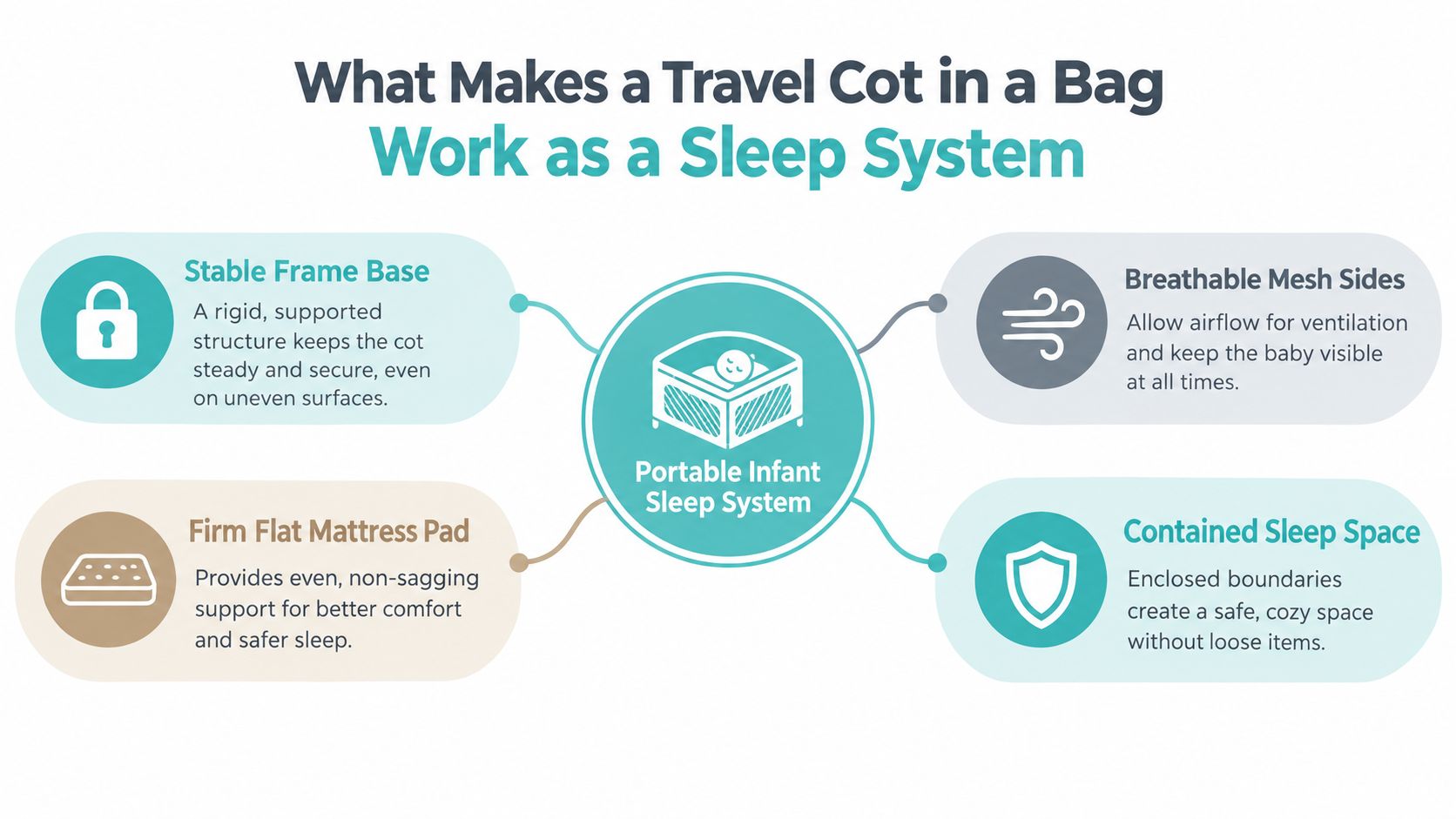
The American Academy of Pediatrics recommends a firm, flat, non-inclined surface inside a portable crib or play yard that meets applicable safety standards. The surface shouldn't indent under the baby's weight. An incline above 10° isn't safe for sleep, as explained in the AAP safe-sleep guidance.
Use only the mattress or pad specified for the cot. It needs to lie flat, fit snugly, and leave no dangerous perimeter gaps. A taut fitted sheet is the only bedding layer to add. A topper, folded blanket, pillow, or aftermarket cushion can soften the surface or create entrapment zones.
Before every sleep, run the same quick inspection:
- Check the base: It should feel supported and sit flat.
- Check the edges: Look for gaps between the supplied mattress and cot walls.
- Check the frame: Lock every rail and base support fully.
- Check the interior: Remove blankets, bumpers, toys, and loose objects.
Folding frames have hinges, joints, and attachment points. Transport can damage them, and a rail that looks extended may not be locked. Never put a baby down until the structure is fully open and secure.
Safe-Sleep Rules Parents Should Follow with a Travel Cot in a Bag
The safest routine is straightforward: place the infant on their back, on a firm, flat surface, close to the parents' bed but in a separate sleep space. Keep the cot clear of soft or loose bedding.
A 2024 study in Pediatrics, based on surveys and focus groups with 25 U.S. mothers who reported using nonrecommended infant sleep positions or locations, found that almost all knew the ABCs of safe sleep (Alone, Back, Crib), but many still used other sleep spots or positions because they seemed more comfortable or helped their baby sleep. A travel cot helps only when caregivers use it the safe way every time.
Grandparents and babysitters need the same simple instructions as parents. Share the manufacturer's setup guidance, show the locking points, and make the rule memorable: baby on their back, supplied mattress only, empty cot.
For a more detailed companion, use Hiccapop's guide to travel crib safety.
Choosing the Right Size and Meeting Sleep Standards
A compact folded package can be useful, but folded size shouldn't decide the purchase. The measurement that matters is the usable internal sleep area once the cot is erected.
In the U.S., play yards, including portable cribs with mesh or fabric sides, must meet the federal safety standard at 16 C.F.R. part 1221. Check the label or product page for the age, height, and weight limits the manufacturer lists.
Before buying, check the product information for:
- Internal dimensions: Measure the erected sleeping area, not the outside fabric shell.
- Intended child size: Confirm the age or size range supplied by the manufacturer.
- Maximum permitted load: Don't assume a cot designed for an infant suits a heavier toddler.
- Mattress configuration: Verify whether the supplied pad is integral to the tested setup.
- Replacement parts: Confirm that the manufacturer identifies compatible parts.
The mattress must match the cot. A slightly smaller cushion can leave gaps around the edge, while a thicker substitute can change how the frame performs. A cot that packs smaller isn't a bargain if it encourages parents to buy an incorrectly sized mattress.
Set it up on a level floor, lock every folding rail and base support, and inspect the fabric, seams, floor, and bag hardware after repeated use. If the instructions are missing, find the correct manual before assembly. Guesswork belongs in vacation packing, not cot installation.
Setting Up Correctly and Handling Travel Sleep Transitions
A baby who falls asleep during travel doesn't automatically have a safe sleep arrangement. Car seats, strollers, carriers, hotel beds, and improvised floor spaces serve different purposes. Once you arrive, move a sleeping baby into a correctly assembled cot rather than treating the travel gear as the destination bed.
If your baby falls asleep in a car seat, stroller, swing, or carrier, the AAP says to move them to a firm sleep surface on their back as soon as possible. The cot should hold only a firm mattress designed for it that fits tightly and a fitted sheet, with no pillows, quilts, mattress toppers, bumper pads, toys, or blankets, as set out in the AAP safe-sleep guidance.
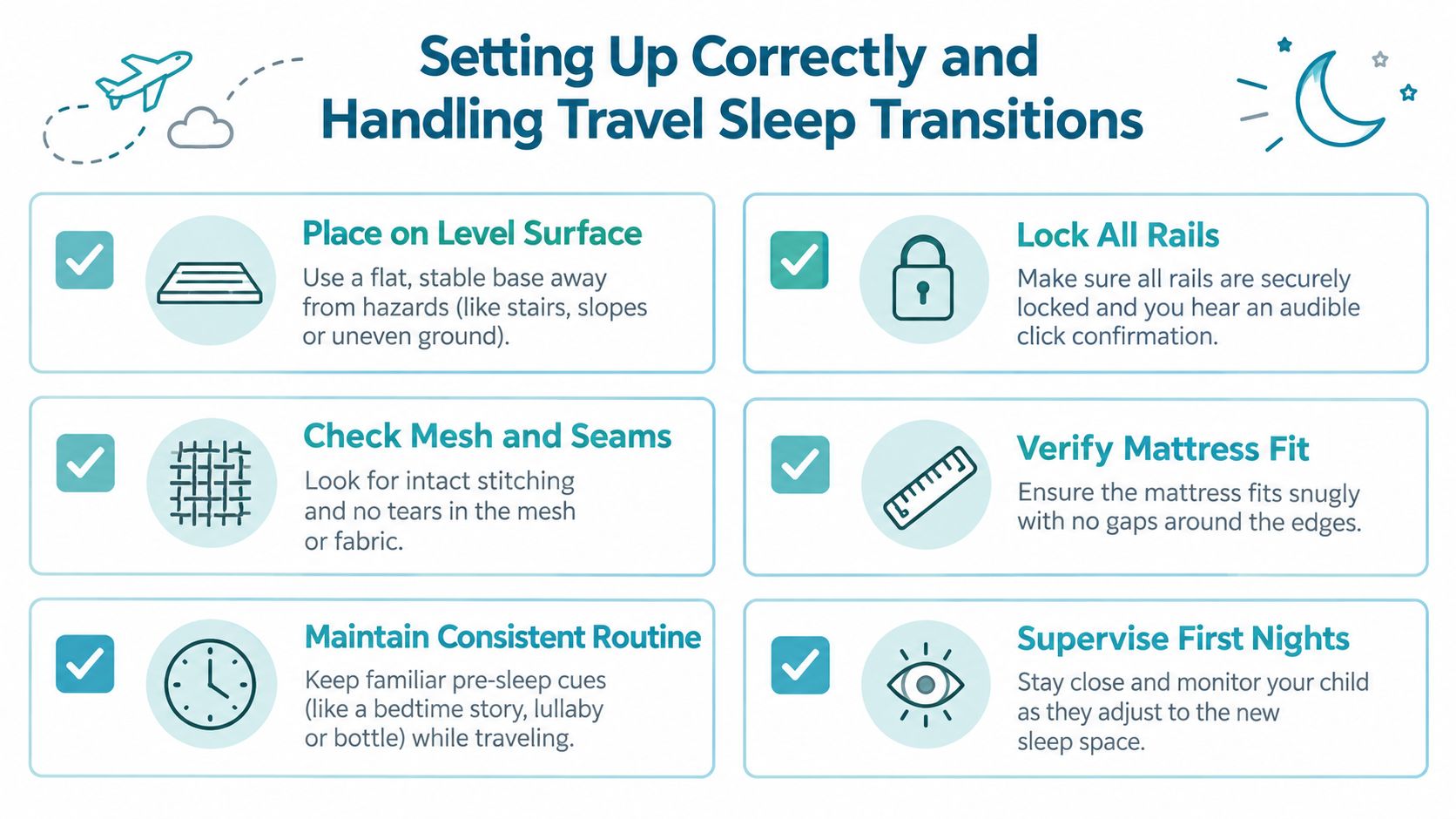
A good arrival routine is deliberately boring. Put the cot on a level surface away from hazards, open and lock the rails, check the mesh and seams, press around the mattress edges, then recreate the baby's usual wind-down cues. If the baby repeatedly nods off en route, start the routine earlier and assemble the cot before leaving the airport, driveway, or hotel lobby. Practice setting up and folding the cot at home before your first trip.
More cushioning isn't automatically more comfortable. A firm, flat, uncluttered surface is the priority, even when the supplied travel-cot pad feels thinner than the mattress at home.
Avoiding Risky Add-Ons and Second-Hand Hazards
The softest-looking setup often creates the biggest problem. Don't add a second mattress, folded blanket, pillow, quilt, cot bumper, pod, nest, positioning product, or soft toy to make the cot feel homier. Keep blankets and padding out from under the baby, even when a travel-cot mattress feels thin. The AAP warns that soft objects and loose bedding raise the risk of entrapment, suffocation, and strangulation, and it advises against sleep products that don't meet federal safety standards.

Second-hand cots need more than a wipe-down. CPSC guidance urges families to check recall lists before using used nursery equipment, including equipment passed down from a sibling. Portable cribs and play yards have been recalled for top rails that can collapse and entrap a child, as shown in the CPSC recall notice.
Use this checklist before accepting an inherited, hotel-provided, or marketplace cot:
- Photograph the product label and record the model and date code.
- Search CPSC's recall list at cpsc.gov/Recalls.
- Confirm every locking rail engages completely.
- Inspect mesh, seams, hinges, fasteners, and the floor.
- Check the supplied mattress for a snug fit.
- Reject the cot if instructions are missing or parts have been altered.
A clean-looking cot can still be recalled or unsafe. If you're booking accommodation, ask whether the supplied cot has a model label and complete mattress before you travel.
Packing, Airline Rules, and Long-Term Care Tips
Pack the frame, mattress, fitted sheet, and instructions together. The carry bag should protect the cot from dirt, but it won't protect a damaged frame from being used without inspection. After every flight or long drive, open the cot before bedtime and check the rails, mesh, seams, floor, zippers, and bag straps.
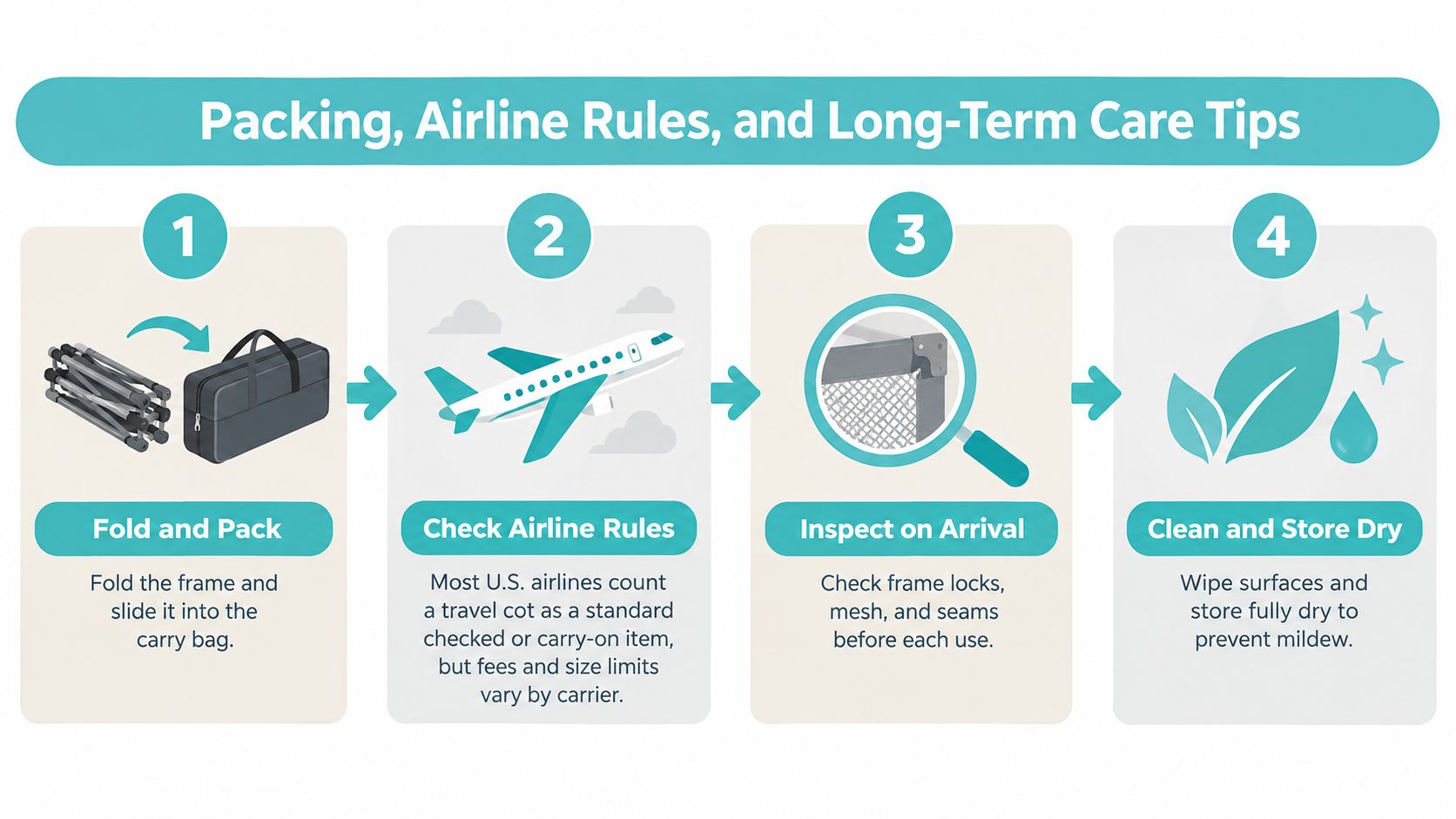
Airline rules vary, so don't assume a travel cot qualifies as a free cabin item. Delta says portable cribs, playpens, and wagons count toward the passenger's checked-baggage allowance and should be checked before airport security. An FAA-approved child restraint is different. It may be used in an aircraft seat when the child has a purchased seat or an empty seat is available in the row, otherwise it may need to be gate-checked, according to Delta's current child and infant item rules.
A travel cot supports sleep at the destination. It doesn't secure a child during flight. For the wider luggage plan, review airline-approved carry-on luggage.
Wipe surfaces according to the manufacturer's care instructions, let fabric dry fully, and store the cot dry. Don't pack damp mesh or bedding inside the bag. A few minutes of inspection after each trip can prevent a small transport defect from becoming a bedtime emergency.
Hiccapop makes travel gear for families on the go. The TravelPod Playard folds into its carry bag with a shoulder strap. For toddlers who have outgrown the crib, the Inflatable Toddler Travel Bed packs into its included XL travel bag. See the TravelPod Playard → or see the Inflatable Toddler Travel Bed →
Related Products
-
![Grey mesh playard (TravelPod) with a sleeping baby inside, shown next to its compact grey travel bag/backpack.]()

- Regular price
- $144.99
- Sale price
- $144.99
- Regular price
-
$199.99 - Unit price
- per
Sold out -
![Inflatable toddler travel bed featuring a white four-bumper frame, navy blue inflatable mattress, electric air pump, and blue carry bag.]()

- Regular price
- $99.99
- Sale price
- $99.99
- Regular price
-
$99.99 - Unit price
- per
Sold out


Related Products
-
![Grey mesh playard (TravelPod) with a sleeping baby inside, shown next to its compact grey travel bag/backpack.]()
- Regular price
- $144.99
- Sale price
- $144.99
- Regular price
-
$199.99 - Unit price
- per
Sold out -
![Inflatable toddler travel bed featuring a white four-bumper frame, navy blue inflatable mattress, electric air pump, and blue carry bag.]()
- Regular price
- $99.99
- Sale price
- $99.99
- Regular price
-
$99.99 - Unit price
- per
Sold out