


Toddler Travel Bag: The Complete Buying Guide
You're crouched beside the boarding gate, one hand holding a toddler who has decided the floor is unacceptable, while the other searches through a stuffed diaper bag for wipes. The snack is missing, the comfort toy is tangled in a charger, and the tablet is announcing its final battery warning. A dedicated toddler travel bag won't stop airport chaos, but it can keep the chaos contained.
The right choice depends less on the cutest animal face and more on who carries the bag, where you're going, and how quickly you need to reach the essentials. This guide covers bags for flights, road trips, hotel stays, and day outings, with practical advice on weight, storage, safety, and airline rules. For broader diaper-bag organization ideas, see our guide to what goes into a diaper bag before you shop.
Why Every Traveling Family Needs a Toddler Travel Bag
A toddler travel bag is a small logistics system. It gives diapers, snacks, wipes, clothes, toys, and drinks a predictable home, so you're not unpacking the entire family's luggage every time your child spills something. That matters most during transitions, when you're boarding a plane, moving through a security line, or stopping the car on a busy roadside.
The bag should also reflect your toddler's real role in the trip. Toddlers can enjoy choosing a toy or carrying a snack, but parents usually remain responsible for the supplies that keep a travel day moving smoothly. For younger children, a practical approach is to separate the child's personal items from the supplies an adult needs to manage.
Start with the trip, not the product page
Before comparing colors or character designs, answer three questions:
- Who carries it? A child-held backpack needs a very different load plan from a parent-managed carry-on.
- Where will it travel? Airport floors, car seats, hotel corridors, and uneven sidewalks expose different weaknesses.
- What must be reachable immediately? Wipes and snacks need front access. Spare pajamas can stay deeper inside.
A useful toddler bag doesn't need every possible feature. It needs a sensible shape, durable materials, easy cleaning, and enough organization that you can find the emergency snack without creating a second emergency.
Who Actually Carries the Bag?
Toddlers love the idea of luggage. They like choosing a backpack, pulling a handle, and announcing that they're carrying their own things. That's wonderful for confidence, but it doesn't mean they should carry the family's practical supplies through an airport.
The American Academy of Pediatrics' HealthyChildren.org backpack guidance says children's backpacks should generally weigh no more than 15% of the child's body weight. That guidance is written for school backpacks rather than toddler travel bags, so it should be treated as a general load-management reference rather than a toddler-specific medical limit.
For example, a 12 kg toddler would have a 1.8 kg maximum under that 15% guideline. That does not mean a 1.8 kg travel bag is appropriate for every toddler. Younger children may be more comfortable carrying substantially less, especially during long walks.
A child who carries a comfort toy and a small snack may be fine for a short walk. A child who carries drinks, spare clothes, books, and electronics may tire before the adults do.
| Factor | Parent-Carried Bag | Child-Carried Mini-Backpack |
|---|---|---|
| Best use | Flights, long walks, road-trip stops | Short strolls and outings |
| Capacity | Practical backup supplies | A few lightweight personal items |
| Fatigue | Parent absorbs the load | Toddler tires sooner as weight rises |
| Gate-side agility | Adult can switch shoulders or set it down | Child may drop, drag, or remove it |
| Independence | Parent controls the essentials | Toddler practices ownership and choice |
| Access | Fast access for diaper changes | Child can reach selected snacks or toys |
Use a two-layer system
Put the functional load on the parent. A crossbody bag, adult backpack, or compact duffel can hold the supplies you can't afford to lose. Give the toddler a lightweight mini-backpack containing one comfort item, one toy, and perhaps a small snack.
Practical rule: Short strolls and light personal items can belong in the toddler's bag. Airport transfers, long sightseeing walks, and backup clothing are usually better managed by an adult.
This approach preserves independence without turning a tired toddler into the family's luggage carrier. It also makes gate changes easier because you can take the child's small bag when the terminal gets crowded.
Backpack, Rolling, or Duffel?
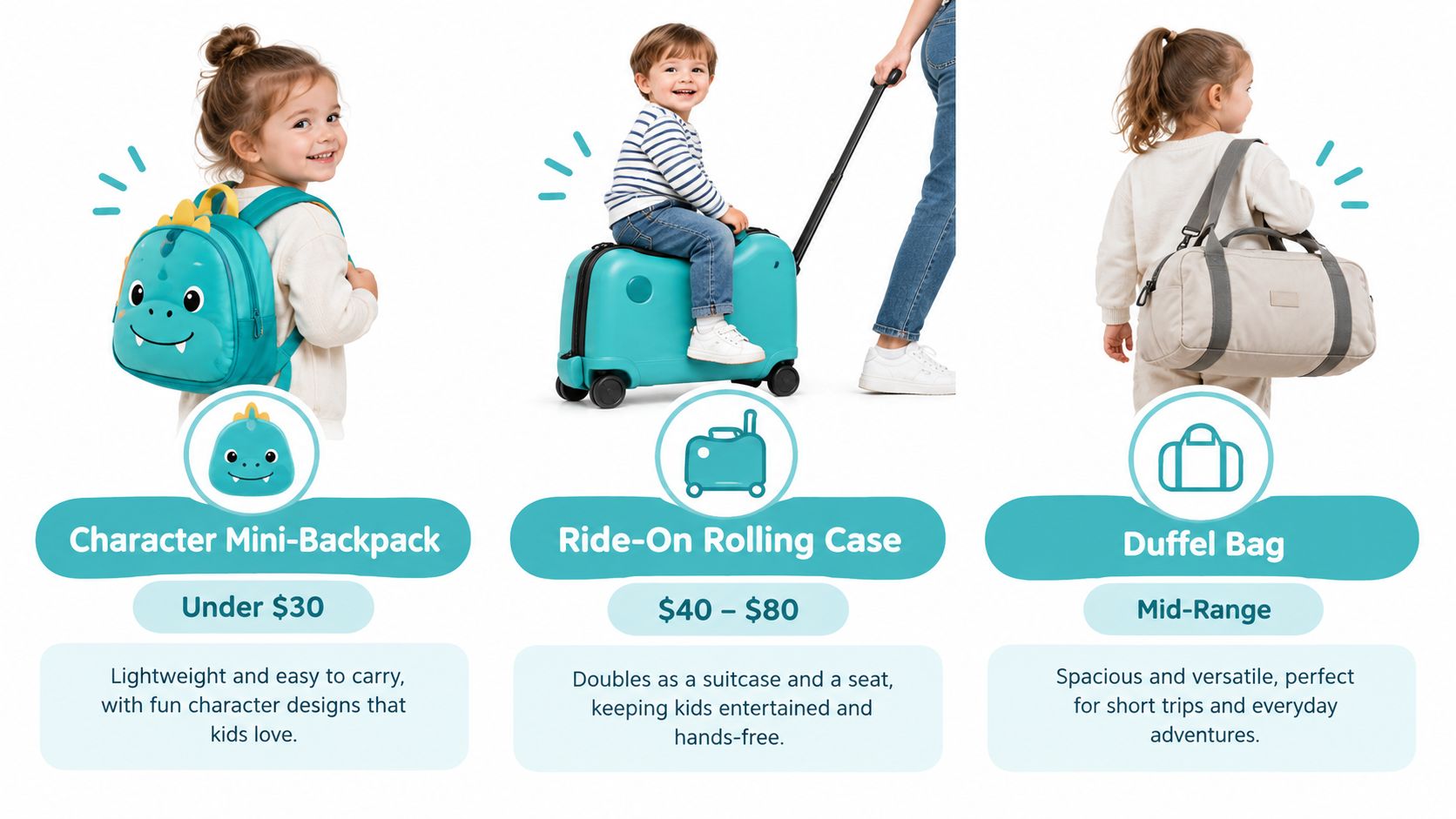
Families commonly choose among backpacks, rolling bags, and duffels. Each format solves a different travel problem.
Backpacks
Choose a backpack for day trips, preschool-style outings, and situations where keeping both hands free matters. It can leave your hands available for a stroller, car seat, or child, but long walks expose poor strap design quickly.
Character-themed mini-backpacks can be appealing to children, but novelty prints don't compensate for uncomfortable straps, weak zippers, or a shape that is difficult to organize.
Rolling bags
Rolling luggage works well across smooth airport terminals and hotel hallways. Ride-on designs can entertain a child while an adult pulls, but wheels can be less convenient on cobblestones, gravel, carpet transitions, and crowded boarding areas.
A rolling toddler travel bag also becomes awkward when you need to carry the child and the bag at the same time.
Duffels
A duffel suits road trips, overnights, and situations where an adult controls the entire load. It can hold clothing and snacks easily, although soft bags can be harder to organize when they lack structure.
Ask one question before buying: will this bag be carried, pulled, or repeatedly opened with one hand? The answer usually eliminates two of the three formats.
Key Features That Actually Matter
At the gate, the right toddler travel bag keeps a diaper change, drink, snack, and spare clothes within reach without becoming another awkward load. Judge every feature by one question: who carries the bag? A parent can manage more weight and structure. A toddler needs a lighter, better-fitting pack.
Capacity that matches the carrier
A child-carried bag should stay compact enough that it doesn't encourage unnecessary packing. Choose capacity based on what the child can comfortably carry rather than choosing the largest bag available.
For a parent-managed bag, prioritize a wide opening and stable shape. You should be able to remove clean clothes without pulling out toys and charging cables first. A structured design can also be easier to position under an airline seat or on a road-trip floor.
Organization that saves time
Choose features that support one-handed access:
- A wipeable lining around snack and drink storage.
- An exterior pocket for wipes, tissues, or other frequently used items.
- An insulated bottle sleeve that helps keep a drink upright.
- A child-accessible pocket for one approved snack or toy.
- Separate wet storage for accidents and damp clothing.
A useful layout keeps the diaper kit separate from snacks and limits the child's accessible pocket to a few items. Use this diaper bag packing guide to build the essentials list.
For soft materials, look for durable, easy-to-clean fabrics with reinforced seams that can handle everyday wear.
Safety hardware
Inspect buckles, zipper pulls, seams, and decorative attachments before buying. Skip bags with detachable small parts, sharp edges, or hardware that appears likely to come loose during ordinary use.
U.S. children's-product requirements can apply depending on how a product is designed, intended, marketed, and used. The CPSC defines a children's product generally as a consumer product designed or intended primarily for children 12 years of age or younger. Products subject to applicable children's-product safety rules may require third-party testing and certification.
Lead and phthalate requirements can also apply to certain children's products and components. However, not every toddler travel bag is automatically subject to every children's-product rule simply because a toddler may use it. Check the manufacturer's compliance information and the requirements applicable to that particular product.
ASTM F963 is the U.S. toy safety standard. It is not a luggage-specific standard, so an ordinary travel bag should not be presented as requiring ASTM F963 certification merely because it is marketed to children.
Comfort controls the real load
Padded, adjustable shoulder straps can improve comfort when properly fitted. A chest strap can help keep backpack straps from sliding outward when the backpack is designed with one.
A telescoping handle should lock securely, and rolling bags should track reasonably well without excessive wobbling. Smooth wheels do not make an overloaded bag appropriate for a toddler.
Flying With a Toddler Travel Bag
Air travel rewards compact organization, not maximum capacity. TSA does not establish one universal carry-on size for all airlines. Airlines set their own baggage dimensions and weight limits, so check the specific carrier's current cabin-bag rules before you buy.
Airline rules vary
| What to check | Why it matters for a toddler bag |
|---|---|
| Cabin size and weight limits | Airlines set their own carry-on and personal-item rules; they are not a single TSA standard. |
| Infant or child baggage allowances | Lap-infant and ticketed-child rules often differ by airline, fare, and route. |
| Strollers and car seats | Gate-check and free-item policies vary; confirm before you pack around them. |
Airline baggage rules can change by fare, route, and date. Always check the airline operating your flight before you travel.
Pack for security access
Per TSA, formula, breast milk, toddler drinks, and baby/toddler food, including puree pouches, are allowed in carry-on baggage in quantities greater than 3.4 ounces or 100 milliliters. These items do not need to fit within the usual quart-sized liquids bag. Inform the TSA officer at the start of screening; the items may be screened separately and may receive additional inspection.
Keep these items together in a clearly reachable compartment. Put wipes, snacks, and other frequently needed items in exterior pockets, and leave some space so you can repack quickly after screening.
Airport rule: If your airline permits the bag as an under-seat personal item, keeping it under the seat can make essentials easier to reach. But whether a particular bag qualifies depends on the airline, fare, aircraft, and available space.
For broader carry-on planning, compare airline-approved carry-on luggage.
Packing Lists for Every Trip Type
Pack by scenario, not by anxiety. A toddler travel bag works best when each item earns its space and the most urgent supplies stay visible.
Short day trip
Use a small backpack or parent-managed day bag:
- Diapering: Diapers or pull-ups, wipes, and hand sanitizer.
- Clothing: One complete change of clothes.
- Food: Two snacks and one refillable bottle.
- Comfort: One familiar toy or comfort object.
- Health: A small first-aid kit.
This list handles many of the problems most likely to derail a day without carrying an entire nursery. Keep one snack in a front pocket and reserve the comfort toy for moments when ordinary distraction fails.
Long road trip
A car trip needs repetition and mess control:
- Food and drink: A snack pack and refillable bottle.
- Clothing: Extra layers and additional changes of clothes.
- Entertainment: Books, simple toys, or a tablet with headphones.
- Comfort: A familiar blanket or comfort item.
- Cleanup: A small trash bag for crumbs and wrappers.
- Health: A compact first-aid kit.
The road-trip bag should stay within adult reach when practical rather than being buried in the trunk. Avoid packing every toy your child owns. Rotate a few options so each one remains interesting.
Overnight stay
Add sleep and hygiene items to the day-trip foundation:
- Sleep: Pajamas and a familiar sleep toy.
- Toiletries: Toothbrush and child-safe basics.
- Clothing: A fresh outfit and suitable footwear.
- Practical backup: A compact towel and a bag for dirty clothes.
Leave bulky items to the adult suitcase unless your toddler can comfortably carry them. For more ideas on selecting useful travel gear, see travel essentials for toddlers.
Safety and a Quick Decision Checklist
A toddler travel bag must survive drops, tugging, spills, and rushed airport handling without adding unnecessary hazards. Judge the construction, not the logo.
For products that qualify as children's products under applicable U.S. rules, look for appropriate compliance information and documentation. Depending on the product and applicable requirements, children's products can be subject to limits involving lead, phthalates, small parts, and other hazards, as well as third-party testing and certification.
Run this shopping check
- Inspect seams: Reject loose threads, skipped stitches, and weak points around handles.
- Test hardware: Open every zipper and buckle. Sharp edges or flimsy clips are reasons to choose another bag.
- Check the straps: Adjust them so the bag sits securely and comfortably. If the child leans forward, twists, or struggles to keep balance, reduce the load or have an adult carry it.
- Assess the wheels: Rolling bags should track reasonably well and resist excessive wobbling.
- Review the label: Look for clear manufacturer information and applicable compliance information rather than vague safety claims.
- Apply the weight rule: Include the empty bag when considering the child's total load.
- Consider the environment: A bag that works on smooth airport floors may be less practical on gravel, stairs, or uneven sidewalks.
The practical choice usually depends on who handles the bag. For flights, an adult-controlled bag can keep snacks, wipes, and spare clothes accessible through security and boarding. For road trips, keep essential supplies within practical adult reach. Let your toddler carry only a light personal load, then test the packed design at home before departure.
Disclosure
Hiccapop manufactures baby and toddler travel products, including an inflatable toddler travel bed and related travel gear. Hiccapop is the publisher of this article, so the article may include references to Hiccapop products. The information provided is educational and is not a substitute for current TSA, airline, CPSC, or individual product instructions.
Hiccapop offers baby and toddler gear, including an inflatable toddler travel bed with safety bumpers, an XL travel bag, and an electric turbo pump for portable sleep setups. Visit Hiccapop to review its travel-friendly products.