


Toddler Car Seat Safety Ratings Explained
The most popular car seat advice is also the most incomplete: buy the highest-rated toddler car seat you can find. A strong laboratory score matters, but it won't protect your child if the seat doesn't fit your vehicle, your toddler has outgrown it, or the harness is loose on the drive to preschool.
That's why the better question is simpler: Which seat can you install correctly, adjust correctly, and use consistently every time? Toddler car seat safety ratings are useful tools, but they work best when you understand what each rating measures and apply it to your real family routine.
The Hidden Flaw in Chasing Perfect Scores
A top-rated seat can perform impressively in a controlled crash test and still become a poor everyday choice if its installation instructions are confusing. A seat that requires repeated adjustments, unusual routing, or a difficult recline setup creates more opportunities for a tired caregiver to make a mistake.
That isn't a criticism of testing. It's a reminder that laboratory performance and human-factor performance are different things. The seat has to work in your actual vehicle, with your child buckled into it on an ordinary morning, not only in a test environment.
NHTSA's 2011 National Child Restraint Use Special Study estimated overall car seat and booster seat misuse at 46%, and the CDC notes that misuse can reach 59% when booster seats are excluded. Loose installation, loose harnesses, and incorrect recline positions can reduce the protection a highly rated seat is designed to provide.
Practical rule: An average seat installed correctly is a safer choice than a top-scoring seat installed incorrectly.
Look beyond the badge on the box. Read the manual before buying, check whether the seat fits your back seat, and consider whether another caregiver can repeat the installation without guesswork. Independent testing can help you compare products, as explained in this guide to independent product testing, but comparison should support your decision, not replace it.
The “best” toddler car seat is often the one that gives you a secure installation without a wrestling match. A clear manual, accessible belt path, useful recline indicators, and an easy-to-tighten harness may matter more to your daily safety than a small difference between two laboratory scores.
Decoding the Major Rating Organizations
The word rating doesn't always mean crash protection. Parents often see a number, star, or category and assume it describes how well a seat protects a child in a collision. Sometimes it only describes how easy the seat is to install.
Consumer Reports goes beyond federal compliance with an independent crash-test protocol using simulated 35-mph frontal impacts. It combines crash protection, vehicle fit, and ease of use into an overall score, and rates crash protection as Basic, Better, or Best to show which models provide a larger margin above FMVSS 213 minimum requirements. You can review its explanation of car seat safety testing for the methodology.
NHTSA's ease-of-use ratings measure something different. The agency explicitly says its scores evaluate installation and usage simplicity, not crash protection. That makes them valuable for identifying seats that may be less likely to be misused in your specific vehicle, but you shouldn't treat an ease-of-use score as a crash-test ranking.
Car seat rating sources at a glance
| Organization | What They Measure | Key Takeaway for Parents |
|---|---|---|
| Consumer Reports | Independent comparative crash testing, fit, and ease of use | Look for seats that provide more margin above the federal baseline |
| NHTSA | Installation and usage simplicity | Use the rating to judge how manageable the seat may be in your vehicle |
| IIHS | Research on restraint effectiveness and injury risk, not a consumer rating program | Use its research to understand restraint effectiveness and injury-risk patterns rather than to compare individual seat models |
All seats sold in the United States must meet the same federal baseline. That means a certification label confirms compliance with minimum requirements under FMVSS 213, but it doesn't create a complete ranking of every seat on the market.
When you encounter a product-specific review, separate crash performance, installation experience, child fit, and vehicle fit in your mind. For travel systems, judge the car seat separately from the stroller: confirm it meets FMVSS 213 and fits your child and vehicle.
Understanding Global Safety Standards and Side Impacts
U.S. and European standards don't organize car seat protection in exactly the same way. FMVSS 213 establishes the U.S. federal baseline, while Europe's ECE R129, commonly called i-Size, uses a more modern framework built around a child's standing height and additional crash scenarios.
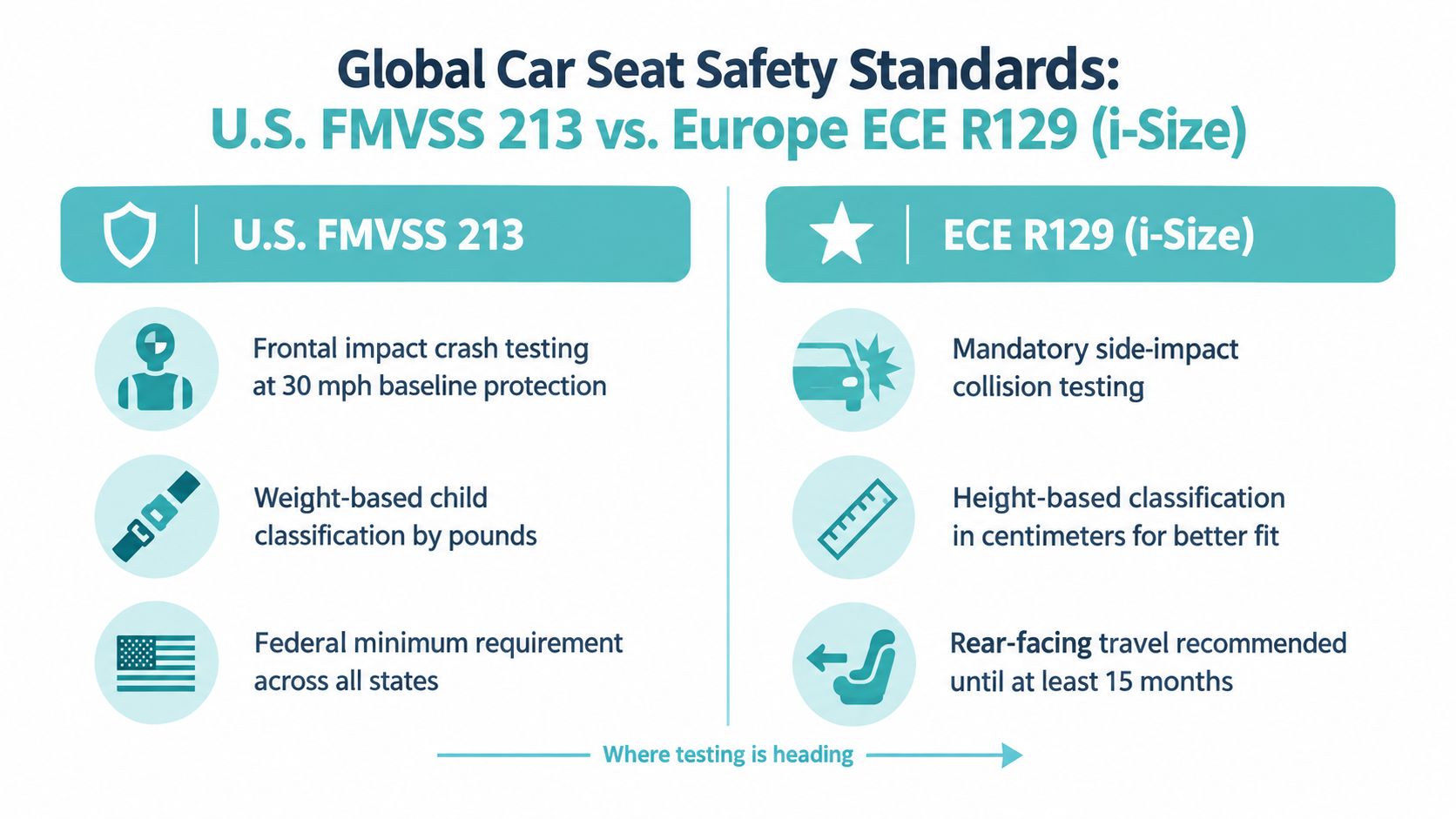
Under R129, children must travel rear-facing until at least 15 months, and the standard adds a specific side-impact test intended to improve head-and-neck protection. It also classifies seats by height rather than weight. The NHS guidance on choosing a baby car seat explains these core differences.
Height-based classification can make the selection process more intuitive. A toddler may fall within a weight range but still be too tall for the seat's shell or harness geometry. Checking standing height alongside the manufacturer's limits helps prevent that mismatch.
What i-Size doesn't mean
A seat approved under R129 isn't automatically safer in every vehicle or for every child. The regulation was introduced to run alongside the older R44/04 system rather than immediately replace it, though the EU stopped the sale of R44-approved seats in September 2024. Even so, i-Size seats still need a compatible vehicle seating position. The UNECE regulation material on i-Size compatibility explains that i-Size seats fit vehicles with i-Size approved seating positions and can also be installed in existing ISOFIX positions listed by the seat manufacturer.
The useful takeaway is practical, not promotional. R129 addresses side impacts, fit by stature, and reduced misuse risk through its test and installation framework. You still need to confirm that the seat suits your vehicle and that your child fits within the seat's current limits.
Matching the Rating to Your Child and Vehicle
A rating can't tell you whether a seat fits your toddler's body or your vehicle's back seat. Those checks come first.
Start with the child. Measure height, review the seat's stated height and weight limits, and check the harness position. Don't treat the upper limit as a target to stretch toward. If your toddler's head, shoulders, or harness position no longer meet the manual's requirements, the seat has been outgrown even if the marketing copy says it lasts for years.
Then check the vehicle. A seat may install securely in one vehicle and sit poorly in another because seat cushions, belt geometry, head restraints, and anchor locations differ. Use either the lower-anchor system or the vehicle seat belt exactly as the manuals describe, and verify whether the seat permits the installation method you plan to use.
NHTSA's ease-of-use ratings can help you assess installation and daily adjustment, but they don't measure crash protection. Read the agency's car seat ease-of-use rating guidance with that distinction in mind.
Make the rating personal
Ask yourself three questions:
- Does it fit my child now? Check the harness, shell, recline position, and stated limits.
- Does it fit my vehicle? Try the seat in the seating position where you intend to use it.
- Can I use it correctly? A babysitter, grandparent, or second parent should be able to follow the same instructions.
Families managing limited back-seat space can also compare practical layout considerations in this guide to car seats that fit three across.
Your Foolproof Installation and Safety Checklist
The manual is your starting point, not an accessory you toss into the recycling. Car seats and vehicles have different rules, so read both manuals before tightening a strap.
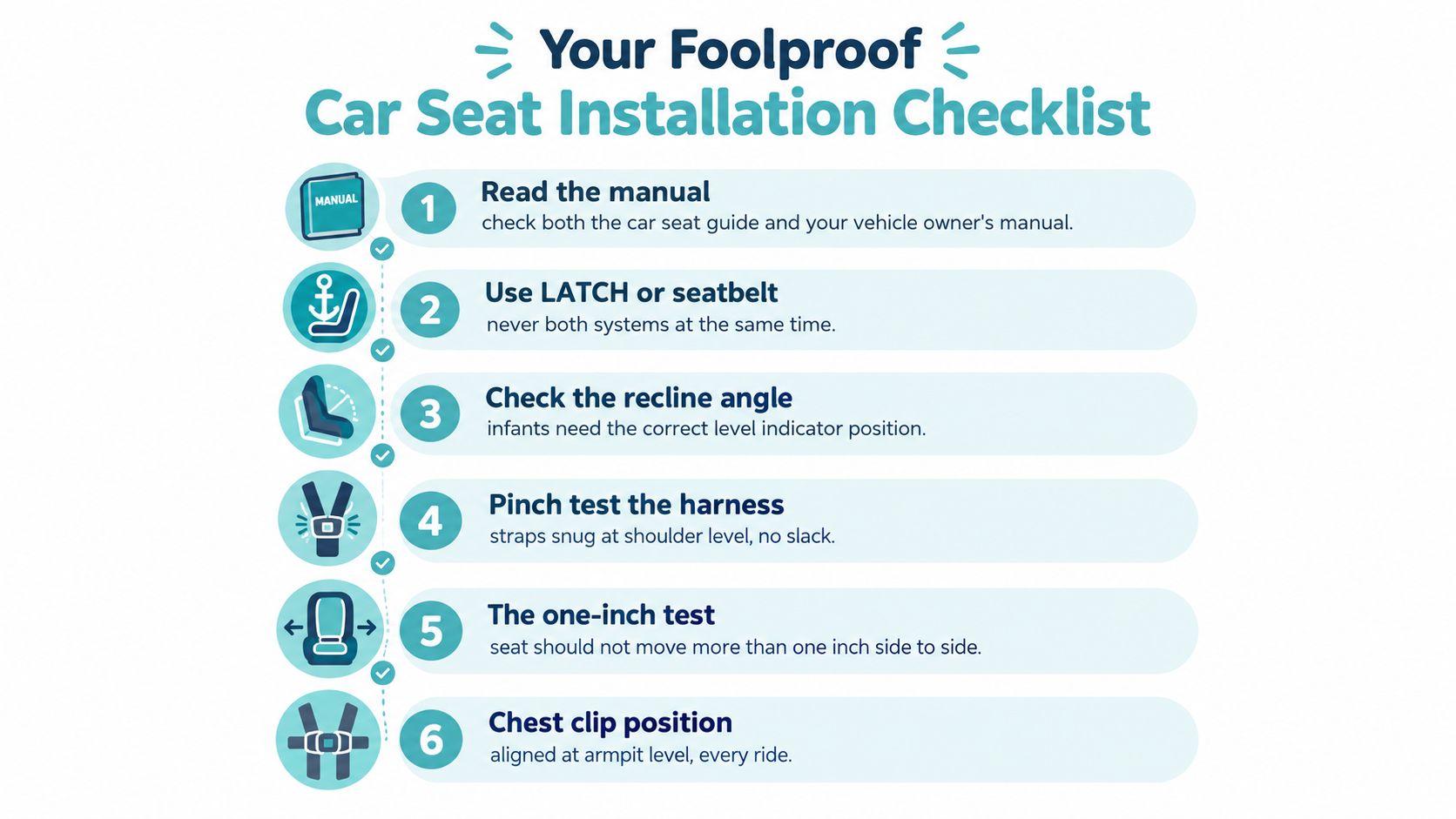
Use this driveway check before a trip:
- Read both manuals. Confirm the approved seating position, installation method, recline setting, and harness instructions.
- Choose one installation system. Use the lower anchors or the seat belt according to the instructions. Don't combine systems unless the manufacturer specifically allows it.
- Set the recline correctly. Match the indicator to the position required for your child's size and direction of travel.
- Tighten the harness. Remove slack at the hips and shoulders. The straps should lie flat and the chest clip should sit at armpit level.
- Check for movement. After installation, test the seat where the belt or lower anchors secure it. Excessive side-to-side or front-to-back movement means you need to review the installation.
- Recheck every ride. Bulky clothing, twisted straps, and a changed recline position can create a poor fit.
Forward-facing installations also require careful attention to the top tether when the seat manual and vehicle manual call for it. If you're uncertain, find a certified car-seat inspection through NHTSA rather than relying on a quick glance at the label.
Watch the installation demonstration below, then compare each step with your own manuals.
Navigating the Transitions from Rear to Forward Facing
Transitions should happen because your child has reached a seat's limit or can safely use the next restraint type, not because another child in the carpool has moved up.
Rear-facing travel lets the seat manage crash forces across the child's back, head, and neck. Keep your toddler rear-facing until the seat's rear-facing limits are reached and the manufacturer permits the next stage. A child's age alone doesn't tell you that the move is appropriate.
Forward-facing harness use comes next, with the harness adjusted to the child's body and the seat installed exactly as directed. AAA reported in 2025 that, according to the National Digital Car Seat Check Form (NDCF) database, nearly 81% of forward-facing seats checked by Child Passenger Safety Technicians weren't used correctly. The same AAA child passenger safety report found, from NDCF data, that nearly 23% of children moved to booster seats too soon and more than 89% transitioned to a seat belt too soon.
Readiness matters more than impatience
A booster doesn't restrain a child like a harness. It positions the vehicle belt so the belt can fit properly across the strong parts of the body, but the child must remain seated correctly for every ride. If your child leans, slouches, moves the belt behind the back, or can't stay positioned, a harnessed seat may still be the better choice.
IIHS, citing NHTSA research, reports that harness-based restraints reduce fatal injuries by 54% to 59% for children ages 1 to 4 compared with no restraint. That finding appears in the IIHS child restraint safety information. Staying harnessed longer, within the seat's limits, is a safety decision rather than a sign that your child is behind.
Verifying Your Setup with Certified Experts
A professional check can catch problems that aren't obvious from the driveway. A certified Child Passenger Safety Technician can review the seat's direction, recline, belt path, lower-anchor connection, tether use, and harness fit in your actual vehicle.
Bring the car seat, vehicle, and child if possible. Bring both manuals too. A useful appointment shouldn't feel like a test you can fail. It should leave you knowing what you did correctly, what needed adjustment, and how to repeat the installation after cleaning, travel, or a vehicle change.
A second set of trained eyes is a safety tool, not an admission that you've done something wrong.
Check the seat's recall status and registration information, and keep the manufacturer's instructions available. A highly rated seat still needs attention if parts change, instructions are updated, or the product reaches the end of its approved service life. For foundational guidance before choosing an infant or convertible seat, review these infant car seat safety guidelines.
The sticker is only the beginning. Your child's real protection comes from the right restraint, a correct fit, and an installation you can repeat without hesitation. If you have doubts, arrange a certified inspection and take the pressure off yourself.
Disclosure
Hiccapop makes the UberBoost booster seat mentioned at the end of this article.
Hiccapop offers practical baby and toddler products, including the UberBoost inflatable booster seat for kids who've outgrown their harnessed seat, which meets FMVSS 213 requirements for use in the United States. Visit Hiccapop to explore products designed to make everyday parenting routines more manageable.
Related Products
-
![Navy blue inflatable car booster seat and its blue travel bag, with a small photo of a boy using the seat.]()

- Regular price
- $39.99 - $41.99
- Sale price
- $39.99
- Regular price
-
$44.99 - Unit price
- per
Sold out


Related Products
-
![Navy blue inflatable car booster seat and its blue travel bag, with a small photo of a boy using the seat.]()
- Regular price
- $39.99 - $41.99
- Sale price
- $39.99
- Regular price
-
$44.99 - Unit price
- per
Sold out