


A Guide to Car Seats That Fit 3 Across
Trying to fit three car seats across your back seat is the ultimate parenting game of Tetris. If you’ve ever found yourself sweating in the back of your car, wrestling with buckles and belts, you are not alone. The struggle is real, and it often feels like you're trying to solve a puzzle with pieces that were never meant to fit together.
The 3-Across Car Seat Puzzle
Welcome to the big squeeze. You’ve got a growing family, a car you love, and three little passengers who need to ride safely. The problem? Most back seats weren't designed with a trio of car seats in mind. It’s a super common hurdle that leaves parents wondering if they have to trade in their sedan for a massive SUV just to get everyone buckled in.
At its core, the issue is simple math. The average car seat is between 17 and 22 inches wide, but the back seat of a typical midsize car only gives you about 50 to 57 inches of hip room to work with. Do the math: three standard seats could easily eat up over 51 inches, leaving you with zero wiggle room. This mismatch is exactly why manufacturers started creating "slim-fit" car seats, some as narrow as 16 inches, that don't compromise on safety. You can learn more about these baby car seat market trends if you want to dive deeper.
It’s About More Than Just the Numbers
But as any parent who’s tried this knows, it’s not just a numbers game. Even if your measurements seem to add up on paper, the real world throws a few curveballs your way. You're not working with a perfectly flat, square bench. You have to deal with:
- Contoured Vehicle Seats: Those comfy, bucket-style seats on the sides? They steal precious inches right where you need them most.
- Bulky Side-Impact Protection: The "wings" on modern car seats are fantastic for safety, but they often flare out and prevent the seats from nesting together neatly.
- Awkward Buckle Placement: Sometimes the seat belt stalks are located exactly where the edge of a car seat needs to sit, making it nearly impossible to get a secure installation or even click the buckle.
The goal isn't just to jam them in there. Each car seat needs to be installed independently and correctly, without relying on its neighbor for stability.
It's this combination of factors that turns a seemingly straightforward task into a logistical headache. So yes, your frustration is completely valid. Getting three car seats to fit is a genuine accomplishment! The good news? With the right information and a solid game plan, you can absolutely conquer this car seat conundrum.
Measure Twice, Buy Once: Your Vehicle's Blueprint
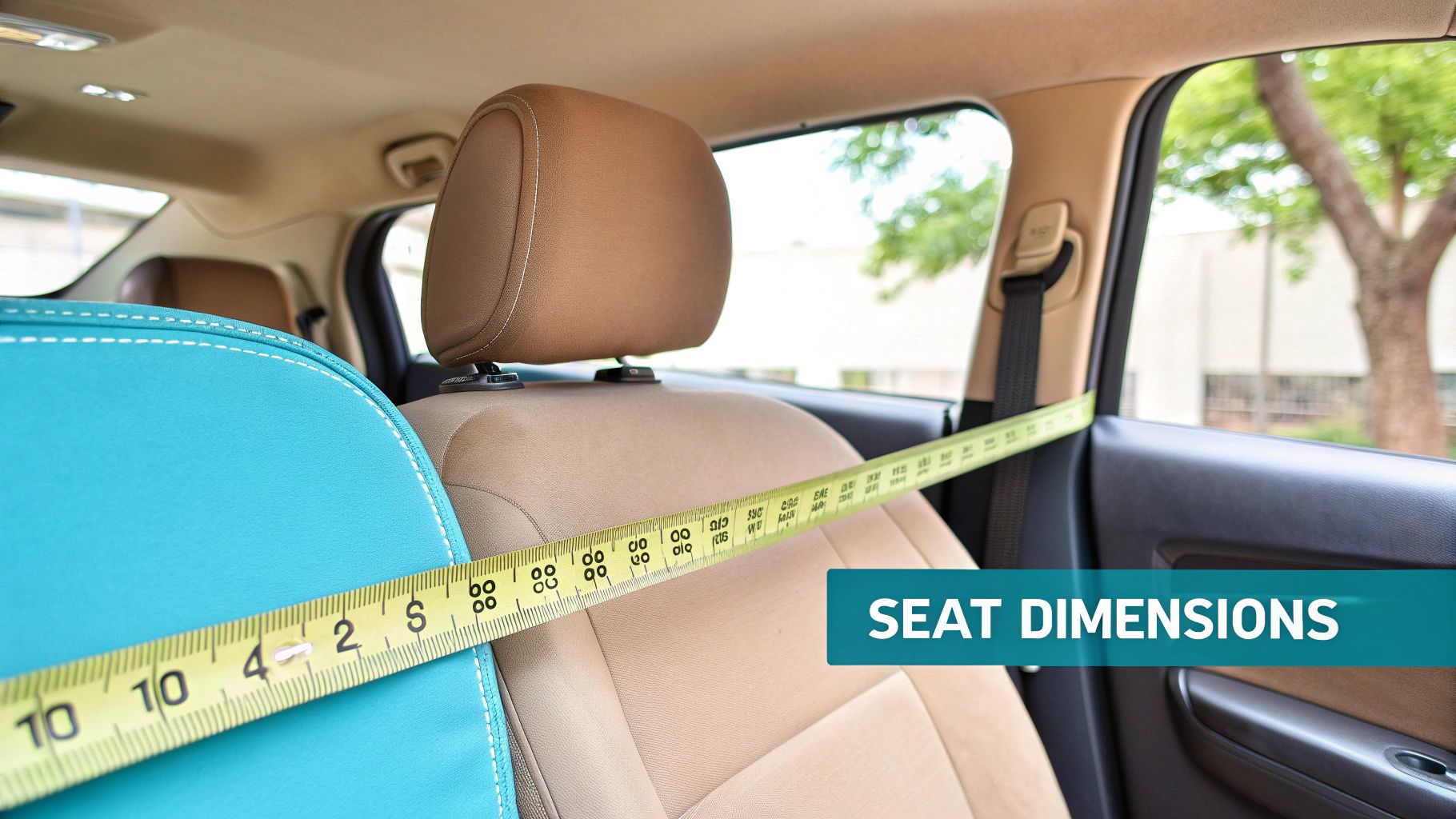
Before you even think about adding a car seat to your online cart, grab a measuring tape. Seriously. This simple tool is your secret weapon, turning the overwhelming task of finding car seats that fit 3 across from a wild guess into a confident, calculated decision.
Think of it as creating a blueprint for your vehicle's backseat. This isn't just about getting a rough idea; it's about drawing a precise map that will save you time, money, and the massive headache of returns.
Your first instinct might be to measure from one door panel to the other, but that number is a classic rookie mistake—it's totally misleading. What you actually need is the true usable seating width. This is the real-world hip room on the flattest part of the bench where a car seat can safely and securely sit. Ignore the armrests and the plastic trim; your focus is only on the cushion itself.
Mapping Your Backseat Terrain
Once you have that core measurement, it's time to get a little more detailed. Your blueprint needs to account for the unique landscape of your back row, because I can promise you it’s not a perfect, flat rectangle.
Start by locating your lower LATCH anchors and measuring the distance between them. Most cars only have two sets for the outer seats, which is critical information for your plan. Note their exact positions on your blueprint.
Next, hunt down all the seat belt buckles. Pay close attention to their stalks—the semi-rigid parts they're attached to. Are they long and floppy, or short and stiff? Their placement can completely interfere with a car seat's base, making a secure fit flat-out impossible. Mark these on your map, too.
Finally, keep an eye out for these common space-stealers:
- Bolstered Sides: Those raised, bucket-like cushions on the outer seats love to push car seats toward the middle, eating up precious inches.
- Center Hump: That bump on the floor in the middle position can tilt a car seat base, preventing a level installation.
- Cupholders: Some sneaky built-in cupholders can stop a car seat from sitting flush against the vehicle seat.
Measuring your vehicle's true capacity is the single most crucial step in solving the 3-across puzzle. An accurate blueprint eliminates all the guesswork and stops you from buying seats that simply will not fit, no matter how narrow they are.
Putting Your Blueprint to Use
With this detailed map in hand, you now have a realistic picture of the space you’re actually working with. This data is your superpower. It lets you shop smarter by comparing your car's real dimensions to the specs of potential car seats.
Understanding your vehicle's limits is everything. Of course, exploring larger options like 7-seater vehicles like the Lingzhi M5L can be a great solution for growing families, but for making your current car work, this blueprint is gold.
Now, let’s find the seats that will actually fit into your unique space.
Top Narrow Car Seats for 3-Across Setups
Alright, you've got your tape measure out, you know your car's "magic number," and now comes the fun part: finding the car seats that will actually fit. Shopping for these things can feel like a high-stakes game of Tetris, but knowing which models are famous for their slim profiles makes it so much easier.
This isn’t just a random list. It's a field guide to the top contenders in the narrow car seat world, the ones parents turn to again and again to solve that 3-across puzzle. We’ll break them down by type so you can find exactly what you need.
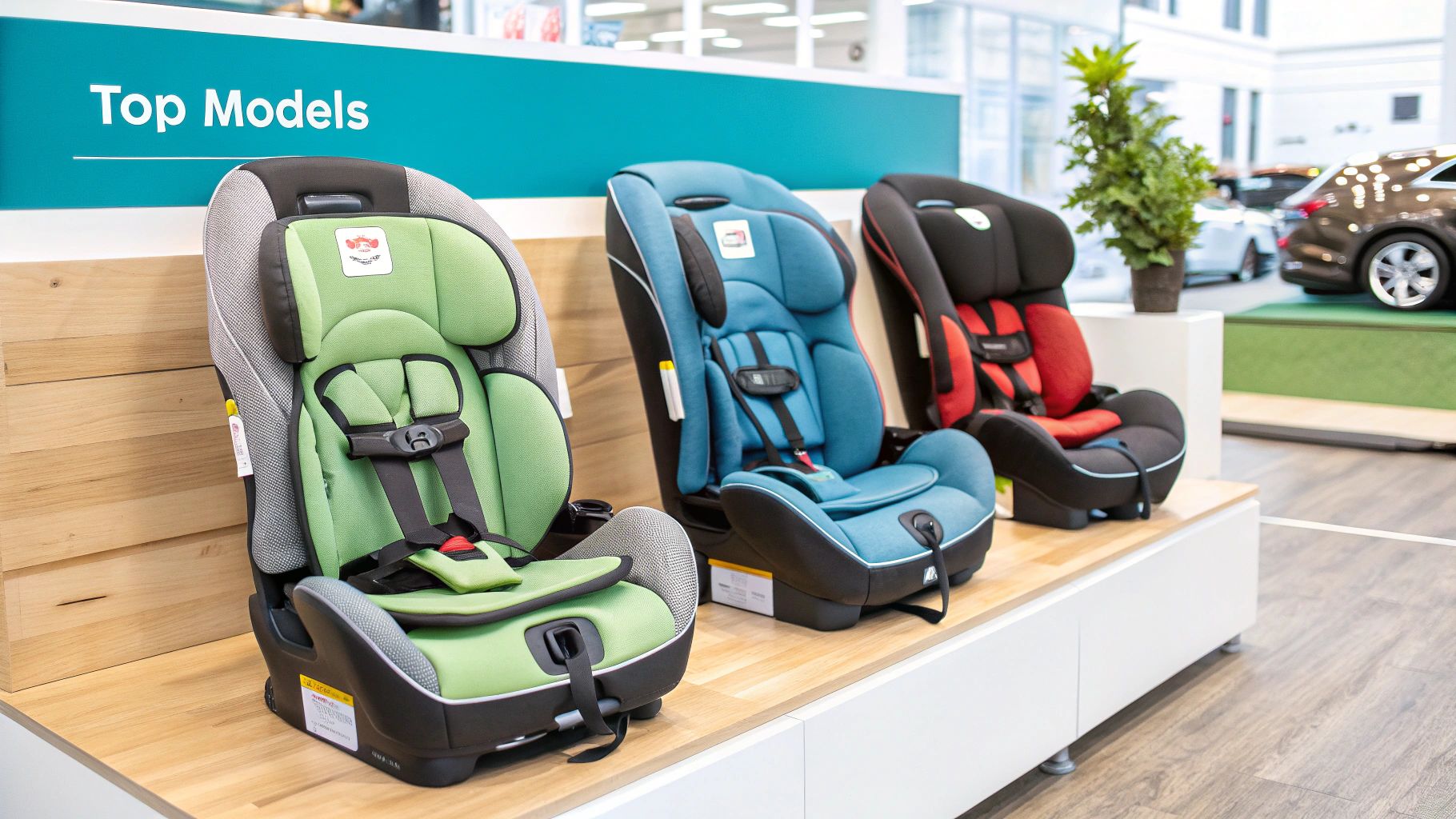
Infant and Convertible Car Seats
For your littlest passengers, a narrow seat is a non-negotiable part of the 3-across equation. While infant seats are only used for a short time, their width is critical when you're trying to wedge them between two bigger seats. Convertible seats, on the other hand, are a long-term investment, so picking a slim one pays off for years.
Here are a few popular models known for saving space:
- Chicco KeyFit 30/35: This is a fan favorite for good reason. Parents love how easy it is to install, and its base often measures around a tidy 17 inches wide.
- Diono Radian Series (3R, 3RX, 3RXT): These are the undisputed champs of narrow car seats. Built with a steel-core frame and an impressive 17-inch width, they were literally engineered for 3-across setups.
- Clek Foonf & Fllo: Known for their rock-solid safety features and rigid-LATCH installation, both the Foonf and Fllo come in at a slim 17 inches wide (and are often even narrower at the base).
When you're looking at convertible car seats, think about your family's lifestyle, too. If you travel a lot, some features might be more important than others. For more on that, check out our guide on choosing a convertible car seat for travel.
Here's a pro tip: The key to a successful 3-across setup is often mixing and matching. Sometimes, all you need is one super-slim convertible in the middle to make your two existing, wider seats fit perfectly on either side.
All-in-One and Booster Seats
Kids just keep growing, and their car seat needs change right along with them. All-in-one seats are the ultimate convenience, transitioning from a rear-facing harness to a forward-facing one, and finally to a high-back booster. For your bigger kids, a slim booster can be the final piece that keeps your 3-across dream alive.
These seats prove you don’t have to give up space for safety or longevity:
- Graco SlimFit3 LX / True3Fit LX: This seat lives up to its name. It’s designed to save precious inches without compromise, measuring just under 17 inches wide. It's a fantastic solution for fitting three kids of different ages in one row.
- Safety 1st Guide 65: An excellent budget-friendly pick, this convertible seat is specifically marketed as being able to "fit 3 across in the back seat of most vehicles." Can't get much clearer than that.
- Diono Everett NXT: When your child is ready to graduate to a booster, this high-back model is a slim, lightweight option that ensures your 3-across configuration can continue for years to come.
Narrow Car Seat Cheat Sheet
To make it even easier, here's a quick comparison of some of the best narrow car seats out there. Think of this as your cheat sheet for finding the models that give you the best shot at a perfect 3-across fit.
| Car Seat Model | Type (Infant, Convertible, etc.) | Width (Inches) | Key Features |
|---|---|---|---|
| Diono Radian 3R Series | All-in-One Convertible | 17 | Steel alloy frame, foldable for travel, renowned for 3-across setups. |
| Clek Foonf/Fllo | Convertible | 17 | Advanced safety features, rigid-LATCH install, anti-rebound bar. |
| Graco SlimFit3 LX | All-in-One | 16.7 | 3-in-1 design from rear-facing to booster, space-saving cup holders. |
| Chicco KeyFit 30/35 | Infant | ~17 | User-friendly installation, compatible with many strollers. |
| Safety 1st Guide 65 | Convertible | 18.5 | Budget-friendly, compact design ideal for smaller vehicles. |
| Diono Everett NXT | High-Back Booster | 18.5 | Lightweight, easy to move between cars, slim profile for older kids. |
Remember, these widths are a great starting point, but always double-check the specs for the exact model year you're buying. Sometimes, the perfect fit comes down to that extra half-inch.
Mastering the 3-Across Installation
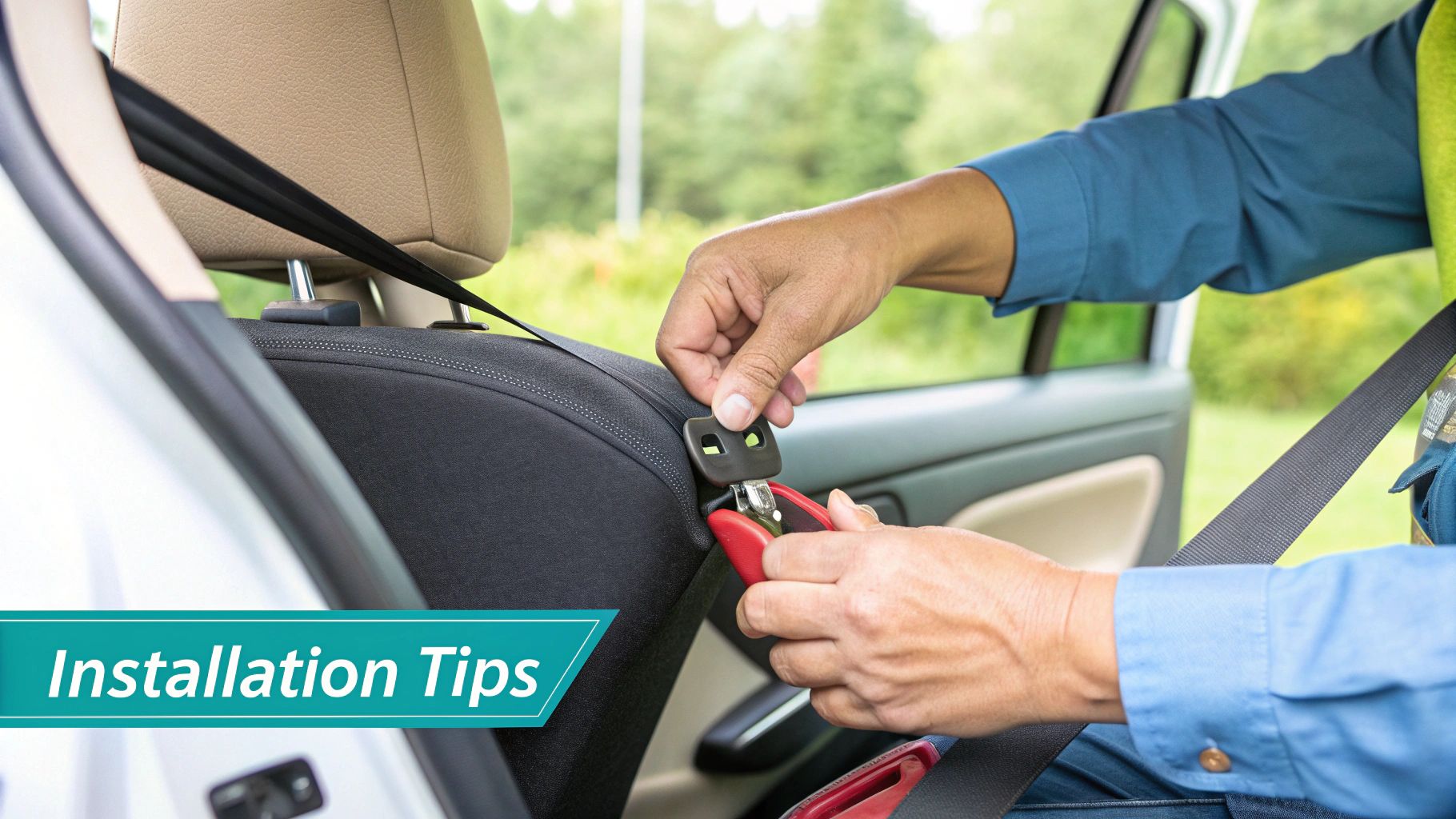
Having the right narrow car seats is a huge win, but it’s only half the battle. Now comes the real-world puzzle of installation, where a safe, secure fit is absolutely non-negotiable. This is where your patience and strategy will pay off big time.
Think of it less like brute force and more like a delicate art form. Each seat needs to be installed as an independent unit, rock-solid and secure on its own. They can touch and press against each other, but they should never rely on their neighbor for stability.
Start in the Middle
When tackling a 3-across setup, a great rule of thumb is to install the center seat first. This position is often the trickiest due to a floor hump or limited access, so conquering it early sets a stable anchor point for the other two seats.
Once the middle seat is locked in tight, you can work your way outward, installing the passenger-side and driver-side seats. This method prevents the outer seats from gradually squeezing the middle one out of a proper fit.
LATCH vs. Seat Belt Installation
While the LATCH (Lower Anchors and Tethers for Children) system is convenient, it might not be your best friend for a 3-across installation. Most vehicles only have LATCH anchors for the two outer seats, and their fixed positions can limit your flexibility.
Using the vehicle’s seat belts for all three installations often provides the wiggle room needed to slide seats closer to the doors, freeing up precious inches in the middle.
This approach gives you more control over the exact placement of each seat, which is crucial for making everything fit snugly. Just be sure to read your car seat manual for proper seat belt installation instructions, as it can be a bit more involved. You can also review general product use instructions for tips on securing various baby gear.
The Art of Puzzling and Final Checks
Sometimes the key is simply arranging the seats in the right order. This is the fun part we call "puzzling."
- Alternate Directions: Try arranging your seats forward-facing, rear-facing, and forward-facing. The different shapes often nestle together like perfect puzzle pieces.
- Watch for Buckle Crunch: Ensure the plastic shell of one car seat isn’t resting on top of a seat belt buckle needed for another. This is unsafe and can prevent a secure latch.
- Remove Cupholders: Many narrow car seats come with removable cupholders. Taking them off can instantly gain you an extra inch or two.
After everything is in, perform the one-inch test on each seat individually. Grab the seat at the belt path and give it a firm tug—it shouldn't move more than one inch in any direction. If you remove one seat and the others become loose, it’s a sign they weren't installed independently and you need to start over.
Having the right vehicle and seats makes this much easier. In fact, a 2014 study by the Insurance Institute for Highway Safety (IIHS) found that in cars where it's possible to fit three seats across, the probability of correct installation increases significantly.
Why Narrow Car Seats Are a Growing Global Trend
If you're currently wrestling with the car seat puzzle—trying to make three fit where it seems only two belong—you're not alone. Far from it. That feeling of frustration isn't just your personal headache; it's a huge global trend that's forcing the entire baby gear industry to adapt.
Your search for car seats that fit 3 across is part of a much bigger story. Family dynamics are changing everywhere. It's not necessarily that families are getting bigger, but more parents are choosing to stick with their current cars as their family grows. For many, automatically trading up to a massive minivan or three-row SUV just isn't in the budget—or the game plan.
The Market Responds to Modern Families
This shift has created a real-world clash. On one side, you have modern vehicle designs that aren't getting much wider. On the other, you have car seat safety standards that have led to bulkier seats with beefed-up side-impact protection. Something had to give.
Parents made it clear they needed a better solution—safer, slimmer car seats that didn't require buying a whole new car. And the manufacturers listened. The result has been an explosion of innovation, with brands racing to engineer slim-profile seats that pack maximum safety into a minimal footprint.
This isn't just some niche trend. The baby car seat market is booming to meet this exact demand. The U.S. market alone was valued at USD 1.22 billion in 2023 and is on track to hit nearly USD 2.21 billion by 2031. A huge part of that growth comes from parents who need smarter options, especially since about 34% of vehicles sold in North America are mid-sized or large SUVs where a 3-across setup is a realistic goal. You can dig deeper into these baby car seat market trends for more insights.
Your Problem Is an Industry Driver
Your search for a workable 3-across solution is a powerful signal to the industry. It tells manufacturers that adaptability, efficiency, and smart design are just as important as crash-test ratings.
So, as you’re out there with a tape measure, comparing seat widths and checking angles, remember this: you’re not just solving a logistical puzzle for your own family. You're part of a massive consumer movement that's reshaping the future of family products for the better.
Every parent who digs in their heels and refuses to accept "you just need a bigger car" is pushing the industry to create smarter, safer, and more innovative solutions for everyone.
Conquering the 3-Across Challenge
Finding the right car seats that fit 3 across can feel like a daunting quest, but it is absolutely achievable. By arming yourself with a tape measure, understanding your vehicle's unique layout, and choosing the right slim-fit seats, you can create a safe and secure setup for your growing family—without having to buy a new car.
Remember these key takeaways:
- Measure First: Your car's true usable width is your most important number.
- Choose Wisely: Opt for car seats known for their narrow profiles, like those from Diono, Clek, or Graco's SlimFit line.
- Install Smart: Start with the center seat and use the seat belt installation method for maximum flexibility.
- Check Your Work: Each seat must be independently secure and pass the one-inch test.
The perfect 3-across configuration is out there. It might take a little trial and error, but with the right strategy, you'll solve the puzzle and be ready to hit the road with confidence.
Have you successfully installed three car seats across? Share your winning combination of car and car seats in the comments below to help other parents in the same boat! And for more on making your gear work for you, don't forget to check out our guide on traveling with car seats.