


Schedule for Newborn: A Calm, Practical Guide for Tired Parents
Throw out any idea of a rigid, clock-based schedule for your newborn. Seriously. Trying to force a tiny human onto a strict timetable is a one-way ticket to Frustration-ville for everyone involved. A "schedule" in these early days is really about finding a flexible, predictable rhythm that works for your baby.
The secret isn't in watching the clock, but in learning to read your baby's unique cues for eating, sleeping, and just being awake. This guide will help you decode their language, find a gentle flow, and keep your sanity intact.
What a Newborn Schedule Really Means (Hint: It’s Not About the Clock)
If you're staring at your brand-new baby and wondering how on earth you'll ever get them on a schedule, just take a deep breath. A schedule for newborn babies isn't about numbers on a clock—it’s about creating a gentle, predictable flow to your days and nights.
Think of it less like a strict itinerary and more like a dance. Your baby leads, and you learn to follow their cues. It all boils down to three simple ideas: hunger cues, sleepy cues, and wake windows. Getting a feel for these will do more for your sanity than any color-coded chart ever could. You're learning to work with your baby's natural instincts, not against them.
Decoding Your Baby’s Hunger Cues
Long before that first desperate wail, your baby has been trying to tell you they're getting hungry. Responding to those early signals—often called feeding on demand—makes life so much easier. Crying is actually a late sign of hunger, so if you can catch the cues before then, feedings will be calmer and more successful for both of you.
Keep an eye out for these subtle hints:
- Rooting: You'll see them turn their head and open their mouth, searching for a breast or bottle. This is especially obvious if you gently stroke their cheek. It’s their “food over here?” radar.
- Hand-to-Mouth Action: They might start sucking on their tiny fists or bringing their hands up to their face.
- Lip Smacking: You might hear little sucking sounds or see them puckering their lips. It's their "I'm ready for my meal" signal.
When you respond to these early nudges, you're not just feeding them; you're building a deep sense of security and trust.
At birth, a newborn's stomach is incredibly tiny—about the size of a cherry. That's why they need to eat so often, usually every 1-3 hours. Following their cues is the best way to make sure they get the constant nutrition they need for all that rapid growing.
Understanding Wake Windows
This one is a game-changer. The wake window is simply the amount of time your baby can happily be awake between naps before they turn into a fussy, overtired mess. For a brand-new baby (0-4 weeks), this window is shockingly short—often just 45 to 60 minutes.
And yes, that 45-minute window includes the entire feeding, a diaper change, and any "playtime," which at this age is really just cuddling and looking at your face. If you miss that sweet spot, your baby can get overstimulated and overtired in a flash. The cruel irony? An overtired baby often fights sleep even harder.
Think of an overtired baby's body getting a jolt of cortisol, a stress hormone that acts like a shot of adrenaline. It's a little engine that just can't shut off. By keeping an eye on the clock and their sleepy cues, you can get them winding down for a nap before that happens.
Recognizing When Your Newborn is Sleepy
Just like with hunger, babies send out signals that their battery is running low long before they start melting down. Learning to spot these sleepy cues is your ticket to getting them down for a nap peacefully, without the battle.
Early sleepy cues can be very subtle:
- They might get a "faraway" or zoned-out look in their eyes.
- They'll often become quieter and still.
- They might suddenly lose interest in you or a toy.
- You might notice a little redness around their eyebrows.
As they get more tired, you'll see the more obvious signs, like yawning, rubbing their eyes, or getting fussy. The trick is to start your little nap routine as soon as you spot those first, quiet signs. It makes sleep feel like a natural, peaceful transition instead of something to fight against.
Navigating the First Month With Your Newborn: The Fourth Trimester
Welcome to the fourth trimester! Those first four weeks with your newborn are an absolute whirlwind of snuggles, diaper changes, and round-the-clock feedings that all seem to blur into one long, beautiful, and exhausting day. If you're trying to impose a strict schedule for a newborn right now, I'll save you the trouble: it's like trying to catch mist in your hands. It’s pointless and will only leave you frustrated.
Your only goal right now should be to find a gentle rhythm. This is a period of pure survival and bonding, powered by an astonishing amount of caffeine and an even more overwhelming amount of love. My best advice? Forget the clock. Your baby is your only guide for now.
The day-to-day is really just a simple, repeating cycle: your baby shows a feeding cue, has a short window of awake time, and then shows sleepy cues that it's time to rest again.
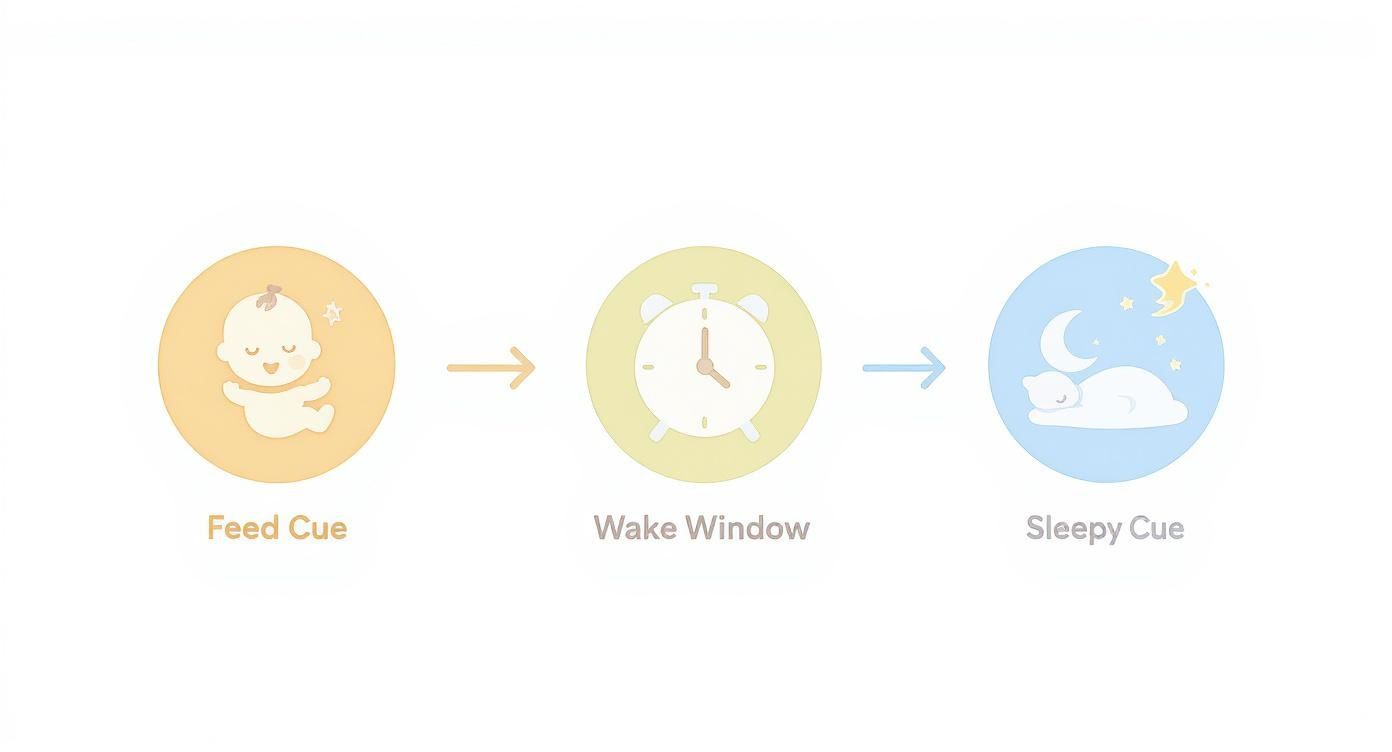
Think of this less as a schedule and more as a predictable pattern. Once you learn to spot the cues, you'll be able to anticipate what your baby needs next, which is a huge win in these early days.
What to Realistically Expect
In these first few weeks, your baby’s stomach is impossibly tiny—about the size of a cherry. This means they get full fast but also get hungry again just as quickly. You can expect to feed your baby every 2-3 hours, all day and all night. Yes, that includes 3 AM.
Their wake windows are also incredibly brief, lasting only about 45-60 minutes at a time. And get this: that tiny sliver of awake time includes the entire feeding, a diaper change, and maybe a few minutes of quiet cuddling before they're already tired and ready for another nap.
Parent Tip: Please don't stress if your baby's "playtime" consists of them just staring blankly at the ceiling fan while you hold them. At this age, simply being held, feeling your warmth, and hearing your voice is all the stimulation they need. You are their whole world.
The Challenge of Day-Night Confusion
It's one of the classic newborn challenges: many babies arrive with their days and nights completely backward. They might be sleepy and calm all day, only to become a wide-eyed party animal at 2 AM. This is perfectly normal. Their internal clock, or circadian rhythm, just hasn't developed yet.
You can gently help them sort it out.
-
During the day: Keep the house bright and filled with normal sounds. Open the curtains, let the sunlight in, and don’t tiptoe around. Engage with your baby during their short wake windows. This is also a great time to discover the benefits of taking your newborn outside for some fresh air and natural light.
-
At night: Create the opposite environment: dark, quiet, and frankly, boring. Use a dim night light for changes and feedings, keep your voice low, and avoid any stimulating interaction. The message you're sending is, "Nighttime is for sleeping."
This simple contrast helps their brain start to connect light with being awake and active, and darkness with rest.
A Sample Daily Flow for Newborns (0-4 Weeks)
Remember, the goal here is a flexible flow, not a rigid schedule set by the clock. The day is built around a simple, repeating eat-wake-sleep cycle. Below is a realistic look at what you can expect from each part of that cycle.
| Cycle Element | What to Expect | Helpful Parent Tips |
|---|---|---|
| Feeding | Feed on demand, which works out to roughly every 2–3 hours. Newborns can take 20-45 minutes per feeding. | To encourage a full feeding, try tickling their feet or even unswaddling them if they get too sleepy. A full tummy often leads to a better nap. |
| Wake Time | This window is very short—only 45-60 minutes, and that includes the entire feeding time! | Keep activities simple. Cuddling, talking, or a quick diaper change is more than enough. It's easy to overstimulate a new baby. |
| Nap Time | Naps are unpredictable. They can last anywhere from 20 minutes to 2 hours. Short naps are completely normal at this age. | Don't be afraid of contact naps! A well-rested baby is the goal, however you can get there. Swaddles are also great for mimicking the womb. |
This cycle will repeat all day and night. Just when you finish one, you're getting ready to start the next. It's a marathon, not a sprint.
The Infamous Cluster Feeding
Just when you think you might be getting the hang of a rhythm, your baby will likely throw you a curveball: cluster feeding. This is when they want to nurse or take a bottle almost constantly for several hours, usually in the evening.
I know it can feel absolutely draining, and it's easy to worry that your milk supply is low. But this is a completely normal—and temporary—behavior. It's your baby's way of stocking up on calories for a growth spurt and, fingers crossed, giving you a slightly longer stretch of sleep.
The best way to get through it? Surrender. Set up a comfortable nest on the couch with snacks, a big bottle of water, and the TV remote. This phase will pass.
Finding Your Groove From Two to Four Months
Just when you’re getting used to the newborn fog, something incredible happens. Your baby starts to notice the world around them, and their once-chaotic patterns begin to make a little more sense. This is the two-to-four-month sweet spot—a time when you’ll move from pure survival mode toward a more consistent, yet still wonderfully flexible, schedule for your newborn.
During this stage, your baby’s little world is expanding. They're eating more efficiently, staying awake for longer stretches, and (hallelujah) sleeping for more consolidated periods. It’s an exciting time where a predictable daily rhythm finally starts to emerge from the chaos.
Longer Wake Windows and More Playtime
One of the biggest changes you'll see is that your baby's wake windows are starting to stretch. That fleeting 45-60 minute window from the early weeks will gradually lengthen to a much more manageable 60-90 minutes.
This extra awake time is a total game-changer. Suddenly, there’s time for genuine interaction beyond the feed-burp-change cycle. "Playtime" becomes a real thing, filled with more than just staring into your eyes (though that’s still a five-star activity for them).
You can start bringing in simple, engaging activities like:
- Tummy Time: A few minutes here and there throughout the day is perfect for building that crucial neck and core strength.
- Reading a Book: Their developing eyes love the bold patterns in high-contrast board books.
- Singing Songs: Your baby is your biggest fan—they absolutely love the sound of your voice, even if you think you’re off-key.
- Looking in a Mirror: A baby-safe mirror can be endlessly fascinating for a little one discovering their own reflection.
While this extra awake time is fantastic, it's still so important to watch for their sleepy cues. To get a better handle on how these windows evolve, our complete guide on wake windows by age breaks it all down month by month.
Consolidating Nighttime Sleep
And now for the news every exhausted parent has been waiting for: this is often when nighttime sleep starts to get longer. While your baby will almost certainly still need one or two night feeds, you might start seeing glorious stretches of 4, 5, or even 6 hours of sleep at a time. It feels like you’ve won the lottery.
This little miracle happens because their sleep cycles are maturing and their tummies can finally hold more milk, keeping them full and content for longer. This is the perfect time to double down on a consistent, calming bedtime routine. A warm bath, a final big feed in a dimly lit room, a cozy swaddle, and a lullaby can work wonders in signaling that it’s time for a long rest.
Updated Sample Routine for 2-4 Months
Every baby writes their own rulebook, of course, but a typical day during this period might start to look a bit more structured. The eat-wake-sleep cycle is still your North Star, but each part of that cycle is getting longer.
Here’s a glimpse of what a day could look like:
| Time | Activity | What's Happening |
|---|---|---|
| 7:00 AM | Wake & Feed | Greet the day with a full feeding and some morning cuddles. |
| 7:30 AM | Wake Window | Time to play! Think tummy time, a play gym, or reading a story. |
| 8:30 AM | Nap 1 | The first nap of the day, which is often the easiest to nail. Can last 1-2 hours. |
| 10:30 AM | Wake & Feed | Another full feeding to power the next cycle. |
| 11:00 AM | Wake Window | Maybe a walk outside, singing some songs, or enjoying floor time. |
| 12:30 PM | Nap 2 | The midday nap. These can still be unpredictable—some are long, some are short. |
| 2:00 PM | Wake & Feed | Time for another meal and some one-on-one interaction. |
| 2:30 PM | Wake Window | More playtime. This is a great time for baby-wearing around the house. |
| 4:00 PM | Nap 3 | This late-afternoon nap is often a short "catnap" to get them to bedtime without being overtired. |
| 5:00 PM | Wake & Feed | The "witching hour" might still be a thing; evening cluster feeding is common. |
| 6:30 PM | Start Bedtime Routine | Dim the lights, run a warm bath, and get into comfy PJs. |
| 7:00 PM | Final Feed & Bedtime | A last, full feeding in a quiet, dark room before laying them down for the night. |
This is a guide, not gospel. Your baby might take four naps one day and three the next. The real goal is to follow their cues within these new, longer windows.
Navigating Growth Spurts and Developmental Leaps
Just when you feel like you've cracked the code, a growth spurt or developmental leap arrives to shake things up. Out of nowhere, your baby might seem ravenously hungry, start waking up more at night, or fight naps like a tiny, sleep-deprived gladiator.
Don't panic—this is completely normal. These intense periods of growth demand a ton of energy, which means more food and, often, temporarily haywire sleep. The best strategy is to just roll with it. Offer extra feedings, give more cuddles, and don’t feel guilty about relying on contact naps for a few days to get them the rest they need. Be patient with your baby and yourself. Your rhythm will come back.
Essential Tools and Safe Sleep Guidelines
As you start to figure out your newborn's natural rhythm, having the right tools and a solid understanding of safe sleep practices is everything. While you’re busy tracking feeds and naps to decode their unique patterns, nothing is more important than creating a secure space for them to rest and grow.
Tracking Tools: Tech vs. Tradition
When it comes to logging your baby's every move—feeds, sleeps, diaper changes—you've got a couple of choices: go digital with an app or keep it old-school with a notebook. Honestly, there's no right or wrong answer here. It’s all about what makes your life easier.
- Baby-Tracking Apps: These can be a lifesaver for exhausted parents. They give you easy-to-read charts, sync between phones (perfect for you and your partner), and can even send you reminders. The only catch? It's one more reason to be glued to your phone when you could be soaking in those newborn snuggles.
- A Simple Notebook: Never underestimate the power of pen and paper. It’s simple, it never runs out of battery, and it can become a really sweet keepsake to look back on. The main downside is that it’s not as easy to share updates with other caregivers in real-time.
No matter which way you go, just be consistent. Tracking is what helps you spot those emerging patterns and gives you solid data to share with your pediatrician.
The ABCs of Safe Sleep
While newborn routines are meant to be flexible, safe sleep practices are not. The American Academy of Pediatrics (AAP) has clear, life-saving guidelines to reduce the risk of Sudden Infant Death Syndrome (SIDS). The easiest way to remember the rules is with the ABCs of Safe Sleep.
Alone: Your baby needs their own separate sleep space, like a crib or bassinet. No bed-sharing with parents, siblings, or pets.
Back: Always, always place your baby on their back for every single sleep—naps and nighttime. If they can roll over on their own, you don't have to reposition them.
Crib: Use a crib, bassinet, or play yard that has a firm, flat mattress and a fitted sheet. The sleep space should be completely bare. That means no blankets, no pillows, no bumpers, and no soft toys.
These guidelines are the non-negotiable foundation for keeping your baby safe while they sleep. Part of that safe environment also involves choosing a breathable crib mattress.
Connecting Your Routine to Your Baby's Health
Your newborn's daily rhythm is directly connected to their overall health. By tracking their habits, you gain critical insight into both their immediate needs and their long-term well-being.
One of the most important things you’ll be tracking is diaper output. It's the simplest and most reliable way to know if your baby is getting enough to eat. In those first few weeks, you're looking for at least 5-6 wet diapers and 3-4 dirty diapers every 24 hours.
Keeping up with vaccinations is another pillar of your baby's health. Your pediatrician will provide a recommended schedule, which is vital for protecting your little one from serious diseases. The World Health Organization (WHO) provides global data on this effort, noting that immunization averts an estimated 4-5 million deaths every year. You can explore more about global immunization coverage and see the incredible progress being made.
Got Questions About Your Newborn's Schedule? We've Got Answers
Even with a plan, you're bound to have questions. You're navigating a brand-new world with your baby, and it’s completely normal to look for a little extra reassurance along the way.
Let’s dive into some of the most common questions I hear from parents trying to find a gentle rhythm with their newborn.
When Can I Really Start a Schedule for My Newborn?
The honest answer? You don't. At least, not the rigid, by-the-clock schedule you might be picturing. Trying to force that kind of structure on a brand-new baby isn't just unrealistic—it can actually work against you in those critical early weeks.
For the first 6-8 weeks, your one and only job is to follow your baby’s lead. This means establishing a flexible rhythm guided entirely by their hunger and sleep cues. Responding to their needs on-demand is essential for building a healthy milk supply (if you're breastfeeding) and ensuring they get the constant nutrition they need to grow. It also builds a powerful foundation of trust and security.
You’ll start to see more predictable patterns emerge all on their own around the 2–3 month mark. That's your cue. It’s the perfect time to begin introducing a more structured—but still very flexible—routine.
What Exactly Is a Wake Window?
Think of a wake window as your secret weapon against an overtired, fussy baby. It's simply the total amount of time your newborn can comfortably stay awake between naps before their little system gets completely overwhelmed.
For a brand-new baby (0-4 weeks), this window is incredibly short—often just 45–60 minutes. This includes feeding time, a diaper change, and a few cuddles. As they grow, this window gradually gets longer. The key is to watch for their sleepy cues before the window slams shut. This lets you start your wind-down routine and get them to their next nap peacefully.
Should I Wake My Sleeping Newborn to Eat?
In the very beginning, the answer is almost always yes. Most pediatricians recommend waking a newborn for a feeding every 2–3 hours during the day and at least every 4 hours at night.
This is especially important until your baby has regained their birth weight. Those frequent feedings are crucial for keeping them hydrated and making sure they get enough calories to thrive.
Once your doctor gives you the green light at a weight check-up, you can finally start letting your baby sleep in longer stretches at night. Always follow your pediatrician's specific advice on this one.
How Can I Help My Newborn Sleep Longer at Night?
First, take a deep breath. Frequent waking is biologically normal and absolutely necessary for newborns. That said, there are things you can do to gently encourage longer stretches of sleep over time. Many parents ask about the role of pacifiers in a newborn's routine, and it's worth exploring all the tools at your disposal, including learning about when to introduce a pacifier.
A few other strategies that can help:
- Differentiate Day from Night: During the day, keep the house bright and full of normal activity and noise. At night, make their sleep environment dark, quiet, and frankly, a little boring. This helps set their developing internal clock.
- Create a Bedtime Routine: A consistent, calming ritual is a powerful signal to their brain that it's time for a long sleep. Think a warm bath, a final full feeding, and a cozy swaddle.
- Focus on Full Daytime Feedings: Try to make sure your baby gets nice, full feedings throughout the day. A well-fed baby is much less likely to wake up purely from hunger overnight.
This gentle encouragement is a slow, gradual process. It’s very different from formal sleep training, which isn't appropriate for young newborns. It’s all about creating the right conditions for sleep to happen more naturally.
You've Got This
Remember, every baby is unique. What works for your friend's baby might not work for yours, and that’s perfectly okay. The most important thing you can do is stay responsive, trust your gut, and give yourself plenty of grace. You’re learning a new dance partner who can’t talk, and that takes time.
The newborn phase is a beautiful, blurry, and brief chapter. By focusing on a flexible rhythm instead of a rigid schedule, you give both you and your baby the space to figure things out together.
We’d love to hear what's working for you! What's the most surprising cue your newborn gives you? Share your stories and tips in the comments below to help out other parents in the trenches.
At Hiccapop, we understand the beautiful chaos of parenthood. Our products are thoughtfully designed to make your journey a little easier and a lot more comfortable, so you can focus on what truly matters—soaking in every precious moment with your little one. Explore our innovative baby and toddler essentials at Hiccapop.