


A Parent's Guide to Encouraging Newborn Deep sleep
If you’re a new parent, you’re probably spending a lot of time staring at your sleeping baby, wondering what in the world is going on in that tiny head. You’ve likely noticed that not all newborn sleep is created equal. There's the twitchy, grunty, active sleep, and then there’s the good stuff: newborn deep sleep.
Understanding this "quiet sleep" is your secret weapon for navigating those exhausting early months. This is the truly restorative state that fuels your baby's incredible brain development and physical growth. Cracking this code will help both of you get the rest you desperately need.
Getting to Know Your Newborn's Unique Sleep Patterns

First things first: forget everything you know about your own sleep. Newborns aren't just mini-adults. Their entire sleep architecture is built for one purpose—rapid development.
Their sleep cycles are incredibly short, often lasting only 45-60 minutes. This is the real reason they wake up so often. It can feel exhausting, but this constant cycling between light, active sleep and deep, quiet sleep is a biological must. Each phase is busy helping their brain forge new connections and their body grow stronger.
The Science Behind Newborn Sleep
Newborns spend about 16 to 17 hours sleeping every day. Unlike adults, who gradually drift into deep sleep, babies can drop into it almost immediately. This deep, non-REM sleep is when the real magic happens: their body is still, their breathing is slow and regular, and growth hormones are released.
About 50% of their total sleep is this deep, restorative kind, while the other 50% is active REM sleep. This is crucial for brain development. To go a bit deeper, it can be helpful to understand what REM sleep is and why it matters for your little one.
A Quick Tip from Experience: Frequent waking isn’t a sign that you're doing something wrong; it's a built-in feature of being a newborn. Shifting your mindset from "Why won't my baby sleep?" to "How can I work with my baby's natural rhythm?" can make a huge difference.
To quickly see just how different their sleep is, let's compare it side-by-side with an adult's.
Newborn Sleep vs Adult Sleep At a Glance
The differences are pretty stark, and seeing them laid out can help it all make sense.
| Sleep Characteristic | Newborn | Adult |
|---|---|---|
| Sleep Cycle Length | 45-60 minutes | 90-110 minutes |
| Time to Deep Sleep | Almost immediately | After 45-60 minutes |
| Total Daily Sleep | 16-17 hours | 7-9 hours |
| Percentage of REM Sleep | ~50% | ~20-25% |
This table really highlights why you can't expect a newborn to sleep like an adult. Their needs are just on a completely different level.
Why Is Their Sleep So Different?
It all boils down to survival and development. A newborn's tiny stomach needs to be refilled every few hours, and their light sleep stages ensure they can wake easily when hunger strikes.
At the same time, their brain is working overtime. That huge proportion of active (REM) sleep is thought to be essential for all the neurological wiring happening in their first few months. These short cycles are basically a protective mechanism.
The good news? As your baby grows, their sleep patterns will mature, and you will see those longer stretches you're dreaming of. It’s a marathon, not a sprint. The first step is learning to spot their sleepy cues and work with their natural rhythms. A great place to start is by understanding their ideal awake times—you can learn all about them in our guide to wake windows by age.
Creating the Ideal Sanctuary for Deep Sleep

If you want to help your newborn find that blissful, deep sleep, think about creating a true sleep sanctuary. This goes way beyond just dimming the lights; it’s about crafting an environment that consistently signals to your baby, "it's time to rest."
Two of the most powerful tools in your arsenal are darkness and sound. Since a newborn's internal clock, or circadian rhythm, isn't developed yet, they rely heavily on outside cues to regulate their sleep. This is where blackout curtains become a new parent's best friend. They create a dark, cave-like space that encourages sleep, even if the sun is still shining.
Next up is sound. The womb was a noisy place, filled with the constant whoosh of your body at work. A good white noise machine can help replicate that familiar, comforting soundscape. Just as importantly, it masks the sudden, sharp noises of everyday life—a dog barking, a doorbell ringing—that can easily startle a sleeping baby.
The Non-Negotiables of Safe Sleep
While a cozy atmosphere is wonderful, nothing is more important than safety. The American Academy of Pediatrics (AAP) has established clear, evidence-based guidelines that are the absolute golden rules for newborn sleep.
These aren't just helpful tips; they are critical practices proven to reduce the risk of Sudden Infant Death Syndrome (SIDS) and other sleep-related incidents. Following them to the letter gives you the peace of mind that your baby is as safe as possible while they rest.
Here’s exactly what the AAP recommends:
- Back to Sleep: Always, always place your baby on their back to sleep, for every single nap and at nighttime.
- Firm, Flat Surface: Your baby needs to sleep on a firm, flat surface in a safety-approved crib, bassinet, or portable play yard. Never put them to sleep on a couch, armchair, or an adult bed.
- Bare is Best: The sleep space should be completely empty except for a fitted sheet. That means no blankets, no pillows, no bumpers, and no stuffed animals.
Deep sleep is when your baby's brain does some of its most important work, including a process called neural pruning. But this is also when they are most vulnerable. The AAP’s back-sleeping rule is crucial, as the risk of SIDS is significantly higher for babies who sleep on their stomachs, especially on soft bedding.
Putting Safety into Practice
Bringing these guidelines to life in your own home is pretty straightforward. It starts with choosing the right gear, like a firm crib mattress that fits snugly inside the crib frame with no gaps.
For families who travel, a portable travel bed that meets current safety standards is an invaluable tool. It allows you to maintain a consistent and safe sleep setup no matter where you are.
A baby's brain actually triples in size during their first year, and so much of that incredible growth is fueled by deep sleep. Ensuring their environment is secure allows this vital development to happen safely. To learn more, check out our detailed guide on creating a safe sleep environment for infants. The right setup takes the guesswork out of following expert advice, letting both you and your baby rest easier.
Building a Soothing Pre-Sleep Routine
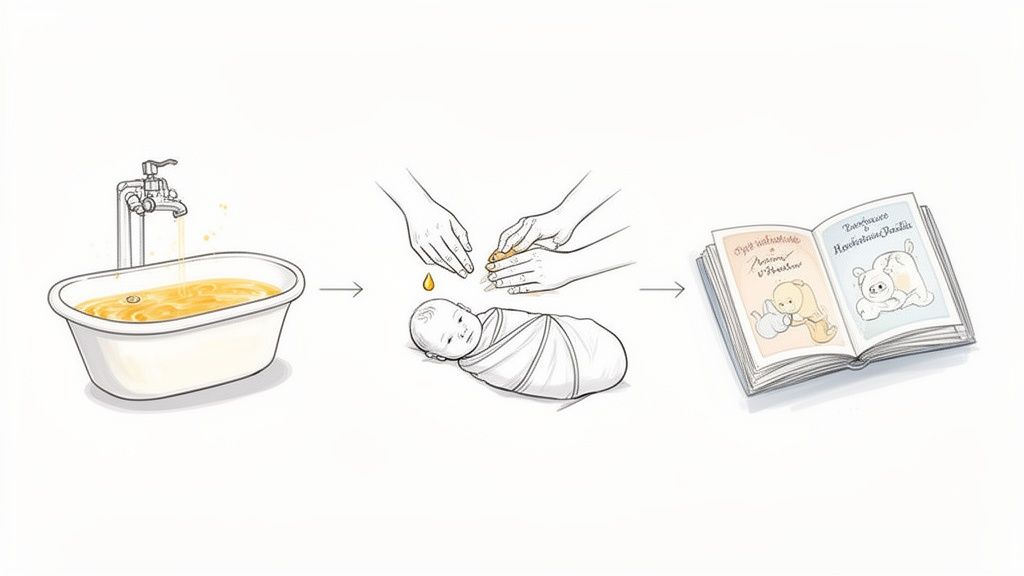
Babies are tiny creatures of habit. They thrive on predictability, and there’s no place this is more true than with sleep. A consistent, soothing pre-sleep routine is probably the most powerful tool you have for signaling to your baby’s brain and body that it’s time for restorative newborn deep sleep.
Don’t worry, this doesn't have to be a rigid, hour-long production. The magic is in the sequence—a short series of calming activities, done in the same order, that gently guides them toward sleep.
Crafting Your Calming Ritual
Think of this routine as a peaceful bridge from the busy, stimulating world of being awake to the quiet, calm world of sleep. It helps your newborn feel safe and relaxed, making that transition into slumber much smoother.
The first step is a change of scenery. Move into the dimly lit, quiet room where they’ll be sleeping. This simple environmental shift is a powerful first cue.
Here are a few gentle, effective ideas you can mix and match to build your own perfect ritual:
- A Warm Bath: The feeling of warm water is incredibly relaxing. Plus, the slight dip in their body temperature after getting out is a natural trigger for sleepiness.
- A Gentle Massage: Using a baby-safe lotion or oil, a slow, gentle massage can calm their little nervous system. It's also a beautiful bonding moment.
- Quiet Cuddles or a Book: Even the youngest babies benefit from hearing your voice. Reading from a soft book or just holding them close while you hum or sing softly can be deeply comforting.
The most important ingredient here is consistency. Performing the same 2-3 activities in the same order, every single night, builds an incredibly strong sleep association. Some parents also find it meaningful to incorporate cultural or spiritual elements, like this gentle Islamic bedtime routine for toddlers, which can add another layer of peace and connection.
Harnessing Your Baby’s Calming Reflex
Newborns come equipped with a set of reflexes that can be absolute game-changers for soothing them. Dr. Harvey Karp famously packaged these as the "5 S's," and they are fantastic for calming a fussy baby and easing them into sleep.
Expert Tip: Think of these techniques as an "off-switch" for crying and an "on-switch" for calm. They work because they recreate the familiar, soothing sensations of the womb.
Here’s a quick rundown of the 5 S’s:
- Swaddling: A snug swaddle mimics the secure feeling of the womb and, just as importantly, prevents their startle reflex from waking them up.
- Side or Stomach Position: Holding your baby on their side or stomach (while you are holding them, of course—never for sleep) can be incredibly calming.
- Shushing: Making a loud, continuous "shushing" sound right near their ear imitates the constant whoosh of sounds they heard in utero.
- Swinging: Gentle, rhythmic motion like rocking or swaying is deeply soothing to their developing balance system.
- Sucking: A pacifier can satisfy their powerful, innate need to suck, which is a major self-soothing mechanism.
You don't have to use all five at once. Just experiment and find the combination that your baby responds to best.
Learning to Spot the Signs of Deep Sleep
Have you ever found yourself frozen, mid-tiptoe, staring into the bassinet and whispering, "Are they really asleep?" It’s a classic new parent moment. Knowing how to tell the difference between your newborn's main sleep states is a total game-changer. It helps you figure out when you can finally exhale and when they might actually need you.
Newborn sleep is basically broken down into two very different categories: active sleep and quiet sleep.
Quiet sleep is that blissful newborn deep sleep we’re all dreaming of. This is when your baby is completely still, and their breathing is slow, deep, and steady. You won't see much movement at all, just the gentle rise and fall of their tiny chest. This is their most restorative, truly restful state.
Active Sleep vs. Quiet Sleep
Active sleep, on the other hand, can look like a full-on performance. You might see their eyelids fluttering, their little hands twitching, or hear grunts and whimpers. They might even crack a little smile. Their breathing can seem all over the place—short, shallow breaths followed by deeper ones. It's incredibly easy to mistake this for them waking up.
And this is where so many of us (myself included!) make a classic rookie mistake. We see a twitch, hear a grunt, assume they're about to wake up, and rush in to "save" them—often startling them out of a perfectly normal sleep cycle.
Parenting Pro-Tip: When you see them stirring, just pause. Wait a minute. More often than not, if you give them a moment, they'll settle right back down into a deeper sleep all on their own.
What the Research Says
This whole process of shifting from chaotic newborn sleep to more predictable patterns is a massive developmental leap. Newborns actually spend over 50% of their sleep in REM (that’s the active, twitchy stage), which is absolutely vital for their rapidly developing brain. As they get older, that percentage slowly drops, making way for more of the deep, non-REM sleep that fuels physical growth and repair.
As they mature, you’ll start to see longer and longer stretches of that truly quiet, immobile deep sleep. By three months old, many babies can sleep for six to eight hours at a time—a milestone that honestly feels like winning the lottery when you're in the thick of it.
If you're interested in the science behind it, you can explore the full study on infant sleep development.
Learning these signs helps you read your baby’s cues with confidence. When you see those still limbs and rhythmic breaths, you can finally take a deep breath yourself, knowing they're getting the deep, restorative rest they need to grow.
Troubleshooting Common Newborn Sleep Challenges
Even when you’ve done everything right—the perfect sleep space, a solid routine—some nights are just tough. That’s newborn sleep for you. It’s a moving target, and hitting a few bumps along the way is completely normal. Think of this as your field guide for figuring out the most common reasons your baby might be struggling to find that blissful newborn deep sleep.
Don't panic when things go off-script. Most of these challenges are just temporary phases. With a little knowledge, you can navigate them like a pro.
The Startle Reflex and the Magic of the Swaddle
Ever seen your sleeping baby suddenly fling their arms out like they’re falling, only to jolt themselves awake and start crying? That’s the Moro reflex, or the startle reflex. It's a completely normal response for a newborn, but it’s a massive sleep disruptor.
This is exactly why the swaddle is a new parent’s best friend. Wrapping your baby up snugly mimics the comforting pressure of the womb and, crucially, keeps their arms from flailing and startling them awake. It’s such a simple thing, but it can be a total game-changer for connecting sleep cycles.
Gas Pains and Reflux Realities
It’s just heartbreaking to watch your little one squirm and fuss because of gas or reflux. While some gassiness is part of the newborn package, persistent crying, pulling their legs up, or arching their back during or after a feed might point to something more.
For gas, you can try a few gentle tricks:
- Make sure they have a good latch when feeding to keep them from swallowing too much air.
- Burp them really well, not just after the feed but during it, too.
- Get things moving with "bicycle legs" or a gentle tummy massage.
Reflux, when stomach contents travel back up, is also incredibly common in the early months. A simple but effective strategy is to keep your baby upright for 20-30 minutes after they eat. If you start to see more concerning signs like poor weight gain, forceful vomiting, or just extreme irritability, that's your cue to call the pediatrician.
Trust Your Gut: You know your baby better than anyone. If their fussiness seems off or you think they're genuinely in pain, don't second-guess yourself. It's always better to get a professional opinion and peace of mind.
This little decision tree can help you figure out if your baby is in a light or deep sleep phase.
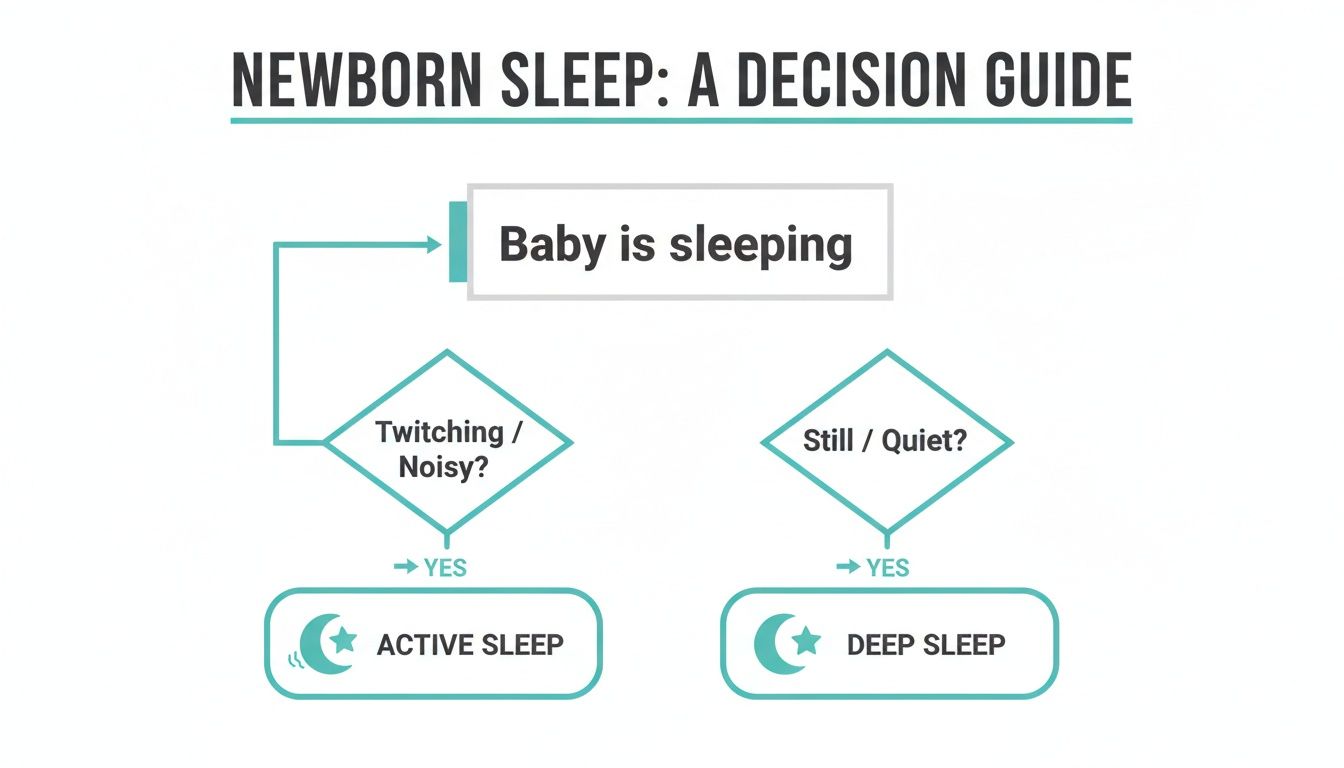
As you can see, a still, quiet baby is likely in that restorative deep sleep we're aiming for. On the other hand, all those twitches, grunts, and little noises are hallmarks of a much lighter, active sleep phase.
Day and Night Confusion
It's no surprise that newborns often have their days and nights completely backward at first. Their internal clock, or circadian rhythm, simply hasn't developed yet. The fix? Give them really strong, consistent cues about what time it is.
During the day, let the light in! Open the curtains, don't shy away from normal household sounds, and interact with your baby. When night comes, flip the script. Keep the lights low, your voice soft, and the environment calm and quiet. This stark contrast is what helps their internal clock get with the program.
Cluster Feeding and Growth Spurts
Just when you think you’ve finally figured out a feeding schedule, your baby might suddenly decide they need to eat constantly for several hours, usually in the evening. This is cluster feeding, and it’s often their way of "tanking up" before a longer stretch of sleep.
Growth spurts will also throw a wrench in your sleep plans. Your baby will be hungrier and often fussier as their little body works overtime. These phases can feel intense, but they’re usually short-lived. The best you can do is roll with it. Follow their lead, offer the extra feeds and cuddles they need, and remind yourself it’s a sign of healthy development.
Your Newborn Sleep Questions Answered
We get it. When you’re in the thick of it with a newborn, a million questions pop into your head, usually in the middle of the night. Here are the straight-up answers to the most common things parents ask us about getting that precious deep sleep.
How Long Should a Newborn Be in Deep Sleep?
This is a big one, and it often trips parents up. You might be imagining long, peaceful stretches of deep sleep like we adults have, but a newborn's brain just isn't wired that way yet.
Newborn sleep cycles are incredibly short, lasting only about 45-60 minutes. During that time, they flip-flop between light, "active sleep" and deep, "quiet sleep." They aren't meant to stay in one continuous deep sleep phase for hours.
The real goal isn't to force one long chunk of deep sleep but to help them get enough quality rest overall—which for a newborn is a whopping 16-17 hours over a 24-hour period. As they get a little older, those sleep cycles will start to lengthen, and you'll see the longer, more consolidated stretches of night sleep you're dreaming of.
Should I Wake My Newborn from a Deep Sleep?
For the first few weeks, the answer is almost always yes. It can feel wrong to disturb a sleeping baby, but your pediatrician will likely advise waking them to eat every 2-4 hours, even if they’re completely zonked. This is absolutely critical for them to get enough calories and get back to their birth weight.
Once your doctor confirms your baby is gaining weight like a champ, you'll probably get the green light to let them sleep for longer stretches at night. Until you hear that, the feeding schedule is king. After that point? Absolutely let that sleeping baby lie—that uninterrupted rest is pure gold for their growth and development.
Why Is My Sleeping Baby So Noisy and Twitchy?
If you've ever stared at your baby wondering if they're part-dinosaur, part-drummer, you've witnessed "active sleep." Welcome to the club! This is the newborn version of REM sleep, and it’s a symphony of grunts, twitches, fluttering eyelids, and even little smiles. It looks for all the world like they're about to wake up, but they're actually fast asleep.
A newborn spends about 50% of their total sleep time in this phase, and it’s incredibly important for their brain development. The trick is to not mistake it for waking. If you rush in to scoop them up, you might be the one who actually wakes them. Just pause for a minute—you'll often see them settle right back down on their own.
Parenting Reality Check: Active sleep is a master of disguise. So many new parents worry they have a "bad" or "light" sleeper, when in reality, their baby is just doing exactly what they're supposed to be doing.
When Should I Worry About My Newborn's Sleep?
A chaotic sleep pattern is par for the course with a newborn. But you should definitely trust your gut. It's time to call your pediatrician if your baby:
- Seems overly sleepy, lethargic, or is consistently tough to wake for feedings.
- Isn't gaining weight as expected.
- Has noticeable pauses in their breathing (longer than 10-15 seconds).
- Is crying inconsolably, and you have a nagging feeling that they might be in pain.
You know your baby better than anyone. If something feels off, don't hesitate to get a professional opinion. It’s always better to be safe and have peace of mind.
Navigating newborn sleep can feel like one of the biggest challenges of early parenthood. But by understanding your baby's unique rhythms and creating a safe, soothing environment, you’re giving them the best possible foundation for healthy growth. Remember to be patient with your little one—and with yourself. You're both learning, and you're doing a great job.
At Hiccapop, we design products to make these early days feel a little less overwhelming and a lot safer. From travel beds that create a familiar sleep space wherever you are to nursery gear that just makes sense, we’re here to support your family. You can explore our full collection and find something that makes your life easier.