


How to Care for a Newborn Baby: A Practical Guide for New Parents
When it comes down to it, caring for a newborn is a simple, repeating loop: feed, sleep, change. Getting the hang of these three things is what builds your confidence and helps you figure out what your baby needs in those blurry, beautiful first weeks at home.
Your First Weeks With a Newborn
So, you're home. The car seat is unbuckled, the bags are dropped by the door, and there’s a tiny human in your house who is now your full-time roommate. It’s a wild, wonderful feeling, often followed by a wave of "Oh my gosh, I'm in charge now."
Take a deep breath. The goal isn't to be perfect. It’s about learning your baby, responding to their needs, and surviving on lots of snuggles and maybe a little too much caffeine.
A newborn’s world is incredibly small, focused on just a few basic needs. Since they can't use words, they communicate with cues—a little head turn searching for a nipple, a big yawn, or a wriggle that says, "this diaper is wet!" Your job is to become a bit of a detective, learning to read their signals.
Decoding Your Baby's Needs
Learning to spot these early cues is the secret to newborn care. If you can respond before the frantic crying starts, everyone will be much happier.
- Hunger Cues: Look for your baby turning their head and opening their mouth (rooting), sucking on their hands, or making little smacking sounds. Crying is actually a late sign of hunger.
- Sleepy Signs: A baby who is getting tired might yawn, get that "thousand-yard stare," rub their eyes, or just start to get fussy for no clear reason. Catching this window makes getting them to sleep so much easier.
- Discomfort Clues: Is their body stiff? Are their fists clenched? An arched back can often mean they have gas, need a diaper change, or are just feeling overwhelmed.
Parent to Parent Tip: You cannot spoil a newborn. Responding to their needs quickly and lovingly makes them feel safe and builds a powerful bond between you. You're teaching them that their world is a good, reliable place.
Creating a Simple Routine
You won’t have a rigid schedule for a while, and that’s okay. Instead, think in terms of a gentle rhythm or pattern. Many parents find success with an "eat, play, sleep" cycle. After a feeding, have a short period of awake time—maybe some tummy time on a play mat or just cuddling on your chest—before you start watching for those sleepy signs again.
We dive deeper into this topic in our guide on creating a flexible schedule for a newborn.
For a quick reference you can keep handy, here’s a simple checklist of the essentials.
Newborn Care At-a-Glance Checklist
| Care Area | What to Expect | Key Tip |
|---|---|---|
| Feeding | Every 2-3 hours, 8-12 times a day. | Watch for hunger cues like rooting and lip-smacking—don't wait for crying. |
| Sleeping | 16+ hours a day in short bursts. | Always place baby on their back to sleep on a firm, flat surface. |
| Diapering | 8-10 wet diapers and 3-4 poopy ones daily. | Have all supplies ready before you start to make changes quick and easy. |
| Soothing | Crying is normal communication. | Try the 5 S's: swaddling, side/stomach position (while held), shushing, swinging, and sucking. |
| Cord Care | Stump will fall off in 1-2 weeks. | Keep it clean and dry. Fold the diaper down to expose it to air. |
This table is just a guide to help you feel more prepared, not a strict set of rules to follow. Every baby is different!
As you get ready for this new chapter, many friends and family will want to help you celebrate. There are some truly lovely gifts celebrating pregnancy and new babies out there that can feel really special.
On a global scale, supporting new families is a huge priority. With an estimated 152 million preterm babies born between 2010 and 2020, the focus on neonatal health has grown immensely. This has propelled the neonatal infant care market to a value of around USD 2.8 billion in 2024, reflecting a massive worldwide effort to give every baby the best possible start.
Mastering Newborn Feeding and Nutrition
Feeding a newborn feels like a full-time job where you're always on the clock. It’s a blur of burp cloths, bottles, and late-night sessions that can feel both beautiful and completely overwhelming. Let’s break down the realities of feeding your tiny human, whether you're breastfeeding, formula-feeding, or doing a little of both.
First, let go of perfection. The goal is to feed your baby in a way that works for your family, keeps them healthy and growing, and preserves your own sanity. There's a steep learning curve, for sure, but you will find your rhythm.
Newborns have impossibly tiny stomachs—about the size of a cherry on day one. That means they need to eat frequently. This translates to feeding on demand, which usually works out to every 2 to 3 hours, or about 8 to 12 times in a 24-hour period. This constant demand is also nature's clever way of establishing a good milk supply if you're breastfeeding.
Decoding Breastfeeding Basics
For breastfeeding parents, the number one mission is getting a comfortable latch. A good latch is the secret to preventing pain and making sure your baby is actually getting milk efficiently. It shouldn’t feel like a sharp, pinching pain. Instead, you're looking for a strong tugging or pulling sensation.
Here are a few tips I've seen work wonders for achieving a better latch:
- Tummy to Tummy: Position your baby so their entire body is facing yours, belly to belly. This simple alignment trick means they don't have to awkwardly turn their head to nurse.
- Wait for the Gape: Let your baby open their mouth wide—think of a big yawn—before you bring them to your breast. Aim to get as much of the areola (the darker area) in their mouth as possible, not just the nipple.
- Check the Lips: Your baby’s lips should be flanged out, like a little fish, against your breast. If they’re tucked in, you can gently use your finger to pull them out.
Don't be afraid to experiment with different positions to find what works for you. The cradle hold, cross-cradle, football hold, and side-lying are all great options to try. A good nursing pillow can also be a total back-and-arm-saver.
Navigating Formula and Bottle-Feeding
If you're using formula, the focus shifts to proper preparation and smart feeding techniques. It is critical to follow the instructions on the formula container precisely when mixing. Using the wrong water-to-powder ratio can be dangerous for your baby.
To help avoid overfeeding and reduce uncomfortable gas, give paced bottle-feeding a try. This method is designed to mimic the natural flow of breastfeeding and gives your baby more control over how fast they eat.
Here’s the simple breakdown:
- Sit Baby Up: Hold your baby in a more upright position, not lying flat on their back.
- Keep the Bottle Horizontal: Hold the bottle parallel to the floor, tilting it just enough to fill the nipple with milk. This makes your baby work a little harder to get the milk, similar to how they would at the breast.
- Take Little Breaks: Every 20-30 seconds of active sucking, gently tip the bottle down to pause the milk flow. This gives your baby a moment to breathe and register if they're starting to feel full.
Figuring out the right path for your family is a key part of the journey. If you're weighing your options, our guide on the different feeding choices of breastfeeding, formula, and combo feeding can offer some helpful perspective.
Common Feeding Worries and How to Handle Them
Every new parent has that nagging thought: "Is my baby getting enough to eat?" Instead of obsessively watching the clock, watch your baby for the real clues.
The most reliable way to know if your baby is well-fed is by tracking their diapers and weight gain. A healthy newborn should have at least 6-8 wet diapers and several soft, yellowish stools per day by the time they are a week old. Your pediatrician will keep a close eye on their weight at every check-up.
Other classic worries, like gas and spit-up, are totally normal. A newborn's digestive system is still a work in progress. To help with gas, make sure to burp your baby both during and after feedings. Spit-up is also incredibly common, so just keep a burp cloth handy at all times.
However, if the spit-up is forceful (think projectile vomiting), or if your baby seems to be in pain, that's your cue to call the doctor.
Decoding Newborn Sleep and Soothing Techniques
Newborn sleep isn't really a "schedule" so much as a chaotic series of naps. In those first few months, your baby will probably sleep for 16 hours a day or more, but it'll be in maddeningly short 1- to 3-hour chunks. Why? Their tiny stomachs need constant refills, and their internal clocks simply haven't been set yet.
Your goal right now isn't to get them to sleep through the night—trust me, that comes much later. The focus should be on two things: creating an incredibly safe sleep space and learning the art of calming a fussy baby. This is the foundation of newborn care, especially during those long, quiet nights.
The ABCs of Safe Sleep
When it comes to where and how your baby sleeps, there is absolutely no room for compromise. Following the ABCs of Safe Sleep is the single most important thing you can do to reduce the risk of Sudden Infant Death Syndrome (SIDS).
- A is for Alone: Your baby needs to sleep by themself in their own dedicated space, like a crib, bassinet, or play yard. That means no sharing the bed with parents, siblings, or pets. It also means keeping all soft bedding—pillows, bumpers, blankets, and stuffed animals—out of their sleep area.
- B is for Back: Always, without a single exception, place your baby on their back to sleep. This goes for every nap and every nighttime sleep. Even if they've started rolling over on their own, your job is to put them down on their back to start.
- C is for Crib: The sleep surface must be firm and flat. Use a crib, bassinet, or play yard that meets current safety standards, covered only with a tight-fitting sheet. Avoid letting your baby sleep for extended periods in swings, car seats, or inclined loungers.
These aren't just helpful suggestions; they are life-saving practices backed by decades of research from organizations like the American Academy of Pediatrics. You can dive deeper into creating a completely safe sleep environment for infants in our detailed guide.
Often, the path to sleep starts with a full belly. This simple flow shows the rhythm of care that leads to a settled baby: watching for hunger cues, feeding, and then burping to make them comfortable.
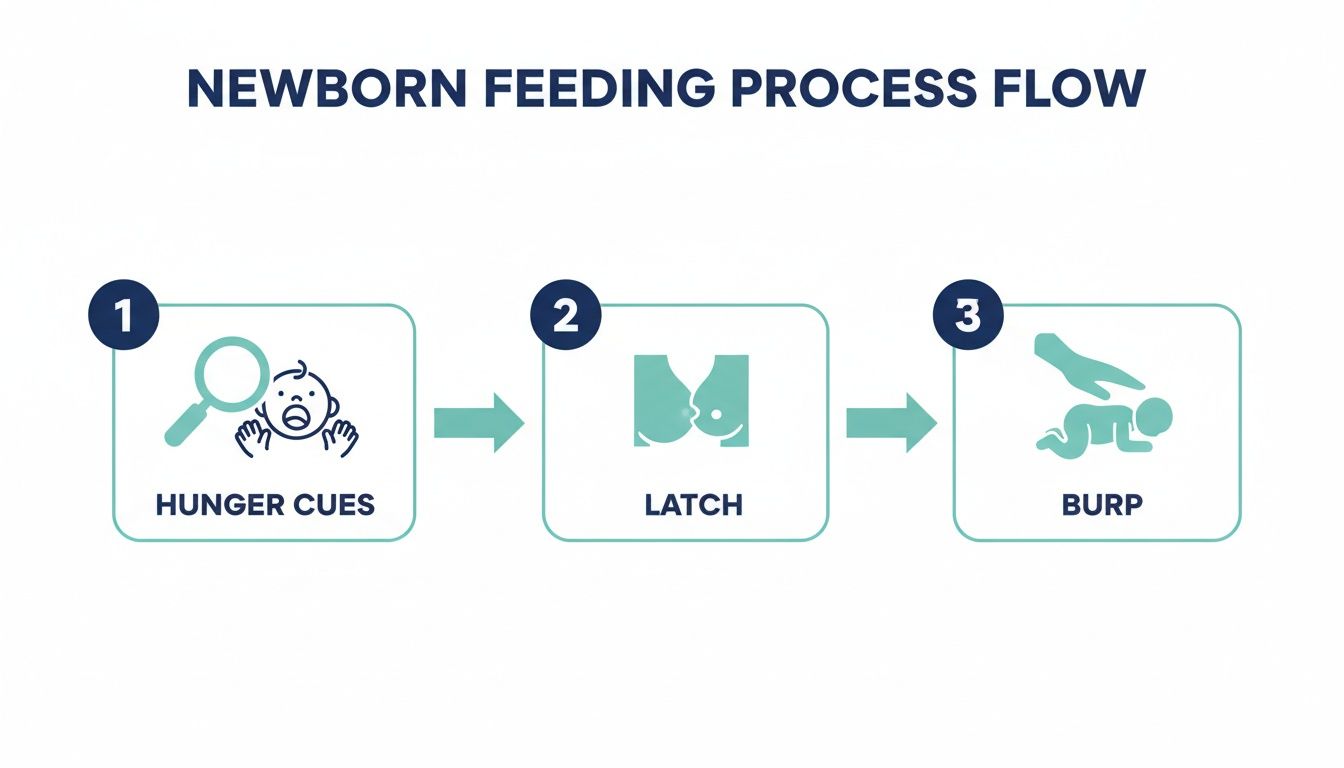
It’s a great reminder that a comfortable, well-fed baby is a baby who is ready for safe, restful sleep.
Mastering the Art of Soothing
It's easy to feel helpless when your baby is wailing and nothing seems to be working. This is where Dr. Harvey Karp's "5 S's" come in. These techniques are designed to mimic the womb and trigger a baby's natural calming reflex. For many parents, they are a total game-changer.
-
Swaddle: A snug swaddle brings back that cozy, secure feeling of being in the womb. It also helps prevent their startle reflex from waking them up. Just be sure to wrap their arms down at their sides while leaving plenty of room for their hips to move freely.
-
Side or Stomach Position: Try holding your baby on their side or stomach across your lap. This position can feel more comforting and helps switch off that jumpy startle reflex. Heads up: This is only for soothing while you're holding your awake baby—never for sleep.
-
Shush: The womb is actually quite loud! Making a strong "shushing" sound close to your baby's ear mimics that environment. A good white noise machine can also work wonders by providing constant, calming sound.
-
Swing: Gentle, rhythmic motion is incredibly soothing for a newborn. Think small, jiggly movements rather than a big, dramatic swing. The key is to support their head and neck while keeping the movements tiny and controlled.
-
Suck: Sucking is a powerful self-soothing tool for babies. Offering a pacifier, your clean finger, or helping them find their own hand can provide almost instant comfort.
Combining a few of these at once can feel like magic. A swaddled baby, held on their side while you shush and gently jiggle them, is often the perfect recipe for a calm, sleepy baby.
Diapering, Bathing, and Daily Hygiene: Getting Hands-On
Beyond the blur of feeding and sleeping, the hands-on tasks like diaper changes and baths are where you really start to bond. It can all feel a little intimidating at first, but trust me, these routines quickly become second nature. Before you know it, you'll be a pro.
The Never-Ending Diaper Change
Let's get real: you are about to change an unbelievable number of diapers. Newborns can easily tear through 8-10 diapers every single day. The secret to a smooth, stress-free change isn't some fancy technique; it's simply being prepared.
Before you even scoop up your baby, get your changing station locked and loaded. Have a clean diaper, wipes, a protective pad, and any barrier cream within arm's reach. A little prep work saves you from that classic one-handed scramble for wipes while trying to keep a wiggly baby in place.
A Crash Course in Newborn Poop
One of the most surprising (and talked-about) parts of being a new parent is the wild world of newborn poop. The changing colors and textures are just a sign that your baby’s digestive system is firing up and working as it should.
- Meconium: For the first day or two, you'll see a thick, sticky, tar-like substance. It looks alarming, but it's completely normal! This is just your baby clearing out what they ingested in the womb.
- Transitional Stools: After the meconium passes, the poop will shift to a greenish-brown or even a greenish-yellow as they begin digesting breast milk or formula.
- Mature Stools: Around day five, you'll settle into a new normal. For breastfed babies, this is typically a loose, seedy, mustard-yellow poop. Formula-fed babies usually have stools that are a bit firmer and more tan or yellow in color.
Diaper rash is a common annoyance. To keep it at bay, change diapers as soon as they're wet, clean the area gently, and let your baby’s skin air out for a few minutes whenever you can. A thin layer of a zinc oxide-based cream is fantastic for creating a protective barrier against moisture.
Umbilical Cord Stump Care
That little stump on your baby's belly might look fragile, but caring for it is surprisingly simple. The golden rule is to keep it clean and dry.
To help it dry out, fold the top of your baby's diaper down and away from the stump. This lets the air get to it and helps it heal faster. The stump will typically fall off on its own within one to two weeks. Until it does, stick with sponge baths. If you notice any concerning signs like persistent redness, swelling, or a foul-smelling discharge, it's time to call your pediatrician.
Bath Time Without the Tears
Until that umbilical stump is gone, sponge baths are your best friend. And you really don't need to bathe your newborn every day—in fact, it's better if you don't. Bathing 2-3 times a week is plenty, as too much water can dry out their incredibly sensitive skin.
When you're ready to graduate to a baby tub, here’s how to make it a calm and safe experience:
- Set the Scene: Get everything you need before you put the baby in the water. Grab a soft towel, washcloth, baby-safe soap, and a clean diaper and outfit. And the most important rule: never, ever leave your baby unattended in the water, not even for a split second.
- Check the Temp: The water should feel comfortably warm on your skin, not hot. Aim for around 100°F (38°C). A quick test with your wrist or elbow is a great way to check. Always swirl the water to make sure there are no hidden hot spots.
- Wash Gently: Use one arm to securely support your baby’s head and neck, and use your free hand to wash. Start with their face (using just plain water), and then work your way down. I always save the soap for the very end so they aren't sitting in suds for too long, which can be drying.
A clean baby needs a clean environment. Beyond personal hygiene, keeping their clothes, bedding, and favorite soft toys clean is just as crucial. For some practical advice on this, you can find great tips for cleaning plush toys to keep germs at bay.
Monitoring Your Newborn's Health
It’s completely normal to find yourself watching your baby’s every breath and analyzing every little squeak. That hyper-awareness is baked into the new parent experience. The trick is to channel that energy into knowing what's actually normal for a newborn and what signs mean it's time to call the pediatrician.
Knowing what to look for will help you trade some of that anxiety for confidence. Monitoring your baby's health isn’t about expecting trouble; it’s about being an observant, informed caregiver who can act when it matters most.
Key Health Indicators to Watch
Newborns come with their own unique set of "normals." Their breathing can be erratic, they make all sorts of strange noises, and their skin can do surprising things. Learning their baseline helps you spot when something is truly off.
A few key areas to keep an eye on include:
- Breathing Patterns: Newborns often have what’s called periodic breathing—short pauses followed by a little burst of quick breaths. This is usually totally fine. What you need to watch for are signs of respiratory distress: persistent rapid breathing (over 60 breaths per minute when calm), grunting with each breath, or their nostrils flaring. Those warrant an immediate call.
- Temperature: A stable body temp is a great sign of a healthy baby. The most accurate way to check a newborn's temperature is rectally. A normal range is anywhere between 97.7°F and 99.5°F (36.5°C and 37.5°C).
- Jaundice: Many babies get a touch of jaundice, which gives their skin and the whites of their eyes a yellowish tint. It’s caused by a buildup of a substance called bilirubin. While mild jaundice often resolves on its own, it’s really important to have it monitored by your doctor, especially if the yellowing seems to be spreading or getting deeper in color.
When to Call the Pediatrician
Trust your gut. Seriously. You know your baby better than anyone, and if something just feels wrong, it's always better to make the call. Your pediatrician's office is used to calls from new parents—they would much rather you check in than worry alone at home.
Here’s a clear guide on when you should definitely reach out:
Don't hesitate to contact your doctor if you notice a fever (a rectal temperature of 100.4°F or higher), persistent crying that you can't soothe, a refusal to eat for several feedings in a row, or signs of dehydration (like fewer than six wet diapers in 24 hours).
Recognizing these signs is a critical part of newborn care. On a global scale, neonatal health is a major focus, as millions of newborns face risks every year. In 2022, approximately 2.3 million newborns died within their first 28 days, with most of these tragedies occurring in low- and middle-income countries. Scaling up essential care interventions is a crucial step toward reducing these numbers. You can read more about these global health efforts and their impact.
Well-Baby Visits and Vaccinations
Your baby's first few months will be dotted with a series of well-baby visits. These appointments are so much more than just "shot" appointments—they are incredibly important.
During these visits, your pediatrician will:
- Track your baby’s growth (weight, length, and head circumference).
- Perform a complete physical exam from head to toe.
- Discuss developmental milestones and what's coming next.
- Administer scheduled vaccinations to protect against serious diseases.
These check-ups are also your dedicated time to ask every single question you have, no matter how small it seems. Following the recommended vaccination schedule is one of the most powerful and effective ways you can protect your child’s health right from the very beginning.
Your Newborn Care Questions Answered
Even after reading every guide out there, you're going to have a million little questions that pop into your head at 3 AM. This is totally normal. Let's tackle some of the most common worries that new parents face.
Think of this as your quick-reference spot for those "is this normal?" moments. You've got this, and we've got your back with the info you need.
Why Does My Baby Sneeze So Much?
It's a little jarring to hear a big sneeze come out of such a tiny person, but it's almost never a sign that they're sick. Newborns have incredibly small nasal passages, and it doesn't take much to clog them up—we're talking dust, lint, or even a little leftover amniotic fluid from their time in the womb.
Sneezing is just their body's built-in, super-effective way of clearing everything out. As long as those sneezes aren't paired with a fever, any trouble breathing, or thick, colored mucus, it's just a normal part of being a new human.
How Do I Handle Visitors and Set Boundaries?
Everyone wants to meet the baby, which is lovely but can also be completely overwhelming when you're trying to heal and figure things out. Your top priority is your recovery and your baby's health, and it is 100% okay to set firm boundaries.
Here are a few gentle but effective ways to manage the flow of well-wishers:
- Set the schedule: Don't be afraid to ask people to text before they even think about coming over. You can also suggest short visiting windows, like "between 2 and 3 PM would be great!"
- Enforce a strict "no sickness" rule: Politely ask anyone who's feeling even slightly off—a sniffle, a cough, a tickle in their throat—to wait until they're fully recovered.
- Make handwashing non-negotiable: Leave a bottle of hand sanitizer by the door and kindly ask everyone to wash their hands the moment they come in, before they even think about holding the baby.
Remember, "No" is a complete sentence. You are not being rude by protecting your peace and your newborn's fragile immune system; you're being a responsible parent.
Is It Normal for My Baby to Be So Fussy in the Evening?
If your baby seems to transform into a ball of fussiness around the same time every evening, you're not imagining things. Many parents call this the "witching hour," and it's incredibly common. This period of intense fussiness often peaks around 6 weeks of age and usually starts to improve by the 3-4 month mark.
No one knows for sure what causes it, but most experts think it's related to overstimulation after a long day or just a baby's nervous system getting its bearings. To get through it, try dialing everything down—dim the lights, turn off the TV, and lean on your soothing tricks like swaddling, white noise, or gentle rocking. Sometimes, a simple change of scenery, like a quick walk outside, can work miracles. This phase can be really tough, but hang in there—it is temporary.