


Flying With a 3 Month Old: Your Survival Guide
Flying with a 3-month-old is generally safe for healthy, full-term babies, but your pediatrician’s green light is non-negotiable. Seriously, before you even think about booking tickets, a quick check-in with your doctor is the most important first step. It’s the difference between traveling with anxiety and traveling with confidence.
Is It Actually Safe to Fly With a 3-Month-Old?
Let's get right to the question that's probably keeping you up at night. The thought of bringing your tiny baby onto a crowded plane with recycled air is enough to make any new parent nervous. You’re definitely not alone in wondering if it’s a good idea. The short answer? Yes, for most families, it's totally doable.
But that "yes" comes with a big condition: you have to talk to your pediatrician first. This isn't just a box to check off. Your doctor knows your baby's specific health history and can give you personalized advice that you simply can't find online.
Why Your Baby’s Age Matters
Three months old is a funny little age. They’re not brand-new newborns anymore, but their little bodies are still incredibly delicate. Understanding what’s going on with them physically helps explain why that doctor's visit is so crucial.
Here’s a look at what makes this age so unique for travel:
- A Developing Immune System: Your baby’s immune system is still a work in progress. It just hasn’t had enough time to build up defenses against the sheer volume of germs you'll encounter in an airport or on a plane.
- Tiny Airways: An infant's Eustachian tubes (the little passages connecting the middle ear to the throat) are much smaller and flatter than an adult's. This makes it harder for their ears to equalize pressure, which can lead to some serious discomfort during takeoff and landing.
- Breathing and Oxygen Levels: The cabin pressure on a plane is similar to being at an altitude of 6,000 to 8,000 feet. Most healthy babies handle this just fine, but for an infant with any underlying heart or lung issues, it could be a real challenge.
When you put it all together, you can see why something that's a minor annoyance for us can be a major physical stressor for a 3-month-old.
Key Takeaway: The biggest concerns with flying aren't about the plane itself. It's about how your baby's delicate system will handle a completely new and demanding environment.
Getting the All-Clear From Your Pediatrician
So, what will your pediatrician be looking for? They'll do a quick check of your baby's overall health, making sure there are no colds or ear infections that could get much worse in the air. This is also a great time to talk about your baby's vaccination schedule and see if any adjustments are needed before your trip.
This conversation is even more critical for babies who were born prematurely or have other health conditions. Experts at the Mayo Clinic often recommend waiting a few months before flying with preemies or babies with chronic heart or lung problems. Their little lungs might struggle with the lower oxygen levels in a pressurized cabin, and their immune systems are extra vulnerable to germs.
Once you have your doctor’s approval, you’ll feel so much better. It allows you to stop worrying about if you should go and start planning how to make the trip as smooth as possible. For more general advice, our comprehensive guide on how to travel with infants has a ton of extra tips for every part of your journey.
Booking Flights and Seats for a Peaceful Trip
Some of the most important decisions you'll make happen long before you start packing. When you're flying with a baby, booking a flight is about more than just finding the best deal—it's about setting the stage for a smooth, low-stress experience. A bit of strategic thinking here can honestly save your sanity later.
First, think about your baby's natural rhythm. Are they bright-eyed and cheerful in the morning, or do they find their groove in the afternoon? Try to book a flight that lines up with their "happy hour." A red-eye might sound good in theory, but if that’s your baby’s fussiest time, you're just making the journey harder on everyone.
And if you can swing it, always, always book a direct flight. I know they can be more expensive, but completely avoiding the chaos of a layover—the deplaning, the waiting, the re-boarding—is priceless.
Choosing the Right Seat on the Plane
Ah, the great debate for traveling parents: aisle or window? Each one has its perks, and I've done both.
An aisle seat is your ticket to freedom. You can easily get up to walk, bounce, or soothe a fussy baby in the galley without having to awkwardly climb over your seatmates. That quick escape route is a lifesaver when the wiggles set in.
On the other hand, a window seat gives you a little pocket of privacy. It’s a more secluded spot for nursing or bottle-feeding, and it keeps your baby tucked away from a busy aisle with carts and people bumping past. There's no wrong answer here; it really comes down to whether you prioritize easy movement or a private corner.
Seat Selection Tip: I’ve found that a seat toward the back of the plane, near the lavatories, is often the most practical spot. You’re close to the changing table, and the engine noise back there can work like a giant white noise machine for a sleeping baby.
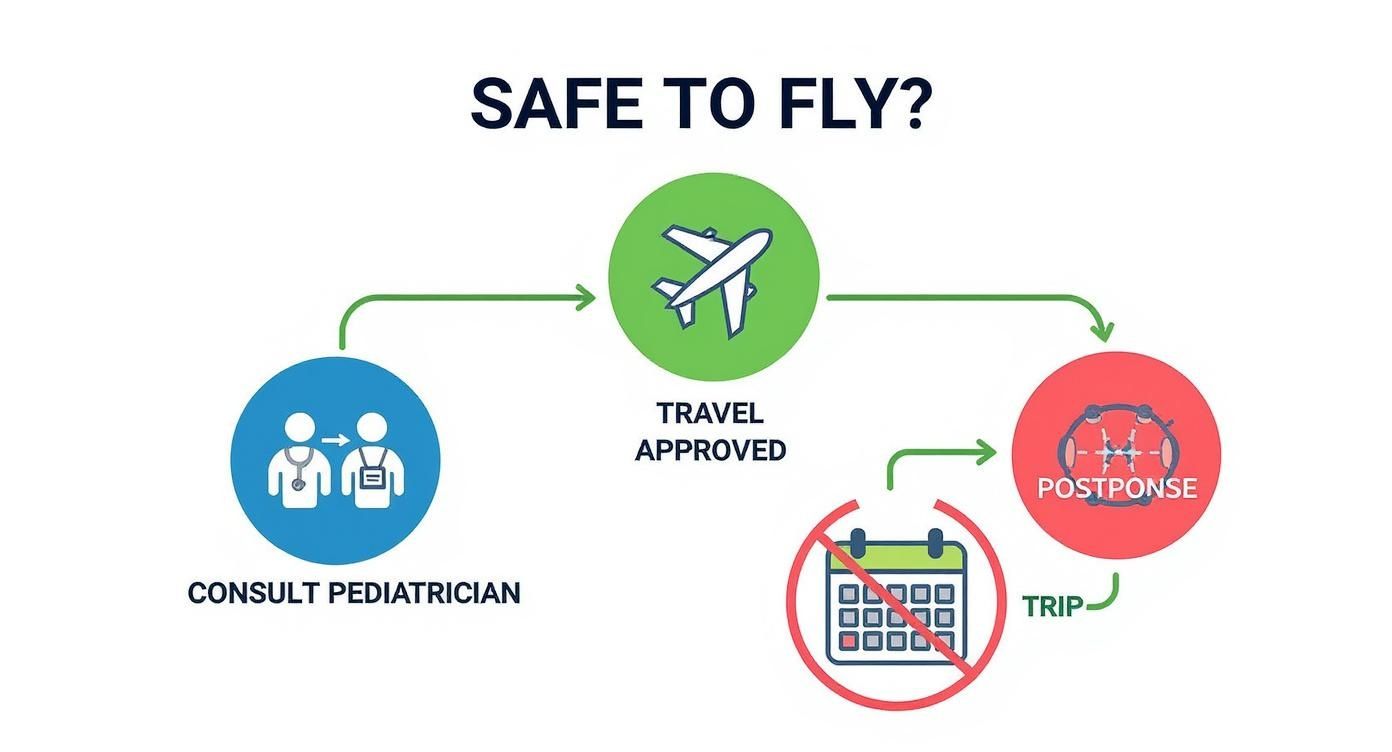
As the infographic makes clear, your doctor's okay is the real starting line for any travel plans. It ensures your trip is not just fun, but safe.
Lap Infant vs. Buying a Separate Seat
In the United States, airlines let kids under two fly for free as a "lap infant" on domestic routes. It’s a great way to save money, but it's important to know what the experts say. The Federal Aviation Administration (FAA) strongly recommends that the safest place for your baby is in their own seat, properly buckled into an FAA-approved car seat. During unexpected, severe turbulence, it can be incredibly difficult to keep a secure hold on a baby.
If you do buy a separate seat, you’ll need to bring your own car seat on board. Before you go, check the side of the car seat for a sticker that says, "This restraint is certified for use in motor vehicles and aircraft." Our comprehensive guide on traveling with car seats dives deep into the rules and how to install them on a plane.
And while the baby’s comfort is front and center, don't forget about your own. If you need a bit more room to get comfortable, this guide to airplane seat belt extender types is a fantastic resource. After all, when you're comfortable and relaxed, it's so much easier to care for your little one.
The Ultimate Carry-On Diaper Bag: Your In-Flight Mission Control
When you're flying with a 3-month-old, your diaper bag isn't just a bag—it's your command center. Think of it as your lifeline, your toolbox, and your secret weapon against mid-air meltdowns. Packing it strategically means thinking ahead about every possible scenario, so you can handle whatever the friendly skies throw at you with total confidence.
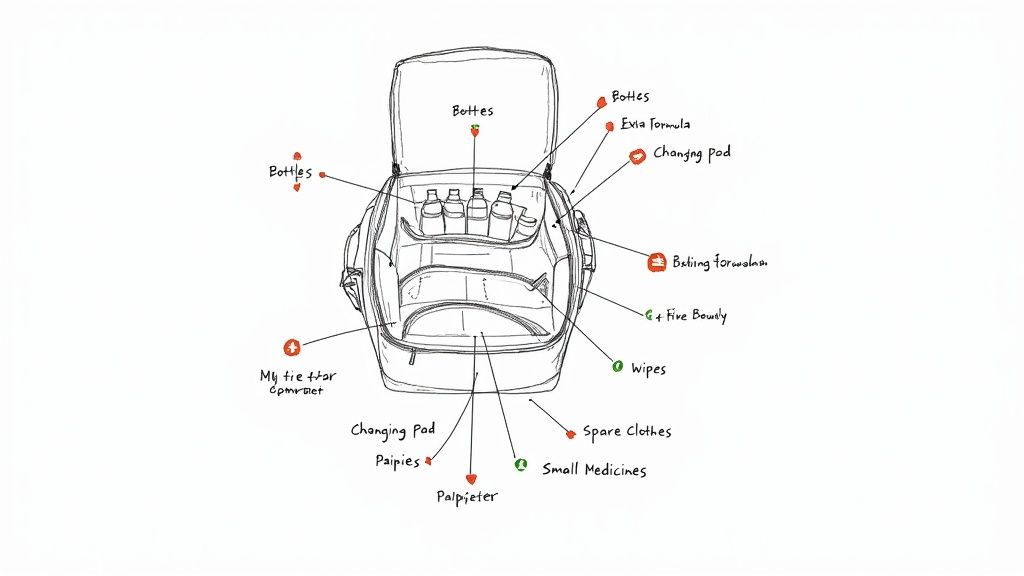
Forget just tossing things in randomly. The real key is to organize by category. This way, you’re not frantically digging for a pacifier while your baby is hitting a new vocal octave. I like to think of it as creating little "kits" for diapering, feeding, and comfort.
Building Your Diapering "Go-Kit"
This seems like the most obvious part, but it's also where it’s easiest to under-pack. A good rule of thumb I swear by is to pack one diaper for every hour of your total travel time—from the moment you leave your house to when you arrive at your final destination. Then, add a few extras just in case.
Trust me, a blowout at 30,000 feet is a unique parenting rite of passage you want to be ready for.
- Wipes: Bring a full pack, not a dinky travel-sized one. You'll use them for diaper changes, of course, but also for sticky hands (yours and theirs) and wiping down germy-looking tray tables.
- Changing Pad: A portable, foldable changing pad is absolutely non-negotiable. Those airplane lavatory changing tables are tiny and, let's be honest, not exactly sparkling clean.
- Diaper Cream: A small tube of your go-to brand is all you need.
- Disposable Bags: Perfect for sealing away smelly diapers or soiled clothes. You—and everyone sitting around you—will be very grateful you have these.
The In-Flight Cafe: Feedings and Hydration
Whether you're breastfeeding, bottle-feeding, or doing a bit of both, having your feeding plan dialed in is crucial. Here’s the cardinal rule of flying with an infant: pack at least two more feedings than you think you'll need. Delays are common, and a hungry baby is the last thing anyone wants to deal with on top of travel stress.
For formula feeders, pre-measured powder in a formula dispenser is a total game-changer. It saves you from the awkwardness of trying to scoop and measure in a cramped airplane seat. All you have to do is add bottled water when it’s time for a feeding.
If you're breastfeeding, a lightweight nursing cover can give you some privacy if you'd like it. Don't forget any pumping equipment you might need, either. It’s considered a medical device and typically doesn't count toward your carry-on allowance, but it’s always smart to double-check with your specific airline first.
Baby's Essential Carry-On Checklist
| Category | Essential Items | Pro-Tip |
|---|---|---|
| Diapering | Diapers (1 per hour of travel), full pack of wipes, portable changing pad, diaper cream, disposable bags. | Keep this "kit" in a single large pouch or packing cube so you can grab the whole thing and head to the lavatory easily. |
| Feeding | Formula dispenser with pre-measured powder, bottles, bottled water, nursing cover, pump and parts, burp cloths. | Pack 2 extra feedings! Delays are unpredictable. For breast milk, use a small, insulated cooler bag with ice packs. |
| Comfort | Pacifiers (at least 3), pacifier clip, a familiar swaddle or blanket, one or two small soft toys (a rattle or lovey). | The scent of a blanket from home is incredibly calming for a baby in a new, loud environment. |
| Health & Safety | Infant Tylenol (with doc's okay), nasal aspirator, saline spray, any personal medications, travel-size hand sanitizer. | The dry cabin air can make babies stuffy. Saline spray is a lifesaver for clearing tiny nasal passages. |
| Clothing | Two complete changes of clothes (onesies, pants), extra socks, a light jacket or sweater. | Layers are your best friend. The cabin temperature can swing from warm to chilly in an instant. |
| For You | A spare shirt, snacks, a reusable water bottle, phone charger, wallet, and travel documents. | Spit-up happens. A clean shirt for yourself can make the rest of the flight so much more comfortable. |
Comfort Items, First-Aid, and Navigating TSA
A comfortable baby is a happy baby, especially in a strange place like an airplane. Your goal here is to bring a few things that smell and feel like home.
Don't feel pressured to pack a whole toy chest. At 3 months old, your baby is more interested in you than anything else. A few well-chosen comfort items are all you need.
- Pacifiers: Bring several. I promise you, one will fall on the floor at the worst possible moment. Pacifier clips are your best friend.
- A Familiar Blanket: The scent of home is incredibly soothing. It also doubles as a nursing cover, a play mat at the gate, or a shield against the chilly cabin air.
- One or Two Soft Toys: A small, soft rattle or a favorite lovey is perfect.
Insider Tip: Try introducing a new, special "travel only" toy about a week before your trip. This builds a positive association and makes the toy feel extra engaging when you finally pull it out on the plane.
You also don't need a full pharmacy, but a few key health items provide major peace of mind. A simple zip-top bag with infant Tylenol (get your pediatrician's okay first), a nasal aspirator, and some saline spray for the dry cabin air is perfect.
This brings us to the big question: what about all the liquids? Thankfully, the TSA has special rules for families. The standard 3.4-ounce (100ml) liquid limit does not apply to breast milk, formula, and juice for infants. You can bring them in "reasonable quantities." Just remember to take them out of your bag for separate screening.
Finally, do not forget to pack a change of clothes for the baby and a spare shirt for yourself. Spit-up and blowouts don't discriminate, and having a clean shirt will make a huge difference in how you feel for the rest of the flight.
For an even more exhaustive list to ensure you don't miss a single thing, take a look at our complete diaper bag checklist for newborns. A well-packed bag is the foundation for a calm and successful trip.
Navigating the Airport Without Losing Your Cool
The airport is where your travel adventure really kicks off, but it can feel like the first big hurdle. Juggling a baby, luggage, and your own sanity requires a solid game plan. The goal isn't just to survive it; it's to make the whole experience feel surprisingly manageable. Forget the last-minute scramble—let's make this a smooth operation.
Your secret weapon for this part of the journey is a good baby carrier. Seriously, wearing your baby is a total game-changer. It keeps them feeling safe and snug against you, which is incredibly calming in a loud, chaotic environment. More importantly, it leaves both of your hands free. You'll need them for flashing passports, grabbing your carry-on, and, of course, holding that desperately needed coffee.
Trust me, trying to wrangle a stroller while pulling a rolling suitcase is a special kind of travel nightmare. Strap your little one on and you can glide through the check-in line feeling like you've got this.
Mastering the TSA Security Checkpoint
The security line is probably the biggest source of stress for parents. But here’s the good news: TSA agents see families all day long, and they have procedures in place to help you through. You will not be asked to take your baby out of the carrier. They will, however, likely swab your hands for explosive residue while you’re holding them. It's quick, painless, and over in a flash.
Here’s a quick rundown of what to expect:
- Liquids Get Special Treatment: Remember that breast milk, formula, and baby food are exempt from the 3.4 oz liquid rule. Keep them in a separate, easy-to-reach bag and give the TSA officer a heads-up. They'll just need to screen these items separately.
- Gear Goes on the Belt: Your stroller, car seat, and diaper bag all need to go through the X-ray scanner. If the stroller is too bulky to fit, an agent will screen it by hand.
- Keep Your Shoes On: In many cases, parents traveling with infants get to keep their shoes on. It’s a small thing, but it makes a big difference.
The real aim here is to move through the line smoothly, not to set a new speed record. Take your time, let the agents know what you've got, and don't hesitate to ask for an extra hand if you need it. A calm parent almost always equals a calm baby.
Family travel is booming, and airports are getting better at accommodating us. Before the pandemic, global air travel hit over 4 billion passengers a year, a number that's expected to keep climbing. This just goes to show why keeping your baby in a controlled space, like their carrier, and being mindful of hand hygiene is so crucial in a crowded terminal. You can find more about the growing baby travel market and what it means for families on HDINresearch.com.
From Security to the Gate
Once you're past security, you can finally take a breath. You're in! Now the strategy shifts to making the most of your time before boarding. Don't just plop down at the gate and wait—think of this as your pre-flight mission control.
This is the golden opportunity for one last diaper change. Airport family restrooms are usually more spacious and a lot easier to manage than the tiny airplane lavatory. It’s also the perfect time to offer a final feeding. A baby with a full tummy and a fresh diaper is far more likely to be a happy traveler during boarding and takeoff.
Almost every airline offers pre-boarding for families with small children. Take them up on it! That extra few minutes to get settled in your seat, install a car seat if you brought one, and arrange your essentials without a line of people breathing down your neck is priceless. This small head start can set the tone for a much calmer, more positive flight.
Keeping Your Baby Happy and Calm In-Flight
Alright, you’ve navigated the airport, boarded the plane, and settled into your seats. Deep breath. Now comes the main event: keeping your tiny travel buddy content at 30,000 feet. This is less about a rigid plan and more about being flexible and having a few tricks up your sleeve.
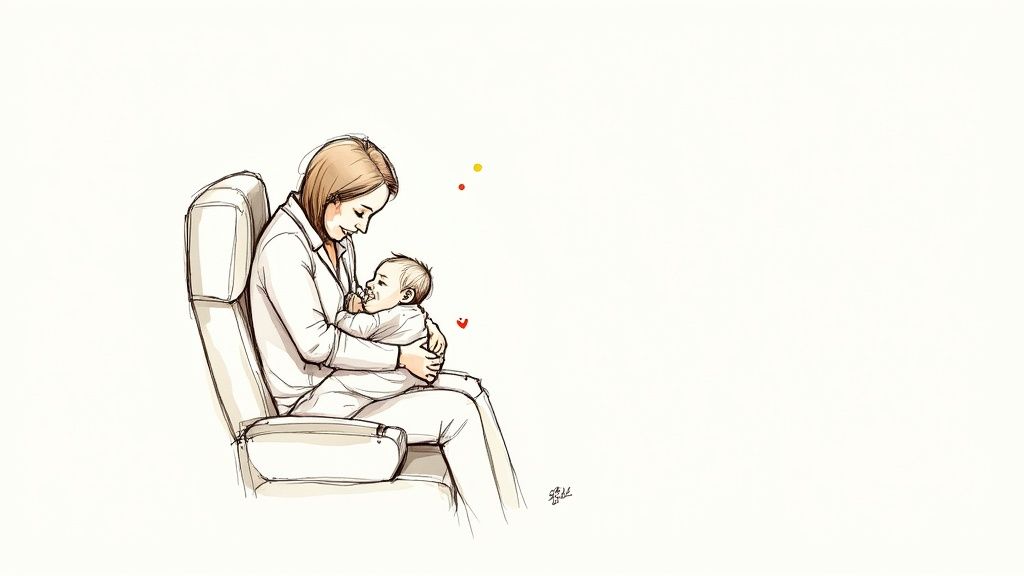
Honestly, your biggest priority is managing the ear pressure changes during takeoff and landing. This is the most common culprit behind a suddenly unhappy baby on a plane.
Conquering Ear Pressure Like a Pro
You know that popping feeling you get as the plane climbs or descends? For a baby who can't intentionally pop their ears, that pressure can be really painful. The secret to helping them is to get them sucking and swallowing.
This is where you can use your feeding schedule to your advantage. Try to time a feeding—whether it's breast, bottle, or even just a pacifier—for the initial ascent and especially for the final descent. The descent often feels longer and can be more uncomfortable, so that's the most critical time to offer them something to suck on.
The U.S. Centers for Disease Control and Prevention (CDC) confirms this, explaining that babies can't equalize that pressure on their own. Swallowing is what does the trick. It's also worth noting that the CDC advises against using antihistamines for this purpose, as they aren't proven to work and can have side effects. You can read more about the CDC’s guidelines for traveling safely with infants on cdc.gov.
Feedings, Diapers, and Naps in a Tiny Space
Once you’re at cruising altitude, the flight will likely fall into a simple rhythm of eating, sleeping, and diaper changes. It’s a bit of a dance in a cramped space, but totally manageable.
In-Flight Feedings
- Get comfortable first. If you're nursing, a lightweight cover can be great for privacy if you want it, but don't feel pressured to use one. For bottle-feeding, have your pre-measured formula and water ready to mix.
- Ask for help. Flight attendants can be your best friends. They can bring you water or toss an empty bottle, but just remember they can't warm bottles for safety reasons.
The Lavatory Diaper Change
Changing a diaper in an airplane bathroom is a real skill. The fold-down changing tables are tiny, and there’s barely room to turn around.
My best tip: Create a "diaper clutch" before you board. Just pack a couple of diapers, a small travel pack of wipes, and a disposable bag into a small pouch. It's so much easier to grab that one little thing than to haul your entire diaper bag into that tiny bathroom.
Creating a Cozy Bubble for Sleep
The constant drone of the airplane engine is basically a giant white noise machine—perfect for lulling a baby to sleep. You can lean into this and create a cozy little nap zone for your infant.
Here’s how to set the scene for an in-flight snooze:
- Watch for sleepy cues. At three months, a strict schedule is a fantasy. Instead of watching the clock, watch your baby for those tell-tale signs: yawning, rubbing their eyes, or getting a bit fussy.
- Bring comforts from home. A swaddle or blanket that smells familiar can work wonders. That scent provides a sense of security in a totally new environment.
- Control the light. If you have a window seat, closing the shade can make a huge difference, creating a darker, less stimulating space.
If you booked a separate seat for your baby and have their car seat, that's often the easiest place for them to sleep. If they're a lap infant, a soft baby carrier can be a lifesaver, letting them doze off while snuggled right up against you.
Troubleshooting In-Flight Fussiness
Let's be real—even with perfect planning, you’ll probably have some fussy moments. It happens. When the crying starts, take a breath and run through a quick mental checklist: Hungry? Wet diaper? Too hot? Too cold?
If you've covered all the basics and they're still upset, it could just be overstimulation. A change of scenery often helps. A slow, gentle walk up and down the aisle can be a fantastic reset. The movement and new things to see are often just enough to break the spell.
And remember, most of your fellow passengers are far more understanding than you might think. You’re doing great.
Still Have Questions About Flying With a 3-Month-Old?
Okay, even after you’ve packed everything but the kitchen sink and mapped out your travel day, a few questions are probably still nagging you. That’s totally normal. Let’s tackle some of the most common worries parents have, so you can walk into that airport feeling like you’ve got this.
Do I Need to Buy My Baby a Seat?
Technically, no. For domestic flights, airlines let you fly with an infant under two on your lap. But here’s the thing: the FAA is crystal clear that the safest place for your baby is in their own seat, strapped into an FAA-approved car seat. If the plane hits unexpected turbulence, holding on securely becomes incredibly difficult.
If an extra ticket just isn't in the budget, you still have a shot. When you get to the gate, ask the agent if the flight has any empty seats. If it’s not a full flight, they are often happy to let you bring your car seat on board for free. It never hurts to ask!
How Do I Keep My Baby on Their Sleep Schedule?
At three months old, "schedule" is a pretty loose term anyway. My best advice? Aim for flexibility over a rigid routine. Trying to force a nap at a specific time while juggling security lines and boarding calls is a recipe for stress for both of you.
Instead, just watch your baby. You know their cues—the little yawns, the eye rubs, the tell-tale fussiness. When you see them getting tired, try to create a little sleep bubble for them. The drone of the airplane engine is actually a huge help! A familiar swaddle and a quick feeding can often do the trick and lull them to sleep.
Remember This: Your baby’s routine will get thrown off, and that’s perfectly fine. Just roll with it and focus on what they need in the moment. You can get back on track once you land.
What Paperwork Does My Baby Need to Fly?
This is a big one, and it really depends on where you’re headed.
For domestic flights in the U.S., you usually don't need a specific ID for the baby. That said, I always recommend tucking a copy of their birth certificate into your bag. It’s the easiest way to prove their age if the airline asks.
For any international travel, your baby will absolutely need a passport. There’s no getting around this, no matter how tiny they are. Always, always double-check the airline’s website for their specific rules before you leave home to avoid any nasty surprises at the check-in counter.
Can I Bring My Stroller and Car Seat?
Yes, and you should! Airlines let you check both a car seat and a stroller for free, and they won't count against your checked baggage limit.
Most parents find it easiest to use the stroller to get through the airport and then gate-check it right before boarding. They’ll have it waiting for you on the jet bridge when you land.
If you bought a separate seat for your baby, you can bring an FAA-approved car seat on board. Just check for a sticker on the side that says something like, "This restraint is certified for use in motor vehicles and aircraft." That’s your green light.
For all your travel adventures, from airport navigations to cozy naps on the go, hiccapop creates products designed to make parenting simpler and safer. Our travel essentials are built for real life, giving you one less thing to worry about. Explore our collection and travel with confidence at https://hiccapop.com.