


Dust Mite Resistant Bedding That Actually Works
Your toddler wakes up stuffy again. You've washed the sheets, vacuumed the floor, and cleared the dust from the dresser, yet the bedroom still seems to be part of the problem. Before buying another product labeled hypoallergenic, it helps to understand what that label can't tell you.
Dust mite resistant bedding works best as a system: a properly sealed barrier, a workable laundry routine, and a sleep space that stays safe for your child's age. The aim is less allergen exposure, not a promise that a new mattress cover will cure congestion.
What Dust Mite Resistant Bedding Really Means
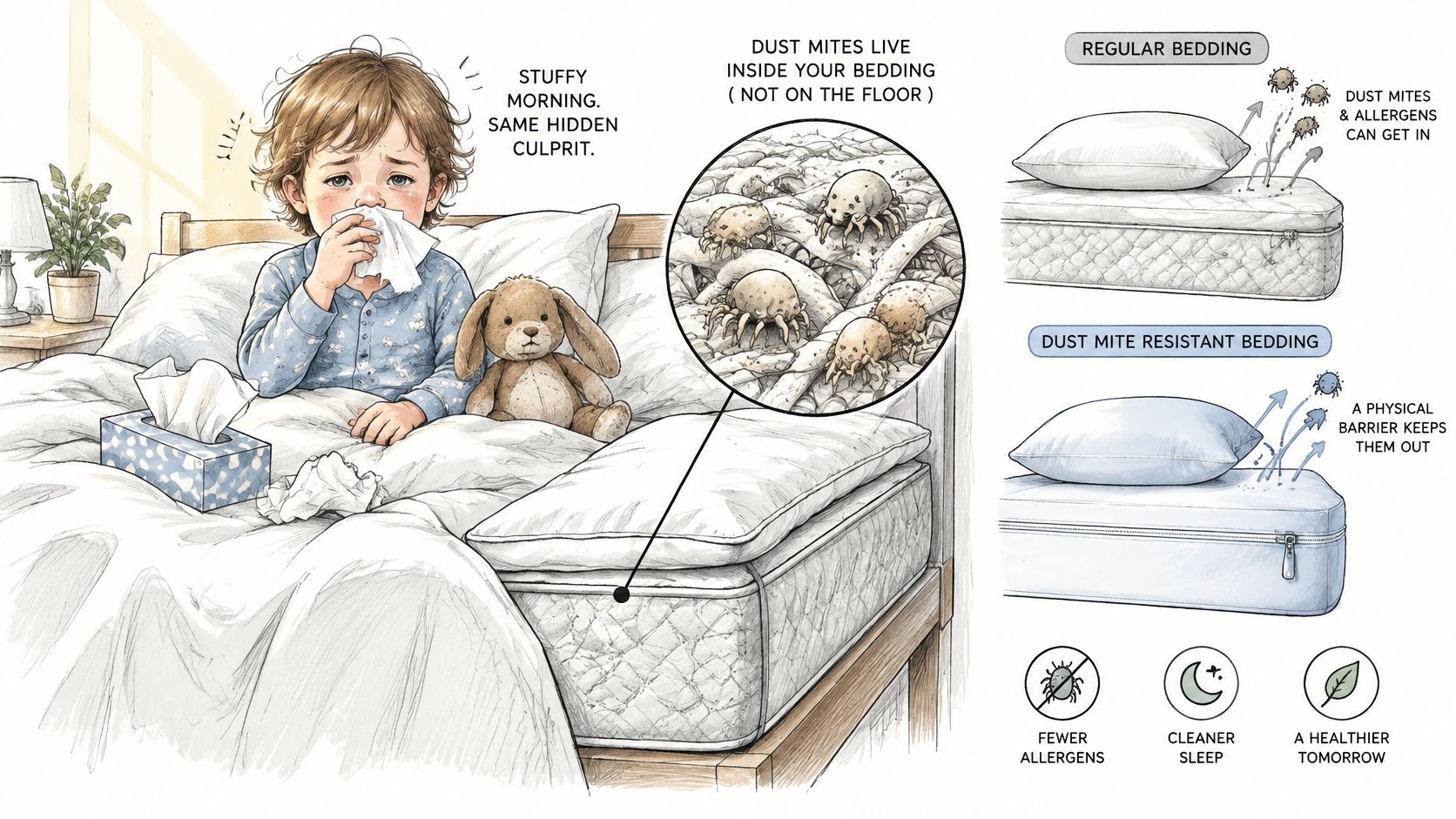
A clean-looking room can still contain allergens inside its soft furnishings. In a typical stuffy-morning scenario, the mattress deserves attention alongside the floor, but waking congested doesn't establish that your child has a dust-mite allergy.
Dust mite resistant bedding is a physical barrier around an allergen reservoir. It isn't a spray, a pesticide, or a medical treatment. The Mayo Clinic's dust-mite guidance recommends dustproof or allergen-blocking encasements for mattresses and pillows as part of household exposure control.
Similar labels, different jobs
Shoppers often encounter these descriptions as though they mean the same thing:
- Mite-resistant fiber: Describes a material or finish, not necessarily a sealed product.
- Hypoallergenic sheet: Doesn't, by itself, establish that the sheet blocks dust-mite allergens.
- Zippered allergen encasement: Surrounds the mattress or pillow and separates the sleeper from material stored inside it.
Dust containing mite waste and body fragments carries allergenic proteins. Names you may encounter include Der p 1 and Der f 1. Ordinary sheets aren't a substitute for a tested allergen barrier.
Practical rule: Judge the complete cover, including its closure, rather than the adjective printed on the package.
Who should consider it?
Children and adults with a confirmed dust-mite allergy have a clearer reason to consider barrier bedding than families buying it because a nursery seems dusty. Morning symptom patterns are worth discussing with a clinician, not treating as a home diagnosis.
Parents choosing bedding for infants and toddlers also need a practical maintenance plan. Sheets, washing, and room moisture still matter after a barrier goes on.
Babies need the most careful product choice because any protective layer must preserve their approved sleep surface. Nothing loose belongs in the crib, and an allergy claim never overrides fit or safe-sleep requirements.
Bedding Barriers Compared and How Encasements Seal
What each bedding type blocks
| Bedding type | How it works | Allergen control | Best use |
|---|---|---|---|
| Ordinary cotton sheets | Washable fabric without a seal | Reduced migration in a used-bed trial, but didn't enclose the reservoir | Everyday sheet over a suitable barrier |
| Mite-resistant fiber claim | Tighter weave or finish, often with open edges | May reduce exposure; doesn't establish complete containment | Not enough on its own |
| Tightly woven zippered encasement | Small pores plus complete enclosure | Restricts mites and allergen particles when tested and fully closed | Compatible mattresses and age-appropriate pillows |
| Impermeable membrane or older plastic | Continuous barrier with limited airflow in some designs | Strong physical separation; comfort requires attention | A breathable, tested version compatible with the bed |
| Pad, pillowcase, or open cover | Covers only part of the item | Leaves routes around edges and openings | Surface protection, not a complete allergy barrier |
The important comparison isn't fancy fabric versus plain cotton. It's an enclosed reservoir versus an open one.
Think of the mattress as a jar holding allergen-containing dust. The encasement is the lid, and the fitted sheet is the washable layer outside it. A cloth resting across the jar's opening isn't the same as a closed lid, even if the cloth itself has useful barrier properties.
What the used-bed trial actually measured
In a controlled trial of 60 regularly used beds, a nylon mattress barrier beneath ordinary cotton sheets reduced group-I dust-mite allergen migration onto the sheet surface by 94%, compared with 66% for cotton sheets alone, with the effect persisting for six months.
Those results concern allergen migration onto sheets, not the percentage of mites killed or children whose symptoms improved. Cotton offered some separation in that experiment, but the added barrier offered substantially more.
The mechanism also explains an easily missed maintenance issue: dust can remain beneath the barrier. Containment doesn't mean the mattress interior has become clean or allergen-free.
Examine the whole enclosure
A useful mattress encasement wraps the top, bottom, and sides. The zipper must close the opening completely, with no exposed gap where the slider stops. It doesn't need to travel around every edge of the mattress; it needs to create a secure closure.
Look closely at these details:
- Corners: The fabric should reach them without excessive stretching or bunching.
- Seams: Stitching should be intact, without open channels or tears.
- Zipper end: A flap or protected closure should prevent an obvious escape route.
- Barrier material: The listing should identify allergen-barrier performance, not just softness or water resistance.
A waterproof protector can be useful for spills without being a complete dust-mite barrier. Likewise, a tightly woven upper panel can't compensate for an open underside.
Comfort matters, too. Older plastic barriers raised breathability concerns; modern membrane products shouldn't all be treated as identical. Ask what the complete construction offers rather than assuming every waterproof material sleeps hot or every woven cover blocks allergens.
A good barrier needs both suitable material and a closed enclosure. Neither can compensate for the absence of the other.
Keep the system closed during use
For a child who already uses a pillow appropriately, protecting only the mattress leaves another nearby reservoir untreated. Age-appropriate duvets and other filled bedding also need their own cleaning or barrier strategy, rather than an assumption that the mattress cover protects everything nearby.
Keep encasements zipped when moving or storing bedding. When removal is necessary, handle the cover gently instead of shaking dust into the room, then follow its cleaning instructions.
Check the closure again after changing sheets. A caught corner, damaged seam, or partly open zipper is easier to address during laundry than after another frustrating shopping trip.
If it can't close around the whole item, it isn't a complete encasement.
Evidence on Exposure Versus Symptom Relief
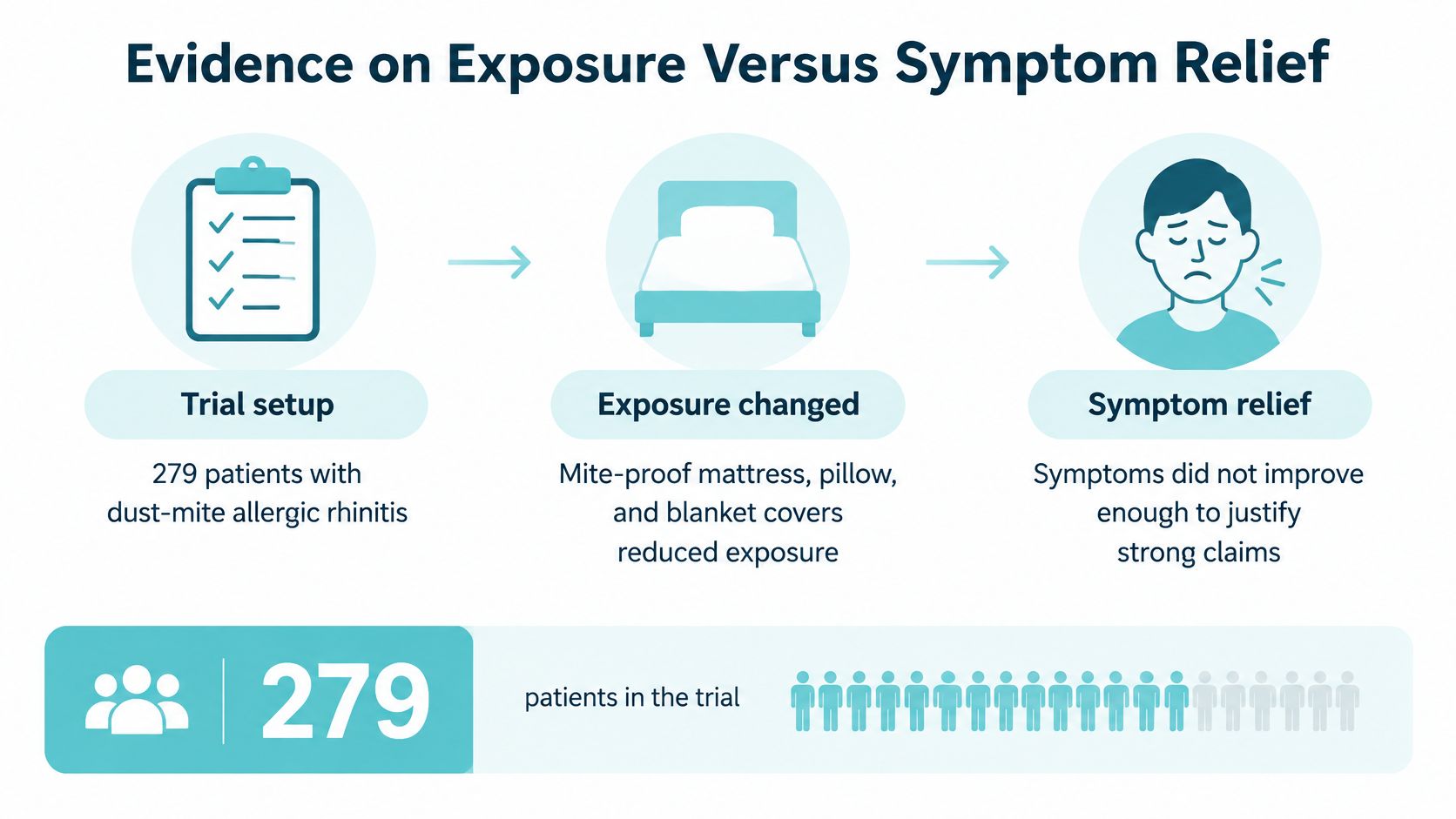
The clinical evidence supports a careful distinction: less allergen exposure doesn't always mean fewer symptoms.
A review of protective bedding evidence describes a randomized trial involving 279 patients with dust-mite allergic rhinitis in which mite-proof mattress, pillow, and blanket covers reduced exposure; a trial of 434 mite-sensitized children aged 3–17 with asthma found fewer exacerbations with impermeable encasings; and a multicenter, double-blind trial of 232 pediatric and adult rhinitis patients found lower bedroom allergen levels without clinical improvement.
These weren't interchangeable populations or outcomes. An asthma exacerbation, bedroom allergen measurement, and rhinitis symptom score answer different questions.
What parents can reasonably expect
A 2024 review available through PubMed Central also reported lower Der f 1 levels by age 8 among children using mite-impermeable mattress covers than among children using placebo covers. That's an exposure finding, not a guarantee of symptom relief.
Together, these findings support using bedding as part of an exposure-reduction program. They don't justify calling a zippered cover an allergy treatment, and trials involving older children don't establish equivalent medical benefits for infants.
Keep the boundary clear: Bedding manages contact with a potential trigger. A pediatrician or allergist diagnoses and treats the child.
Don't stop prescribed treatment because a new cover arrives. Don't stack extra bedding products into a child's bed to chase persistent symptoms, either. Ongoing congestion or wheeze deserves clinical attention, especially when it disrupts sleep.
Infant Sleep Rules That Limit Extra Bedding
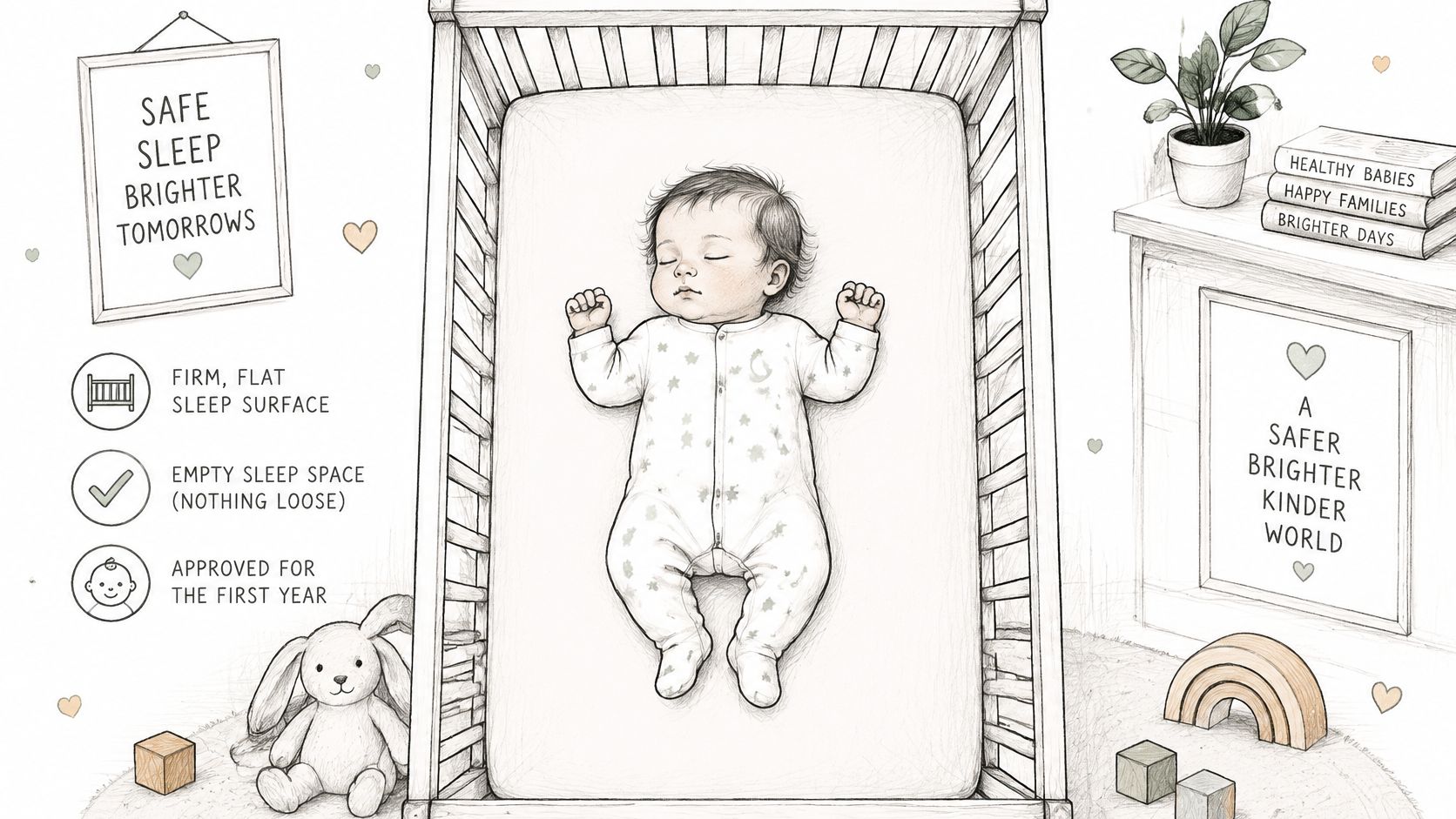
Start with the fitted-sheet-only rule, not the allergy aisle. The American Academy of Pediatrics recommendations call for a firm, flat sleep surface in a safety-approved crib, bassinet, or portable play yard, covered only by a fitted sheet designed for that product.
The same guidance keeps soft objects and loose bedding out because pillows, quilts, comforters, blankets, non-fitted sheets, bumper pads, and stuffed toys can increase suffocation, entrapment, or strangulation risks. An allergen-control claim doesn't make those items appropriate for an infant.
Make safety the purchase filter
Before adding a protective cover, establish whether the sleep-product manufacturer permits it. A compatible layer must fit securely without changing the mattress's firmness, dimensions, or fit inside the sleep space.
Use this order:
- Confirm compatibility. Match the exact mattress and sleep product, not merely a label saying nursery size.
- Check the finished surface. Reject bunching, loose fabric, added cushioning, or a cover that pulls the mattress out of shape.
- Keep extras outside. Don't add an allergen blanket, pillow, topper, or padded mattress protector.
- Choose appropriate warmth. Use a suitable wearable blanket instead of a loose blanket.
Our guide to a safe sleep environment for infants can help caregivers agree on the same setup before bedtime.
Travel doesn't change the rule
Bassinet and play-yard mattresses have their own dimensions and approved configurations. A home mattress encasement that happens to stretch over a travel pad isn't automatically compatible.
If you can't establish a safe fit, choose the product's approved fitted sheet and manage cleaning outside the sleep space. Don't add cushioning to make a thin travel surface feel more like a household mattress.
Toddlers who have moved to an appropriate bed can use compatible mattress encasements and, when appropriate, pillow encasements. That transition still isn't a reason to buy soft pads marketed as allergy protection.
For an infant with persistent congestion, the useful next step is a conversation with their clinician, not another layer beneath their head.
Buying Checklist for Certifications and Fit
A listing may promise hypoallergenic fabric, breathable protection, independent testing, and easy washing. Those claims answer different questions. None should stand in for a report showing allergen-barrier performance.
The Mayo Clinic's guidance on allergen-blocking bedding supports tightly woven, zippered covers that enclose mattresses and pillows. When comparing products, ask whether testing applies to the complete encasement or only a fabric sample.
Buying checklist for allergen barrier products
| Criterion | What to check | Red flag |
|---|---|---|
| Full enclosure | Wrap covers the entire mattress or pillow | Open edges or a one-face pad |
| Zipper | Opening closes fully, with a protected end or tight closure | Visible corner gap |
| Weave or membrane | Tight weave or membrane identified as an allergen barrier | Soft or hypoallergenic claim without barrier evidence |
| Breathability | Documented breathable construction | Unexplained plastic construction with no comfort information |
| Independent testing | Lab report names the test method and tested product | Only a marketing badge |
| Textile safety | Chemical-limit label such as OEKO-TEX Standard 100 | No stated testing information |
| Laundering | Care instructions support your intended wash and drying routine | Dry-clean-only care when you need home laundering |
| Infant fit | Manufacturer-approved fit that stays taut without bulk | Loose, padded, or incompatible layer |
Read the report, not just the badge
A textile chemical-limit label such as OEKO-TEX Standard 100 addresses a different concern from allergen containment. Don't treat it as proof that mites or allergen particles can't pass through a cover.
For barrier testing, look for the named laboratory, test method, product identification, and measured outcome. A material tested before washing doesn't automatically establish how a finished cover performs after repeated laundering.
Our explanation of independent product testing offers useful context for separating a specific test result from a broad safety claim.
Make care requirements realistic
Read the laundry label before paying. A cover that requires delicate handling may still work as a barrier, but it needs a maintenance routine you can sustain.
For infants, manufacturer compatibility and safe fit come first. For older children and confirmed allergy sufferers, prioritize enclosure and documented performance before decorative fabric choices.
If the seller can't explain what was tested, don't pay extra for the word hypoallergenic.
A Laundry Routine That Removes Mites and Allergen
Laundry has separate jobs: kill mites and remove allergen-containing residue. Dead mites don't make the remaining dust harmless, and washing can remove material without killing every mite.
A machine-washing study and laundering evidence summary reports the removal and temperature results below. They describe different routines and outcomes, not a single head-to-head test of every option.
Wash and dry results against mites and allergen
| Routine | Mites | Allergen | When to use it |
|---|---|---|---|
| Water or detergent wash | About 60–83% of live mites removed | About 84% of Der f 1 removed | Regular washing; repeat for further reduction |
| Detergent plus bleach | Not a default for baby bedding | About 98% of Der f 1 removed | Only when product and bleach labels permit |
| Wash at 140°F (60°C) | 100% killed in reported testing | Killing doesn't replace residue removal | When the fabric and barrier tolerate it |
| Wash at 104°F (40°C) | About 9.6% killed | Kill rate doesn't measure allergen removal | Add compatible drying |
| Wash at 86°F (30°C) | 6.5% killed | Low kill doesn't establish low removal | Don't rely on it as a mite-kill cycle |
| Cold wash plus machine dry | About 93% mite reduction in reviewed work | No matching allergen percentage established here | When labels permit drying but not hotter washing |
| Weekly hot washing or a hot-dryer alternative | Follow the clinical guidance below | Wash after a dryer-only kill step | Washable sheets, pillowcases, blankets, and bedcovers |
Mayo Clinic recommends weekly washing at least 130°F (54.4°C), or drying above 130°F for at least 15 minutes when hot washing isn't available, followed by washing to remove residue, in its dust-mite treatment guidance. These temperatures aren't interchangeable with the hotter laboratory wash in the table.
Fit the routine to the fabric
Use detergent as directed and rinse thoroughly. Bleach isn't a baby-bedding default: it may damage some fabrics or membranes, so use it only when the relevant labels permit.
Don't boil an encasement or assume its dryer tolerance matches that of the sheet. Follow the specific cover's instructions, including wiping only when directed, and dry every layer completely before reuse. Our mattress-cover washing instructions explain how to approach care without treating every construction alike.
Manage room moisture alongside laundry
The Lawrence Berkeley National Laboratory reports that mites generally don't survive when relative humidity stays below approximately 50% for an extended period; in one U.S. study, mites fell 98% and allergens 78% when humidity remained below 51%, averaging 46%. Results vary, and bedding microenvironments may be more humid than the room average.
Use a hygrometer rather than guessing from how the room feels. Address moisture problems and use appropriate ventilation, air conditioning, or dehumidification where needed.
For complementary room-care reading, Purified Air Duct Cleaning discusses air filtration for dust mite allergens. Treat filtration as a separate household consideration, not a replacement for controlling the bedding reservoir.
Set Up a Low-Allergen Sleep Space Tonight
You don't need to replace everything in the bedroom. Start with the child's actual sleep setup, remove unnecessary products, and make the maintenance manageable.
A practical order of work
- Inspect the mattress barrier. For a toddler or older child, close the compatible encasement completely and inspect seams. Include any age-appropriate pillow they use.
- Put the fitted sheet outside the barrier. That keeps the regularly changed sleep surface accessible for washing.
- Simplify the infant sleep space. Use only the approved mattress setup and its fitted sheet, with no loose objects or added cushioning.
- Schedule laundry. Choose a recurring wash day and use the hottest wash and drying routine each item permits. A dryer-only kill step still needs washing to remove residue.
- Measure moisture. Place a hygrometer in the room and respond to persistently high readings rather than relying on touch.
- Clean nearby reservoirs. Give carpets, upholstered furniture, and washable stuffed animals their own cleaning routine. Keep toys outside the crib.
- Pack for the actual travel bed. Take a compatible washable fitted sheet, not extra padding intended to improve comfort or allergy protection.
Keep travel care straightforward
For our inflatable toddler travel bed, we recommend crib-sized sheets, preferably stretch cotton jersey. Clean the bed by wiping it with mild soap and water without scrubbing, then rinse and wipe with a soft cloth or allow it to air-dry.
The bed passes all federal health standards and laws under the CPSIA of 2008. That compliance isn't an allergen-barrier certification, and a toddler travel bed isn't an infant sleep surface.
Choose a setup you can maintain consistently, rather than adding products you can't safely fit or regularly clean.
This week, choose one concrete change: inspect and fit an appropriate encasement, or establish a dependable bedding wash day. If congestion or wheeze continues, take the symptom pattern to a pediatrician or allergist instead of adding more layers to the bed.
Hiccapop offers baby and toddler sleep products, including crib mattresses and toddler travel beds, alongside practical care guidance. Visit Hiccapop to explore options for your child's sleep stage, and compare fit and cleaning requirements before adding anything to their bed.