


Crib Mattress Foam: Types, Safety and What to Buy
The Consumer Product Safety Commission counted 139 deaths among the crib mattress incidents it reviewed for its 2022 rule, and the hazards it targeted were softness, poor fit, and construction, not what the core was made from. That's the lens for judging crib mattress foam. A label that says memory, breathable, organic, or high density doesn't tell you whether the finished mattress stays firm, fits your crib, and carries compliance records. Those three checks do.
Disclosure: Hiccapop makes the Dual-Sided Foam Crib Mattress mentioned in this post.
Crib Mattress Foam Types and How They Differ
Crib mattress foam is a foam core under a cover, often with a barrier layer, and it's judged as one finished product in a specific crib. Start with how the core behaves under your baby's head and torso, not with how the material sounds in an ad.
Polyurethane (standard polyfoam)
- Typical feel: Firm to medium, uniform support
- Main infant-sleep concern: Emissions and flame-retardant additives vary by product
- What to check on the label: Compliance statement and finished-mattress test results
Polyester foam
- Typical feel: Softer, springy feel
- Main infant-sleep concern: Fewer VOC types than polyurethane in one study; compression recovery must be verified model by model
- What to check on the label: Compression recovery and firmness results
Memory (viscoelastic) foam
- Typical feel: Slow-response, contours to shape
- Main infant-sleep concern: Conforms around an infant's face, which can raise rebreathing risk
- What to check on the label: Not recommended as the sleep surface for infants under 12 months
Latex foam
- Typical feel: Firm, bouncy, durable
- Main infant-sleep concern: Allergy risk; firmness varies by model
- What to check on the label: Documented firmness results and allergy notes
Plant-based or soy-based foam
- Typical feel: Firmness set by the finished blend and construction
- Main infant-sleep concern: A marketing claim alone does not prove performance
- What to check on the label: Documented compliance and firmness results
The two rows parents confuse most
Standard polyurethane foam is common because it can be made uniformly firm and light. The catch is that products differ a lot in additives and emissions, so you can't grade one polyurethane mattress by another. Polyester foam tends to feel springier, and the 2014 study in Environmental Science & Technology found polyurethane released a greater diversity of VOCs than polyester. That contrast is useful context, not a pass. A polyester mattress that dents a lot or leaves a gap is still the wrong mattress.
For infants under 12 months, memory foam is the clearest no as the sleep surface. It's designed to soften with heat and pressure and contour to a shape, which is the opposite of what an infant surface should do if a baby rolls face down. Latex can feel firm and resilient, but families need to weigh allergy notes and still verify the specific model's firmness. Plant-based or soy-based foam usually describes part of the feedstock or blend. It doesn't, on its own, prove firmness, fit, or compliance.
Practical rule: Shortlist only foam types that come with documented compliance and a finished-mattress firmness result, and set aside any you can't verify.
Under 16 CFR 1241, the federal crib mattress rule, the question isn't whether a foam name sounds natural or technical. It's whether this mattress, with this cover and these dimensions, performs as intended in your crib. Keep that order. Foam type narrows your questions. Documentation answers them.
Federal Rules Every Foam Mattress Must Meet
In the United States, regulators don't approve a block of foam in isolation. They test the assembled mattress, including foam chemistry, cover fabric, barrier layers, adhesives, seams, and compression state. Change one part and the result can change.
For a full-size crib, the CPSC full-size crib guidance states the mattress must measure at least 27 1/4 inches by 51 5/8 inches and may not exceed 6 inches in thickness. Those numbers prevent a baby's head or body from becoming trapped between mattress and crib sides and keep the sleep surface at the height the crib was designed for.
Full-size crib dimensions
- U.S. rule or limit: At least 27 1/4 in by 51 5/8 in
- What it protects against: Head or body trapped between mattress and crib sides
Full-size crib thickness
- U.S. rule or limit: No more than 6 in
- What it protects against: Thicker mattresses change the crib's intended geometry
Cigarette ignition test (16 CFR 1632)
- U.S. rule or limit: Char length no more than 2 in (5.1 cm) in any direction
- What it protects against: Smoldering spread
Open-flame test (16 CFR 1633)
- U.S. rule or limit: Peak heat release no more than 200 kW in 30 min; total heat no more than 15 MJ in first 10 min
- What it protects against: Fire intensity
Crib mattress rule (16 CFR 1241, ASTM F2933)
- U.S. rule or limit: Mandatory firmness, edge, small-part, coating and labeling requirements
- What it protects against: Hazards that foam chemistry alone does not address
What the fire tests actually measure
Under the CPSC mattress flammability FAQ, 16 CFR Part 1632 limits cigarette-test char length to no more than 2 inches (5.1 cm) in any direction from the ignition point, and the open-flame requirements cap peak heat release at 200 kW during the 30-minute test and total heat release at 15 MJ during the first 10 minutes. In plain language, one test checks slow smoldering, the other checks how intense a fire becomes. A soft-feeling foam spec can't tell you either result. Only the tested construction can.
16 CFR part 1241 makes ASTM F2933 mandatory and covers firmness, dimensions, thickness, compatibility, sharp points and edges, small parts, surface coatings, finger entrapment, and labeling. That's why two mattresses using similar foam can perform differently in the same crib.
Look for the compliance statement on the law label, packaging, and manufacturer documents before you compare colors or covers. The guide to crib mattress standards walks through where those statements usually appear. If a seller can't show you a clear statement for the exact model, treat that missing paperwork as a reason to walk away, not as a small detail to sort out later.
Memory Foam, Breathable and Organic Claims Explained
The most persuasive label in the aisle is often memory foam, because adults associate contouring with comfort. For an infant, contouring is the problem. The image below shows why a surface that forms a pocket around a face raises rebreathing and suffocation concerns.
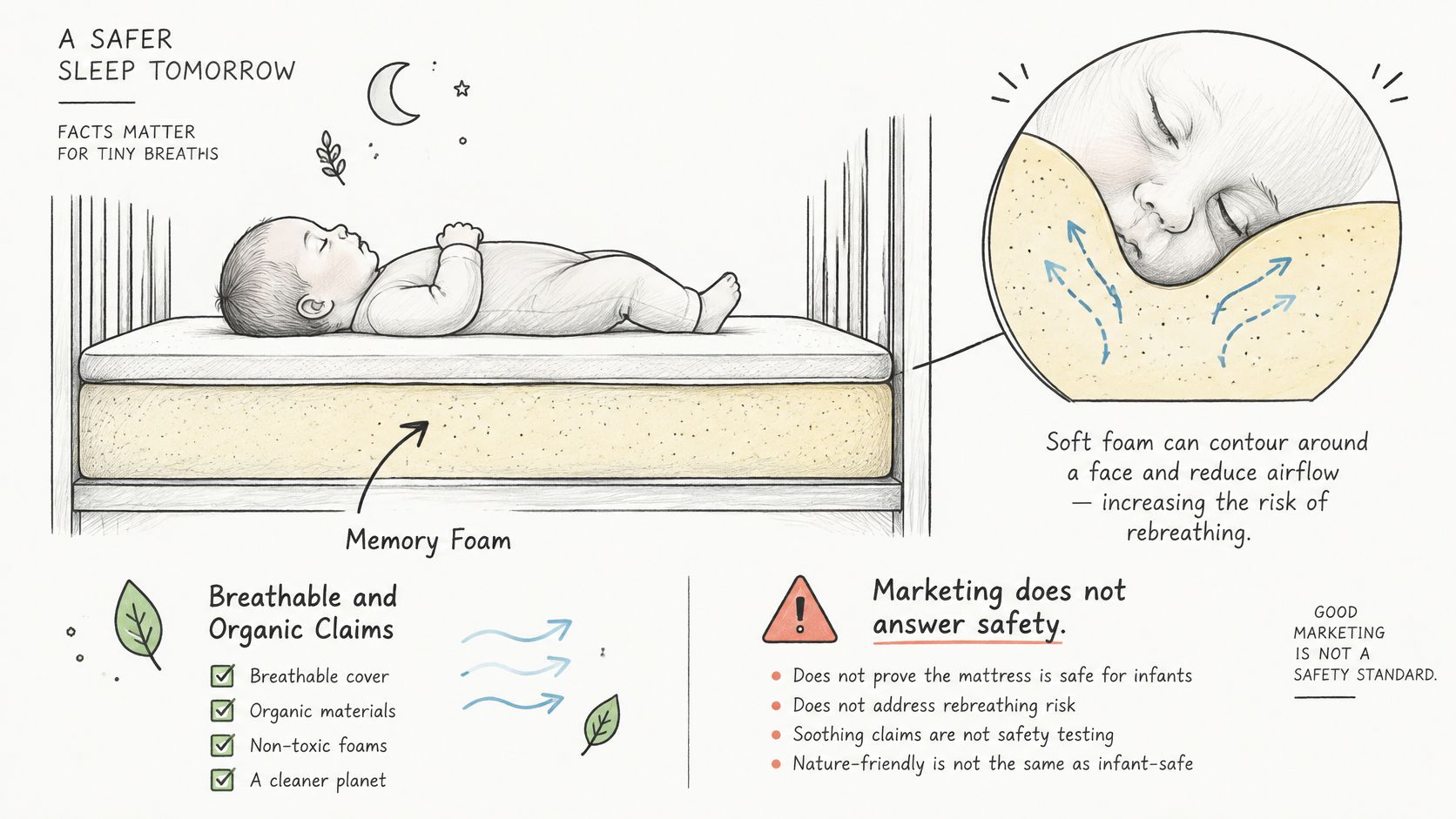
The American Academy of Pediatrics' sleep guidance recommends a crib, bassinet, or portable play yard with a firm, flat mattress and a fitted sheet. Research on crib mattress firmness hazards explains that a soft surface that conforms to an infant's face can increase airflow resistance and carbon dioxide rebreathing.
Words that need documentation
Breathable usually describes airflow through a cover or surface layer. It doesn't prove the mattress is firm enough, fits tightly, or prevents a face from sinking in. Organic versus synthetic is also the wrong first question. A natural material can still be too soft, and a synthetic foam can still be part of a firm, compliant, well-fitting mattress. Mechanical hazards from softness, facial conformity, and poor fit need answers before material origin.
For terms such as low-VOC, plant-based, high-density, breathable, and supportive, ask for documentation behind these terms. They aren't interchangeable technical claims, so give the most weight to documented compliance with 16 CFR 1241 and ASTM F2933, finished-mattress firmness results, and dimensions approved for your crib. If you're comparing natural options, the roundup of the best organic crib mattresses is most helpful after you've made that shortlist. Ask for documents first, adjectives second.
Chemical Emissions, Care and When to Replace
Chemical emissions are one part of choosing a mattress, alongside the firmness and fit of the finished product. The 2014 Environmental Science & Technology study tested 20 new and used crib mattresses. Every mattress emitted volatile organic compounds (VOCs), with mean total-VOC emission rates of 56 micrograms per square meter per hour at 23°C and 139 micrograms per square meter per hour at 36°C. The study also found that VOC concentrations near an infant's breathing zone were 1.8 to 2.4 times higher than in surrounding room air.

Mean total-VOC emission at 23°C
- Value: 56 micrograms per square meter per hour
- Context: 2014 study, 20 mattresses
Mean total-VOC emission at 36°C
- Value: 139 micrograms per square meter per hour
- Context: Warmer conditions raise emissions
Breathing zone vs. room air
- Value: 1.8 to 2.4 times higher
- Context: 2014 study
What those numbers mean, and what they do not
The study's findings describe emissions under specific conditions; they do not show that every detected chemical causes harm at the measured levels. A separate 2015 peer-reviewed analysis examined 20 new and used infant crib mattresses. It found at least one identifiable plasticizer in 17 of the 20 covers, and DEHP or DINP in nine of the 20 covers. Some products also contained flame retardants and unreacted isocyanates.
These findings make ingredient transparency worth considering, but they do not replace checking the finished mattress for firmness, proper fit, and compliance records. Airing out a new mattress may help reduce indoor odors, but it cannot correct a mattress that sags, is damaged, or does not fit the crib.
An older, intact mattress may emit fewer VOCs than a new one, but it may contain flame retardants no longer used, and age alone doesn't make it a good choice if it's sagging, damaged, or the wrong size.
Care steps you can actually follow
- Air it out: Unwrap a new mattress in a ventilated room before first use.
- Avoid unnecessary heat: The study found higher emissions at warmer temperatures, so keep the mattress away from excessive heat.
- Use a fitted sheet: Skip toppers and loose layers that change the sleep surface.
- Clean carefully: Spot-clean the cover with mild soap, dry it fully, and keep liquid out of the foam core. Follow this guide to how to clean a crib mattress without soaking the foam.
- Replace based on condition: Retire a mattress if it sags, cracks, remains stained or odorous, or no longer fits the crib.
Foam Compared With Other Crib Mattress Materials
Parents often ask whether foam is better than springs or natural fiber. The honest answer is that each material can fail the same basic tests if it isn't firm, flat, and correctly sized.
Polyurethane foam
- Advantages: Lightweight, uniform, affordable
- Drawbacks: Emissions and flame-retardant questions; fit must be checked
- Best fit for: Budget buyers who can verify a compliant product
Innerspring
- Advantages: Firm, familiar support
- Drawbacks: Heavier; coil edges need proper covering
- Best fit for: Families who want a traditional firm surface
Coir (coconut fiber)
- Advantages: Natural, firm
- Drawbacks: Thickness and density vary between models
- Best fit for: Parents who want natural materials and can confirm firmness
Latex
- Advantages: Firm, durable
- Drawbacks: Allergy risk; heavier; often more expensive
- Best fit for: Buyers who want durability and have no latex allergy concerns
Hybrid (coil and foam)
- Advantages: Layered firmness
- Drawbacks: Layers can create gaps or sag
- Best fit for: Buyers who have verified fit in their specific crib
Foam wins on light weight, which matters during 2 a.m. sheet changes, and on uniform construction. Its weak spots are the chemical questions covered by product-specific documentation and the need to confirm edge fit after installation. It's a sensible fit for a budget-conscious buyer who can verify compliance for the exact model.
Innerspring offers familiar, firm support and tends to hold its shape, but it's heavier and the coil edges must be properly covered. Choose it if you want a traditional feel and the finished mattress passes firmness and fit checks. Coir appeals to parents who prefer natural fiber and a firm feel, but thickness and density vary between models, so don't assume one coir mattress behaves like another.
Latex is durable and resilient, with allergy as the main family-specific question. Hybrid designs layer coil and foam, which can feel balanced, but layered edges deserve extra attention for gaps or sag over time.
Whatever you pick, the CDC sleep guidance defines the surface as firm, flat, and not angled, in a crib that meets current federal standards and covered by a fitted sheet. Install the mattress, then look for bowing, curling, or folding across the base. Pick the material that suits your budget and handling needs, then verify that specific model. Material preference comes second to flatness you can see.
How to Check Firmness, Fit and Compliance Before You Buy
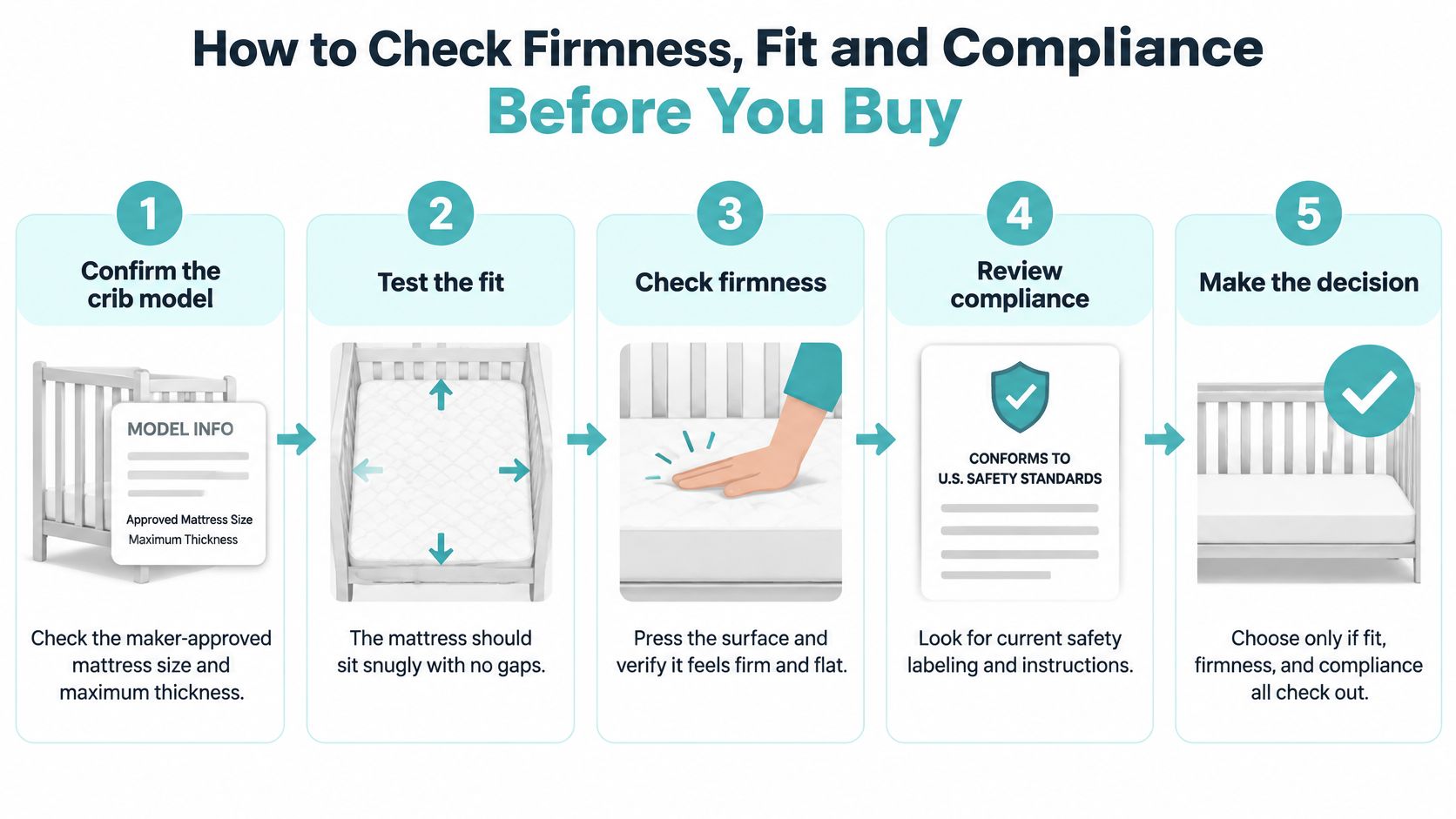
Check the mattress in the crib where it will be used. Foam labels alone cannot show whether the finished mattress is firm enough, fits the crib, and has the required compliance documentation. The research on crib mattress firmness hazards discusses airflow resistance and carbon-dioxide rebreathing as separate hazards that may have cumulative effects. A hand press can help screen firmness, but it cannot replace documented results.
- Confirm the crib model: Record the exact model and the mattress size and maximum thickness approved by its manufacturer. “Standard” may not be enough to establish compatibility, especially for mini cribs, hand-me-downs, or travel systems.
- Measure inside the crib: Note the interior length and width, then compare them with the mattress specifications. A mattress may feel firm on a store floor but still be the wrong size for your crib.
- Press the center and edges: Push a flat hand firmly into the center, then near each edge, and release. The foam should resist a head-sized dent and recover without holding a deep contour. A lasting hollow could create a space where exhaled air collects.
- Check the side gap: Install the mattress and run your fingers along each side and corner. The CPSC's crib checklist says to make sure there are "no gaps larger than two fingers between the sides of the crib and the mattress." If the gap is larger, stop and recheck the specifications. A gap can trap a child's head or body.
- Check that the surface is flat: Look across the mattress for curls, bows, folds, or slopes. A slanted surface can change a child's sleeping position, and an incompatible base may affect how the foam performs.
- Fit the sheet: Put on the fitted sheet you plan to use. It should be snug, with no loose corners or bunching that lifts the mattress edge.
- Skip add-ons: Do not add toppers, pads, wedges, or extra foam layers. They change the finished mattress's firmness or height from what was assessed.
- Request the paperwork: Ask for the compliance statement for 16 CFR 1241 and ASTM F2933, along with finished-mattress firmness results. For labels such as firm, high density, or plant-based, ask for documentation behind these terms.
How to judge what your hand feels
The goal is support for a small head and torso, followed by predictable recovery when pressure is released. Adult mattress firmness labels are inconsistent, so for a crib, prioritize the installed checks and the manufacturer's documents over a comfort rating.
Pass-or-fail rule: If the mattress fails any check, it is not a suitable match for that crib, even if the foam itself seems firm.
Hiccapop's Dual-Sided Foam Crib Mattress measures 52 x 27.5 x 6 inches and is made for full-size cribs. The firm side is the infant side. The softer toddler side uses CertiPUR-US memory foam and isn't for infants, for the reasons covered above. If you use it for a baby, keep the firm infant side facing up, and run the same fit and gap checks above in your own crib. View the mattress specifications.
Sources and Further Reading
These are the sources behind the figures and rules in this guide, named so you can look each one up directly.
- Boor et al., Environmental Science & Technology (2014), DOI 10.1021/es405625q: Study of 20 new and used crib mattresses measuring VOC emissions, temperature effects, foam differences, and breathing-zone concentrations.
- Environmental Science & Technology Letters (2015), DOI 10.1021/acs.estlett.5b00039: Analysis of 20 crib mattresses covering plasticizers, DEHP and DINP, flame retardants, and unreacted isocyanates.
- Barker and Leshner, Cureus (Feb. 11, 2025): Investigation of Suffocation Mechanisms in the Infant Sleep Environment Using a Mechanical Breathing Model Simulation, covering airflow resistance and carbon dioxide rebreathing on soft surfaces. DOI 10.7759/cureus.78852.
- 16 CFR Part 1241 and ASTM F2933: The federal crib mattress rule and the mandatory standard it incorporates for firmness, dimensions, compatibility, and labeling.
- 16 CFR Parts 1632 and 1633: Federal flammability requirements covering cigarette ignition and open-flame performance.
- Consumer Product Safety Commission: Guidance on crib mattress compatibility, full-size crib dimensions, and flammability.
- American Academy of Pediatrics and CDC: Sleep guidance calling for a firm, flat, unangled surface covered only by a fitted sheet.
Related Products
-
![]()

- Regular price
- $154.99
- Sale price
- $154.99
- Regular price
-
- Unit price
- per
Sold out


Related Products
-
![]()
- Regular price
- $154.99
- Sale price
- $154.99
- Regular price
-
- Unit price
- per
Sold out