


Best Baby Storage Containers for Every Need
The changing table is crowded with diapers, clean bottles are sharing space with folded pajamas, and the diaper bag still contains yesterday's empty snack box. You don't need another matching set of containers. You need storage that makes each job easier without creating a cleaning chore or a safety problem.
The best baby storage containers work as a connected system: accessible organizers for nursery supplies, properly documented food-contact containers for feeding, and secure, manageable options for travel. Start with what you're storing, not what looks neat in a shopping photo.
Disclosure: Hiccapop makes and sells some of the nursery products mentioned in this post.
Why the Right Baby Storage Matters
A basket beside the changing table can be perfect for diapers and completely wrong for prepared food. A tightly sealed meal container can be useful in a caregiver's bag but annoying for socks you reach for throughout the day. Buying everything in the same format usually means compromising somewhere.
Give each storage area a clear purpose. Keep changing supplies together, separate clean feeding equipment from used items, and give outgoing travel supplies a designated place. You should be able to explain the arrangement to a babysitter without opening every drawer.
Match the container to the job
Use this comparison as a starting point, not a universal ranking.
Diapers and everyday clothing
- Strong starting choice: Open bin or divided organizer
- What to prioritize: Easy access and visible labels
- What to avoid: Deep containers that hide supplies
Backup nursery supplies
- Strong starting choice: Removable-lid box
- What to prioritize: Clear identification and manageable weight
- What to avoid: Oversized boxes you struggle to move
Homemade baby food
- Strong starting choice: Small, shallow food containers
- What to prioritize: Documented intended use and portion visibility
- What to avoid: Large tubs opened repeatedly
Prepared meals away from home
- Strong starting choice: Secure meal container
- What to prioritize: Reliable closure and easy cleaning
- What to avoid: Complicated lids you can't inspect
Bottles during outings
- Strong starting choice: Carrier with appropriate cold storage
- What to prioritize: Temperature management
- What to avoid: Assuming insulation alone is refrigeration
A useful system performs distinct jobs: organizing belongings, protecting contents, managing portions, allowing thorough cleaning, and avoiding hazards around children. Those priorities don't always point toward the same product.
Treat labels as questions
“Airtight” should prompt you to inspect the seal. “Stackable” should make you check the loaded arrangement. “Food-grade” should lead you to the manufacturer's intended-use instructions, not end your evaluation.
For room layouts and organizing approaches, Hiccapop's nursery storage solutions offer a useful place to develop your setup. Choose the locations before buying the containers, especially around a crowded changing station.
Practical rule: Buy for the task you perform most often, then account for cleaning, carrying, and child access.
A coordinated nursery doesn't require identical boxes. Consistent labels and predictable locations matter more than matching lids.
Baby Storage Container Types Explained
Separate nursery organization, food storage, and transport before comparing materials. A divided tray for clean socks and a divided lunch box may look related, but they solve different problems. Don't assume a household organizer belongs in a feeding routine.
These formats give you a practical vocabulary for shopping.
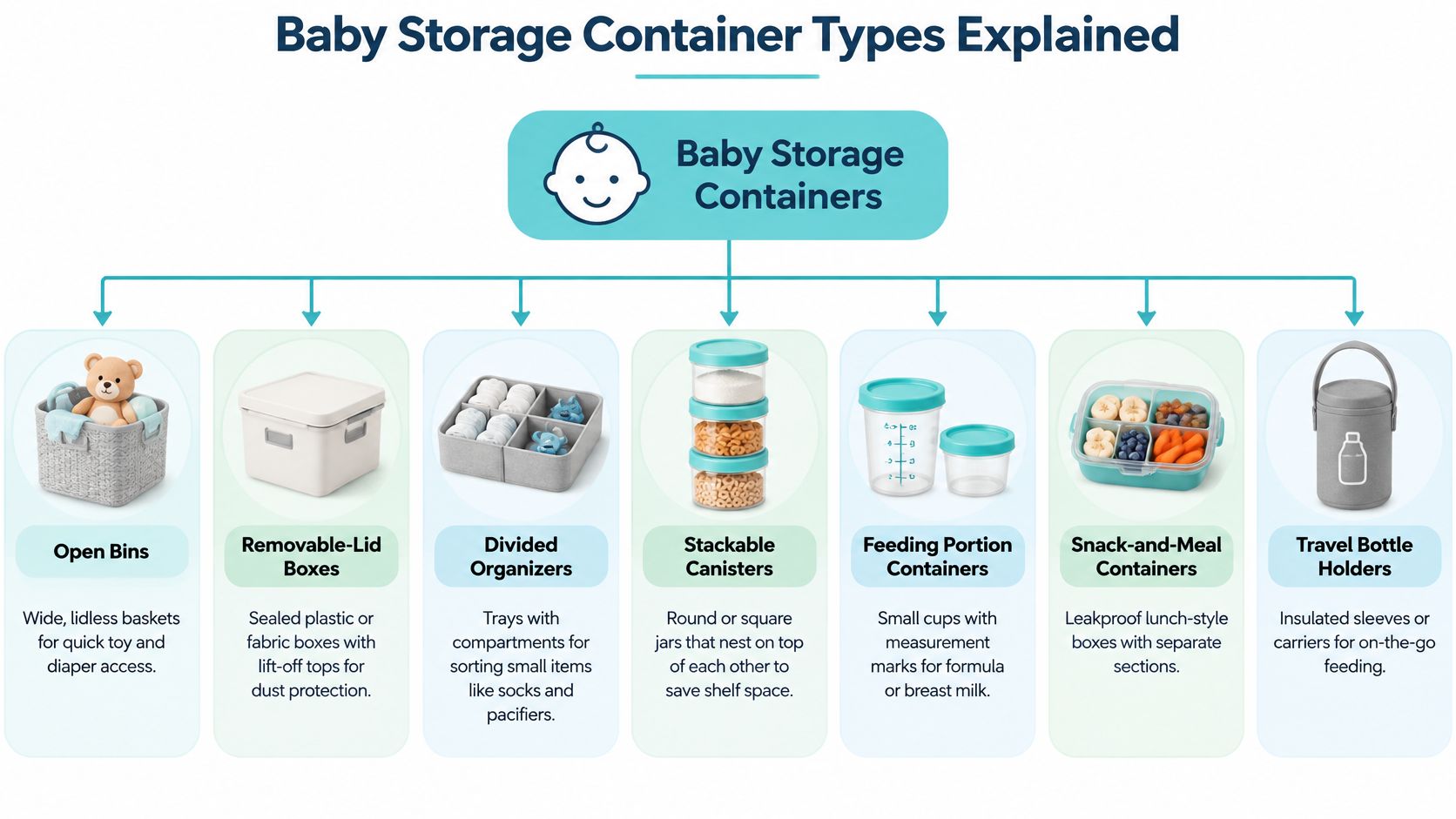
Nursery formats favor access
Open bins suit diapers, bibs, and toys that adults retrieve frequently. Choose a shape that lets you see the contents rather than requiring a rummage through unrelated items.
Removable-lid boxes make sense for backup clothing or supplies you don't need during every change. Keep their contents focused: spare pajamas in one place, larger clothing in another. A box labeled “miscellaneous” usually needs a better assignment.
Divided organizers help separate small belongings, such as socks and clean feeding accessories. Check that you can remove or reach the dividers for cleaning rather than treating compartment count as the main selling point.
Feeding and travel formats need different scrutiny
- Stackable canisters: Consider these for an adult-managed shelf or dry-storage station. Decorative canister sets can be handy for styling, but how they look tells you nothing about whether they're suitable for infant food.
- Feeding portion containers: Look for readable markings and a size suited to the food you intend to store. Containers for dry formula, prepared formula, and breast milk aren't automatically interchangeable.
- Snack-and-meal containers: Compartments can separate foods, but inspect whether the lid seals each compartment. A baby snack container should also suit how your child eats and how you'll clean it.
- Travel bottle holders and soft-sided bags: Treat these as carrying equipment. Choose them around the bottles, containers, and cold source you'll pack.
Avoid asking one format to handle the entire household. An open organizer can make changing easier while a small sealed container handles lunch, with neither needing to imitate the other.
Before buying a large set, map each format to a location. If you can't name its contents and where it will live, leave it off the shopping list.
Glass, Silicone, and Plastic Compared
BPA-free isn't a complete material assessment. FDA evaluates food-packaging materials by how much substance may migrate into food and whether the resulting exposure is safe for the intended use; its guidance on BPA and food-contact applications makes intended conditions of use central to that assessment.
Ask for explicit food-contact compliance information and instructions covering the uses you need. Freezer suitability doesn't establish microwave suitability, and permission to wash the base doesn't necessarily extend to every lid component.
Glass for a controlled home routine
Glass is worth considering for home food storage when an adult handles it and breakage is manageable. Visibility helps you identify contents, but the additional weight can make a crowded diaper bag less practical.
Don't assume every glass jar tolerates freezing, reheating, or sudden temperature changes. Follow the specific product's instructions, including those for its lid. A glass base with an unsuitable closure isn't a complete freezer-storage solution.
For cleaning, inspect the whole assembly. Glass doesn't eliminate the need to reach lid grooves, remove permitted seals, and check for damage.
Silicone for flexible portioning
Silicone is worth considering when you want a flexible portion tray. Judge the actual design: can you carry it when filled, close it without spilling, and remove portions without struggling?
Require stated food-contact suitability and temperature limits rather than relying on a soft texture or reassuring packaging. Check cleaning access and whether food odors remain after washing. Don't assume all silicone products perform identically.
Plastic for manageable transport
Lightweight plastic can be a practical choice for caregiver bags and outings. Its convenience doesn't settle questions about repeated heating or prolonged food contact, so buy around documented use conditions.
A UCSF-affiliated pediatric environmental-health guide advises avoiding plastic food storage where possible and choosing glass or unlined metal, citing concern about plastics breaking down into microplastics. That recommendation supports reducing unnecessary exposure; it doesn't establish that every plastic baby container is harmful.
Choose a material for the conditions you can control, not for a promise that it solves every feeding risk.
Unlined metal deserves consideration too, particularly for dry, non-acidic items when the manufacturer explicitly permits them. You can't inspect the contents through the wall, so labeling becomes more important. Don't infer suitability for acidic food, freezing, or heating from the word “metal.”
The right material is situational: glass where careful handling is realistic, flexible trays for an appropriate portioning routine, and documented lightweight containers where carrying weight matters. For every material, evaluate washing, odors, impact, and temperature limits at the product level.
Features That Survive Real-World Testing
A lid that closes neatly on an empty container may behave differently after washing or when the container is full. Test the complete setup before trusting it beside spare clothing, in a vehicle, or at the bottom of a caregiver's bag.
Start with the manufacturer's instructions, then run simple household checks. These aren't laboratory tests. They're a way to discover awkward handling before you depend on the container.
Baby storage features by use
Open bin
- Contents at a glance: Easy with shallow contents
- Stackability: Usually limited
- Secure closure: None
- Portion tracking: Not intended
- Travel suitability: Poor for loose items
Removable-lid box
- Contents at a glance: Depends on transparency
- Stackability: Check loaded fit
- Secure closure: Design-dependent
- Portion tracking: Usually limited
- Travel suitability: Useful for supplies
Divided organizer
- Contents at a glance: Easy when open
- Stackability: Design-dependent
- Secure closure: Often secondary
- Portion tracking: Compartment-based
- Travel suitability: Requires a suitable lid
Stackable canister
- Contents at a glance: Depends on material
- Stackability: Designed for stacking, verify stability
- Secure closure: Inspect individually
- Portion tracking: Markings vary
- Travel suitability: Can be bulky
Feeding portion container
- Contents at a glance: Often straightforward
- Stackability: Check lid support
- Secure closure: Essential to inspect
- Portion tracking: Strong with clear markings
- Travel suitability: Useful with temperature control
Snack-and-meal container
- Contents at a glance: Easy when opened
- Stackability: Shape-dependent
- Secure closure: Check compartment seals
- Portion tracking: Visual separation
- Travel suitability: Often practical
Soft-sided travel bag
- Contents at a glance: Requires opening
- Stackability: Limited
- Secure closure: Secures the bag, not its contents
- Portion tracking: None
- Travel suitability: Designed for carrying
Check the details that affect daily use
- Seal fit: Close the container and inspect for gaps, displaced gaskets, or uneven grip. For liquid-rated products, test with water before packing food.
- Loaded stability: Stack filled containers on the intended shelf. Reject arrangements that rock or require careful balancing.
- Readable markings: Check volume marks while holding the container as you would during preparation. Decorative printing isn't useful if you can't read it.
- Cleaning access: Confirm you can reach corners and reassemble removable parts correctly.
- Usable labels: Try the label method through the washing and storage routine the manufacturer permits.
For food portions, favor shallow containers with room for freezer expansion. Food-safety guidance supports small portions, airtight storage, date labeling, and refrigeration at 40°F or lower, with FoodSafety.gov's baby-food storage chart providing food-specific storage windows.
Don't fill freezer containers tightly to the brim. Select a label area that remains visible when containers are arranged together, so you don't have to dismantle the freezer to identify dinner.
Finally, check the complete use cycle. Chilling, freezing, reheating, washing, and repeated opening may involve different instructions. If the lid and base have different limits, build your routine around those differences rather than the broadest claim on the package.
Choose Containers for Nursery Feeding and Travel
Build separate setups, then use consistent naming and labeling across them. You don't need a nursery that looks like a warehouse, but another caregiver should know where clean bibs belong and which food portion to use.
This mixed arrangement keeps everyday supplies accessible while giving feeding and travel their own requirements.
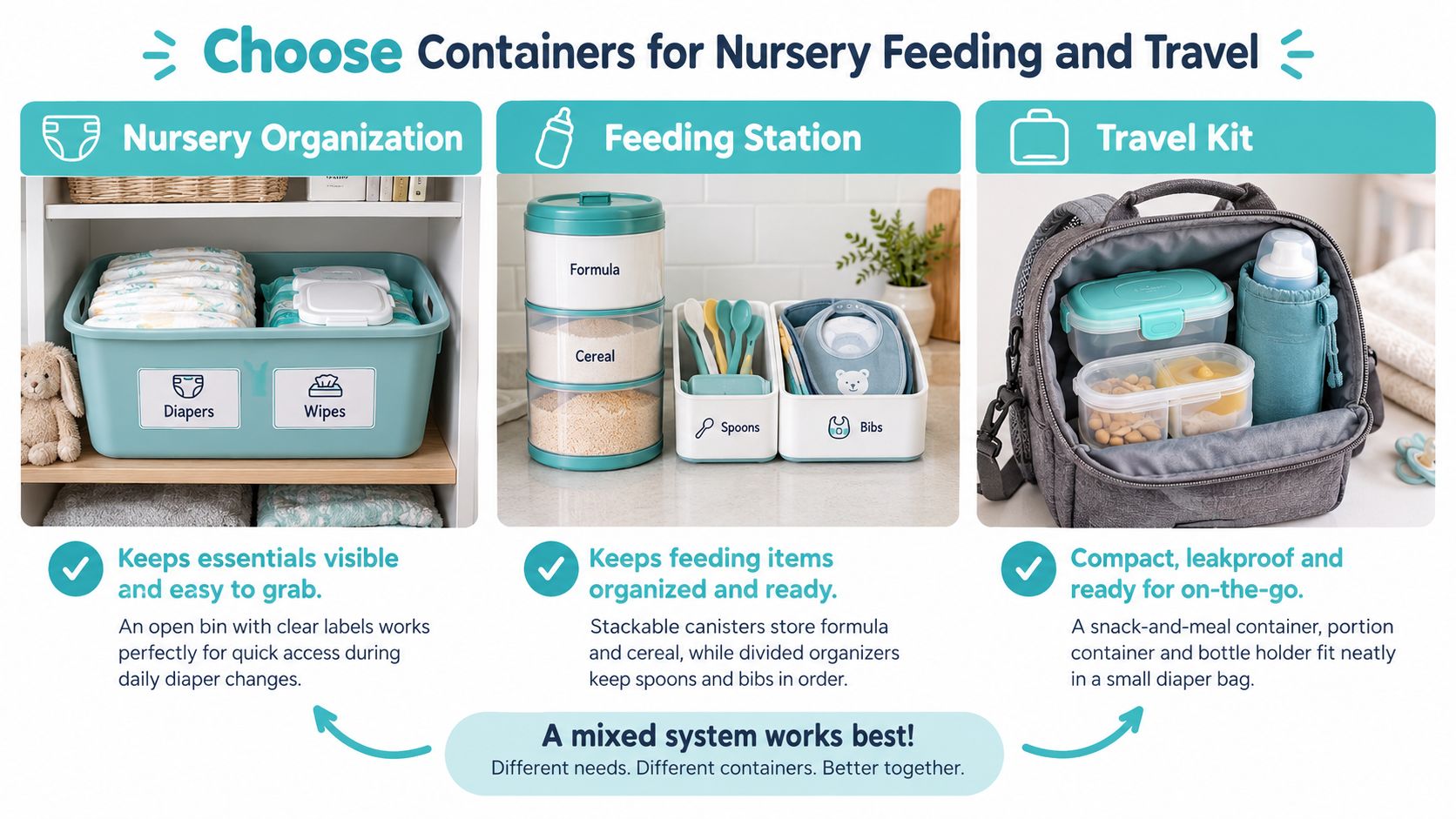
Set up the nursery around adult tasks
Place frequently used diapers, wipes, and spare clothing together. Separate backup stock from the supplies needed during a change, and give toys their own storage rather than letting them migrate into feeding equipment.
Use divided organizers for small clothing and clean accessories. For dry supplies, label the contents plainly and keep any necessary preparation instructions with the product. Don't decant something merely because a matching canister looks tidier.
Give homemade food a defined route
Plan the path from preparation to storage to serving before buying baby food freezer containers. FDA recommends freezing homemade baby food in cubes or small portions, transferring frozen portions to an airtight container or freezer bag, and adding a date. Its guidance also says to serve into a separate dish to avoid contaminating stored food with saliva from a used spoon, and not to leave perishable infant food, milk, or formula without refrigeration or another cold source for more than two hours, as explained in FDA's infant food-safety guidance.
Use the food-specific storage chart cited earlier to set your rotation. Don't choose the largest container merely because you cooked a large batch.
For formula, preserve access to the original preparation and product information. A baby formula storage container should fit the distinction between dry powder and prepared feeds, not blur it.
Pack travel supplies for the actual outing
- Choose manageable weight: Glass may suit your kitchen but be awkward alongside bottles, clothing, and changing supplies.
- Pack cold storage deliberately: A secure lid prevents spills; it doesn't maintain food temperature.
- Separate clean and used equipment: Give the used spoon or empty meal box a designated return space.
- Check handoff clarity: Include the food name and any preparation instructions another caregiver needs.
Food preparation still matters once the box is packed. CDC advises avoiding hazardous foods such as whole grapes, popcorn, spoonfuls of nut butter, and cheese cubes for children under four, and emphasizes appropriate preparation and supervision in its choking-hazard guidance.
Before leaving, rehearse the handoff: open the bag, identify the meal, retrieve the spoon, and put used equipment away. A setup that works on the counter should also work when you're carrying it.
Avoid Lock-In and Falling-Lid Hazards
A roomy storage chest isn't automatically a family-friendly purchase. Once a child can reach into it, pull against it, or climb inside, the lid and locking mechanism become more important than capacity.
CPSC warns that automatic latches can trap children inside storage chests. Its storage and toy chest safety guidance recommends disabling or removing applicable automatic locks, maintaining unobstructed ventilation openings, and using supports that hold hinged lids open in every position.
Use the visual checklist as a reminder, but follow those specific mechanical checks rather than relying on a “child-resistant” or “soft-close” label.
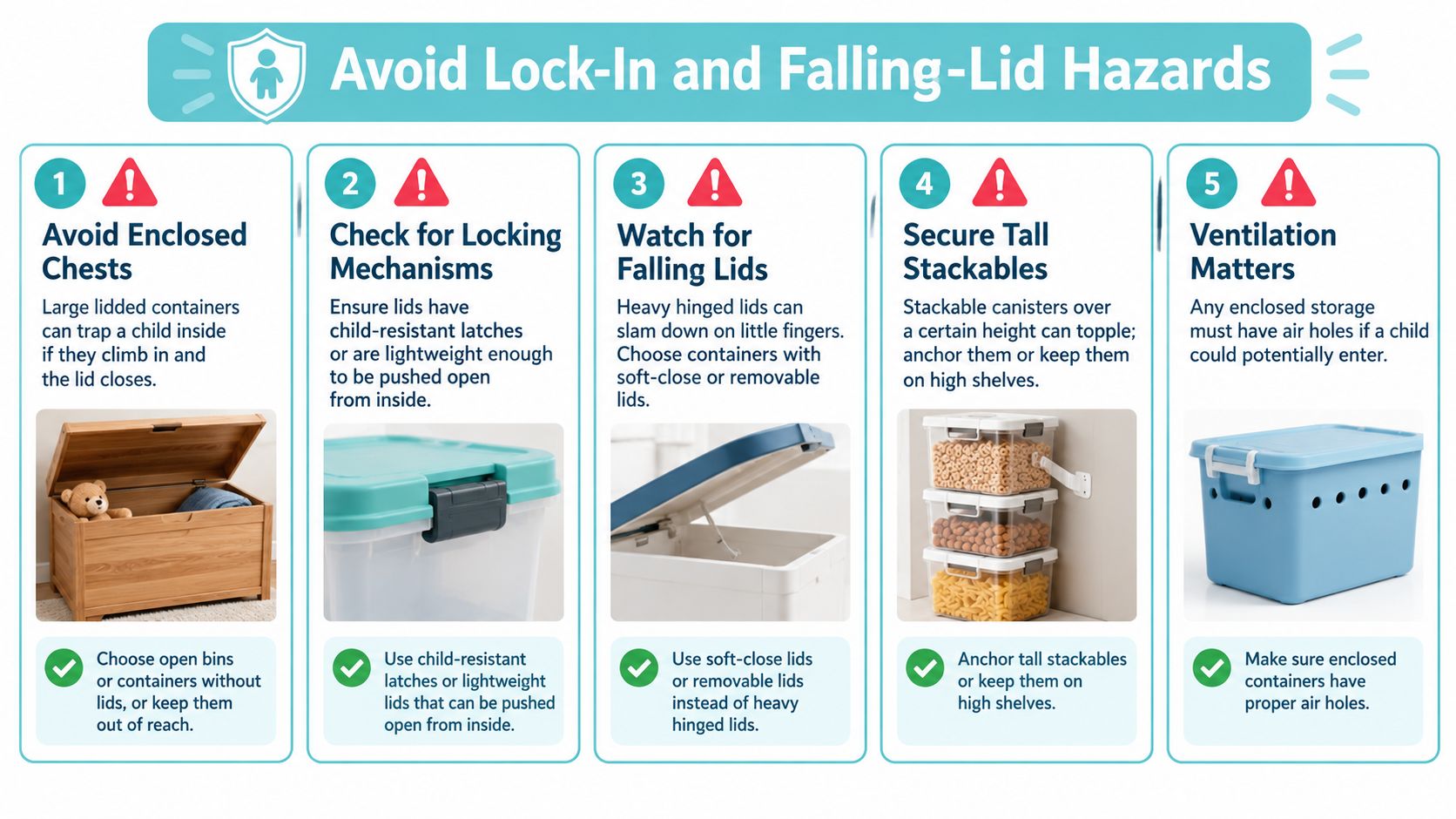
Inspect before buying or reusing
Start with an empty chest, away from your child. Raise and lower the lid while checking its support, then inspect the interior and hinge area.
- Lid support: It should hold the lid open in every position, not just when fully raised.
- Locking mechanism: Don't treat a latch requiring simultaneous actions as a substitute for addressing an applicable automatic lock-in hazard.
- Ventilation: Check that openings remain clear when the chest is in its intended position beside a wall or on the floor.
- Edges and hinges: Look for sharp edges and places where fingers could be pinched.
- Ongoing condition: Recheck the mechanism rather than assuming an older support still works correctly.
A falling lid requires action, not a reminder to be careful. CPSC's toy chest safety alert recommends open bins, lightweight removable lids, or sliding-door storage as alternatives, and advises removing a freely falling lid or fitting a functioning support.
Consider the room, not just the container
Position storage so you aren't encouraging children to climb for a favorite toy. Don't solve a tipping concern by placing an unstable stack somewhere harder to reach.
Safety checkpoint: If a child could climb inside, assess the container as an enclosure, not merely an organizer.
When you can't verify an older chest's mechanism, choose a simpler alternative. Sentimental value isn't a reason to accept an unreliable lid.
Make Your Final Baby Storage Decision
Buy the smallest coordinated system that solves your actual problems. A large matching bundle can leave you with unsuitable sizes, unused lids, and nowhere sensible to put the extras.
The short version: open or removable-lid organizers for nursery supplies, appropriately documented containers for food, and manageable secure containers for travel. Choose glass at home if careful handling fits your routine; choose another documented material when weight, flexibility, or breakage concerns make it more practical.
Use a purchase checklist
Before ordering, answer these questions for the actual product, not the material category.
- Documentation: Does the manufacturer clearly identify food-contact suitability where needed?
- Conditions of use: Are freezing, heating, hot-food contact, and washing instructions explicit?
- Closure: Can you inspect, clean, and correctly reassemble the seal?
- Capacity: Does the size match the portion or nursery item you'll store?
- Identification: Are volume marks and date labels readable in the intended arrangement?
- Handling: Can you carry and open it comfortably when occupied with childcare?
- Placement: Does it fit without precarious stacking or creating a child-access hazard?
If an answer depends on an unsupported assumption, pause the purchase. A seller should be able to clarify intended use without substituting “non-toxic” for practical instructions.
Trial the routine before expanding it
Start with a limited selection and use it through your ordinary day. Ask another caregiver to find a clean bib, identify a stored meal, and repack the travel kit.
Notice friction. If lids get mixed up, simplify the range; if labels disappear from view, change their placement; if a container is tedious to wash, reconsider it before buying more. Your system should remain workable on a tired evening, not only immediately after organizing.
The best baby storage containers won't replace temperature control, clean handling, or discard rules. They should make those habits easier to follow without adding unnecessary decisions.
Choose the problem you want to solve first: changing-table clutter, homemade food portions, or a difficult diaper-bag handoff. Share that priority with the people who care for your child, and build a setup everyone can use consistently.
Once the storage is sorted, the changing station is the next spot to simplify. Hiccapop's Wipe Warmer & Dispenser keeps wipes warm and within reach at home, and the Portable Wipe Warmer & Dispenser brings the same comfort to the diaper bag. Shop Hiccapop nursery essentials and finish your changing-table setup today.