


Best Baby Proofing Products for Your Home: Safe Gates and Locks
When you’re looking for the best baby-proofing products, remember this: the goal is to create layers of safety, not to replace your watchful eye. From my experience, the essentials that tackle the biggest risks are hardware-mounted gates for stairs, magnetic locks for cabinets, and anti-tip straps for heavy furniture. The real secret is finding reliable, well-made gear that’s simple for you to operate but impossible for a clever toddler to outsmart.
Creating a Safe Harbor for Your Curious Explorer
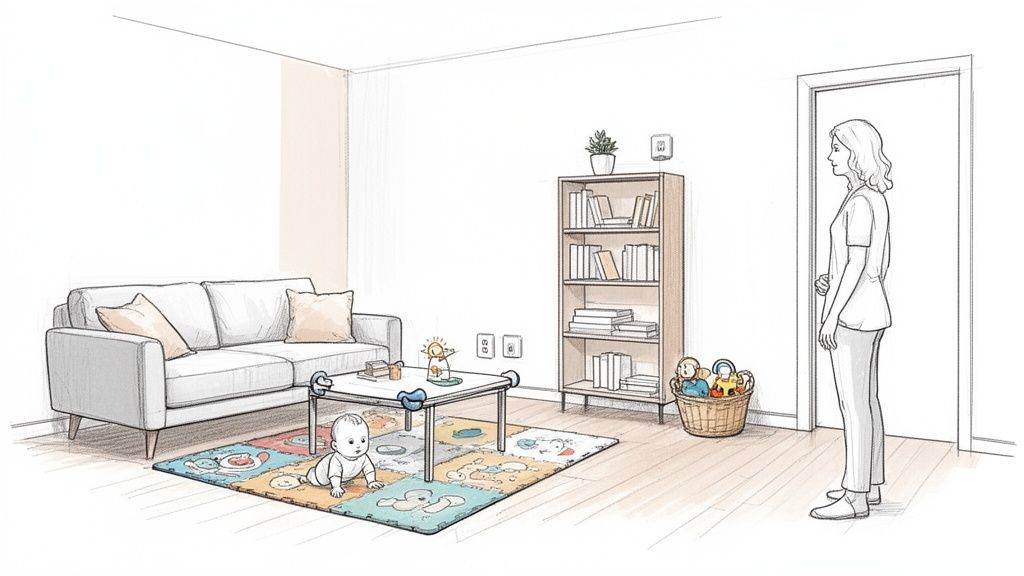
It happens in a flash. One moment your baby is cooing in their bouncer, and the next they’re halfway across the room, making a beeline for a power outlet. It’s a classic parenting milestone that kicks off a whole new chapter: the age of exploration.
This isn't about wrapping your home in bubble wrap or stifling your child's curiosity. It’s about thoughtfully building a safe harbor where they can learn, play, and grow without you having to worry about what’s lurking around the next corner.
Forget the flimsy gadgets and outdated advice. We're moving beyond that. Today’s best products are effective, innovative, and designed to blend right into your home. The idea is to strategically create secure zones, giving you peace of mind while your little one gets the freedom they need.
Why Proactive Baby Proofing Matters
The best time to baby-proof is before you think you need to. Babies don't give you a two-week notice before they start crawling. One day they're happily stationary, and the next they're pulling up on everything in sight. Setting up a safe environment ahead of time means you’re ready for these milestones instead of frantically trying to catch up.
This proactive mindset is catching on. The global baby safety products market has seen huge growth, jumping from USD 227.54 billion in 2023 to an estimated USD 232.24 billion in 2024. This isn't just a trend; it's driven by parents who understand that proper proofing dramatically reduces the risk of childhood injuries. For a deeper dive into these numbers, you can find more market insights on GlobeNewswire.
Baby proofing isn't about creating a "no" environment. It's about building a "yes" space, where your child has the freedom to touch, play, and learn within safe boundaries. It's a fundamental part of creating the perfect play environment for your baby or toddler.
Ultimately, baby proofing is a tangible expression of care. It's about anticipating needs and designing a home that works for every member of your family—especially the smallest ones.
A Practical Room-by-Room Baby Proofing Checklist
Feeling like you're staring up at a mountain of baby proofing tasks? You're not the only one. The idea of securing an entire house can feel completely overwhelming. Let's break it down into a simple, room-by-room game plan that actually works.
Think of this as your personal home safety tour. We'll walk through the biggest "hotspots"—the kitchen, living room, bathroom, and nursery—and point out the hazards you might not even see yet. By focusing on one space at a time, you can turn a huge job into a series of small, satisfying wins.
The Kitchen: The Heart of the Home and a Hazard Hotspot
The kitchen is where everyone gathers, but for a little one, it’s an obstacle course of potential dangers. Hot appliances, sharp utensils, and chemical cleaners are everywhere. The goal here is simple: create clear boundaries.
To really get it right, you have to see the world from their level. Get down on your hands and knees. What looks interesting? What’s just begging to be pulled on or opened?
Key Kitchen Safety Actions:
- Secure Cabinets and Drawers: Get locks on all your lower cabinets and drawers. This is non-negotiable for anything containing cleaning supplies, knives, heavy pots, or glass. Magnetic locks are fantastic for keeping toxic items completely sealed away.
- Lock Down Appliances: Toddlers are shockingly strong. Use appliance latches on the fridge, oven, dishwasher, and microwave to stop them from prying open heavy doors.
- Manage Cords: A dangling cord from a coffee maker or toaster is an invitation to pull, which can bring a heavy appliance crashing down. Keep them unplugged and tucked away.
- Stove Safety: Stove knob covers are a must-have to prevent tiny hands from turning on a burner. A stove guard adds another layer of protection, creating a physical barrier between your child and hot surfaces.
Nailing these key areas will drastically cut down the risks in your kitchen. For a deeper dive, you can learn more about how to childproof your home in our comprehensive guide.
The Living Room: Creating a Safe Playspace
Your living room is where your family kicks back and your baby plays. The mission here is to soften sharp edges and anchor anything big and heavy that could tip over. This space is all about preventing bumps, bruises, and more serious accidents.
Look at your furniture and electronics through the eyes of a tiny, aspiring mountaineer. That entertainment center? It's a jungle gym. Stability is everything.
Essential Living Room Safeguards:
- Anchor Your Furniture: This is the big one. Bookshelves, dressers, and TV stands must be anchored to the wall. Anti-tip straps are cheap, easy to install, and could save a life. According to the U.S. Consumer Product Safety Commission, a child goes to the ER every 46 minutes from a furniture or TV tip-over.
- Soften Sharp Corners: Coffee tables, media consoles, and fireplace hearths all have sharp corners right at head-level for a wobbly toddler. Cushion them with soft corner guards or edge bumpers.
- Cover Electrical Outlets: Open outlets are magnets for curious fingers. Simple plug-in covers work, but for outlets you use often, a sliding cover or a full box shield is a much safer bet.
- Tidy Up Cords: All those cords for lamps, TVs, and chargers need to be secured. Bundle them with cord shorteners or hide them in a cord cover to eliminate tripping and pulling hazards.
Here's a quick-reference table to help you pinpoint the most critical areas in your home and the products designed to secure them.
Baby Proofing Hotspots and Essential Solutions
| Room | Common Hazards | Essential Products |
|---|---|---|
| Kitchen | Sharp objects, cleaning chemicals, hot surfaces, heavy appliances | Cabinet & drawer locks, appliance latches, stove knob covers, stove guard |
| Living Room | Unstable furniture (TVs, bookshelves), sharp corners, electrical outlets, loose cords | Furniture anchors/anti-tip straps, corner guards, outlet covers, cord organizers |
| Bathroom | Drowning risk (toilet, tub), access to medications, slippery surfaces, hot water | Toilet lock, cabinet locks, non-slip bath mats, water spout cover |
| Nursery/Bedroom | Window blind cords, climbing out of crib, heavy furniture, electrical outlets | Cordless blinds or cord wraps, furniture anchors, outlet covers |
This table isn't exhaustive, but it covers the absolute must-haves for making the most-used rooms in your house significantly safer for your little explorer.
The Bathroom: A Splash Zone of Potential Dangers
The bathroom is a triple threat: water, hard surfaces, and easy access to medications. Securing this room is all about preventing slips, burns, and accidental poisonings. It only takes a couple of inches of water to create a serious risk for a small child.
The golden rule of bathroom safety is constant supervision, especially during bath time. Baby proofing products are your backup, not a substitute for your own two eyes.
Top Bathroom Proofing Priorities:
- Install a Toilet Lock: This handy little device stops your toddler from lifting the heavy lid (which can slam down on their fingers) and keeps them from playing in the toilet bowl.
- Secure Cabinets: Lock up any and all cabinets that hold medicines, cosmetics, or cleaning supplies. A simple latch or magnetic lock is all it takes to prevent a tragedy.
- Prevent Slips and Scalds: A non-slip mat inside the tub and a bath mat outside of it are essential. You can also install an anti-scald device on faucets to keep the water from ever getting dangerously hot.
- Use a Spout Cover: A soft, cushioned cover for the bath spout can save your baby from a nasty bump on the head if they slip or play too enthusiastically in the tub.
With these straightforward but crucial steps, you can methodically transform these high-risk rooms into safe, welcoming spaces for your child to grow and explore.
Choosing the Right Safety Gates and Cabinet Locks
When you’re trying to create safe zones for a curious little one, gates and cabinet locks are your absolute best friends. They're the physical barriers doing the heavy lifting, standing between your toddler and a world of potential trouble. I like to think of them less as restrictions and more as tools that create freedom—freedom for your child to explore safely and for you to finally take a breath.
But let's be honest, staring at a wall of options can feel overwhelming. Let’s cut through the noise and break down the most common types so you can pick what actually works for your home's unique layout.
This is a great way to visualize the challenge: think of home safety as a pyramid, with each room presenting its own unique set of risks that need specific solutions.
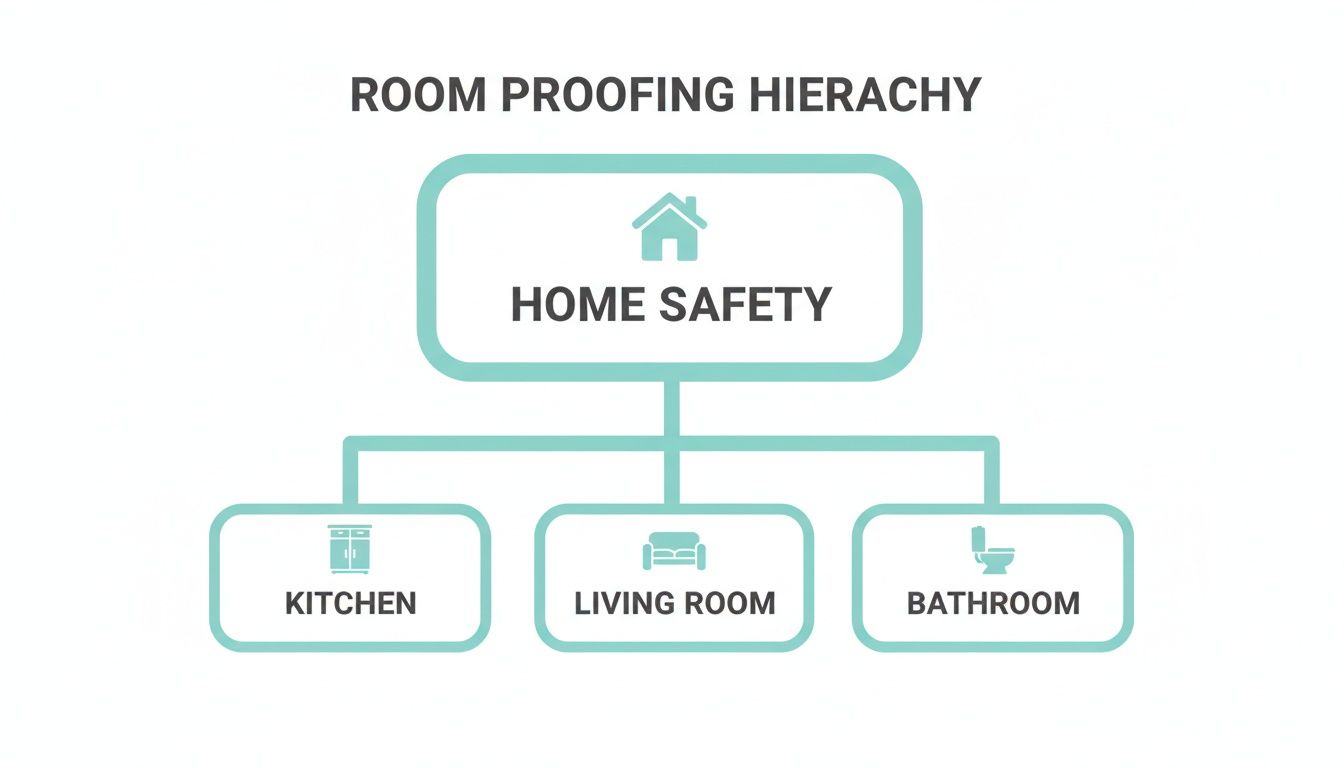
As you can see, a solid baby-proofing plan means tackling the high-risk zones head-on. Places like the kitchen and bathroom are where the right guards and locks become non-negotiable.
Demystifying Safety Gates
Safety gates are your first line of defense for walling off entire rooms or, most importantly, blocking access to staircases. You'll mainly see two types: pressure-mounted and hardware-mounted. Knowing the difference isn't just helpful—it's critical.
-
Pressure-Mounted Gates: These are the ones held in place by, you guessed it, pressure against a doorframe or walls. They’re fantastic for doorways between rooms or at the bottom of stairs because they don't require any drilling and you can move them around easily. But, and this is a big one, they are not secure enough for the top of a staircase. A determined toddler could potentially push one over.
-
Hardware-Mounted Gates: These gates are screwed directly into the wall or doorframe, making them the most secure option you can buy. This is the only type of gate that should ever be used at the top of stairs. The solid installation ensures it can withstand a surprising amount of force without budging an inch.
When you're looking at different barriers, understanding the components of various fence and gate kits can be useful, as the core principles of a secure install are often the same. My pro-tip? Look for gates with an auto-locking mechanism. A gate that closes and locks itself is an absolute lifesaver when your hands are full.
Unlocking the Secrets to Cabinet Safety
The moment your baby becomes mobile, every single cabinet handle becomes an irresistible new toy. And what’s inside? Cleaning chemicals, sharp objects, and all sorts of other hazards. This is where cabinet locks come into play.
There’s a good reason the market for these locks is booming. Falls account for a staggering 50% of non-fatal injuries in kids under five, and incidents of cabinet entrapments are also on the rise.
Here are the main types of locks you'll be choosing from:
Magnetic Locks
Think of these as the Fort Knox of cabinet locks. They install on the inside of the cabinet, so they're completely invisible from the outside—perfect for keeping your kitchen looking sharp. You just use a magnetic "key" to unlock them from the exterior.
Best For: Securing cabinets with seriously dangerous stuff, like chemicals or medications. Because they're hidden, your toddler won't even know there's a lock to mess with.
Adhesive Strap Locks
These are the jack-of-all-trades and incredibly easy to install. An adhesive strap connects two anchor points, letting you secure everything from cabinets and drawers to refrigerators and even toilets. They're a fantastic, damage-free choice if you're renting.
- Pro Tip: Look for straps that have a dual-action release. This means you have to perform two separate motions to open it, which is much, much harder for little fingers to figure out.
Spring-Loaded Latches
These are a classic for a reason. They're simple latches installed inside a drawer or cabinet that you release by pressing down on the plastic latch while opening the door. They're affordable and get the job done for low-to-medium risk areas.
At the end of the day, choosing the right gate or lock isn't about finding one single "best" product. It’s about matching the right tool to the specific risk in your home. By understanding these key differences, you can build a layered defense system that keeps your little explorer safe and sound.
Securing Overlooked Dangers Around Your Home
Okay, you’ve tackled the big stuff—gates are up, outlets are covered, and the cleaning supplies are locked down. That’s a huge win! But now it’s time to put on your detective hat and spot the less obvious dangers hiding in plain sight.
These are the hazards that often get missed in that first frantic wave of baby proofing but are every bit as critical. Think of this as moving from the beginner level to the advanced course. This is how you create a space where your little one can explore safely, and you can breathe a little easier.
Anchoring Heavy Furniture and TVs
This one is a big deal, and frankly, it’s non-negotiable. To a curious toddler, a tall bookshelf or a dresser looks like a personal Mount Everest. That big-screen TV on its stand? Same thing. Without being anchored, these heavy items are incredibly unstable and can tip over in a heartbeat.
The statistics here are genuinely scary. A child is sent to the ER every 46 minutes because a piece of furniture or a TV tipped over on them, according to the U.S. Consumer Product Safety Commission. This is a tragedy we can absolutely prevent.
Furniture anchors or anti-tip straps are the answer. They’re cheap, surprisingly easy to install, and create a rock-solid connection between your furniture and the wall. It becomes impossible for a child to pull it over on themselves. This isn't just one of the best baby proofing products you can buy—it's one of the most essential.
Addressing Hidden Strangulation and Choking Risks
Some of the most serious hazards are the things we, as adults, barely even notice. Dangling cords and small, everyday items can pose a huge risk to babies and toddlers.
- Window Blind Cords: Those long, looped cords are a major strangulation hazard. The absolute safest bet is to switch to cordless blinds. If that's not in the budget, use a cord cleat or wrap to get the cord high up and completely out of your child's reach.
- Trash Cans: To a toddler, your trash can is a treasure chest filled with fascinating things like bottle caps, food scraps, or used batteries—all serious choking hazards. A trash can with a secure, child-resistant lid is a must-have.
- Door Pinch Guards: A slamming door can do serious damage to tiny fingers. Simple C-shaped foam pinch guards slip over the edge of the door and stop it from closing all the way, leaving a finger-safe gap.
A truly safe home goes beyond securing physical objects. It also involves maintaining a healthy environment. Beyond physical obstacles, truly securing your home involves addressing environmental threats. Watch out for these unmistakable signs of mold in your house, which can pose significant health risks to infants.
Managing Water and Electrical Hazards
You’ve probably covered the outlets in the living room and nursery, but it's easy to forget about the hidden electrical and water dangers, especially in the kitchen and bathroom.
Hot water is a danger most parents don't think about until it's too late. A child's skin is far more sensitive than ours, and they can get a serious burn from water that feels perfectly warm to you.
Installing an anti-scald device on faucets and showerheads limits the maximum water temperature, adding a critical layer of protection. These are simple to install and bring incredible peace of mind during bath time. This detailed guide on how to baby proof stairs can also help you tackle another major home hazard.
How to Spot High-Quality and Reliable Products
Not all baby-proofing products are created equal. Walk down the safety aisle, and you’ll find a dizzying array of gadgets. It’s tempting to just grab the cheapest option, but flimsy products are like a leaky umbrella—they’re guaranteed to fail when you need them most.
Learning to spot quality isn’t just about avoiding frustration; it’s about investing in real peace of mind. A well-made lock or gate becomes a reliable partner in keeping your home safe. It’s the difference between a cabinet latch your toddler laughs at and one that actually keeps them out of harm’s way.
Look for Safety Certifications
One of the fastest ways to vet a product is to look for a JPMA (Juvenile Products Manufacturers Association) certification. This seal means the product was independently tested to meet or exceed established safety standards. It’s a powerful shortcut for finding gear that’s already been put through its paces.
While not every great product will have this specific certification, its presence is a strong signal that the manufacturer is serious about safety. Think of it as a gold star for reliability.
Prioritize Non-Toxic and Durable Materials
Your baby will inevitably try to chew, lick, or otherwise mouth every single thing they can reach—and that includes your new corner guards and cabinet locks. This is why material safety is non-negotiable.
Always look for products explicitly labeled non-toxic and BPA-free. This ensures that even if your little one decides to taste-test the baby gate, they aren’t being exposed to harmful chemicals.
Durability is the other side of that coin. A quality product will be made from sturdy plastic or metal that can withstand the yanking, pulling, and general chaos that a toddler brings. Weak adhesive or a flimsy plastic latch is a definite red flag.
There’s a reason the market for high-quality, safe baby products is growing. It's projected to jump from USD 269.57 billion in 2025 to a massive USD 431.64 billion by 2034. North America currently leads this market, driven by parents demanding—and laws mandating—features like non-toxic materials and reliable auto-locking gates.
Focus on Functionality for You and Your Toddler
The best baby-proofing products are brilliantly designed: easy for adults to operate but nearly impossible for a child to defeat. If a cabinet lock requires a Ph.D. and a prayer to open, you’ll just end up leaving it unlocked out of sheer frustration.
A truly effective safety device should integrate smoothly into your daily life. The goal is to add a layer of security, not a layer of constant annoyance for you.
Here are a few functional features to look for:
- Dual-Action Mechanisms: Many of the best locks require two separate actions to open (like squeezing and pulling at the same time). This simple complexity is easy for an adult hand but completely stumps a toddler.
- Clear Installation Instructions: Good products come with easy-to-follow instructions and all the hardware you need. If it looks like a nightmare to install, it probably is.
- Invisible Solutions: Magnetic locks and under-mount latches are fantastic because they don’t change the look of your home. More importantly, they don’t give your curious toddler a visual cue that there’s something new and exciting to play with.
By prioritizing official certifications, insisting on safe and sturdy materials, and choosing products that are cleverly designed for real life, you can build a safety net that is both effective and easy to live with.
Answering Your Top Baby Proofing Questions
Even after you've snapped the last cabinet lock into place and anchored that wobbly bookshelf, the questions don't just stop. That’s because baby proofing isn't a "one and done" weekend project—it's an ongoing dance you do with your child's newfound skills.
To help you navigate those "what if" and "what now?" moments, we've compiled answers to the questions we hear most often from parents in the trenches.
When Is the Best Time to Start Baby Proofing?
The golden rule here is simple: start before you think you need to. That sweet spot is often during the second or third trimester, long before your little one is on the move. Most parents really get serious around the 4-6 month mark, right when their baby starts showing the first wiggles of rolling and trying to sit up.
Getting a head start saves you from that heart-stopping moment when you see your baby making a beeline for an open outlet. It lets you approach the job calmly and methodically.
Think of it in phases:
- Phase 1 (The Pre-Crawler): This is the time for the big stuff. Get those hardware-mounted gates installed at the top and bottom of the stairs. Use anti-tip straps to anchor every piece of heavy furniture and every TV in your home.
- Phase 2 (The Explorer): Once they're scooting, crawling, or pulling up, it's time for layer two. Add your cabinet and drawer locks, plug in those outlet covers, and soften all the sharp furniture corners with guards.
Starting early turns a frantic chore into a thoughtful process of preparing your home for its newest, most curious resident.
How Can I Baby Proof Without Damaging My Home?
This is a huge concern, especially for renters who are eyeing that security deposit. The great news is that you don't have to sacrifice safety for the sake of your walls. Many of the best products today are designed specifically for damage-free installation and removal.
Keep an eye out for products that use strong, modern adhesives that are made to be removed cleanly. They're engineered to withstand a toddler's determined pulling but will come off without a fight when you're ready.
A Pro Tip for Removing Adhesives: When it's time to take down corner guards or locks, don't just rip them off the wall. Grab a hairdryer and gently warm the adhesive for about 15-30 seconds. The heat softens the bond, letting you peel it away without taking paint with it or leaving a sticky mess behind.
For baby gates, high-quality pressure-mounted models are your best friend in hallways and doorways. They often come with soft rubber bumpers or wall cups that distribute the pressure, preventing those ugly dents and scuffs on your doorframes.
Are All-In-One Baby Proofing Kits Worth It?
Those big kits can look like the perfect, easy solution. And honestly, they can be a decent starting point to cover the most obvious bases. Most will bundle together outlet covers, some basic cabinet latches, and maybe a few corner guards.
But the reality is that a one-size-fits-all approach almost never fits any one home perfectly. The quality can be hit-or-miss, and you’ll likely end up with a pile of gadgets you don't need and a shortage of the ones you do.
My advice? Use a kit as a jumping-off point, but then cherry-pick high-quality, individual items for the most critical areas of your home.
- Always buy a separate, top-rated, hardware-mounted gate for the top of the stairs. Never rely on a pressure-mounted one from a kit for that location.
- Invest in heavy-duty magnetic locks for any cabinet with dangerous materials, like cleaning supplies or medicine.
- Make sure the furniture anchors you buy are specifically rated to handle the weight of your furniture.
Think of it as creating a custom safety plan for your home's unique quirks and your child's specific brand of mischief.
My Toddler Figured Out the Childproof Locks. What Now?
First off, take a deep breath. It's not a failure on your part—it's a sign that you have a very clever kid on your hands! It happens to all of us. When they crack the code on a simple device, it just means it's time to level up.
If your toddler has mastered that simple spring latch, it's time to upgrade to something more complex, like a magnetic lock that’s completely invisible or a dual-action strap lock that requires two separate motions to open. The name of the game is staying one step ahead.
But most importantly, remember that no gadget is a replacement for your eyes and ears. Baby proofing is all about creating layers of protection that buy you a few precious seconds to intervene. It’s a constant process of observing, adapting, and readjusting—not something you can just set and forget.
At Hiccapop, we build the gear we wish we’d had as new parents—thoughtfully designed, rigorously tested, and ready for real life. From home safety essentials to travel gear that just works, we’re obsessed with giving you peace of mind. See how smart design can make your family’s life a little bit easier and a whole lot safer at Hiccapop.