


Mastering 3 Month Old Wake Windows
The sweet spot for a 3 month old wake window—the amount of time your little one can happily stay awake between snoozes—is usually around 60 to 120 minutes. This chunk of awake time covers everything from feeding and playing to cuddling and winding down for the next nap. Getting this timing right is often the secret to sidestepping an overtired, fussy baby and making naptime a whole lot smoother.
What Are 3 Month Old Wake Windows Anyway?
I like to think of a wake window as a baby's "social battery." It's fully charged when they first wake up, and every coo, feeding, and tummy time session drains it a little. If you let that battery get too low, things start to get glitchy. That’s your classic overtired baby who, paradoxically, can't seem to fall asleep. On the flip side, if you try to put them down for a "recharge" too soon, they won't have used enough energy to sleep well.
At three months old, this whole concept becomes a parent's best friend. Why? Because your baby is finally starting to graduate from that sleepy, unpredictable newborn haze. Their brain is developing at an incredible pace, and their sleep is shifting from random snoozes to more defined patterns.
Why Timing Suddenly Matters So Much
Just a few weeks ago, your newborn probably slept anytime, anywhere, without much rhyme or reason. But around three months, their internal body clock (the circadian rhythm) starts to kick in, making wake windows an essential tool for a calmer, more predictable day. Watching the clock helps you anticipate their needs before the meltdown starts.
Here’s why paying attention to 3 month old wake windows can make such a huge difference:
- Prevents Overtiredness: An overtired baby is a stressed baby. They get a rush of cortisol (a stress hormone) that makes them wired, fussy, and likely to fight sleep with every ounce of their being.
- Promotes Better Naps: When a baby is perfectly tired—not under-tired and bored, but not over-tired and frantic—they’re much more likely to settle easily and take a long, restorative nap.
- Sets the Stage for Night Sleep: Good daytime sleep almost always paves the way for better nighttime sleep. Consistent wake windows and solid naps help regulate their entire 24-hour sleep cycle.
A wake window isn’t just about playtime. It’s the total time your baby is out of their crib or bassinet, including feeding, diaper changes, and the pre-sleep routine.
Understanding Your Baby's Total Sleep Needs
It helps to see how these short wake windows fit into the bigger picture of your baby's day. For a quick overview, here's what you can generally expect.
Quick Guide to Your 3 Month Old's Day
| Metric | Typical Range |
|---|---|
| Total Sleep in 24 Hours | 13 to 13.5 hours |
| Nighttime Sleep | 8.5 to 10.5 hours |
| Daytime Sleep (Naps) | 3 to 5 hours |
| Number of Naps | 3 to 4 naps |
| Wake Window Duration | 60 to 120 minutes |
These numbers give you a great starting point, but remember they are just averages! Every baby is different.
Research shows that most 3-month-olds get about 13 to 13.5 hours of total sleep. This is usually broken down into 8.5 to 10.5 hours at night and a few naps during the day. As they leave the newborn stage behind, you might even notice their longest stretch of sleep hitting 5 hours or more.
Ultimately, tracking wake windows is less about following a rigid schedule and more about learning to read your baby's unique cues. While our guide on wake windows by age offers excellent benchmarks, the best approach is always to watch your baby for their specific sleepy signals.
Why Your Baby’s Sleep Is Suddenly Changing
Does it feel like you just got the hang of your baby's sleep routine, only for it to completely fall apart? You’re not imagining it. Right when you think you’ve cracked the code, your little one throws you a curveball. This sudden shift is so common it has a name: the 4-month sleep regression, which often shows up a little early, right around the three-month mark.
But here’s the thing: “regression” isn’t really the right word. It’s not a step backward at all—it's actually a huge leap forward in their brain development. Your baby's sleep is getting a major upgrade, and like any big system update, things can get a little buggy at first.
From a Light Switch to a Smart System
Newborn sleep is pretty simple. Think of it like a light switch: it’s either on (asleep) or off (awake). There's not much complexity to it.
Around three months, though, that basic light switch gets swapped out for a sophisticated smart-home system. Your baby’s sleep is maturing to look a lot more like adult sleep, complete with distinct stages and cycles. This is an incredible developmental milestone!
This new system means they now cycle between light and deep sleep throughout a nap or the night. The tricky part? At the end of each cycle, your baby briefly surfaces to a much lighter stage of sleep. If they haven’t yet learned how to drift back off on their own, they'll wake up completely—and probably start calling for you.
This biological transformation is why your baby might suddenly start taking frustratingly short naps or waking more frequently at night. They aren't trying to be difficult; their brain is just learning to manage a brand-new operating system.
As their sleep architecture changes to mirror adult patterns, you'll often see more night wakings and shorter naps. This is especially true if a baby relies on external help, like being rocked, to fall asleep in the first place.
Why Wake Windows Become Your Best Tool
Because of this massive neurological shift, paying close attention to your 3 month old wake windows is more important than ever. Nailing that perfect moment for sleep—not too early and not too late—gives your baby the best possible chance of connecting those new, tricky sleep cycles.
This period is all about progress, even when it feels like a step back. By understanding what’s really happening in your baby’s brain, you can see these sleep disruptions not as a problem, but as a sign of healthy development. And as you'll see, these major baby milestones are often linked to big changes in sleep, feeding, and play.
How to Spot Your Baby’s Sleepy Cues
While the clock gives you a fantastic starting point for 3-month-old wake windows, your baby is always going to be your best guide. Learning to read their unique sleepy signals is like getting a secret cheat sheet for naptime. You just have to know what to look for.
The real trick is to catch those early cues. These are the gentle whispers that say, "Hey, I'm getting tired and could probably go for a nap soon." If you can act on these, you've found the golden ticket to getting your baby down for a nap without a fight.
Early Sleepy Cues: The Green Lights for Sleep
When you notice these subtle signs, it’s the perfect time to start your wind-down routine and head for the crib. Think of these as the absolute best indicators that your baby is primed and ready for sleep.
- The Thousand-Yard Stare: Your baby's focus goes a bit fuzzy. They might seem to be looking right through you or staring off into space.
- Slowing Down: They'll often become quieter and more still, losing interest in playing or interacting.
- Red Eyebrows: This is a classic one! You might see a little bit of pink or red appear around their eyebrows or on their eyelids.
- The First Yawn: A single, little yawn is often the very first clear sign that their energy is winding down.
Catching these early cues means you’re working with your baby’s natural sleep rhythms, not against them. It makes everything so much easier.
Late Sleepy Cues: The Overtired Red Alerts
If you miss those early whispers, your baby will start shouting. These late cues are signs that your baby has tipped over into being overtired. Their body is now running on stress hormones like cortisol, which basically acts like a shot of adrenaline. An overtired baby is an exhausted baby who is now too wired to sleep.
An overtired baby is like a tired adult who just chugged a double espresso—they’re desperate for rest, but their body is too revved up to relax. This is exactly why they fight sleep so hard, even when they desperately need it.
Here are the common late-stage cues to watch out for:
- Frantic Eye-Rubbing: Vigorously rubbing their eyes and face.
- Fussiness and Irritability: They go from happy to cranky in the blink of an eye.
- Arching Their Back: This is a classic sign of discomfort and being completely overstimulated.
- Full-Blown Crying: This is their final, desperate plea for help.
Learning to tell the difference between the early signs and the late ones is a game-changer. You’ll become so much more confident in trusting your instincts over a rigid schedule, paving the way for smoother naps and a much happier baby.
Crafting a Flexible Daily Sleep Schedule
Now that you’re getting the hang of spotting your baby's sleepy cues, let's talk about how to weave them into a predictable daily rhythm. The goal here isn't a strict, by-the-clock schedule. Instead, think of it as a gentle, flexible routine that honors your baby’s natural flow. The secret weapon for this is a simple pattern: Wake > Eat > Play > Sleep.
This little sequence is a game-changer. By feeding your baby after they wake up instead of right before they go to sleep, you help them learn to fall asleep on their own, without needing a bottle or nursing to get drowsy. It also means they start their wake window with a full tank, giving them plenty of happy energy for all that important playtime.
Building a Flexible Routine
A 3-month-old's entire day is basically a loop of these wake windows. You'll likely see about four naps throughout the day, though some babies might consolidate these into three longer stretches. The most important thing is to watch your baby for their cues, not the clock.
And what does "play" look like at this age? It's simpler than you think. Quality playtime for a 3-month-old is all about connection and gentle stimulation.
- Tummy Time: Even just a few minutes here and there works wonders for building their neck and core strength.
- High-Contrast Toys: At this stage, their vision is still developing. Simple black-and-white cards or toys with bold, graphic patterns are absolutely captivating for them.
- Face-to-Face Interaction: Never underestimate the power of just talking to your baby, singing songs, or making funny faces. It's rocket fuel for their developing brain.
The infographic below is a great visual reminder of how quickly a baby can go from showing early, subtle sleepy signs to being in full-blown overtired meltdown mode. It’s all about catching them in that sweet spot.
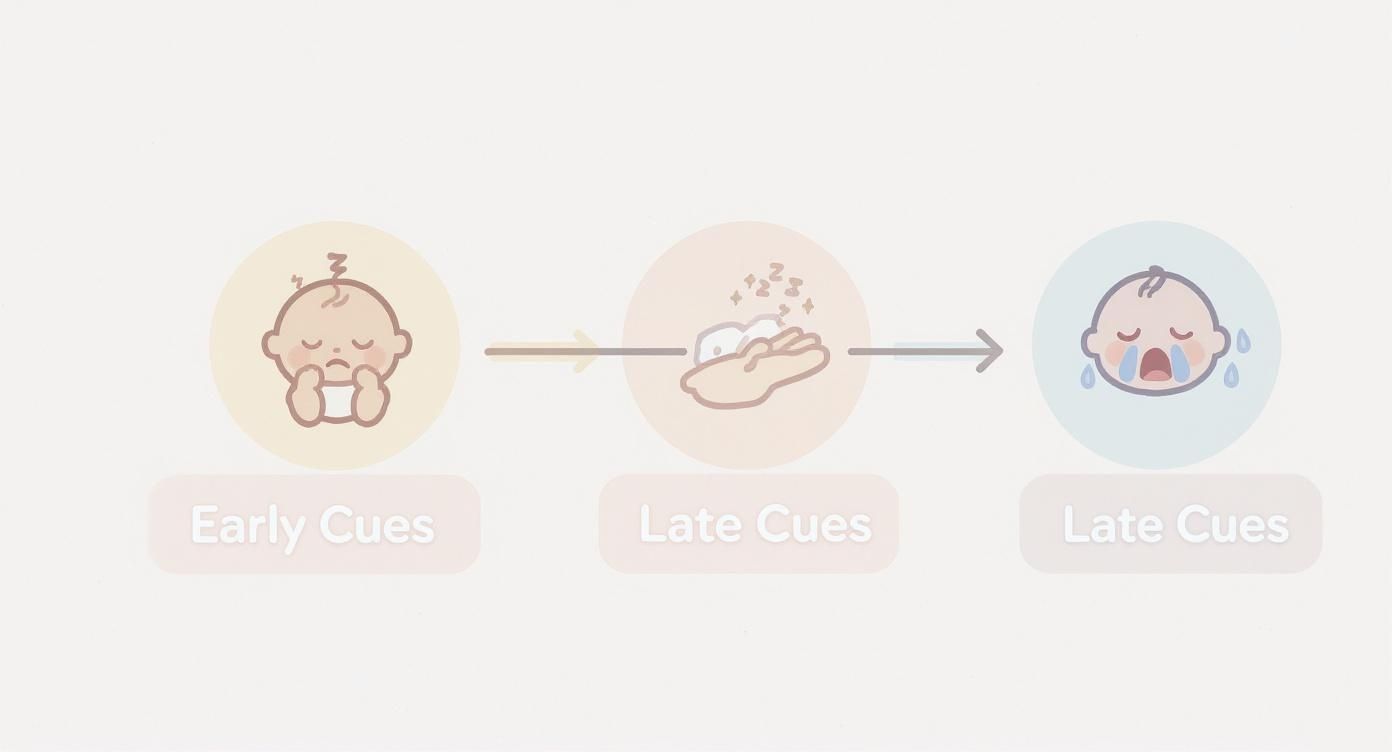
Acting on those first little yawns or that far-off stare can make the difference between a peaceful transition to sleep and a stressful, tear-filled one.
Sample Schedules in Action
Please remember, these are just examples to help you visualize the flow of a day! Every baby is different, and your little one will have their own unique rhythm. Think of these as a starting point, not a rulebook.
A consistent pre-nap routine is your best friend for signaling that sleep is coming. It doesn't need to be long or complicated—just 5-10 minutes is perfect. Dim the lights, change their diaper, pop them in a sleep sack, and sing a lullaby. Doing the same simple steps each time works like magic.
Sample 3-Month-Old Daily Schedules
To give you a clearer picture, here’s how the "Wake > Eat > Play > Sleep" cycle might look for an early riser versus a baby who likes to sleep in a bit.
| Time of Day | Sample Schedule A (Early Riser) | Sample Schedule B (Later Riser) |
|---|---|---|
| Morning | 6:30 AM: Wake, Eat, Play 8:00 AM: Nap 1 (90 min) |
7:30 AM: Wake, Eat, Play 9:15 AM: Nap 1 (90 min) |
| Midday | 9:30 AM: Wake, Eat, Play 11:15 AM: Nap 2 (90 min) |
10:45 AM: Wake, Eat, Play 12:30 PM: Nap 2 (90 min) |
| Afternoon | 12:45 PM: Wake, Eat, Play 2:45 PM: Nap 3 (60 min) |
2:00 PM: Wake, Eat, Play 4:00 PM: Nap 3 (60 min) |
| Evening | 3:45 PM: Wake, Eat, Play 5:30 PM: Catnap (30 min) 7:30 PM: Bedtime |
5:00 PM: Wake, Eat, Play 6:45 PM: Catnap (30 min) 8:30 PM: Bedtime |
Use these as a guide to find a flow that feels right for you and your baby. Don't be afraid to adjust times based on your baby's unique sleepy cues and nap lengths on any given day.
Solving Common Wake Window Problems
Even when you feel like you're doing everything "right," sleep challenges are just part of the deal. If you’ve hit a rough patch with your 3 month old wake windows, don't panic! It happens to everyone.
Let’s walk through some of the most common hurdles that have parents tearing their hair out—from babies who fight sleep like tiny prize fighters to those frustratingly short "disaster naps" that are over before they've even really started.
What if My Baby Fights Sleep?
Does your little one look ready for a rave when their wake window is supposed to be ending? This is a classic sign of one of two things: they're either overstimulated or undertired.
First, let's look at overstimulation. A wake window packed with new toys, bright lights, or lots of household noise can leave a baby’s brain buzzing, making it nearly impossible for them to power down. The fix here is to really lean into a calming wind-down routine for at least 10-15 minutes.
- Dim the lights to signal that sleepy time is coming.
- Turn on some gentle white noise to drown out the doorbell or a barking dog.
- Switch from active play to a quiet cuddle or a soft lullaby.
If you’ve tried a solid wind-down and they still aren't showing any sleepy cues, they might just be undertired. Experiment by extending their next wake window by just 10 to 15 minutes. You might be surprised what a small tweak can do.
Why Are Naps So Short?
Ah, the 30-minute nap. It can be one of the most maddening parts of early parenthood. Your baby wakes up grumpy, you feel like you just sat down, and the rest of the day's schedule goes right out the window. This usually happens because they're waking up after a single sleep cycle and haven't mastered the skill of connecting to the next one.
This short-nap phase is incredibly common around three months as your baby's sleep patterns mature. They are not broken, and neither are you! It's a developmental stage that takes a little patience and consistency to get through.
For these super-short naps, here are a few things to check:
- Check the Environment: Is a sliver of light sneaking past the blackout curtains? Did a loud truck jolt them awake? A dark, quiet, and cool room is your best friend when it comes to encouraging longer naps.
- Adjust the Wake Window: An undertired baby might only sleep for one cycle because they simply don't have enough sleep pressure built up. On the flip side, a slightly overtired baby can also struggle to stay asleep. Small adjustments to the wake window often work wonders here.
This is a period of major transition. Research shows that infants start to consolidate their daytime sleep into longer, more predictable naps as they move from three to seven months. It's a gradual process, but you're laying the foundation for it right now. Discover more insights about these developmental sleep patterns to understand what's on the horizon.
Remember, troubleshooting sleep is about making small, consistent tweaks, not overhauling your entire routine at once. And for more great tips, check out our guide on parenting hacks for achieving quality sleep.
Your Questions About Wake Windows Answered
Trying to figure out your baby's sleep schedule can feel like solving a puzzle where the pieces keep changing. You finally get a good day, and then suddenly, everything shifts. This FAQ section is here to give you clear, straightforward answers to the questions that pop up when you're in the thick of it with your 3-month-old.
Should I Wake My Baby From a Nap?
I know, I know—it feels almost criminal to wake a sleeping baby. But sometimes, it’s exactly the right thing to do. The main goal here is to find a healthy balance between day and night sleep.
Think of it like this: your baby has a "sleep budget" for every 24-hour period. If a late afternoon nap goes on for too long, it can "steal" sleep from the night, which often leads to a much later bedtime or more wake-ups overnight. To protect that precious nighttime rest, it’s often a smart move to gently wake your baby if a nap is creeping too close to bedtime.
How Long Should My 3-Month-Old’s Naps Be?
At this age, nap lengths can be completely all over the map, and that’s perfectly normal. You’ll probably see a real mix of short catnaps (think 30-45 minutes) and some longer, more restorative stretches (60-120 minutes). A typical day might have three or four naps, all of different lengths.
Try not to stress if every nap isn't a perfect two-hour marathon. As long as your baby seems happy and well-rested overall, and their total daytime sleep lands somewhere in the healthy 3-5 hour range, you're on the right track. The real key is to watch their sleepy cues and offer a nap when they need it, no matter how long the last one was.
What’s the Difference Between a 2 and 3 Month Old Wake Window?
That jump from two to three months is a pretty big deal in your baby's development, and their wake windows reflect that. A 2-month-old is still very much in that sleepy newborn phase, so their wake window is usually quite short, around 60-90 minutes.
By the time they hit three months, that window stretches out to 60-120 minutes. This small increase is actually a sign of a huge leap in their stamina and brain development. They can handle more stimulation and interaction now, which is why a slightly longer wake window helps build up enough "sleep pressure" for a solid nap.
That shift from a 90-minute to a 120-minute wake window might not look like much on paper, but for a baby, it’s a massive developmental step. It shows their growing ability to engage with the world around them for longer stretches.
When Can My Baby Connect Sleep Cycles?
Ah, the golden question for every parent struggling with short naps! A single sleep cycle for a 3-month-old is only about 45 minutes long. So when they take a "catnap," what's happening is they're waking up after finishing just one cycle.
Learning to transition smoothly from one sleep cycle to the next is a skill, and it’s one they are just starting to figure out around this age. Most babies start getting the hang of connecting sleep cycles between 4 and 6 months old. You can help them practice by making sure their room is dark and quiet. When they start to stir, give them a few minutes to see if they can drift back off on their own before you rush in. It’s a process that takes time and patience, but they will get there!
Parenting is a journey of constant learning and adapting. At Hiccapop, we're here to support you with products designed to make that journey a little easier and a lot more comfortable. Explore our range of baby essentials.