


What Does JPMA Certified Mean? a Parent's Guide
JPMA Certified means a product has passed a defined, independently tested verification process run by the Juvenile Products Manufacturers Association, not just the maker's own safety claim. The program is voluntary and currently covers 29 juvenile-product certification categories. So why can two cribs from the same brand, one with the seal and one without, both be legal to sell in the United States? Because the seal is third-party verification against a written protocol, not a government license. The gap between what parents assume and what the mark proves is where the useful buying decisions live.
What JPMA Certified Means for Your Baby Gear
JPMA Certified means a juvenile product has passed a defined testing and verification process run by the Juvenile Products Manufacturers Association, rather than resting on the maker's own safety claim. The program is voluntary and open to JPMA members and non-members, including companies selling private-label products, according to JPMA's certification program procedures. JPMA's materials describe 29 certification categories; in 2025 the Baby Safety Alliance program update reported that its verification program, formerly the JPMA Certification Program, covered more than 3,200 products across over 30 categories in the United States and Canada.
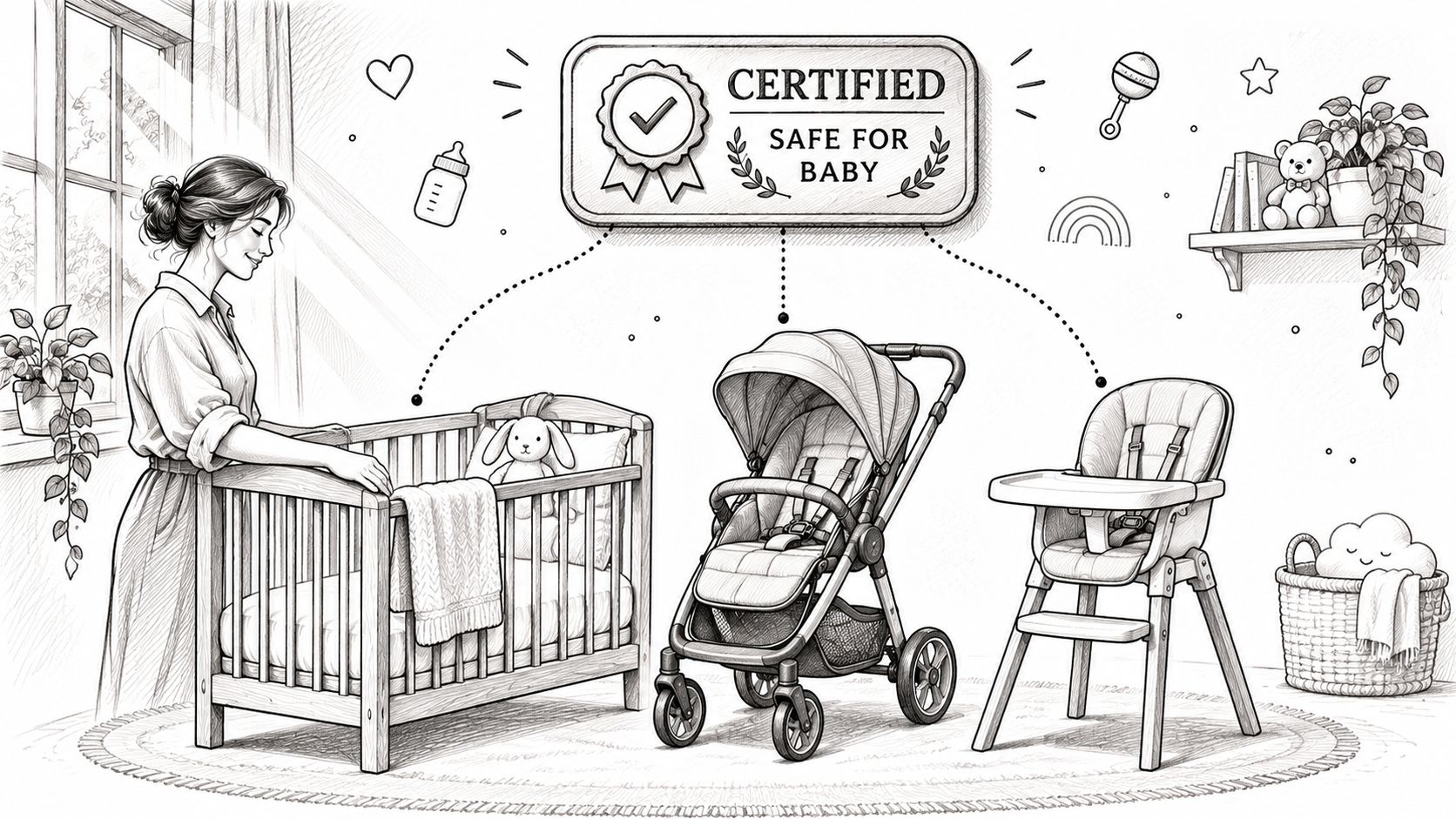
Think of a building inspector. The inspector compares the framing to written code, signs the file, and leaves. That signature doesn't promise the roof will never leak. To earn the seal, a product must meet the applicable ASTM voluntary safety standard, relevant U.S. federal requirements in Title 16 of the Code of Federal Regulations, and in some cases state or major-retailer requirements. Independent labs test product samples against the protocol.
Read the category, not the logo. A seal on a high chair speaks to the high chair protocol, not every item that brand sells.
What does JPMA Certified mean in practice? The answer is narrower than the logo suggests. Note the seal and the category it names, then check the exact model.
What the Seal Tests Before a Product Earns It
The seal is a stack of checks, not one lab visit. Each layer answers a different question.
Layers a product must meet for the JPMA Certified seal
| Layer | Who sets it | What it covers |
|---|---|---|
| Category ASTM safety standard | ASTM International, with JPMA testing to it | Category-specific safety performance such as structure, stability and restraint |
| U.S. federal requirements | Federal regulations in Title 16 CFR | Applicable federal product rules for juvenile products |
| State requirements | Individual states | Added in some cases where a state rule applies |
| Major-retailer requirements | Individual retailers | Added in some cases where a retailer requires it |
| Independent laboratory testing | Labs such as Bureau Veritas, Intertek and SGS | Sample testing against the applicable protocol |
The category standard carries most of the technical weight. A high chair, crib, stroller, or playard is tested to the ASTM standard for that category, which is why the list changes with the product: structural integrity, stability, restraint performance, entrapment hazards, flammability, labeling, and chemical requirements, as JPMA's category testing protocol lays out. Independent labs, including Bureau Veritas, Intertek, and SGS, check samples against that protocol.
The second safeguard happens after the sample passes. ASTM's reporting on standards and consumer safety describes independent laboratory testing paired with follow-up inspection of the manufacturer's production line. Testing catches a failure in a representative sample. Production oversight reduces the chance that mass-produced units drift from the tested design.
Who writes the rules and who checks the work
JPMA administers the certification. ASTM International writes the technical standard. That split keeps the certifier from grading its own technical homework. Compare products within the same category, because they were judged against the same tests. How to read brand durability claims helps separate tested performance from marketing language, and independent product testing shows how a brand's own checks fit around certification.
How the Seal Stays Current After Launch
Certification isn't a graduation photo. It's a schedule. After initial qualification, the participant tests one model for each product family annually under the annual-testing process, according to JPMA's Safe and Sound guide.
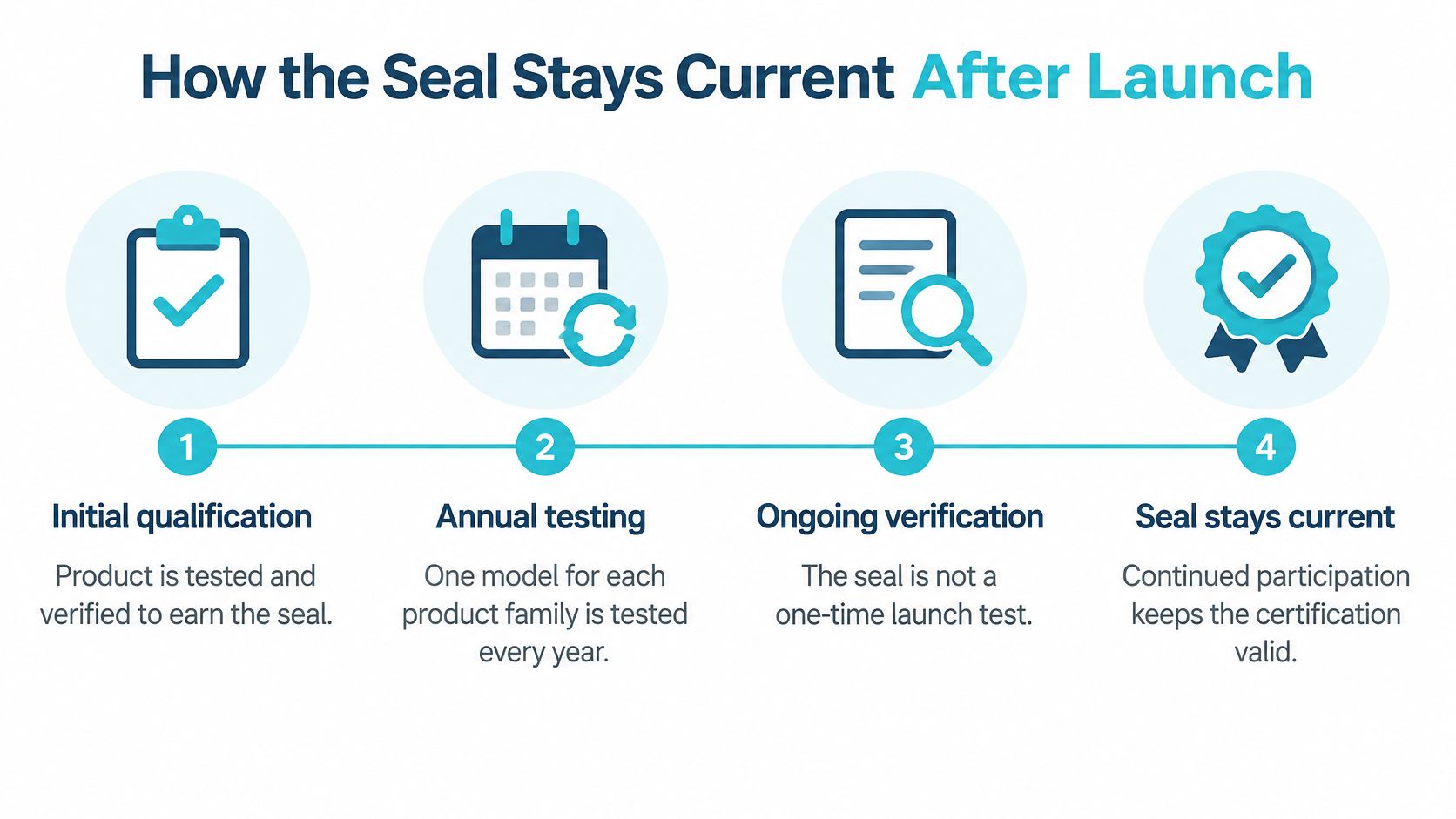
Earlier procedural guidance requires each later new model to be tested and verified before shipment. SGS's forum presentation on JPMA verification notes that retesting is required when a relevant standard changes or a product undergoes a material design or manufacturing change. A redesign doesn't inherit the old paperwork.
- The seal tracks the certified model through the current cycle. It isn't a permanent property of the brand name.
- A changed design, factory process, or rule can leave an older status behind. The model number matters more than the logo.
- An older or secondhand unit needs its own model confirmed. It can't borrow status from a newer version of the same product line.
A seal is a snapshot of a system, not a lifetime warranty.
To see how checks continue after approval, read our quality assurance process.
What the Seal Does Not Promise
The most common misreading is that the seal is a government approval or a blanket guarantee. It's neither.
Common beliefs about the JPMA seal and what is true
| Common belief | What is true |
|---|---|
| It is a government approval | It is a voluntary industry certification; the CPSC is the federal regulator |
| It guarantees the product cannot fail | It is third-party evidence of conformity to set requirements, not a guarantee |
| Every product from the brand is covered | It applies to a specific certified model or category |
| Uncertified products cannot be sold | ASTM standards are voluntary, so a product can be sold without the seal |
| JPMA writes the safety standards | ASTM develops the standards; JPMA operates the certification program |
The CPSC guide to U.S. furniture requirements is a useful reminder that voluntary standards and mandatory rules are separate. ASTM standards are voluntary unless a mandatory rule incorporates them, so a product can be sold legally in the United States without the JPMA seal. The U.S. Consumer Product Safety Commission remains the federal regulator, not JPMA. The seal applies to a specific certified model or category, so one certified stroller doesn't cover the brand's whole lineup.
The seal doesn't prove a product is safer than every uncertified alternative. It proves conformity to a defined set of requirements, and a conforming product can still have use limits or hazards the standard doesn't remove. International shoppers need extra care because the program is built around U.S. requirements and U.S. sale, not global certification.
Better question. Which exact model and category are covered, which current standard was used, and what limits remain in the instructions?
What to Check Beyond the Seal
Before you trust the badge, check how you'll use the product. The seal clears a testing hurdle. It doesn't pack the box for you.
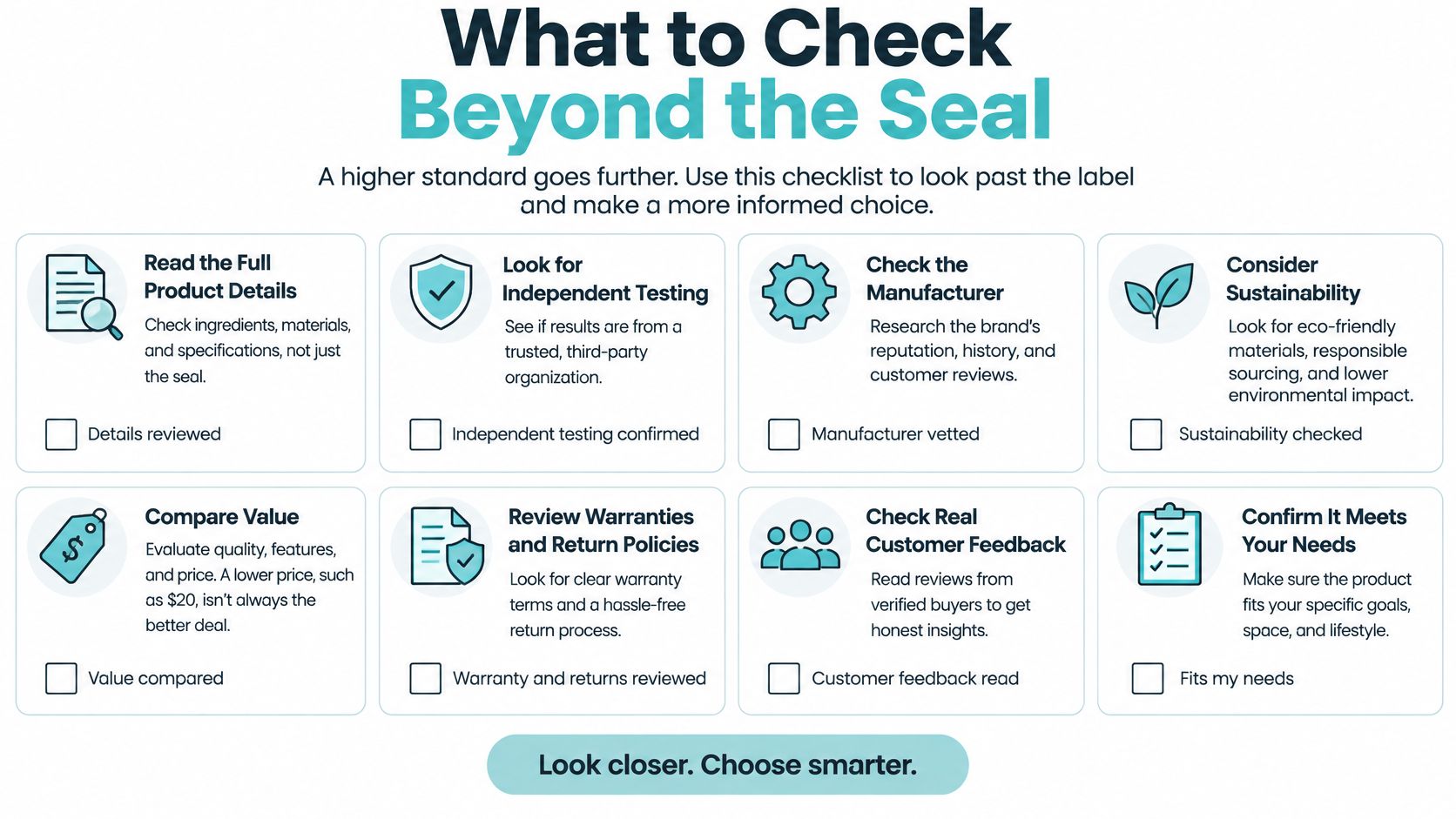
- Read the age, weight, and size limits. They're specific to that model, and certification doesn't replace them.
- Walk through assembly and installation before first use. Confirm every part is present and every fastener is tight.
- Search the CPSC recall database by model name and number. Do it before the return window closes.
- Register the product with the manufacturer. That's how recall and warranty notices reach you, and our Product Registration page is linked in the site header and footer.
- Inspect secondhand gear as if it has no history. Look for missing parts, cracks, frayed straps, and loose hardware.
- Sort the effort by timing. The recall search and registration take minutes at purchase. Physical inspection matters again every time gear changes hands.
A model can be redesigned after an earlier test cycle, and a critical limit may appear only in the manual. For sleep setups, crib mattress safety standards covers the fit and firmness questions that sit outside the seal.
This walkthrough runs the same checklist in motion.
Verify the Seal Before Your Next Purchase
The definition promised a lookup, so use this routine at checkout.
- Find the seal and the category on the package or label. The category matters as much as the mark.
- Open the certified-product listing kept by the Baby Safety Alliance. It now runs the program formerly called JPMA Certification.
- Match the model number on the listing, not the brand name alone. A brand can have one verified model and another that isn't.
- Confirm the listed category matches the intended use and the printed age and size range. A verified product used outside its category is still a misuse.
- Treat a disagreement as unverified. If the package and listing don't align, resolve the model before you buy or use the item.
Keep the recall search, registration, and secondhand inspection from the previous section. They cover the gaps a listing can't. Which check do you run first, the seal category or the model-number match?
Hiccapop builds baby and toddler gear, from travel beds to crib mattresses, and tests every product beyond federal testing standards. If you're outfitting a playard, our playard mattress is designed to fit only the Hiccapop playard and is not a general-purpose mattress, so the fit and use limits stay clear. Visit Hiccapop to explore the lineup and register your product for the lifetime guarantee.