


Travel Bed Side Rails Safety Types and Buying Guide
You arrive at a hotel after a long day, set down the bags, and notice the adult bed is much higher than the one at home. Your toddler is tired, restless, and ready to sleep, but one roll could send them onto the floor. A travel bed side rail can seem like the obvious answer, yet choosing and installing one safely involves more than rail height or a quick marketplace review.
The important questions are practical: Is your child developmentally ready for a portable bed rail? Is the product intended for the type of bed you're using? Does the rail fit securely against the mattress? Does the product provide appropriate compliance information and warnings? And can you install it without creating an unsafe opening?
This guide walks through those questions so families can approach bedtime in a hotel, vacation rental, or grandparent's house with a consistent safety check. For broader trip preparation, families may also benefit from seamless vacation planning for families.
Introduction to Travel Bed Side Rails for Families on the Go
Travel changes the sleeping environment in small ways that matter. A hotel mattress may be softer, a rental bed may have a different frame, and a grandparent's guest bed may differ considerably from the mattress your child uses at home. Even a toddler who usually stays put can move more in an unfamiliar room.
A portable bed rail is designed to create a barrier along the open side of an adult bed and help prevent a child from falling out. It is different from a crib, which is designed as a contained sleep space, and different from a crib conversion rail, which is designed specifically for a compatible crib converted into a toddler bed.
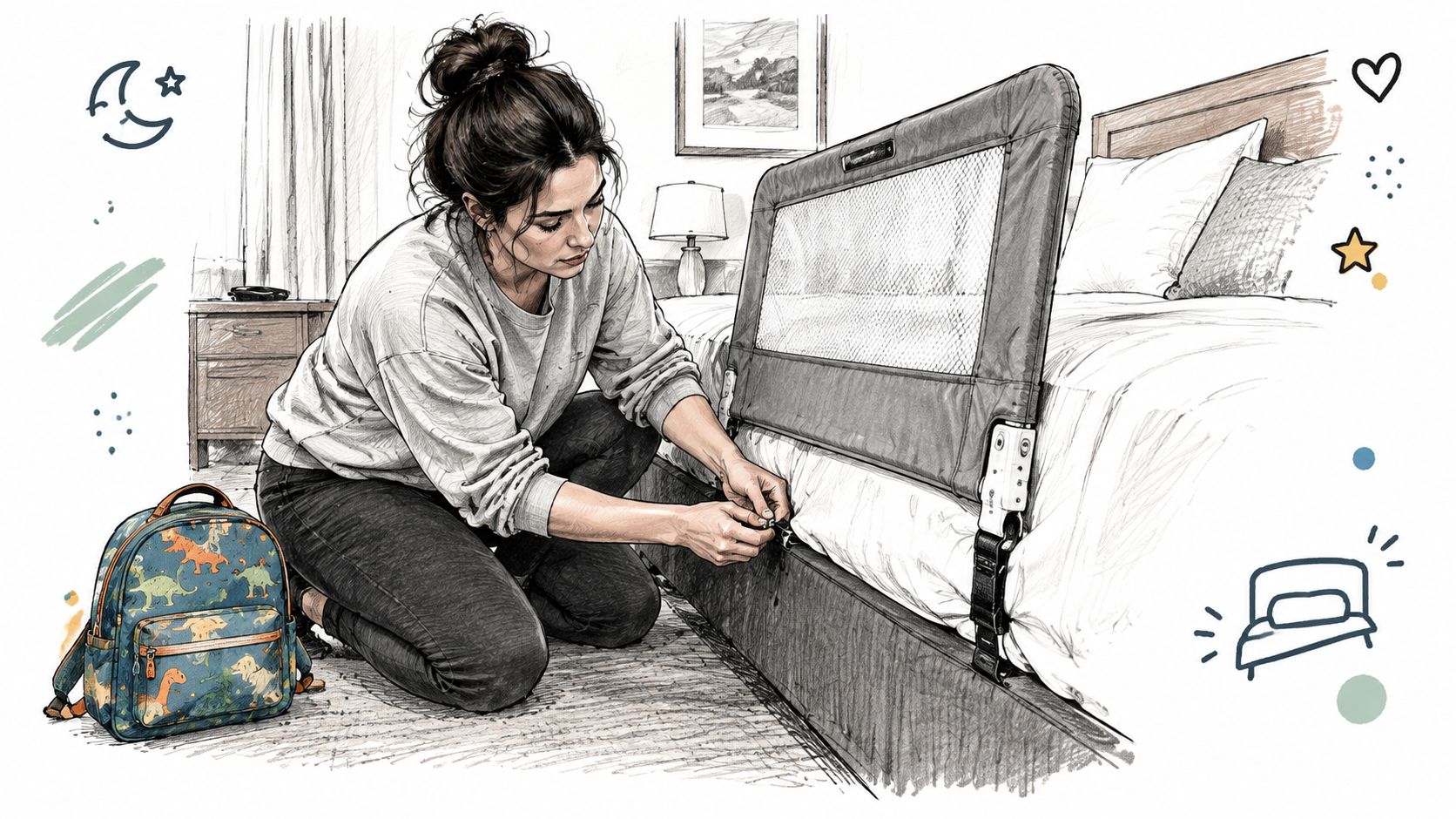
The reassuring part is that you don't need to become a mattress engineer before a trip. You do need to understand the product's intended use, check mattress and bed compatibility, follow the manufacturer's installation instructions, and inspect the setup before your child climbs into bed.
The less reassuring, but essential, point is that a rail can trade one hazard for another if it is incompatible with the bed or installed incorrectly. A product intended to prevent a fall must not introduce an entrapment hazard. That's why fit, developmental readiness, intended use, and compliance information matter more than simply choosing the tallest barrier.
Important: Not All Bed Rails Are Designed for Adult Beds
One of the easiest mistakes to make when shopping for a toddler bed rail is assuming that all bed rails are interchangeable.
They are not.
A crib conversion rail is designed for a compatible crib that has been converted into a toddler bed. A portable children's bed rail is designed for installation on an adult bed. A standalone toddler travel bed provides its own sleeping surface.
These products should not be treated as interchangeable simply because they all use the words "bed rail" or "toddler bed" in their descriptions.
For example, Hiccapop's Convertible Crib Rail is specifically designed for a crib converted into a toddler bed. Hiccapop's FAQ states: “Our anchoring system is not suitable for use on adult beds. Our crib rail is ONLY for use on cribs converted into toddler beds.”
Hiccapop® Convertible Crib Rail for Toddlers
Important: The Hiccapop® Convertible Crib Rail should not be used or presented as a travel bed rail for a hotel, rental, twin, or other adult-sized bed.
For travel or use on an appropriate adult bed, families should instead consider a product specifically designed for that application, such as a portable bed rail or other travel sleep solution.
What Travel Bed Side Rails Are and How They Work
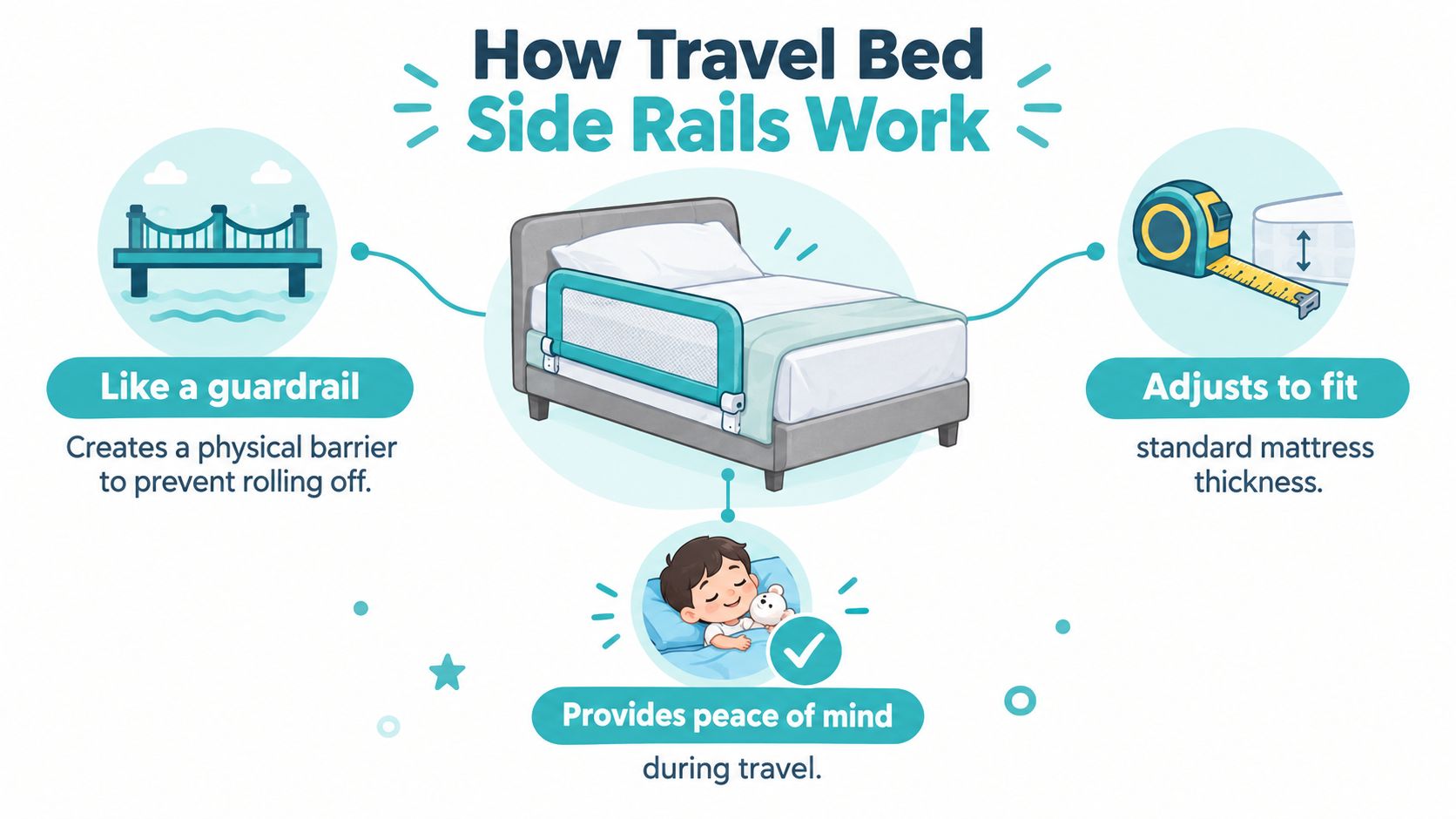
Think of a travel bed rail as a boundary along the exposed side of an adult bed. Depending on the design, the rail may use supports or a retention system beneath the mattress to keep the rail in position.
Portable children's bed rails can use rigid frames, mesh panels, foam, or inflatable materials. CPSC specifically notes that some nonrigid products made from foam or inflatable materials can meet the definition of a children's portable bed rail and fall within the scope of the applicable standard.
Portability doesn't eliminate the need for careful installation. A product should be used only as directed and with the type and size of mattress and bed specified by its manufacturer.
Who These Rails Are Designed For
Under 16 C.F.R. Part 1224, children's portable bed rails are subject to federal safety requirements incorporating ASTM F2085. CPSC describes children's portable bed rails as devices intended to be installed on an adult bed to prevent children from falling out. They are intended for children who can get in and out of an adult bed without assistance, typically 2 to 5 years old.
That developmental threshold matters. A portable bed rail is not an infant sleep enclosure and should not be treated as a substitute for an appropriate crib or other suitable sleep environment for a younger child.
CPSC's children's portable bed rail requirements address hazards including structural integrity, openings, enclosed openings, displacement, protrusions, openings near bedposts, and misassembly.
For families comparing a rail with a separate travel sleep surface, a toddler travel bed is a different type of product. It provides its own sleeping surface rather than modifying an adult bed.
Safety Benefits and Hidden Risks Every Parent Should Know
A properly selected and installed travel bed rail can help reduce the chance of a young child rolling from an adult-height bed onto the floor. The protection is useful only when the rail is appropriate for the child, bed, mattress, and installation configuration.
The hidden concern is entrapment.
A child can be at risk when part of the body becomes caught in an opening or space associated with the rail, mattress, bed frame, or surrounding structure.
This isn't just a theoretical concern. On October 30, 2025, the U.S. Consumer Product Safety Commission recalled approximately 2,370 HOMEAL children's bed rails because, when installed adjacent to the bed, a child could become entrapped in openings on the side of the mattress. CPSC said the product violated the mandatory standard for children's portable bed rails and posed a risk of serious injury or death from entrapment. No incidents or injuries had been reported at the time of the recall.
The recalled HOMEAL rails were sold on Amazon from June through September 2025 for approximately $45 to $50 and were identified as Model No. 338.
That example illustrates why "it looks sturdy" is not enough. The relationship between the rail, mattress, and bed matters.
When checking a setup, pay particular attention to:
- Openings within the rail: Check the rail structure and any openings in mesh or rigid components.
- Between the rail and mattress: Look for spaces that could develop between the rail and the mattress.
- Around the ends of the rail: Check where the rail ends meet the mattress, headboard, footboard, or other bed structures.
- Below or beside the rail: Make sure the installation does not create an unexpected opening when the rail is pressed or moved.
- Displacement: Check whether the rail shifts significantly when reasonable pressure is applied.
Federal requirements for children's portable bed rails specifically address structural integrity, openings, displacement, protrusions, and openings between bedposts or other bed structures and the ends of portable bed rails.
Why Compliance Information Matters
Children's portable bed rails are subject to 16 C.F.R. Part 1224, which incorporates ASTM F2085. CPSC identifies ASTM F2085-19 as the applicable mandatory version for products manufactured or imported on or after May 20, 2020.
The standard addresses areas including structural integrity, openings, protrusions, installation components, labeling, instructional literature, and misassembly.
For consumers, this means a product should not be evaluated solely on its height, appearance, number of reviews, or marketing claims. Look for clear manufacturer information, instructions, warnings, and evidence that the product is intended for the type of use you're considering.
And remember: children's portable bed rails and adult portable bed rails are different regulatory categories. CPSC expressly notes that it enforces different regulations for adult portable bed rails.
Types and Materials of Travel Bed Side Rails Explained
The best option depends on the child's age and developmental stage, the destination bed, and how the product is intended to be used.
Common Designs
Rigid or mesh portable rails use a frame and barrier to create a physical boundary along the side of an adult bed. Mesh can provide visibility while the frame provides structure.
Fold-flat rails are designed to collapse for storage or transportation. Their portability can be useful for travel, but the product still needs to be fully assembled and locked according to the manufacturer's instructions.
Inflatable or foam bed rails create a softer barrier beneath or alongside a fitted sheet. CPSC notes that certain nonrigid foam and inflatable products can fall within the definition of children's portable bed rails and therefore can be subject to the applicable standard.
Material alone does not determine whether a product is appropriate. What matters is whether the complete product is designed, tested, labeled, and used for the intended application.
For example, Hiccapop's Inflatable Bed Rails are marketed as a travel product and are designed to be installed under a fitted sheet. Hiccapop® states that they can be used with toddler, twin, double, queen, and king beds and states that they pass applicable CPSC and ASTM requirements.
Hiccapop® Inflatable Bed Rails
Sizing and Compatibility Guidance for Travel Beds
A rail can be well made and still be wrong for a particular bed. Before travel, check the manufacturer's specified mattress and bed requirements rather than assuming that a universal-looking product will work with every setup.
Start by checking:
- Mattress dimensions: Make sure the mattress is within the manufacturer's specified size range.
- Mattress thickness: Verify that the mattress thickness is within the product's stated range.
- Bed type: Confirm that the rail is designed for the type of bed and frame you are using.
- Headboard and footboard: Check whether the product has restrictions concerning nearby bed structures.
- Installation method: Confirm that the retention system can be installed as instructed.
- Bedding: Make sure the fitted sheet does not interfere with the rail or installation system.
The Hands-On Fit Check
Don't wait until your toddler is overtired to discover that the rail doesn't work with the hotel mattress.
Before bedtime, make the bed exactly as your child will use it. Put on the fitted sheet, install the rail according to the manufacturer's instructions, and inspect the rail-to-mattress interface along its entire length.
Then perform a hands-on check:
- Press against several points along the rail.
- Check both ends of the rail.
- Look closely at the space between the rail and mattress.
- Check whether the mattress compresses in a way that creates an opening.
- Make sure the rail remains in its intended position.
- Repeat the check after the bedding is fully installed.
The rail should remain in the intended position when used as directed and should not create an unexpected opening.
Do not improvise with towels, pillows, blankets, or other materials to fill spaces around the rail. If the product does not fit the bed as specified by the manufacturer, choose a different sleeping arrangement.
Soft mattresses deserve particular attention because compression can change the relationship between the mattress and the rail. If the installation does not remain secure, do not rely on the rail.
| Check Point | What to Look For | Why It Matters |
|---|---|---|
| Rail length | Coverage is appropriate for the mattress and intended use | Helps provide the intended barrier |
| Mattress thickness | Mattress is within the manufacturer's specified range | Helps the product function as designed |
| Rail-to-mattress interface | No unexpected or developing opening | Helps reduce entrapment risk |
| Mattress firmness | Mattress does not create an unstable installation | Helps maintain the intended configuration |
| Bed frame | Attachment system works with the specified bed | Determines whether the rail can be installed correctly |
| Sheet and bedding | Fitted sheet does not interfere with installation | Helps maintain the intended position |
Installation and Everyday Use Tips While Traveling
Set up the rail before your child is exhausted. Unpack every component, identify the retention system, and follow the manufacturer's assembly sequence rather than improvising.
Secure the rail exactly as instructed, then inspect the entire installation. Test the rail from several points to make sure it remains in its intended position.
A Repeatable Bedtime Routine
- Install the rail according to the instructions. Complete the installation before your child gets into bed.
- Add the fitted sheet and recheck. Make sure the sheet does not interfere with the rail or its installation system.
- Inspect the rail-to-mattress interface. Check the full length and both ends for unexpected openings.
- Position the open side thoughtfully. Make sure the surrounding area is clear and avoid placing the bed where nearby furniture creates additional hazards.
- Keep pillows and loose bedding away from the rail. Do not use pillows, blankets, towels, or other materials to fill gaps around the rail.
- Recheck the setup regularly. Travel setups can shift after adults sit on the bed, bedding is changed, or the product is moved.
Placing a bed against a wall should not be used to compensate for a rail that does not fit or install correctly. The rail must still be used according to its instructions.
Teach your toddler where the open side of the bed is and practice getting in and out while you're present. If your child is not developmentally ready to use an adult bed independently, consider a more appropriate sleep arrangement rather than relying on a portable rail.
How to Choose the Right Travel Bed Side Rail for Your Family
Choose the product around your child and destination, not around the product photo.
Use this decision filter:
- Child readiness: The child should be able to get in and out of an adult bed independently and fall within the product's intended age and developmental range. CPSC describes children's portable bed rails as typically intended for children ages 2 to 5 who can get in and out of bed unassisted.
- Destination compatibility: Check mattress dimensions, thickness, bed type, frame configuration, and any headboard or footboard restrictions.
- Compliance information: For children's portable bed rails, look for information addressing 16 C.F.R. Part 1224 / ASTM F2085 and the manufacturer's required warnings and instructions.
- Recall screening: Search the product name, model, and manufacturer before travel. Recent CPSC recalls show why this matters. The October 2025 HOMEAL recall, for example, involved approximately 2,370 children's bed rails that could create an entrapment hazard beside the mattress.
- Realistic setup: If you cannot install and inspect the product correctly at home, do not assume it will be easier to use in an unfamiliar hotel room.
Choosing the Right Hiccapop® Product for the Sleeping Environment
Hiccapop® offers several toddler sleep products, but they are designed for different applications. The key is to match the product to the sleeping environment.
For a Compatible Crib Converted to a Toddler Bed
The Hiccapop® Convertible Crib Rail is specifically designed for a compatible crib that has been converted into a toddler bed, not for an adult bed or other adult-bed travel setup.
Hiccapop® Convertible Crib Rail for Toddlers
For Travel or an Appropriate Adult Bed
For travel on an adult bed, Hiccapop® separately offers its Inflatable Bed Rails, which are marketed specifically as travel bed rails and are installed under a fitted sheet. Hiccapop's own travel guidance also recommends its inflatable bed rails for travel destinations.
Hiccapop® Inflatable Bed Rails
As with any portable bed rail, parents should follow the manufacturer's instructions and verify that the destination mattress and bed are compatible before use.
For a Separate Toddler Travel Sleep Surface
Families who prefer a separate sleep surface can also consider a dedicated toddler travel bed. Hiccapop's Inflatable Toddler Travel Bed with Safety Bumpers is designed as a standalone travel bed rather than a rail attached to an adult mattress. Hiccapop® markets it for use at home, at a grandparent's house, camping, vacation, and other travel situations.
Hiccapop® Inflatable Toddler Travel Bed with Safety Bumpers
The important distinction is simple: use each product only for the sleeping environment it was designed for. A crib conversion rail, a portable bed rail, and a standalone toddler travel bed are different products with different intended uses.
Final Takeaway
The right travel sleep solution isn't necessarily the tallest rail or the most heavily advertised product. Start with your child's developmental stage, then confirm that the product is intended for the specific bed and mattress you plan to use.
The safety concern is not simply whether a rail is tall enough. A rail that shifts, doesn't fit the mattress, or creates an opening can introduce a different hazard. The 2025 HOMEAL recall is a real-world reminder that entrapment can result from the relationship between the rail and mattress.
Check the manufacturer's instructions, look for appropriate compliance information, install the product exactly as directed, and inspect the setup for unexpected openings or movement before your child goes to sleep.
For a hotel stay, family visit, or road trip, practicing the setup at home can make the nighttime routine easier and help you identify compatibility problems before you are away from home.
When comparing Hiccapop® products, make sure you choose the product that matches the intended sleeping environment:
- Convertible Crib Rail: for a compatible crib converted to a toddler bed — not for adult beds
- Inflatable Bed Rails: designed as a travel bed rail for appropriate adult-bed applications.
- Inflatable Toddler Travel Bed: a standalone travel sleep surface for families who prefer not to modify an adult bed.
The safest choice is the one that matches your child's developmental stage, the sleeping environment, and the manufacturer's intended use.