


Portable Booster Seat Car Guide for Safe Travel
You're at the rental-car counter with a tired child, two carry-ons, and no interest in discovering that the “child seat” you reserved is a bulky, unfamiliar booster. A portable booster seat seems like the perfect answer for airport transfers, grandparents' cars, carpools, and rideshares. It fits in a travel bag, but convenience alone doesn't make a booster safe.
Hiccapop makes the UberBoost Inflatable Booster Car Seat mentioned in this article.
The important question is not, “Is this the smallest booster seat?” It's, “Will this child sit upright, in this vehicle, with this belt, for the entire ride?” A portable booster seat is a belt-positioning device, not a miniature harnessed car seat. It works by helping the vehicle's three-point belt fit the child's body correctly. That distinction makes choosing and using a portable booster seat much easier.
Introduction to Portable Booster Seats for Everyday and Travel Use
A family flying to visit relatives may need a booster in a rental car, a taxi from the airport, and a grandparent's sedan. Carrying a full-size seat through the terminal can be awkward, while relying on a vehicle's available equipment may leave parents guessing about its condition, fit, or installation. A compact booster solves the carrying problem, but it doesn't remove the need for a careful fit check.
The same logic applies to an occasional carpool. A booster-ready child may need a seat that moves easily into a friend's car. Portability helps the seat arrive where it's needed; the vehicle belt and the child's behavior still determine whether the setup works.
Booster seats were introduced in the United States by the late 1970s. Washington adopted the first state booster-seat law in 2000, and it took effect in 2002. Congress passed Anton's Law in 2002, directing NHTSA to require three-point belts at each rear seating position in new passenger vehicles; NHTSA's rulemaking phased that requirement in for vehicles manufactured beginning September 1, 2005, with full compliance required by September 1, 2007. This history helps explain why modern boosters focus on belt positioning, three-point belts, and evolving safety standards. NHTSA's technical report on rear-seat three-point belts provides the federal regulatory background.
Practical rule: Portability is a useful feature only after belt fit, child maturity, and vehicle compatibility are confirmed.
This guide focuses on the decisions that matter most: how a booster changes belt geometry, how portable designs differ, how to check readiness, and when a harnessed seat is the better travel choice.
How a Portable Booster Seat Positions the Car's Seat Belt
A vehicle seat belt is designed to restrain an adult-sized body. A smaller child may be too short for the lap belt to rest on the strong bones of the upper thighs and pelvis. The shoulder belt may also sit against the neck or face instead of crossing the chest. A booster raises the child, or changes the belt's path, so the belt can do its intended job.
Think of the belt as a suit. A suit that's too large bunches in the wrong places and restricts movement. A booster acts like tailoring, adjusting the child's position so the lap belt lies low and the shoulder belt crosses the chest.
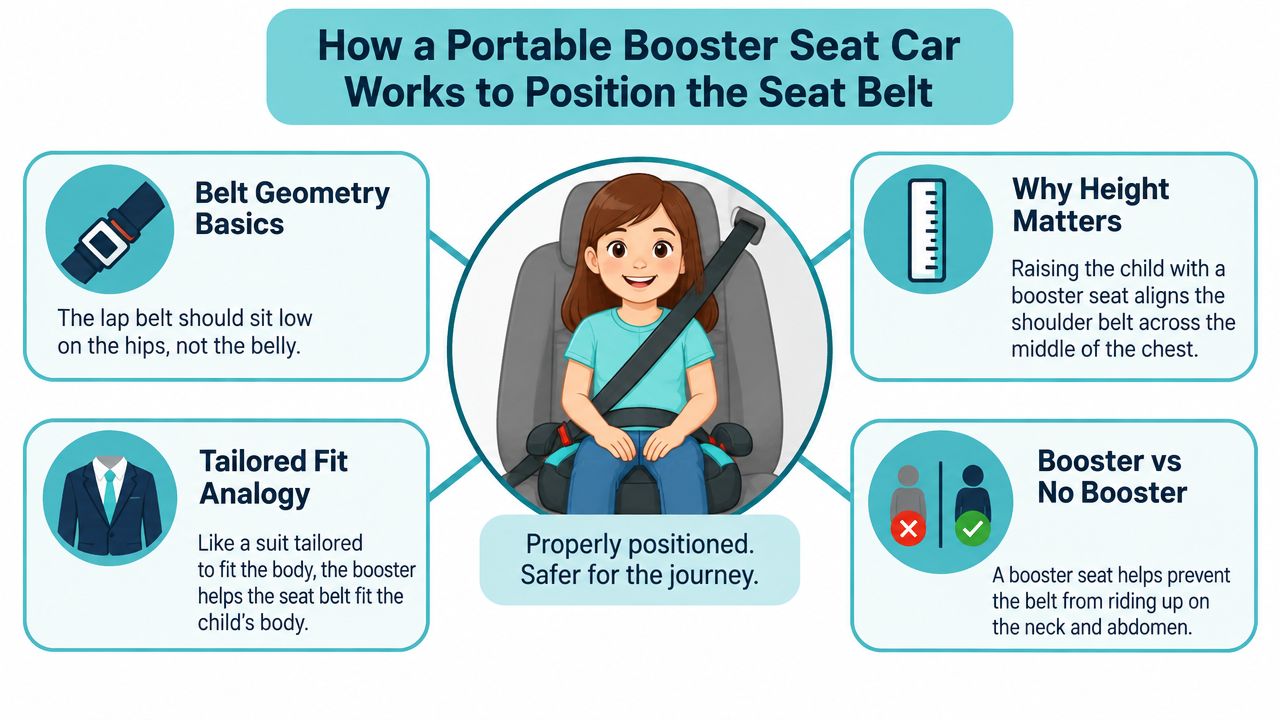
A portable booster seat's core engineering function is belt geometry correction. It raises the child so the vehicle's lap-and-shoulder belt loads the pelvis and chest rather than the soft abdomen or neck, which is the key mechanism behind injury reduction. NHTSA guidance describes proper belt fit as keeping the lap belt low across the hips/upper thighs and the shoulder belt across the chest and shoulder.
What the belt should do
Start with the lap portion. It should lie flat and snug across the upper thighs or hips, not across the stomach. If the belt rides onto the abdomen, crash forces may be directed toward softer tissue instead of the pelvis.
Next, inspect the shoulder portion. It should cross the middle of the shoulder and chest. It shouldn't touch the neck, cross the face, slip off the shoulder, or sit behind the child's back. The child must also remain upright, rather than leaning forward, slouching, or placing the shoulder belt under an arm.
Different designs solve the geometry problem in different ways:
- Backless boosters raise the child while relying on the vehicle seat and headrest for upper-body and head support.
- High-back boosters add back support and may provide more structured shoulder-belt guidance.
- Folding or compact boosters prioritize storage and transport, but parents still need to verify that the guides hold the belt in the right path.
- Belt-positioning clip boosters use guides or clips to position the belt differently from traditional raised platforms, so the product's instructions matter.
A useful explanation of how some boosters anchor and position a child is available in this guide to boosters that anchor. The product's labeling and manual should always take priority over assumptions based on appearance.
Height matters, but maturity matters just as much. A child who can fit the booster physically may still be unsuitable if they won't sit correctly for the whole ride. A portable booster can't prevent a child from leaning away from the shoulder belt or sliding forward.
Types of Portable Booster Seats and How to Compare Them
Shopping pages often make every compact booster look interchangeable. They aren't. The right choice depends on whether the child needs back support, how often the seat will move between cars, and whether the destination vehicle provides suitable head support.
| Booster Type | Portability | Support and Belt Guidance | Typical Use Case |
|---|---|---|---|
| Backless booster | Usually compact and easy to carry | Depends heavily on vehicle seat, headrest, and belt geometry | Older, mature booster riders moving between familiar vehicles |
| Folding high-back booster | Packs more easily than a fixed high-back model, but remains bulkier than backless designs | Adds back support and structured belt guidance | Travel where the vehicle's seat shape or belt position varies |
| Inflatable booster | Packs into a small travel bag | Requires careful inflation, placement, and belt routing according to its instructions | Families prioritizing packability for car travel |
| Belt-positioning clip booster | Designed for grab-and-go transport | Uses integrated guides to adjust belt placement around the child | Carpooling, taxis, rideshares, and occasional rental-car use |
Match the design to the vehicle
A backless booster may be practical in a vehicle with a supportive seat and properly positioned head restraint. It's a weaker choice when the child's head extends above the vehicle seat without adequate support. A high-back model may provide a more forgiving seating structure, especially when the child tends to lean or the vehicle seat has an unusual shape.
Inflatable and folding designs can reduce luggage stress, but convenience introduces another task. Parents must make sure the booster is fully inflated or unfolded, placed flat, and used exactly as directed. A product that is easy to pack but difficult to position consistently may not be the best match for hurried transfers.
Consider the trip, not just the folded size
For a rideshare, a compact design that travels in a backpack may be useful. For a long rental-car trip, a high-back option could offer more support if the child struggles to stay centered. For a grandparent's car, the best booster is the one that fits the vehicle and can be used correctly every time.
Marketing language such as “travel size” doesn't answer the safety questions. Check the belt guides, required belt type, vehicle head support, and the child's ability to remain upright before comparing colors or storage bags.
Safety Standards, Age, Weight, and Fit Checks
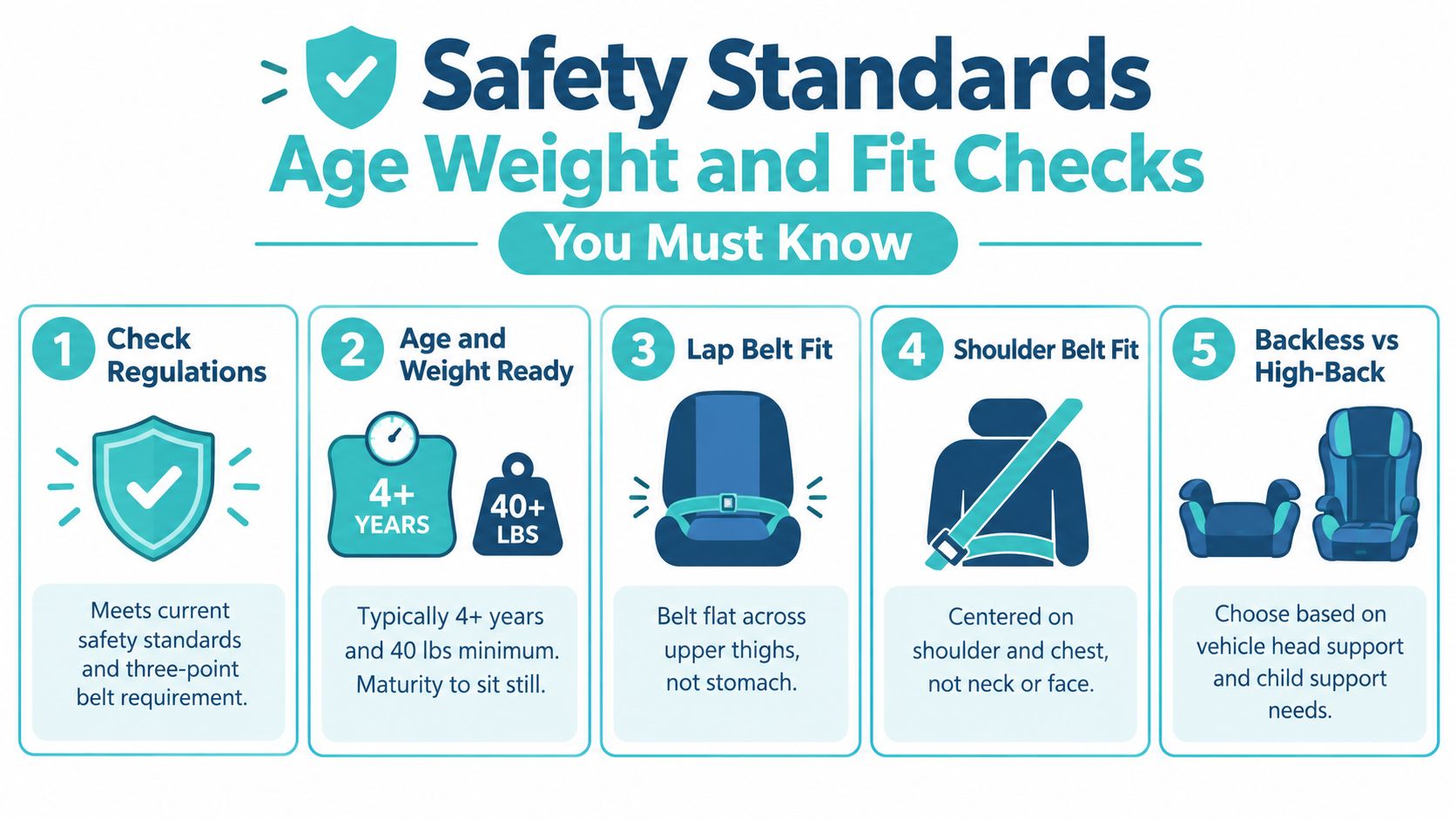
NHTSA recommends keeping children in a booster until the vehicle belt fits properly. Readiness depends on more than a birthday or a compact product label. Parents should confirm the child meets the booster's limits, understand the local requirements, and check the vehicle's seating position before choosing portability. NHTSA's car-seat and booster-seat guidance explains the transition from a child restraint to the adult belt.
The commonly discussed transition point is about 4 feet 9 inches, often within an age range of roughly 8 to 12 years. Those figures provide context, not permission to stop using a booster automatically. A child is ready when the belt fits correctly and the child can stay upright for the entire ride. CDC child passenger-safety guidance explains that children should continue using a booster until the vehicle seat belt fits properly.
Use a repeatable readiness check
Before an unfamiliar ride, work through the same sequence:
- Check the product limits. Confirm the child meets the stated age, size, and maturity requirements. Portability does not make a booster suitable for a child who still needs a harness.
- Check the vehicle belt. A portable booster generally requires a three-point lap-and-shoulder belt. A lap-only belt lacks the shoulder restraint needed for this type of positioning.
- Check belt placement. The lap portion belongs low across the upper thighs or hips, while the shoulder portion should cross the center of the shoulder and chest, away from the neck and face.
- Check the child's behavior. The child must remain seated upright, avoid leaning or sliding, and keep the belt positioned correctly without repeated reminders.
- Check head support. A backless booster relies on the vehicle seat and head restraint for support. If the child's head rises above the supported area, select a design with suitable back and head support or another seating arrangement.
Portable boosters work like belt-positioning tools. Their value depends on the geometry of the belt, the vehicle seat, and the child's posture, rather than on folding speed alone.
Research from the Children's Hospital of Philadelphia (CHOP), published in Pediatrics, found that children ages 4 to 8 using belt-positioning boosters were 45% less likely to sustain nonfatal injuries than similarly aged children using seat belts alone. CHOP's booster-seat guidance explains how boosters position the lap and shoulder belts across a child's hips and chest.
For a plain-language explanation of legal requirements, review this explanation of booster-seat law.
NHTSA's 2023 National Survey of the Use of Booster Seats found that 33.6% of children ages 4 to 7 were restrained in booster seats in 2023, compared with 31.0% in 2021; the difference was not statistically significant. Booster use is only part of the picture, since many children in this age group still ride appropriately in harnessed seats. NHTSA's 2023 NSUBS report (DOT HS 813668) provides the survey results and methodology.
Installation Tips and Common Mistakes to Avoid on Every Ride
A portable booster usually doesn't install like a harnessed car seat. You place it on the vehicle seat, keep it flat, and use the vehicle belt through the designated guides. The child then buckles the three-point belt, while the adult checks that the belt is tight, untwisted, and correctly routed.
A calm pre-drive routine
- Place it flat: Set the booster squarely on the vehicle seat. Don't use it at an angle or on top of another cushion.
- Route the belt: Follow the product directions for the lap and shoulder sections. Keep the belt flat and make sure it passes through every required guide.
- Seat the child fully: Ask the child to sit with their back against the vehicle seat and their bottom positioned correctly.
- Remove slack: Pull the belt snugly. A twisted or loose belt can change the intended load path.
- Recheck posture: The shoulder belt must stay across the chest. Don't allow it behind the back or under the arm.
- The five-second reset: Stop the car, straighten the child, flatten the belt, and buckle again. A small pause is safer than accepting a poor fit for an entire ride.
Never place a booster in the front seat when a suitable rear seating position is available. Don't use a booster with a lap-only belt, and don't assume a vehicle's belt guides will work with every booster. If the vehicle lacks appropriate head support for a backless design, select a different booster or another seating solution.
The benefit of correct use is substantial. The CHOP research described earlier found meaningful injury protection compared with seat belts alone, but that protection depends on the child staying in the belt's designed path. A booster can't correct slouching that an adult never notices.
Travel Use Cases and When a Portable Booster Is Not the Right Choice
A portable booster makes sense when the child is mature enough to sit properly, the destination vehicle has a three-point belt, and the seat provides suitable support. Those conditions can occur in a taxi, rental car, rideshare, or grandparent's vehicle. They may not exist in every car on every trip.
Long rides require honest posture judgment
A child who sits upright during a short trip may slump, sleep, or lean during a longer one. If that happens regularly, a harnessed seat may offer a more appropriate restraint because it doesn't depend on the child maintaining adult-like belt posture. Younger children who can't stay centered should not be moved to a booster because the booster is easier to carry.
Vehicle fit also matters. Check whether the shoulder belt crosses the chest, whether the lap belt stays low, and whether the backless design has adequate head support. If the belt falls across the neck, slides off the shoulder, or lands on the abdomen, the portable booster isn't solving the problem in that vehicle.
Plan for the airport itself
A booster is a car restraint, not an aircraft seat for every phase of flight. The FAA states that booster seats and backless child restraints aren't allowed during ground movement, takeoff, or landing. The FAA-approved CARES device is certified for children up to 40 inches tall and 22 to 44 pounds and can be used during all phases of flight. FAA child-safety-seat guidance provides the current air-travel guidance.
Parents should plan for the complete journey, including walking through the terminal, boarding, baggage collection, and the transfer to a vehicle. A travel booster seat bag can help carry a compact booster, but a bag can't make an unsuitable restraint appropriate for a child or aircraft.
Keeping Your Booster Safe, Clean, and Ready
A portable booster earns its place in family luggage only if it stays ready to use. Follow the manufacturer's cleaning instructions, remove crumbs from belt guides, and avoid harsh products that could damage covers or labels. Inspect the seat after every trip for cracks, loose parts, damaged guides, or changes in shape.
Store an inflatable booster as its instructions direct, typically deflated and rolled in its travel bag, and keep it away from heavy luggage, sharp objects, and extreme heat. Keep the manual available, and follow the booster manufacturer's care instructions before using any cleaning product.
Recheck the belt as your child grows, especially as they approach the commonly cited 4 feet 9 inches transition point. The goal isn't to keep a booster forever. It's to use one consistently until the adult belt fits correctly in every relevant seating position.
Disclosure
Hiccapop® manufactures the UberBoost Inflatable Booster Car Seat mentioned in this article. Please consider that relationship when weighing our product information and recommendations.
Hiccapop® offers the UberBoost Inflatable Booster Car Seat, a backless booster that inflates for car travel, rolls into a travel bag, and is designed for standard three-point vehicle seat belts. Its stated weight range is 40–110 pounds; check the product labeling and instructions for age and height requirements before use. Visit Hiccapop® to explore portable child-travel products and review the product specifications.
Related Products
-
![Navy blue inflatable car booster seat and its blue travel bag, with a small photo of a boy using the seat.]()

- Regular price
- $39.99 - $41.99
- Sale price
- $39.99
- Regular price
-
$44.99 - Unit price
- per
Sold out


Related Products
-
![Navy blue inflatable car booster seat and its blue travel bag, with a small photo of a boy using the seat.]()
- Regular price
- $39.99 - $41.99
- Sale price
- $39.99
- Regular price
-
$44.99 - Unit price
- per
Sold out