


Nursery Examples to Copy: 10 Real-World Designs for 2026
It's 9 p.m., the glider is wedged in a corner, and the dresser is doing double duty. Every parent faces the same puzzle: how to make a small room feel calm, practical, and safe. These ten nursery examples, from Scandinavian calm to a mid-century retro corner, show how different setups solve that puzzle, and what each one costs you in return.
Disclosure: This article is published by Hiccapop, and the Hiccapop products mentioned below are ours.
A beautiful room still has to work during nighttime feeds, diaper changes, laundry emergencies, and the inevitable toddler escape attempt. Use these ideas as replicable builds, not rigid mood boards.
1. Scandinavian Minimalist Nursery
Less clutter means fewer obstacles at 3 a.m. Start with light wood, white or soft-gray walls, one simple rug, and a crib with clear space around it. The familiar Scandinavian look, seen in Nordic interiors that pair white furniture with natural textures, feels restful without becoming sterile.
The strongest trade-off is that minimalism can look unfinished if every surface is bare. Add warmth with a chunky knit blanket, a wool rug, or one botanical print, but keep blankets and decorative items away from the sleep space. Use wicker baskets or closed cabinets for wipes, spare clothes, and the mountain of muslin cloths that appears from nowhere.
Practical rule: Choose one accent color, such as sage or terracotta, then stop adding colors when the room already feels balanced.
The safety advantage is simple. An uncluttered floor gives you a clearer path from the door to the crib and changing area. The low-cost adaptation is even simpler: keep existing furniture, paint one wall a warm white, add a washable rug, and use baskets to hide daily clutter. For more ideas in this restrained palette, see these neutral nursery themes and ideas.
2. Montessori-Inspired Nursery
A Montessori-inspired room gives the child more visible, reachable choices. Low shelving, a small book display, a floor-level play area, and art hung at the child's eye level create a space that can evolve from infancy into the toddler years.
The trade-off is that a low, accessible layout demands more safety work. A curious toddler can reach almost everything, including items you thought were decorative. Secure shelves, anchor furniture, cover outlets, and keep small objects out of reach until they're developmentally appropriate.
Build the room in stages
For a newborn, prioritize a firm, flat, empty sleep surface rather than rushing into a floor bed. The American Academy of Pediatrics recommends keeping pillows, bumpers, and loose blankets out of the sleep space. Later, you can introduce a low bed, open toy storage, and a small table when your child is ready.
Rotate a few toys and books instead of filling every shelf. This costs little and keeps the room easier to reset. A child-height mirror or a framed print can make the room feel intentional without turning it into a showroom.
A low-cost version uses a sturdy basket, a narrow bookshelf anchored to the wall, and a floor mat. The approach works best when independence grows alongside supervision, not when parents treat accessibility as a substitute for active safety checks.
The sleep area needs special attention. A quality-improvement program in a newborn nursery raised “perfect sleep,” defined as supine positioning, a flat bassinet, an empty sleep surface, and appropriate bundling, from 41.9% to 67.3% by approximately week 47, as reported in BMJ Open Quality. The lesson applies to home design too: clear routines matter as much as attractive products.
3. Boho Nursery
The boho nursery earns its relaxed reputation through texture. Layer woven baskets, rattan, terracotta, cream, mustard, and a small gallery of handmade pieces over a neutral base. A rattan bassinet, washable rug, and a few natural-looking textiles can create the look without a complete furniture overhaul.
The main trade-off is maintenance. Macramé, fringe, deep-pile rugs, and unfinished woven surfaces collect dust and can be awkward to clean after a spit-up incident. Choose washable throws and low-pile rugs, and reserve delicate pieces for areas away from daily handling.
Keep macramé, tassels, plants, and hanging decorations well away from the crib and changing area.
Plants need their own safety check. Look up any plant with Poison Control (poison.org or 1-800-222-1222), then place it where a crawling child can’t pull the pot down. The low-cost route is to thrift baskets, make a simple fabric wall hanging, and use one large textile instead of buying a full matching collection.
This look works best when the room has natural light and the accessories can change later. It works poorly when every surface is layered, because the room quickly loses the clear movement paths caregivers need.
4. Woodland Nature Nursery
A woodland nursery gives you a theme without locking the room into a babyish finish. Use earthy green or warm white walls, a tree decal or mural, one animal print, and soft brown textiles. Felt deer, mushroom-shaped lighting, or a small forest reading corner add storybook charm without requiring a full menagerie.
The strongest trade-off is visual busyness. Too many animals, leaves, mushrooms, and signs compete for attention, especially in a small room. Pick one focal point, such as a painted mural on the wall behind the crib, then let the rest of the space stay quiet. If you use peel-and-stick decals instead, place them well out of reach of the crib.
Removable wallpaper and peel-and-stick decals suit renters and parents who expect their taste to change. A low-cost build can use paint, secondhand wooden shelves, and a few framed animal illustrations. For a more polished focal wall, add one large framed animal print.
A canopy tent can create a reading corner once your child is mobile, but it shouldn't become a loose, enclosed sleep area. Keep soft toys, cushions, and decorative blankets out of the crib. Health Canada also advises placing the crib away from windows and accessible blind cords, anchoring furniture, and using a sleep space that meets current Canadian safety regulations, as explained in its nursery safety guidance.
5. Gender-Neutral Nursery
A gender-neutral nursery uses a palette that can adapt to the child, the next baby, or a future playroom. Sage, warm white, oatmeal, clay, and natural wood create a flexible base. Add personality through books, abstract prints, and one or two bright accents, such as a mustard cushion or red book spine.
The trade-off is that neutral can become flat. Contrast matters. Pair a pale wall with darker hardware, vary smooth wood with woven texture, and include art at different scales rather than buying every item in beige.
Spend on longevity, not matching pieces
A convertible crib can support a longer room plan if the manufacturer's instructions and hardware remain available. A dresser with a removable changing setup can later become ordinary storage. Those choices usually serve the room better than a matching set that only works during the newborn stage.
A budget version starts with a neutral rug, a crib that meets current safety standards, and secondhand storage in good condition. Use gifts and registry choices to introduce color gradually. This is also a useful setup for families who don't know the baby's sex or want fewer assumptions built into the room. See these practical unisex nursery theme ideas for ways to keep the palette warm rather than bland.
6. Mid-Century Modern Nursery
Warm walnut tones, tapered legs, geometric textiles, and one mustard or teal accent give this nursery its retro confidence. A walnut dresser paired with a simple crib and sculptural lamp can look polished without feeling precious. Rounded edges and low profiles also suit a family room that may later become a playroom.
The vintage furniture trade-off is safety uncertainty. A beautiful estate-sale dresser may have unknown repairs, unstable hardware, or finishes you can't identify. If you reuse a piece, inspect it closely, replace questionable hardware, and anchor it to the wall.
The U.S. Consumer Product Safety Commission's nursery guidance specifies that crib corner posts must not extend more than 1/16 inch, or 1.5 millimeters, above the top of the end panel. It also warns against older crib designs that could trap a child's head. In other words, vintage style belongs in the dresser, art, or chair, not automatically in the crib.
Keep the rest of the palette quiet when using one strong accent color. A low-cost version pairs a current regulation-compliant crib with a secondhand dresser and new wall-safe hardware.
7. Small-Space Apartment Nursery
A small apartment nursery succeeds through zoning rather than decoration. Put the crib in a clear corner, use a dresser as a changing station, and move supplies vertically with anchored shelves or a compact organizer. In a studio or shared bedroom, a bassinet near the parents' bed can serve the early stage before a crib moves into a dedicated nook.
The trade-off is that every item competes with adult furniture. A fold-down changing table saves floor area, but it must be installed securely and kept closed when not in use. A rolling cart keeps diapers accessible, yet it needs a designated parking spot so it doesn't become a tripping hazard.
Small-room test: Walk from the door to the crib while carrying a baby. If you have to twist around furniture, the layout needs work.
Keep the crib away from windows, blind cords, and wall hangings. The same Health Canada guidance recommends anchoring dressers and bookcases because furniture tip-overs can cause severe injury or death. A portable play yard can help with guest rooms and visits, but use only the mattress or pad made for that model, follow its instructions, and don’t treat it as a general-purpose storage container.
For furniture that earns its space, explore space-saving nursery furniture. The lowest-cost adaptation is often rearranging what you own, then adding one organizer instead of buying a miniature version of every nursery product.
8. Modern Farmhouse Nursery
Modern farmhouse works when rustic texture meets clean lines. A white crib, painted wood paneling, a vintage-style rocker, and one carefully chosen sign create warmth without turning the room into a country-themed gift shop.
The trade-off is visual clutter. Shiplap, barn doors, signs, baskets, plaid, and distressed furniture can all compete at once. Keep one statement wall or sign, then let the rest of the room breathe.
Choose a washable low-pile rug and matte, low-VOC finishes. “Natural” or rustic doesn't automatically mean safer, easier to clean, or lower-emission. Check the exact finish, inspect secondhand items for damage or recalls, and consider whether every textile can be washed.
A sliding barn door can hide storage, but it needs secure installation and enough clearance to avoid pinched fingers. Renters can get a similar effect with a freestanding cabinet, removable wall treatment, and fabric storage bins. The practical win is concealed clutter. The practical failure is building a room around hard-to-clean finishes that look charming only until the first week of real baby life.
9. Gallery Wall and Art-Focused Nursery
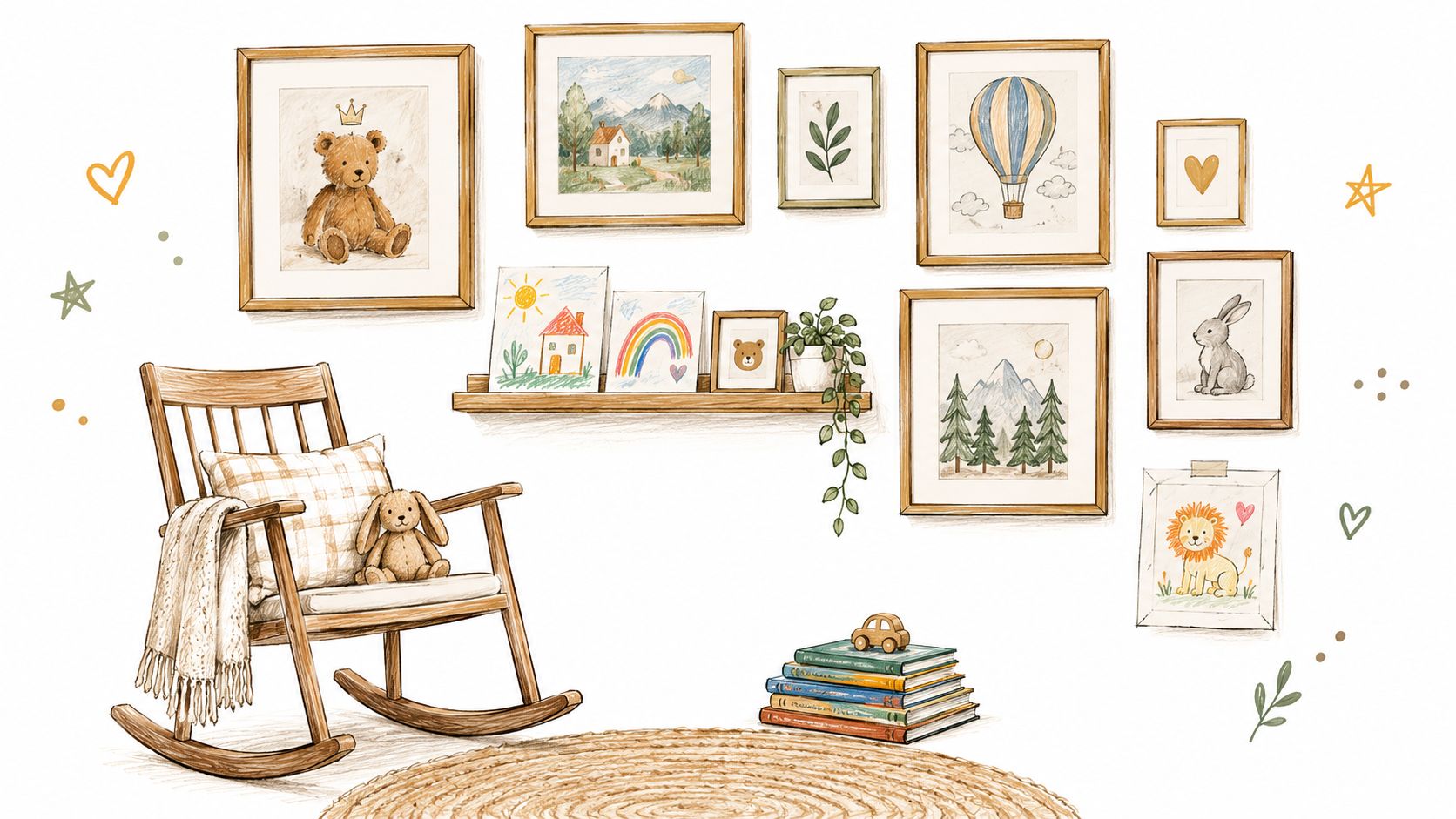
An art-led nursery starts with a neutral wall and lets the collection supply the color. Combine framed prints, family photographs, children's drawings, and one oversized illustration. A picture ledge makes seasonal rotation easy, while a salon-style arrangement gives a small room a collected feel.
The trade-off is installation risk. Keep frames off the wall directly above the crib, and hang the gallery on a wall away from the sleep space. Use acrylic glazing instead of glass, and anchor every frame according to the wall material.
Plan before you drill
Lay the frames on the floor and test the arrangement first. You'll spot awkward gaps, uneven scale, and overcrowding before making holes. Keep the heavier pieces on lower parts of the wall.
A low-cost gallery uses printable art, thrifted frames, and a single consistent color for the frames.
10. Convertible Growing Nursery
A growing nursery treats furniture as a sequence rather than a one-time purchase. A convertible crib may become a toddler bed, daybed, and later a full-size bed, while modular storage and a clear floor zone keep the room adaptable.
The trade-off is that convertible products only save effort when the parts stay organized. Keep conversion hardware with the instructions, follow the manufacturer's steps, and check fasteners regularly. A product that converts badly or lacks replacement parts can create more frustration than a straightforward crib and separate bed.
Place the crib mattress in its lowest position when your baby starts pushing up on their hands and knees, per Health Canada. Keep the play zone free of cords, small toys, and climbable furniture. For childcare settings, the GSA Child Care Center Design Guide recommends soft crawling areas with low level changes, infant platforms no higher than 455 millimeters, about 18 inches, and guardrails for toddlers on constructed surfaces more than 250 millimeters, about 10 inches, above adjacent surfaces. Home nurseries don't copy childcare specifications automatically, but the design principle is useful: make movement predictable and falls less severe.
The cheapest version uses one crib that meets current safety standards, a secondhand dresser that passes inspection, and open floor space. Add toddler furniture only when your child's stage requires it.
Comparison of 10 Nursery Styles
| Style | Implementation Complexity | Resource Requirements | Expected Outcomes | Ideal Use Cases | Key Advantages |
|---|---|---|---|---|---|
| Scandinavian Minimalist Nursery | Moderate, curated simplicity | Moderate (quality wood can cost more) | Calm, timeless; tidy, sleep‑friendly | Parents who want a peaceful, easy‑to‑maintain nursery | Calming; timeless; practical |
| Montessori‑Inspired Nursery | High, child‑height layout & safety checks | Moderate (low furniture, sturdy materials) | Supports independence & self‑directed play | Parents prioritizing child autonomy and long‑term growth | Encourages independence; easy crib-to-floor-bed transition |
| Boho Nursery | Moderate, layered styling & textiles | Low–Moderate (thrifted pieces lower cost) | Warm, textured, visually rich | Budget‑conscious, eclectic aesthetic seekers | Textural interest; budget‑friendly; cozy |
| Woodland Nature Nursery | Low–Moderate, decals & themed elements | Low–Moderate (decals, small décor) | Storybook, gender‑neutral visuals | Families wanting whimsical, neutral themes that photograph well | Gender‑neutral; whimsical; easy to update |
| Gender‑Neutral Nursery | Moderate, palette planning & accents | Moderate (versatile/convertible furniture) | Versatile, long‑lasting, easy to repurpose | Expecting parents who prefer a future‑proof room | Versatile; future‑proof; easy to restyle |
| Mid‑Century Modern Nursery | Moderate, sourcing style & safety checks | Moderate–High (authentic pieces cost more) | Stylish, durable, distinctive | Design‑minded parents seeking longevity and character | Durable furniture; distinctive, ages well |
| Small‑Space Apartment Nursery | High, tight planning & multifunctional solutions | Low–Moderate (multi‑use pieces save space) | Efficient use of square footage; highly functional | Urban dwellers, shared rooms, small homes | Maximizes space; practical; often cost‑effective |
| Modern Farmhouse Nursery | Moderate–High, paneling/finish work | Moderate (materials and labor for finishes) | Warm, classic, broadly compatible | Suburban/country homes wanting cozy, timeless style | Timeless warmth; easy to source décor; inviting |
| Gallery Wall & Art‑Focused Nursery | Moderate, layout planning & secure hanging | Low (prints/frames inexpensive) | Personal, flexible, milestone‑friendly | Families who value personalization and rotating displays | Highly personal; inexpensive to update; showcases milestones |
| Convertible Growing Nursery | Moderate–High, assembly & multiple conversion steps | High upfront; saves over time | Long‑term savings, adaptable across stages | Families planning for multiple stages or future children | Cost‑effective long‑term; sustainable; adaptable |
Choose Your Style and Build It in Stages
The best nursery example isn't necessarily the most decorated room. It's the setup that supports feeding, changing, sleep, storage, and movement without forcing you to fight the furniture every night. A compact Scandinavian room may suit a parent who wants easy cleaning. A small-space apartment layout may be the right answer for a family sharing a bedroom. A convertible room may make more sense when the same space needs to serve a toddler, guest, or future sibling.
Start with the room's constraints. Measure the usable floor area, mark doors and windows, and decide where the crib can sit without creating a route to blind cords or window coverings. Then place the essentials first: sleep space, changing surface, feeding chair, and storage for daily supplies. If the layout works with those pieces, decorative choices become much easier.
Safety should shape the room before style does. Choose a firm, flat sleep surface, use a current regulation-compliant crib, anchor dressers and bookcases, and keep cords and hanging décor out of reach. The CPSC reported an estimated 70,000 emergency-department-treated injuries in 2024 involving children younger than five and nursery products, while CPSC staff recorded 537 associated deaths during 2020–2022, averaging 179 deaths per year. The four categories linked to 62% of the estimated 2024 injuries were high chairs, cribs and mattresses, strollers and carriages, and infant carriers, according to the CPSC's nursery products annual report.
Design the room in stages rather than buying every accessory before birth. Newborn essentials come first. Mobility-stage changes come later, when you can see what your child reaches, climbs, and uses. A functional nursery doesn't require a dedicated room or an expensive theme.
Choose one or two ideas from this list, test the layout on the floor before drilling, and save the rest for the next stage of your child's growth. The room should make caregiving easier, not create another project you have to manage.
Hiccapop makes nursery basics like the Dual-Sided Foam Crib Mattress, with a firmer infant side and a softer toddler side, and the Wipe Warmer & Dispenser, which keeps wipes ready at the changing station. Shop Hiccapop nursery essentials to set up the room.