


Hypoallergenic Mattress Cover: What Works and What Doesn't
Buying a hypoallergenic mattress cover because the label sounds reassuring? Pause before adding it to your cart. Parents need proof of a useful barrier, not another comforting adjective. For babies, that barrier must also preserve a firm, flat sleep surface.
What a Hypoallergenic Mattress Cover Actually Does
A hypoallergenic mattress cover limits movement of allergens stored inside a mattress into bedding and your child's breathing space. But hypoallergenic isn't a single, precise performance standard.
In a 2003 randomized trial published in The New England Journal of Medicine, 279 participants aged 8–50 with dust-mite sensitivity used impermeable or permeable covers on mattresses, pillows, and duvets or blankets for 12 months; mattress allergens fell significantly, but clinical outcomes didn't improve significantly compared with controls.
Think rain jacket, not weather control: a barrier limits exposure without stopping the allergy.
Retire these myths: Covers cure allergies, ordinary cotton sheets work equally well, and natural or organic automatically means hypoallergenic.
Use a cover alongside bedding washing, humidity control, and medical advice.
Is a Mattress Cover Safe in a Baby's Crib
Only if it preserves the intended sleep surface. The American Academy of Pediatrics recommendations call for a firm, flat mattress with a fitted sheet, excluding pillows, blankets, comforters, quilts, sheepskins, bumpers, toys, and toppers because of suffocation, entrapment, and strangulation risks.
The NHS safe-sleep guidance also supports a waterproof mattress cover that keeps the mattress firm, flat, clean, and snugly fitted.
Tonight's fit check
- Match the mattress: Use an expressly compatible cover and follow the crib and mattress instructions.
- Install and press: Confirm the surface stays firm and level, without gaps, bunching, or added cushioning.
- Add the sheet: It must remain secure and wrinkle-free. Stop using a cover that shifts, traps excessive heat, or changes firmness.
Newborns need no added padding. Think book jacket, not second cushion. Inspect travel-crib and shared-care setups after every wash or transfer, and review crib mattress pad safety before adding protective layers.
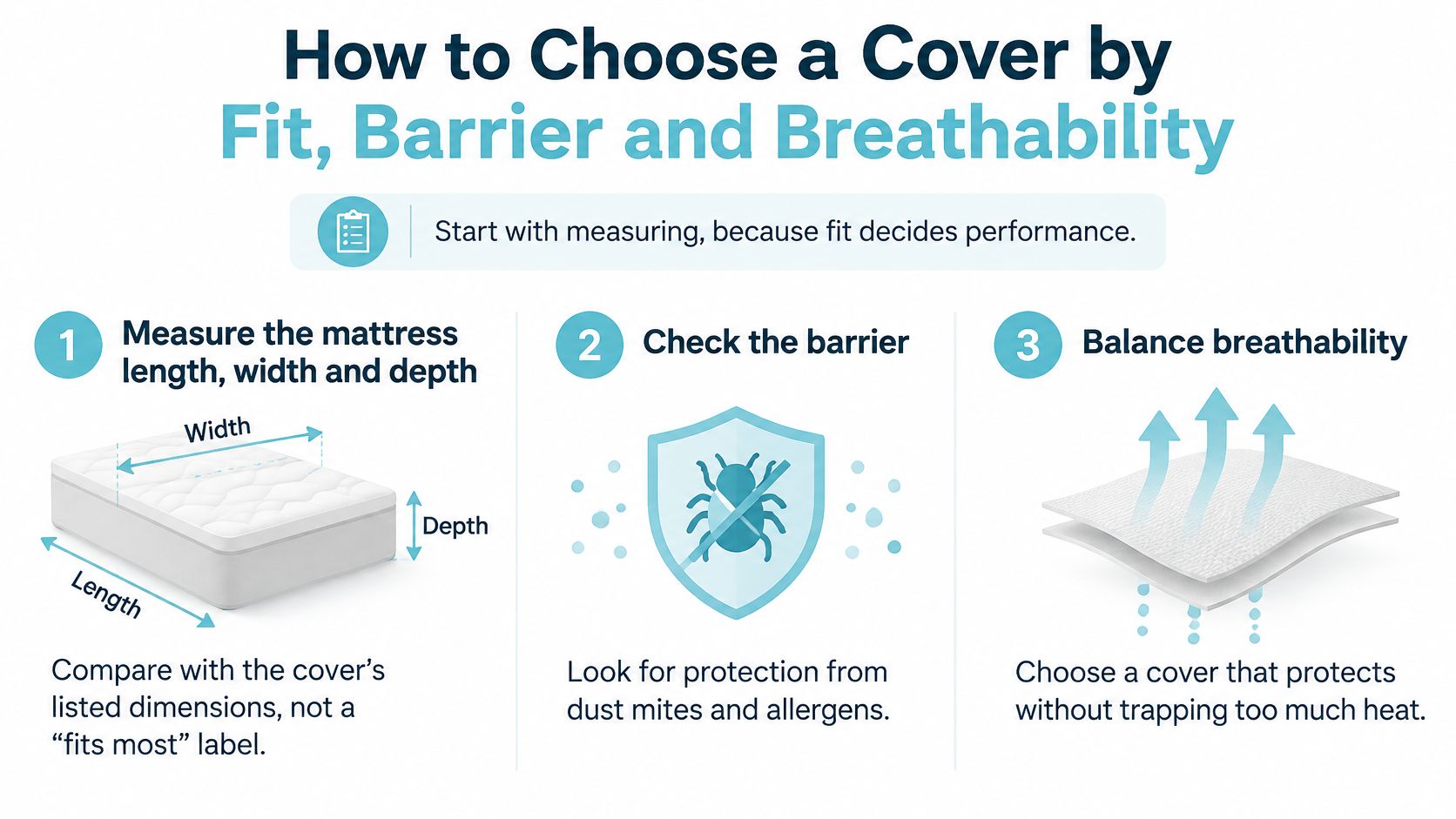
How to Choose a Cover by Fit, Barrier and Breathability
Measure length, width, and depth with a tape measure. Travel-bed mattresses especially need individual checking; don't trust universal sizing.
Cover selection checklist
| Criterion | Look for | Red flag |
|---|---|---|
| Exact size | Matching length, width, depth | Universal sizing |
| Fit method | Taut elasticated skirt or full encasement | Loose corners or unsecured edges |
| Barrier | Tight weave or laminate, sealed seams | Unexplained barrier claims |
| Waterproofing | Waterproof layer with stated breathability | Thick vinyl trapping heat and moisture |
| Thickness | Low profile, no cushioning | Plush, quilted, pillow-top layers |
| Zip | Smooth, covered perimeter zip | Exposed hardware near child |
| Washability | Stated wash temperature, shrink-testing | Spot-clean only, missing instructions |
| Documentation | Dimensions, materials, care, mattress type | Only natural or hypoallergenic wording |
A too-small universal cover can pull off corners; oversized material can bunch. Check skirt depth, too.
The CPSC's mattress guidance distinguishes the smoldering standard, 16 C.F.R. part 1632, for mattresses and mattress pads from the open-flame standard, part 1633, for mattress sets. Ask whether the item is a protector or mattress pad and request applicable compliance documentation.
A tighter barrier can restrict airflow. Look for both allergen testing and meaningful breathability information.
For broader room planning, EcoQuest Purifiers' home air purification for allergy sufferers resource offers another comparison starting point, not proof of mattress protection.
Materials and Certifications Worth Checking
Fibre names matter less than pore size, barrier continuity, and sealed seams and zips. Compare construction using this mattress cover material guide.
A 2000 Thailand hospital-dormitory study indexed in PubMed found a partial nylon barrier had 94% efficacy in preventing mite-antigen migration to sheets, versus 66% for cotton sheets alone. That measured transfer, not children's symptoms.
Materials and labels, what they prove and what they don't
| Material or label | What it does | What it does not guarantee |
|---|---|---|
| Tightly woven polyester or nylon barrier | Limits transfer with small pores and sealed seams | Control of room dust, mould, pet dander |
| Polyurethane or TPU laminate | Liquid barrier | Allergen testing or airflow |
| Cotton terry or quilted top | Absorbency, softness | Allergen blocking; quilting adds infant-inappropriate bulk |
| Bamboo viscose | Smooth feel | Barrier performance alone |
| OEKO-TEX Standard 100 | Tests listed harmful substances | Allergen reduction or waterproofing |
| GOTS | Certifies organic fibre processing | Allergen-free performance |
| Independent allergen test report | Measures specific-product reduction | Symptom relief; ask seller for this uncommon documentation |
Each label answers a different question. A toxin-free claim should identify what was tested, not imply freedom from every substance.
Choosing a Cover for Your Situation
Cover types compared by barrier, waterproofing and use
| Option | Allergen barrier | Waterproof | Best for | Trade-off |
|---|---|---|---|---|
| Hypoallergenic cover | Partial to strong | Often | Everyday sensitivities | Uneven quality |
| Waterproof protector | Usually not designed for allergens | Yes | Spills, bedwetting | Needs suitable construction for mite protection |
| Full allergen encasement | Strongest enclosure | Often | Diagnosed dust-mite allergy | Harder washing; check infant suitability |
| Ordinary cotton fitted sheet | Low to moderate | No | Basic bedding | Allergens can reach surface |
Specifications beat category names. A protector resembles a box lid; an encasement resembles a sealed bag around the contents.
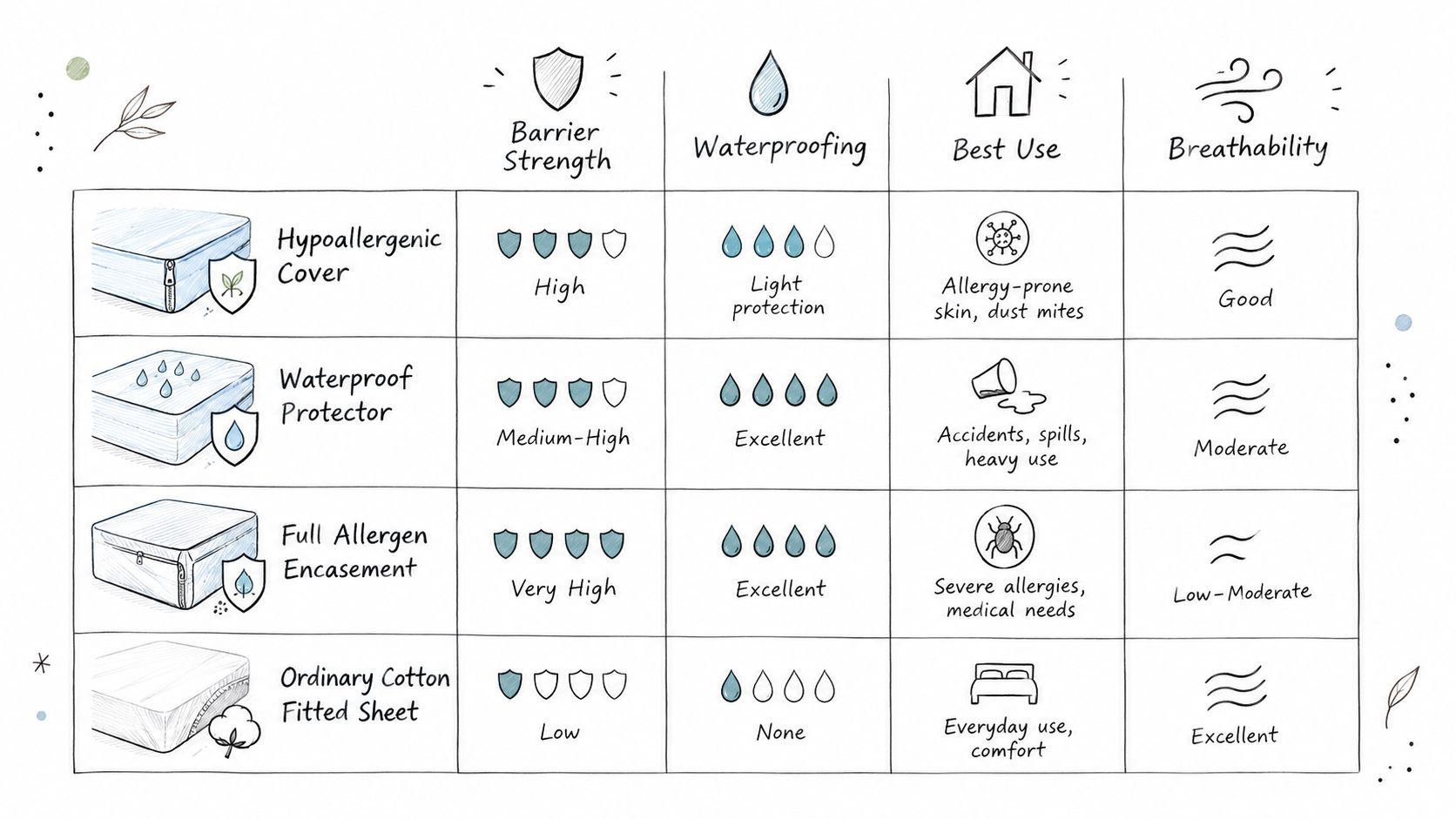
Choose waterproofing for wet nights, full encasement plus bedding washing for diagnosed mite allergy, or a documented sealed-seam barrier for everyday sensitivities. For cribs, compatibility and safe fit take priority.
A 2025 meta-analysis in International Forum of Allergy & Rhinology covering 17 randomized studies found household mite interventions reduced dust and mite allergens without significant improvement in asthma, allergic rhinitis, or quality of life.
Ask for pore-size information, barrier construction, allergen testing, or independent certification. If the seller offers only an adjective, move on.
Washing and Caring for Your Cover
Use this care sequence as a starting point, with the product label taking priority.
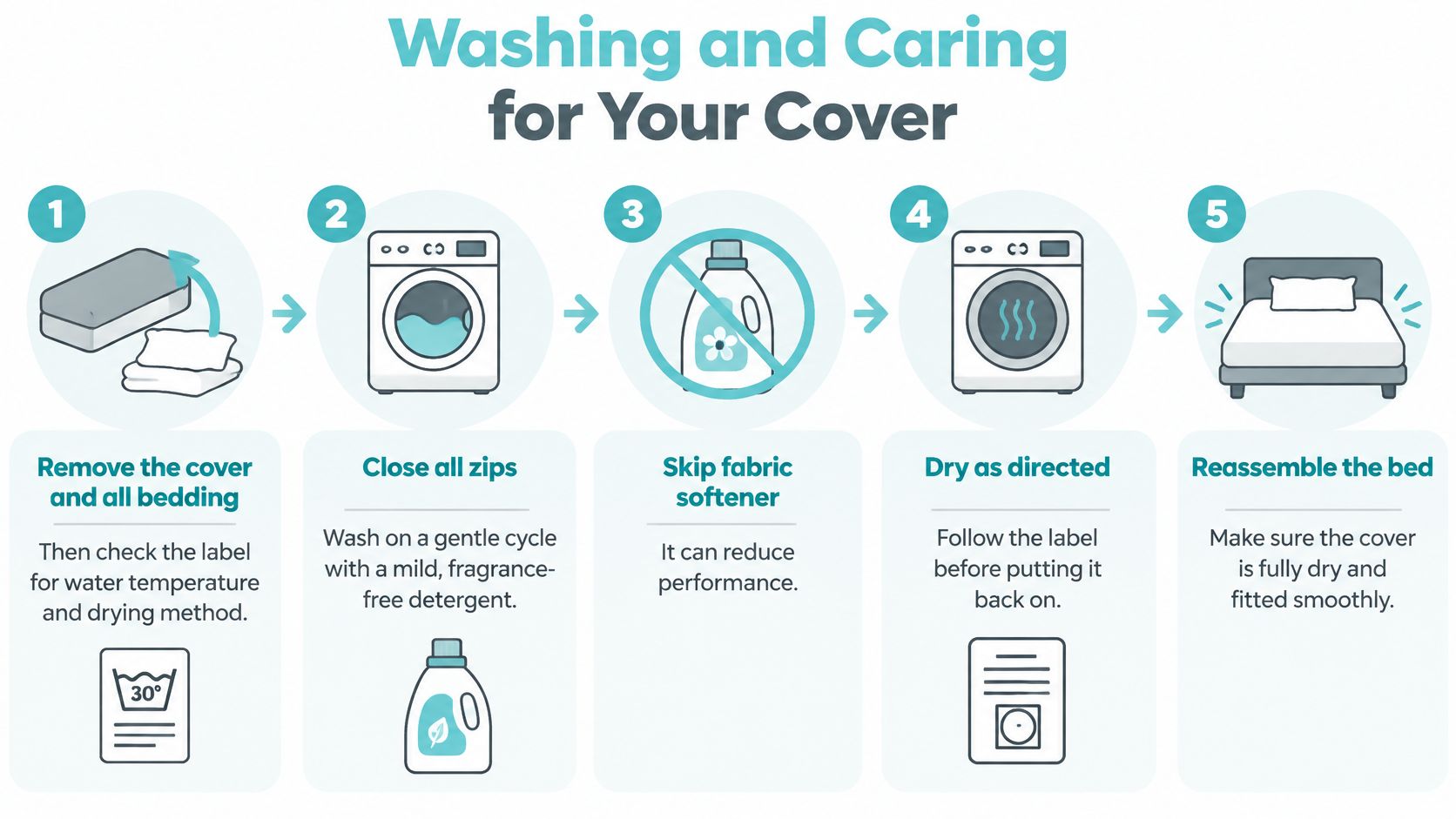
- Remove bedding: Check permitted temperature and drying method.
- Close zips: Use a gentle cycle and mild, fragrance-free detergent if permitted.
- Skip softener: Residue can interfere with barrier performance.
- Dry carefully: Use permitted low heat or air-drying; excessive heat can damage laminates.
- Inspect: Replace torn covers and check seams, elastic, and zips.
- Refit smoothly: Dry completely before replacing the fitted sheet.
Consider monthly washing, plus prompt cleaning after spills or illness, unless instructions differ. Vacuum the mattress surface when uncovered and manage humidity with ventilation or a dehumidifier.
For practical details, consult mattress cover washing instructions. This video provides another care reference.
Parent FAQs and Sources
Will my child's symptoms improve?
Possibly, but don't count on a cover alone. Discuss persistent symptoms with your child's clinician.
Does it protect carpets or upholstery?
No. Vacuum those separately; mattress containment doesn't clean the room.
What if the mattress is already waterproof?
Add protection only for a separate, documented need, such as allergen containment, and only if the manufacturer permits it.
Where can I check the evidence?
Use the linked clinical trial, Thai dormitory study, meta-analysis, AAP recommendations, NHS guidance, and CPSC explanation.
Measure tonight, compare dimensions and care instructions, then share your mattress size in the comments so other parents can compare notes.
Hiccapop offers baby and toddler essentials, including crib mattresses and travel beds, alongside practical parenting guides. Visit Hiccapop to explore options and check product-specific fit and care information before changing your child's sleep setup.