


How to Transport a Bed Without the Drama
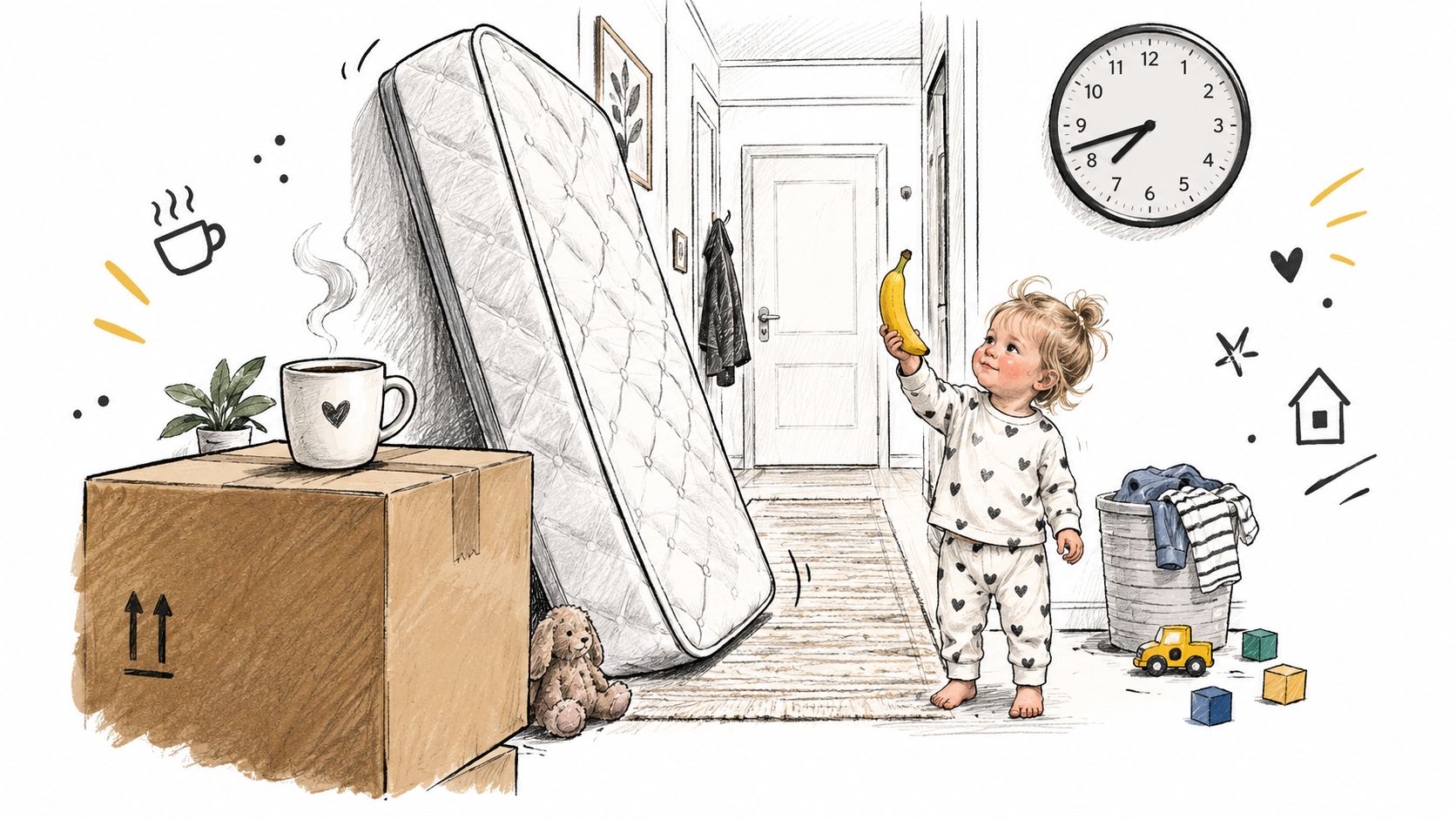
Moving day rarely begins with a calm checklist. It begins at 7:42 a.m., with coffee cooling on a cardboard box, a toddler asking for the same banana twice, and a mattress leaning against the hallway wall as if it's trying to escape. Somewhere under the bed frame, a tiny bag of bolts has already disappeared.
Beds are awkward because they combine bulk, weight, strange angles, and sentimental panic. The safest way to transport a bed depends on what you're moving: a foam mattress, a pocket-spring mattress, a rigid frame, a toddler bed, or a folding travel crib. They aren't interchangeable jobs.
This practical playbook breaks the move into manageable stages, keeping limited hands, narrow stair turns, and a possibly occupied elevator firmly in mind.
The Moving Day You Actually Have
The mattress is usually the first problem you notice, but it isn't always the most difficult one. A queen mattress may fit through a doorway while its headboard refuses to turn, and a box spring can catch on a stairwell corner at exactly the moment your child needs a snack.
A long-distance move adds another layer. Packaging, long-distance transport, and final-mile handling are separate jobs, so it helps to plan each one on its own rather than treating the whole move as one heroic lift.
For a local move, that means taking the bed apart before the hallway becomes crowded. For a longer move, it means packaging each component as a stable unit and making sure the vehicle can handle the packed dimensions. Professional furniture shippers know that most damage happens at the handoffs: loading, unloading, and the final carry through narrow doors and stairwells. That's where it pays to spend less energy on speed and more on protection, access, and load stability.
Practical rule: The fastest way to move a bed is usually to prepare it properly before anyone lifts it.
If you're moving with a baby or toddler, pack the sleep essentials separately from the furniture. A clean fitted sheet, a toddler's familiar blanket or comfort item (for babies under 12 months, just the fitted sheet), and the crib or play yard's own mattress should be easy to reach, not buried under wrapped rails. For travel planning around the move, this traveling with kids checklist is useful because the bed is only one part of keeping the day functional.
A Staged Handling Method That Prevents Damage
A reliable bed move follows four stages: measure first, disassemble second, protect third, and route-check fourth. Skipping the first stage is how people discover that a headboard fits the bedroom but not the elevator.
Measure before the first bolt comes out
Photograph the assembled bed from several angles. Measure the headboard, longest rail, mattress, and packed components against every doorway, elevator opening, stairwell, and sharp turn. Write the dimensions on painter's tape attached to the frame, not on a scrap of paper that will vanish beneath the packing supplies.
Measure the vehicle opening too. A standard queen mattress is 60 inches wide by 80 inches long, with thickness commonly ranging from approximately 8 to 14 inches, so those dimensions must be compared with the actual cargo area before you book transport. U-Haul's queen mattress loading guidance shows how packed orientation can preserve space, but the vehicle still needs enough opening and interior support.
Disassemble in a planned order
Remove bedding, drawers, legs, headboard, rails, slats, and other detachable parts. Put each hardware set in a labeled bag and tape it to the matching rail or largest frame piece. Bundle rails by room, flag fragile parts, and keep the frame pieces together instead of scattering them across the truck.
Protect, then route-check
Moving blankets should cover finished wood, upholstered surfaces, and sharp corners. Check the route after the room is clear, including floors, door stops, rugs, toys, and low ceiling points. NIOSH's manual material-handling guidelines recommend testing a load for stability and weight, using both hands, keeping it close to the body between the knees and shoulders, and stepping to turn instead of twisting.
NIOSH's lifting checklist flags loads over 50 pounds as a risk factor for low back pain. As a general rule, for a bed frame or mattress weighing more than about 50 pounds, use at least two people or a lifting aid such as a dolly. That rule is less glamorous than a solo carry, but it works.
Mattress Type Changes the Transport Position
“Flat is safest” applies to some mattresses, not all. The right position depends on the construction. A wrong orientation can deform foam, crease folding materials, or put uneven pressure on internal coils.
| Mattress Type | Correct Transport Position | Why |
|---|---|---|
| Foam mattress | Completely flat, or rolled only when the manufacturer permits it | Heavy objects and sharp folds can deform foam layers |
| Spring or coil mattress | On its side, lengthwise, and secured | The long edge supports the mattress in shorter cargo areas |
| Hybrid mattress | On its side when the construction allows it, with careful support | Coils and foam need protection from uneven compression |
| Folding foam bed | Fold along factory seams | Creasing outside the designed folds can damage the structure |
| Air mattress | Fully deflated and rolled | A compact roll reduces puncture and moisture exposure |
A foam mattress should travel flat with nothing placed on top. Boxes may keep it from shifting, but they should not press against one small area. Check the manufacturer's instructions before rolling it, because foam layers can hold a permanent bend after being folded or stored incorrectly.
Spring and coil mattresses are generally safer on their side, lengthwise, with straps attached to strong rails or anchor points. The long edge provides support when the cargo area is too short for the mattress to lie flat. A box spring can travel on its side or flat. If it lies flat, place only a mattress on top, not dense boxes or other heavy furniture. U-Haul's mattress-moving guidance covers these foam, spring, and box-spring positions.
Hybrid mattresses need support that avoids uneven compression of both foam and coils. Folding travel beds and roll-up guest beds should follow their factory seams. Inflate air mattresses only after arrival, and fully deflate them before transport. Do not cinch a strap across a folded edge, and keep sharp frame parts away from foam. Use a correctly sized mattress bag.
A mattress bag protects against dirt and moisture. It does not make an unstable mattress safe to stack.
Disassembling Frames and Wrapping Every Part
Start at the top and work downward. Remove the mattress, photograph the connections, loosen the headboard bolts, detach the side rails, remove slats, and then take off the legs. The photos matter because a rail that looks symmetrical at 8 a.m. can become a puzzling piece of modern art by evening.
Tape the labeled hardware bag to the largest frame piece, preferably the headboard or a main rail. Keep the instruction sheet, connection photos, and slat layout photo in a small tote that rides in the cab. If the tote stays in the cargo area, it has a remarkable talent for ending up beneath the heaviest box.
Wrap the parts that suffer first
Protect headboard and footboard corners with moving blankets and secure the blankets with stretch wrap around the blanket, not directly across finished wood. Add padding between long rails before bundling them. Slats should travel as one bundle and stand on edge or lie where they cannot slide into other furniture.
For a metal frame, cover sharp edges and joints so they don't cut a mattress bag or scratch the vehicle. For an upholstered frame, use a furniture pad over the whole unit and cinch it with suitable straps. Tape can pull fabric, leave residue, or compress a soft edge.
A king split frame should travel as two separate halves. Keep the center support bar with the legs and label that bag clearly. Storage drawers should be removed and wrapped independently so they don't open during loading.
The same discipline helps with children's furniture, particularly when the frame includes small connectors or unfamiliar locking points. Photographing each connection and labeling every part makes reassembly calmer, especially if you're also checking how to assemble a crib before the new sleep space is used.
The part that looks too small to lose is the part that disappears first.
Securing the Load So Nothing Slides or Falls
Tie-downs aren't optional. During braking, cornering, and road vibration, even a mattress lying flat can slide, while a tall headboard can tip if it isn't supported. For commercial vehicles, federal cargo-securement rules require tie-downs whose combined working-load limit is at least half the cargo's weight. A typical do-it-yourself household move isn't covered by that rule, but it's a useful benchmark when choosing straps.
Use rated cam-buckle or ratchet straps attached to solid anchor points. Add edge protection where a strap touches fabric, wood, or a sharp corner. Stretch film can hold a bundle together, but it isn't a substitute for tie-downs. Rope tied to a door handle and bungee cords belong in the category of things that look useful until the first hard stop.
| Bed Type | Truck Position | Straps Required | Anchor Point |
|---|---|---|---|
| Foam mattress | Flat on full support | Rated straps over the load without crushing it | Internal rails or rated D-rings |
| Spring mattress | Long edge against a supported wall | At least two straps to prevent tipping | Built-in rails or strong anchor points |
| Box spring | Low and forward, flat or lengthwise | Straps preventing sliding and tipping | Rated floor or wall points |
| Disassembled frame | Bundled against a side wall | Straps around the bundle | Rails, D-rings, or tie rails |
| Travel crib | Collapsed and contained | Strap or block the case so it cannot move | Cargo rails or a blocked position |
Load the heaviest pieces low and centered. In a truck, place the foundation or box spring toward the front, position the mattress where it has full support, and keep lighter frame pieces above or beside it. Don't place concentrated weight on foam, and don't let any item block the doors, driver visibility, or emergency access.
Test the packed bed by pushing it firmly from multiple directions. If it shifts, reduce the stack, add blocking, or use a vehicle with internal tie rails. Recheck the straps after the first short drive and at stops because padding settles and tension changes.
Choosing the Right Vehicle for the Job
Vehicle choice is a dimensions problem, not a size problem. A large truck can still fail if its rear opening is too short for the mattress or lacks reliable strap anchors. A smaller enclosed van may work better because it has a lower loading height, easier parking, and useful tie rails.
Compare the queen dimensions above with the usable cargo height and opening rather than the vehicle's marketing label. U-Haul's cargo-van loading example shows a box spring going through the rear doors at a 45-degree angle, then resting against a side wall with the mattress loaded on top of it. This setup works only when both pieces remain supported and the driver's view stays clear.
| Vehicle | What to Measure | Queen Fit | Best For |
|---|---|---|---|
| SUV | Measure the actual opening | Often difficult without folding or careful positioning | Small frames and compact bedding |
| Cargo van | Measure rear doors and interior clearance | Often workable on an edge with support | One bed and a disassembled frame |
| Pickup truck | Measure bed length, width, and weather exposure | Possible with protection and tie-downs | Local moves with a covered or secured load |
| Moving truck | Measure interior height and tie rails | Usually provides more loading flexibility | A bed plus household contents |
The bed type should guide the vehicle choice. A foam mattress may need full support and protection from bending, while a spring mattress or box spring may tolerate an edge position when it is braced and secured. Folding beds and travel cribs need room to stay contained rather than being forced into a narrow gap.
For a studio move with one bed, an enclosed cargo van can be easier than a large truck. It has a low load floor and less empty space for the mattress to shift through. Rent a four-wheel furniture dolly, then measure both properties before booking, including elevator openings and stair turns.
If the mattress cannot stay stable without excessive strap tension, separate the components further or choose professional transport with internal rails and bulky-furniture equipment.
Kids' Beds, Travel Cribs, and the Final Checklist
Children's sleep equipment needs the same careful workflow, but the parts are often smaller, lighter, and easier to lose. A toddler bed with removable side rails should be photographed before disassembly, with rail hardware placed in its own labeled bag. Keep that bag attached to the matching rail so the screws don't get mixed with adult-bed hardware.
Bunk and loft frames deserve extra attention around ladders, shelves, and narrow supports. Wrap the ladder first, protect its corners, and load it against a padded side wall where it can't bend or crush smaller pieces. Don't wedge loose rails between boxes. A bent connector can turn a straightforward reassembly into a safety problem.
Portable travel cribs and play yards generally travel best as one collapsed unit, not as a collection of disconnected parts. Keep the folding mechanism intact, collapse it according to the product instructions, slide it into a large protective bag, and place the carry bag with the sheets and fitted mattress cover. Keep used bedding separate from the sleeping surface during transit.
Different products need different protection
An inflatable toddler mattress should be fully deflated, rolled, and sealed against punctures and moisture. A folding foam bed should follow its factory folds. A rigid frame should be disassembled and padded. The product type, folded dimensions, and vehicle configuration matter more than a universal rule about carrying every bed flat.
A travel crib's carry bag, mattress cover, and hardware should stay together. Parents often need the sleep setup immediately after arrival, not after unpacking every box in the house. Guidance on travel crib safety is also worth reviewing before the product is put back into use.
Before leaving, run this final check:
- Measure twice: Confirm the packed dimensions, route, and vehicle opening.
- Photograph connections: Keep assembly images with the hardware.
- Bag hardware: Label each bag by bed and part.
- Protect surfaces: Pad corners, rails, foam, and fabric.
- Confirm orientation: Keep foam flat and spring mattresses supported on the long edge when appropriate.
- Secure everything: Use rated straps and solid anchor points.
- Check visibility: Doors, mirrors, exits, and emergency access must remain clear.
- Inspect at stops: Recheck strap tension and make sure nothing has shifted.
- Sweep the room: Look for forgotten screws, legs, brackets, and the one stuffed animal that somehow became structural equipment.
Disclosure: This article is published by Hiccapop, and the product mentioned below is ours.
For families who need a portable toddler sleep option beyond moving day, Hiccapop's Inflatable Toddler Travel Bed comes with an electric pump and an XL travel bag and has an age recommendation of 18+ months. When the trip is over, it folds and rolls into the bag, ready for the next sleepover or family visit. See the Inflatable Toddler Travel Bed →